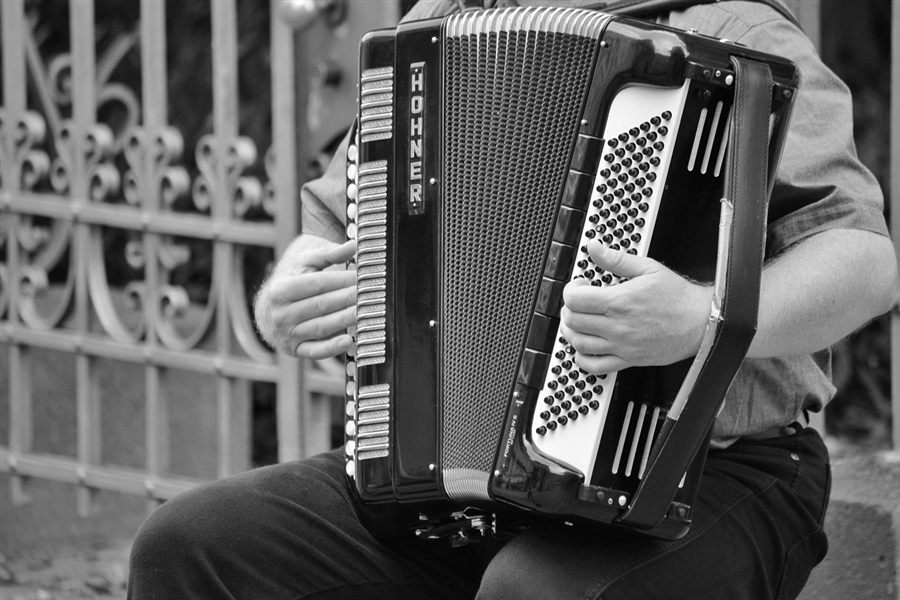
For most beginners the piano accordion is the natural starting point, especially if you already read piano music or your local teacher only teaches that layout. A chromatic button accordion makes sense if you are drawn to the styles it is at home in, or if you value a compact note layout over a familiar keyboard. Whichever you pick, 48 to 72 bass buttons is a sensible size for adults, children need a much smaller and lighter instrument, and weight is often what decides whether you keep practicing happily.
Two treble sides, one shared idea
On both types the right hand plays the melody while the left hand handles the bass buttons and moves the bellows. The only real difference is the treble side: a piano accordion has piano-style keys set at a right angle to the case, a chromatic button accordion has rows of small buttons. The left-hand side is normally the same Stradella bass system on both, so you only have to learn it once.
The piano accordion is generally the more widespread type and a safe default for general music. Button accordions are strong in France, Italy and Eastern Europe, and have a deep tradition in Russia, the Balkans and Scandinavia.
Button or piano: the comparison
Range and size
A full-size piano accordion usually has about 41 treble keys, covering a little under four octaves, and with registers the sounding range reaches roughly six octaves. A five-row button accordion covers a little over five octaves under the hand, and up to about seven with registers. The close spacing of the buttons means notes that sit far apart on a keyboard are within easier reach. That makes the instrument more compact, but do not overstate the weight difference: at a comparable bass size both types weigh about the same.
Fingering and transposition
On a button accordion, scales and chords have the same shape in every key; you just shift the pattern. That makes transposing easier. On the other hand, some positions need a slight wrist twist, and the many alternative fingerings can make sight-reading harder at first. On a piano accordion the black and white keys help you find your way, but each key feels different, just as on a piano.
Learning curve
Most sources agree that the piano accordion is the easier start, particularly with piano or keyboard experience. A button accordion is not inherently harder, but without a background it often feels unfamiliar. Players coming from guitar or a wind instrument sometimes find the logical button layout more intuitive than black and white keys. Whether one is objectively easier therefore depends on your prior experience, your teacher and your goals.
Repertoire
- Piano accordion: a broad all-rounder covering folk, popular, classical and jazz, and the type most teachers and method books assume.
- Chromatic button accordion: especially strong in musette, tango, Eastern European and Russian folk music, classical and contemporary concert repertoire and jazz. Method books exist for both, but finding a teacher is usually harder for button systems.
C-system or B-system
Chromatic button accordions come in two main systems, both fully chromatic. They differ in how the rows are arranged: the semitone steps run as a mirror image of each other, and the key note C (or B) sits in the first and fourth rows. Three main rows are typical, and on five-row models two extra rows repeat the first two to give alternative fingerings.
- C-system: the system many method books and teachers start from. Major chords and broken chords, as used in musette, are easy to reach.
- B-system: widely played in Russia, the Balkans, Scandinavia and Belgium. It is considered advantageous for ornaments with many semitones. If you play in one of those traditions, it is usually the better fit.
What matters most is not which system is theoretically better, but which one your teacher uses and which is played around you. Both can play the same music.
Switching systems later
Moving from keys to buttons (or back) is a genuine restart. The right hand learns an entirely different fingering system; only the left side feels familiar. You keep your note reading, rhythm and bellows control, but not the fingerings. Choose based on the repertoire you want to play in a few years, not only on what feels comfortable today.
Bass sizes: from 8 to 120
The number is the count of left-hand bass buttons. More buttons mean more chord rows and more usable keys, but also a wider and heavier instrument. As a rule of thumb:
| Bass buttons | Typical use | What the left side offers |
|---|---|---|
| 8 to 12 | Very young children, first steps | a few basic basses and major chords, very limited |
| 24 to 32 | Children | major and minor chords, sometimes a few sevenths |
| 48 | Teens, smaller adults, first instrument | major, minor and seventh in the common keys |
| 60 to 72 | Longer-term students | usually adds diminished chords, all keys comfortably playable |
| 80 to 96 | Advanced players | more reed sets and range, noticeably heavier |
| 120 | Full size for adults, concert use | complete Stradella layout, six rows by twelve columns |
Exactly which chord rows are present varies by build, so check the bass layout of the specific instrument. If you expect to play classical literature that uses single bass notes, look at a converter model: it lets you switch the left side to a melody layout of three rows of single notes with no pre-set chords.
Which size for whom
Children
The instrument has to fit the body, not the parents' ambitions. Commonly quoted guidelines are starting at roughly 5 to 7 years old (some sources say as young as 4 or 5 if strength, coordination and attention span allow), with 8 or 12 basses for the youngest, 24 to 48 basses for roughly ages 7 to 10, and 48 to 60 basses from around age 10. The child's size and strength count for more than the age: a tall 6-year-old may cope with a bigger instrument than a small 8-year-old. Tiny toy-format models with 17 keys and 8 basses are often more toy than instrument; for real practice the instrument needs to be in tune and cover the range of the pieces you plan to play.
An accordion that is too large quickly frustrates a child: bellows and keys are hard to reach, awkward postures creep in, and the fun fades. Poor posture and bellows habits formed that way are hard to unlearn later.
Teens and adults
For adults, 48 basses offers the best balance of weight, price and function for a first instrument. If you plan to stay with it, 72 basses is a good long-term choice: the step adds diminished chords and more keys, but it is noticeably heavier. Smaller players often do better with 72 or 80 basses than with a 120-bass instrument that hangs heavily on neck and shoulders. You do not need the full 120 basses to begin; they matter once repertoire or ensemble playing requires them.
Weight: rules of thumb by size
Weight depends on the bass size, the number of keys or buttons, and the number of reed sets. Each additional reed set often adds roughly 1 kg (about 2 lb). Heavy wooden parts and a tone chamber such as the cassotto can add more, see the cassotto article. Figures vary by source and model; as rough guidance (as of Oct. 2026):
| Size | Weight (rule of thumb) |
|---|---|
| 48 basses | about 11 to 13 lb (5 to 6 kg) |
| 72 basses | about 15 to 18 lb (7 to 8.5 kg) |
| 96 basses | about 20 to 22 lb (9 to 10 kg) |
| 120 basses | about 23 to 24.5 lb (10.5 to 11 kg); individual models range from 15 to 34 lb (7 to 16 kg) |
Children's models are much lighter: small piano accordions with 25 to 32 keys typically weigh about 5 to 10 lb (2.3 to 4.5 kg), and the smallest children's models even less. Overall, accordions run from roughly 12 to 30 lb (5.4 to 13.6 kg). That is a lot to carry for hours, especially standing. Before buying, do not rely on the spec sheet alone: strap the instrument on and play it for several minutes, both seated and standing.
Straps and posture
The straps you will meet
- Shoulder straps: carry most of the weight. Wide, padded straps spread the pressure better than narrow ones.
- Back strap: connects the two shoulder straps behind you and stops them slipping off your shoulders. Highly recommended on larger instruments.
- Bass strap (hand strap): keeps your left hand on the bass side. It should be snug enough that there is no audible delay when you change from pull to push, without cutting off circulation. A loose strap leads to unconscious cramping.
- Waist or hip strap: can take noticeable load off your shoulders when standing and is worth considering for long performances.
Leather replacement shoulder straps typically cost about $60 to $150 (as of Oct. 2026). Worn or too-short straps are a reason to haggle on a used instrument, not to rule out an otherwise good one. For more on inspecting an instrument before buying, see buying a used accordion.
Sitting or standing
Beginners are generally advised to start seated. Use a chair without armrests and sit toward the front edge, both feet flat and knees bent at roughly a right angle. The instrument rests lightly on your left thigh, not the right one, and never dangles loosely from your body. Standing feels freer but is harder on neck, shoulders, back and feet, and much easier with a lighter instrument.
Setting up the straps
- The right strap (treble side) is a little longer than the left so the right hand can move freely along the keyboard.
- The left strap is tighter and steadies the instrument during bellows work.
- The keyboard sits roughly under your chin and centered on your torso. Standing, the bottom edge of the instrument should be about level with the floor.
- Do not set the shoulder straps too far apart: a wide spacing puts direct pressure on the shoulders and can cause pain over time. If you feel discomfort after a few days of playing, adjust how the instrument sits left to right on your body.
Protecting your back
- Sit upright and do not lean back or slump. Keep your elbows from creeping up.
- Keep the right forearm roughly parallel to the keyboard so the wrist does not bend up or down.
- Take breaks, especially with a new instrument or new straps.
- If discomfort persists, have an experienced player or teacher check your posture and strap lengths, and see a doctor about any pain that continues in daily life.
What an accordion costs
Prices vary widely by brand, condition, reed sets and features. The figures below are rough guidance for the US (as of Oct. 2026).
- Used entry-level: a playable used accordion can be found from about $200, with $300 to $600 a common range for entry-level, and about $600 to $1,500 or more for good used instruments (as of Oct. 2026).
- New budget models: about $400 to $800 for 48 basses, and about $700 to $1,500 or more for 72 basses (as of Oct. 2026). New instruments of better quality generally start around $1,200 (as of Oct. 2026).
- Chromatic button accordions: about $1,800 to $5,000 for chromatic models (as of Oct. 2026), so the entry price is higher than for a first piano accordion.
- Repairs: a full replacement bellows costs about $500 plus installation (as of Oct. 2026). Other repair costs vary by shop, get a quote.
Buying decision: a simple roadmap
- Decide which music you want to play and who will teach you. That settles keys or buttons, and C or B system.
- Choose the size by body and age, not the maximum. For adults 48 to 72 basses is the sensible start, for children a model matched to size and strength.
- Check the weight by strapping the instrument on and playing for several minutes, standing and sitting.
- Look for adjustable, wide straps with a back strap.
- For used instruments, check or have someone check bellows, tones and mechanics, and budget for repairs.
Common mistakes and myths
- "The biggest accordion is the best." More basses mean more weight, not automatically more enjoyment. 48 to 72 basses is plenty to begin with.
- "A child will grow into a big instrument." An instrument that is too big makes posture and bellows control harder and takes the fun out of practice.
- "Buttons are simply easier." The layout is logical and eases transposing, but without prior experience the start is not easier than on a keyboard.
- "Keys are only for beginners." The piano accordion is played at the highest level in classical, jazz and popular music.
- "Switching later is a small step." It is a real restart for the right hand.
- Toy instead of instrument: very cheap tiny formats often do not play cleanly and are of little use for learning.
- Straps too loose or too far apart: leads to shoulder pressure, tension and shaky bellows control.
- Buying on price alone: the right instrument for the right person matters more than budget.
Frequently asked questions
Can I start on 120 basses?
You can, if you are strong enough to carry the weight comfortably. It is not necessary, and many people are more comfortable on 48 to 72 basses.
At what age can a child start?
Many guides suggest about 5 to 7 years, and some say 4 or 5 if strength, coordination and concentration allow. It is a guideline, not a rule.
Keys or buttons for my child?
For children the piano accordion is mostly recommended, since the move to piano is easier and the layout is familiar. A committed button teacher nearby can shift that balance.