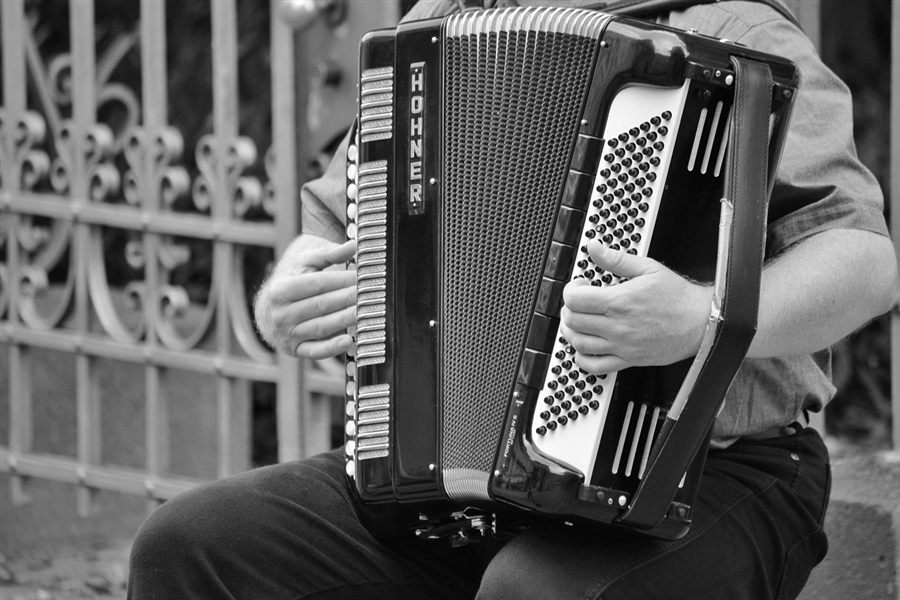
A cassotto is a tone chamber on the treble side: certain reed sets, usually the low (16') and/or a middle (8') rank, sit inside it and release their sound along a longer, angled path. That makes their tone warmer, rounder and less sharp. Tremolo or musette tuning (wet or dry) is a separate matter. It comes from reeds tuned slightly apart on purpose, not from a chamber. Both shape the sound, and you should listen for both before you buy.
How a cassotto is built
On a normal accordion the reed blocks sit directly beneath the sound openings of the treble grille. A cassotto accordion has two soundboards set almost at right angles to each other. Each has its own pallets and its own reed plates. The enclosed space holding the second board's reeds is the tone chamber, and the sound leaves it only after a longer, bent route.
Usually only some of the reed ranks live in the cassotto, typically the lowest and one middle rank, while the rest speak straight out. That is a real advantage: through the register switches you can blend muted (cassotto) and bright (open) voices. Simple shutters or flaps in front of the sound openings, by contrast, always affect every reed at once.
Double cassotto and special builds
Some instruments put two reed groups in the chamber ("double cassotto", often written 2+2). Chambers are usually wood, although some designs use aluminum. Cassottos are harder to build into diatonic accordions than into chromatic ones because the reed plates are laid out differently. A few designs add a removable canopy so the plates are easier to reach during tuning.
What a cassotto does to the sound
The chamber acts as a passive filter. Frequencies roughly between 500 and 1000 Hz are reinforced by resonance and higher components are damped. The result sounds more "fundamental": fewer harsh overtones, more warmth and body. The farther the reed plates sit from the chamber opening, the stronger the effect tends to be.
- Low rank (16'): Very popular with jazz players because it sounds soft and round.
- Middle rank (8'): Carries the melody. With a cassotto it sings and mellows, without one it speaks more directly and brightly.
- High rank (4'): Usually sits outside the chamber and adds sparkle.
Does it make the accordion quieter? A common myth
You will often hear that a cassotto makes an instrument quieter. As a blanket statement that is not accurate. The chamber tames high partials that the ear hears as "edge," so the tone feels more restrained. Opinions on actual dynamics differ: some builders and players report a wider dynamic range and a tone that carries better, others find open reeds cut through a noisy dance hall better. The room you play in decides. A cassotto is not a volume switch, and it does not guarantee a bigger sound either.
Tone chamber and cabinet
The cabinet of an accordion is not a resonating body the way a guitar or violin top is. The tone starts at the reed plates and the air comes from the bellows. Many experienced players therefore consider the wood species of the case close to tonally neutral. Looks and weight change, the sound barely does. A few builders report subtle differences from finish or material, but that is not solidly established and opinions are divided.
What really shapes the sound is four things: the reed plates and reeds, the cassotto, the action (pallets and sealing) and the tuning. As a rule of thumb, a cassotto only shows its full benefit with good reed plates, which is why serious makers usually pair the two.
Reed ranks, registers and octave pitches
A rank (also called a choir or voice) is a complete set of reeds across the whole range. Treble sides usually have two to four ranks, bass sides three to five. A register is a switch above the keyboard that opens certain ranks. More ranks means more combinations. Large instruments can offer around 15 treble and 7 bass registers.
Pitches are named in feet, as on a pipe organ:
- 16': one octave below written pitch, deep and full (often called bassoon)
- 8': written pitch, the foundation of the sound
- 4': one octave above, bright and shimmering (piccolo)
- 32': very rare, only on special instruments
Typical register combinations
| Sound name | Ranks | Character |
|---|---|---|
| Tremolo ("violin") | two slightly detuned 8' | shimmering, chorus-like |
| Musette | two detuned 8' plus 4' | sparkling, rich in overtones |
| Bandoneon | 16' plus 8' | mellow, round |
| Harmonium/organ | 16', 8', 4' without detuning | organ-like, calm |
| Master (tutti) | all ranks | loud, full |
Names and symbols differ from model to model. The layout is in the manual or quickly found by trying each switch.
Musette, wet and dry: the tuning
When two reeds sound at exactly the same frequency there is no beating. The tone is dry: clean, pure and close to a single reed. Tune one reed slightly sharp or flat and the two waves alternately reinforce and cancel each other. You hear an even pulsing, the tremolo. The wider the gap, the faster and "wetter" it gets.
"Musette" traditionally means a pronounced wet tuning on a three-rank middle register (two detuned 8' ranks plus one in tune), linked originally to French café music. Today the word is used for any strongly wet tuning.
Beat speed in cents as a rule of thumb
Tuners describe the gap in cents (100 cents equal one semitone). Figures vary from one source to the next, so treat these as guideposts:
| Tuning style | Gap (rule of thumb) | Beats at A4 (440 Hz) | Typical use |
|---|---|---|---|
| Dry | 0 cents | none | classical, jazz |
| Very light ("swing") | about 4 cents | about 1 per second | jazz with a hint of chorus |
| American / Cajun style | about 10 to 12 cents | about 2.6 to 3 per second | folk, dance music |
| French (musette) | about 18 to 25 cents | about 4.5 to 6.5 per second | musette, chanson |
| Scottish | about 32 cents | about 8 per second | very strong tremolo |
Two notes. First, beat speed depends on pitch. At the same cent gap, a high note pulses twice as fast as the same note an octave lower. Second, some tuners quote the gap between one reed and the reference, others the total spread. Ask what is meant when you shop or order work, and trust your ears over a number.
Can you switch between wet and dry?
The tuning is a fixed property of the reeds. Many instruments do offer several registers, though: one with a dry 8' rank, others with tremolo. More ranks give you more choice. With two 8' ranks, one is often in tune and the other wet, and you choose with the register. To change the basic tuning the reeds must be retuned, which is shop work.
Which sound for which music
- Musette and chanson: Three ranks with strongly wet tremolo and a 4'. For the classic café sound the cassotto ranks matter less, because the bright, overtone-rich ranks carry the style.
- Folk and dance music: Medium tremolo and a direct sound. Instruments without a cassotto often cut through a dance hall better.
- Classical: Dry tuning, a cassotto for warmth and detail, often on a converter or standard bass system. Tremolo stays an option rather than the default.
- Jazz: A soft cassotto, especially on the 16' register, often with very light beating.
- All-round: Four ranks with a cassotto and several tremolo steps cover a lot but are heavier and costlier.
A practical point: many four-rank cassotto instruments have a fairly flat, gentle beat. If you want a strong musette, ask specifically for a model with a dedicated musette register or matching tuning. Some special models combine a cassotto with a brighter, stronger tremolo.
Prices and premiums in the US
A cassotto raises build effort noticeably: extra soundboard, pallets, adjustment. That puts such instruments in the upper price range. For orientation (Oct. 2026):
- Beginner piano accordions in good working condition are commonly found between $350 and $1,000 used, while new ones start around $1,200 (as of Oct. 2026, rule of thumb).
- New cassotto models from Italian makers are commonly listed from roughly $5,000 up to about $8,000 (rule of thumb, Oct. 2026), for example around $5,000 for a Hohner Imperator IV cassotto and around $6,500 for a Piermaria cassotto.
- Used 120-bass cassotto instruments from well-known makers are often listed around $6,900 to $7,400 (Oct. 2026).
- A fixed cassotto premium over an otherwise equal instrument without the chamber is not reliably documented. Compare two specific models rather than trusting a rule.
Used cassotto instruments can be much cheaper than new but need a careful check. What to look for is covered in the used accordion buying guide.
Buying decision: is a cassotto worth it?
A cassotto is a quality marker, not a must-have. It pays off if you
- play classical, jazz or soft solo pieces,
- actually hear and like the warm tone,
- can fit the price and weight into your plans.
It makes less sense if you play loud dance halls, want a bright folk tone, or have a beginner budget. A solid action with clean reeds is often the better investment. Keyboard type matters too: see button vs. piano accordion for that choice.
A cassotto also adds weight. Typical 96-bass cassotto models weigh about 10 to 10.5 kg (roughly 22 to 23 lb), a 120-bass model with many registers around 12 kg (about 27 lb). You notice that during long gigs.
How to test one properly
- Play the same piece on a cassotto and a non-cassotto instrument and listen to each register separately.
- Try the voices in a room like the one you will play in. A tone that sounds mellow in a shop can vanish in a hall.
- Run through all registers and check that every rank speaks cleanly.
- Ask which tremolo tuning the instrument has (the cent figure) and have it played for you.
Common mistakes and myths
- "Cassotto automatically means better." No. It is a tonal character. A poorly built cassotto accordion sounds worse than a well-made one without a chamber.
- "A cassotto makes it quieter." See above: it changes the timbre, while loudness depends on the room and the reeds.
- "The cabinet wood decides the tone." On an accordion the case matters little. Reeds, cassotto and action decide.
- "Wet and dry are easy to switch." Only through registers, not through the basic tuning.
- Deciding on cent numbers alone. Numbers help compare, but the feel under your hands counts more.
- Buying too wet for classical. Strong tremolo gets restless in quiet pieces. Check that the instrument has a dry register.
- Counting only ranks. More ranks mean more weight and cost, not automatically better sound.
Retuning: what and why
Even a good instrument drifts. Causes are fatigue in the reed metal, temperature and humidity swings, and aging leather and wax. Depending on use, a check every two to five years makes sense, sooner with heavy playing or a changing climate. Typical signs: the tone sounds ragged, chords seem off, or the tremolo beats unevenly or has suddenly changed.
Tuning works by removing a tiny amount of material from a reed; depending on where it is taken, the pitch goes up or down. It takes special tools, experience and an opened instrument, and with a cassotto you also need access to the reeds inside the chamber. Material that has been filed away cannot be put back, so this belongs with a qualified technician. What a full tuning or a partial one costs varies by shop, get a quote after the inspection.
If you want to change the basic tuning, say from wet to dry or the other way round, that is a larger job. Ask first whether it is worth it for your model. The reeds' material also plays a part, see the guide to steel and aluminum reeds.
You can help keep it stable yourself: avoid heat, cold and direct sun, protect the case from sudden climate changes, keep humidity moderate and play the instrument regularly.
In short
- Cassotto = tone chamber for selected reed ranks, warmer and rounder tone.
- Wet or dry = the gap between reeds in cents, independent of the cassotto.
- Cabinet wood is nearly tone-neutral on an accordion.
- A cassotto costs more, weighs more and is not better for every style.
- Before buying: audition each register, ask about the tremolo tuning, test in a fitting room.
- Tuning work belongs in a shop.