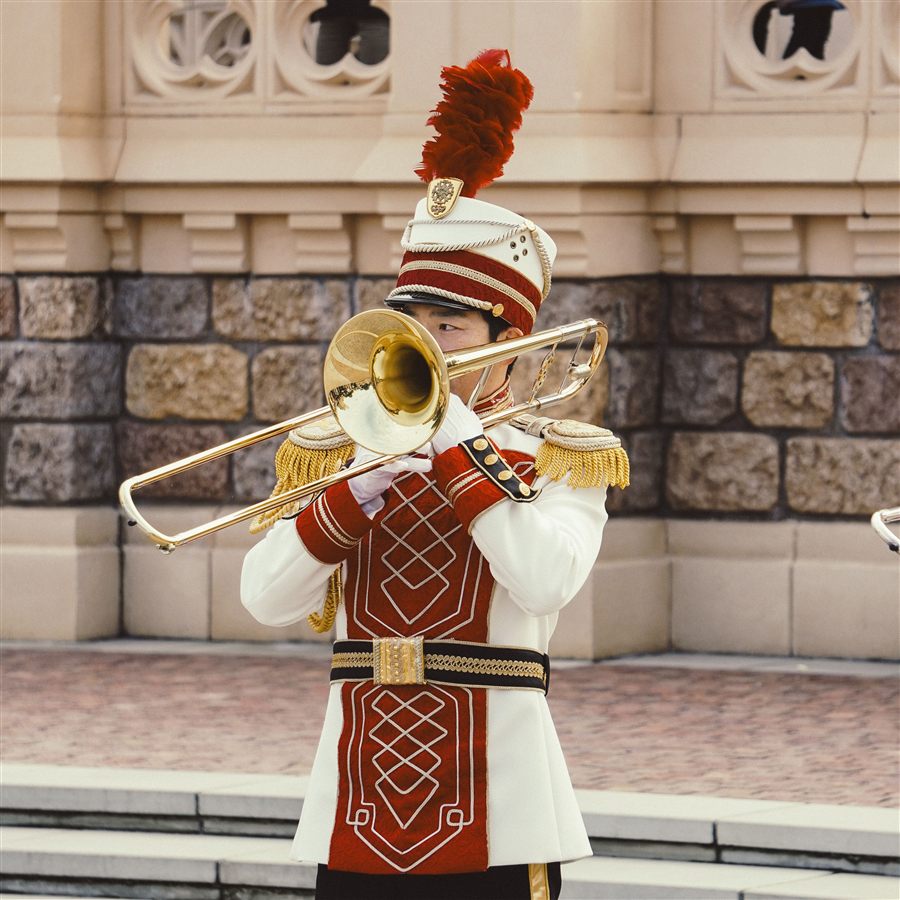
When you buy a used trombone, the slide decides the deal: it has to move evenly and easily through all seven positions, with no catching, grit or tight spots. After that come dents on the bell and tuning slide, the water key, the F-attachment if there is one, corrosion (red rot above all) and a long test play. Cosmetics, lacquer and age matter far less than how the horn actually moves and plays.
Why the slide decides everything
The slide is the working heart of a trombone. A horn that looks flawless is useless if the slide does not run cleanly, while a scuffed horn with a good slide can be an excellent buy. On other brass instruments a dent mostly hurts looks and a little intonation; on a trombone even a small dent in the slide slows the action. Slide problems are also harder to fix on the side than a tired water key, which is why the slide comes first in every inspection.
Condition checklist
Slide: testing the action
- Extend the slide fully and move it slowly through its entire travel. Feel for any catch, drag or roughness, not just at the ends.
- Go through all seven positions one by one. The resistance should be the same everywhere. Tight spots at particular positions usually point to a slight bend in the inner slide, even when no dent is visible.
- Rule of thumb: a well-kept slide glides almost under its own weight when the trombone is held horizontally and given a gentle nudge, with no force needed. That assumes clean lubrication, so ask how it has been cared for or have the slide cleaned and lubricated first.
- Check the hand grip and the brace of the outer slide for looseness. A wobbly brace changes how the slide tracks even if the tubes themselves are fine.
- A useful trick: take the outer slide off and slip it onto the inner slide turned 180 degrees (deliberately misaligned). In that position, imperfections and dents show up more clearly. Then put it back together correctly without forcing or bending anything.
- If the inner slide sits visibly tight against one side of the outer slide, the alignment is off. This is more common on budget instruments.
Dirt is not damage
Dried, crystallized residue from old lubricants can make a slide feel as if it had dents when there are none. A slide that only feels "okay" can improve noticeably after a thorough cleaning and current-generation lubrication, before you assume mechanical wear. The guide Trombone slide care: cream or spray explains how. Stubborn deposits are cleaned by a shop, typically in an ultrasonic bath. If the slide still catches in one spot after a proper cleaning, the cause is more likely mechanical.
Dents: when they are a dealbreaker
What matters is not size but location and effect.
- Slide crook and inner tubes: A dent that deforms the crook (the U-bend joining the tubes) or an inner tube can disturb alignment. The inner and outer slides then bind or give uneven resistance. This is the critical case.
- Small, purely cosmetic dents: If they affect neither roundness nor alignment and the slide runs freely end to end, they are often only a blemish. Some repair technicians leave such dents alone.
- Rule of thumb: Some technicians consider a repair worthwhile once a dent blocks roughly a third of the cross-section. The deciding factor remains how the slide feels.
- Bell and neck: Larger dents on the bell or the neck pipe affect response, tuning and tone, so be more cautious there. Any dent affects intonation, and bigger dents affect it more.
- Braces and counterweight: Damage to the bell brace, side braces or counterweight normally does not affect playability and is more of a bargaining point.
Removing slide dents is not a home job. For a dent in the crook, the bow is typically unsoldered, the dent worked out, the bow soldered back and the slide alignment reset. Because this is labor-intensive, even a small slide problem can produce a surprisingly high quote. It belongs in a professional repair shop. If you are tempted by a damaged horn, get a repair estimate before you buy. Costs vary widely with the shop and the work involved; for brass dent work it is usually priced by the effort, so varies by shop, get a quote.
Water key and tuning slide
- The water key (spit valve) must close firmly so nothing leaks while you play. A hardened cork or a weak spring are normal wear items and not a dealbreaker; replacing them is generally cheap.
- The tuning slide should move easily after lubrication. A ring of corrosion can usually be cleaned off. A stuck tuning slide, however, is a job for a shop and should either lower the price or put you off.
The F-attachment valve
If you are looking at a trombone with an F-attachment (trigger), check the valve separately. The lever should spring back cleanly, the rotor should turn without clicking or slop, and the linkage should not be bent. A misaligned lever or a worn rotor leads to repairs. A compression check helps: operate the valve and listen to whether the air is redirected cleanly, without whistling or leaking. Also try the valve slide and tuning bends of the attachment; they should move. What an attachment brings and who it overwhelms is covered in F-attachment and mutes: does a beginner need them?.
Solder joints, red rot and lacquer
- Solder joints: Look for cracks, gaps or loose connections on the slide, braces and bell. If a brace wobbles, a joint has usually cracked. Resoldering is shop work because heat can distort the instrument.
- Red rot (dezincification): Zinc leaches out of the brass and leaves brittle copper behind. Signs: pink to reddish patches or small dark pin-points, especially in the leadpipe and on the slides, inside and out. Most sources agree that the process cannot be reversed. A horn with active red rot is a clear dealbreaker.
- Worn lacquer is not red rot: Worn lacquer on the slide tubes or where the hand grips is normal. What matters is whether bare metal or active corrosion lies underneath. Silver and nickel finishes usually last longer than lacquer.
- Pitting: Especially in places that are touched a lot. Small marks are fine, eaten-through spots are not.
- Case and smell: A musty smell in the case points to damp storage. Rust on the case hardware together with heavy corrosion on the horn suggests poor storage.
Mouthpiece and receiver
Trombones come with two common shank sizes: the small shank on many student and intermediate horns with smaller bores, and the large shank on large-bore tenors and bass trombones. The included mouthpiece has to fit the horn's receiver. Adapters exist but can change response and tone. Ask whether the mouthpiece belongs to the horn you are trying and whether you can bring your own. Why bore and mouthpiece belong together is covered in Small bore or large bore: what matters on a trombone. A stuck mouthpiece or a damaged rim is a cheap but annoying problem.
Test playing
- Play for a good while. A quick try in the shop is not enough. If possible, take the horn home for a few days before you decide; a dealer with an on-approval policy often makes that doable.
- Bring your own music and mouthpiece and play things you know: slurs, fast slide changes, quiet to loud, high and low register. Aimless noodling hides weaknesses.
- Play open partials without the valve and listen for even tuning. Uneven intonation points to dents or damage.
- Bring a teacher or an experienced friend. A second opinion matters most on expensive horns.
- Individual horns within a model line differ noticeably. Players report horn-to-horn differences even on a Bach 42B or Conn 88H. The specific instrument counts, not the catalog.
Serial numbers and age
The serial number tells you roughly when a horn was built, not what shape it is in. Its location depends on the maker: on Conn, the lower part of the outer slide; on King, the outer slide or the tuning slide; on Bach, the cork barrel of the slide; on Holton and Yamaha, the bell receiver. On Bach trombones the bell and slide usually carry different numbers because the two sections are built separately and paired at the end. That is not a defect.
As a rough guide (approximate; assignments vary slightly by source): Bach trombones with numbers below about 6,000 date from the late 1920s to about 1953, numbers between about 6,000 and 25,000 from the years up to the mid-1960s, up to about 100,000 into the late 1970s, and higher numbers from the 1980s onward. On Conn and King, numbers between roughly 340,000 and 950,000 fall broadly in the 1950s and early 1960s. For newer horns, such as the more recent Conn 88H, classic serial dating is not reliable. Engraving style, brace design and wrap layout help confirm the age.
Important: age says nothing about condition. A well-kept older horn can beat a young, neglected one, and well-maintained 1960s instruments are sought after.
Prices and value retention
New prices as a reference
Rough ranges (as of Oct. 2026):
| Level | Typical new price |
|---|---|
| Student | about $400 to $1,500 |
| Intermediate | about $1,000 to $2,500 |
| Professional | about $2,500 to $6,000 and up |
Very cheap no-name student horns can be found new for under $200, but they usually come without local service and are harder to repair.
Used prices
Used prices vary a great deal with condition, age and seller. As a rough guide, listings for a used Yamaha YSL-354 student trombone mostly sat between about $280 and $900 (as of Oct. 2026), with a few excellent-condition examples listed higher; a new one costs roughly $1,500 to $1,700. Used Bach 42BO listings ranged from about $1,200 to over $4,000, depending on condition and configuration. In terms of value retention, premium professional models such as the Bach 42B and Conn 88H hold their value comparatively well, while student instruments sit at a lower, steadier level. Where possible, compare completed sales rather than asking prices.
Buying used makes the most economic sense in the mid to upper segment. A dealer can sell you an inspected horn, often with a warranty; a private sale saves money but leaves the risk with you. Depreciation has already happened, but hidden damage and the lack of a warranty are the trade-off.
Student and professional budgets
For a student, a well-kept, inspected horn in the student class is often enough. If orchestra playing is on the horizon, an F-attachment is usually part of the plan, so look at used intermediate models. For professionals, the used market stays attractive because these horns last as long as the slide and valve are in good order. The individual horn always decides.
Planning for repair costs
Budget for a service after the purchase even if the horn looks fine. At one large repair shop (as of Oct. 2026), a basic slide service started at about $80 and an extensive one at about $150, plus parts; a slide-only clean and align was listed at roughly $90 to $350. A general service on a plain trombone was about $70, with a student overhaul around $480 and a professional overhaul around $800; with an F-attachment those figures were about $90, $950 and $1,060. Freeing a stuck slide was about $30 where no soldering is needed. Silver plating added roughly $360. Dent removal, soldering and full overhauls are priced by the work involved, so varies by shop, get a quote.
On inexpensive horns, a repair bill can eat up the savings. Factor repairs in before you buy.
Buying online, scams and bad buys
Warning signs
- A price far below the going market value for that model.
- Blurry, few or obviously borrowed photos, with no close-ups of the slide, serial number or damage.
- A seller who will not send a video of the slide, or refuses to share the serial number, take a phone call or meet in person.
- Payment by wire, to strangers or by gift card, often with pressure ("other buyers waiting").
- The overpayment trick, where you are asked to send money back.
Buying more safely
- Learn the usual prices for the model first.
- Ask for photos of the slide, the dents and the serial number, plus a short video of the slide moving. Keep the seller's condition statements in writing.
- Prefer dealers with on-approval shipping and a return option. Inspect the horn the moment it arrives, before the return window closes.
- For private sales, meet in person and play the horn on the spot. Buying from a private seller online without a test is a real gamble: loose solder joints, a dirty interior and rancid grease on the slide do not show in photos.
- Be careful with unknown budget brands and plastic trombones. Budget brands often have no local service, and a plastic horn cannot be repaired. Established makers are easier to service and to resell.
- On expensive instruments, an inspection by a technician before the purchase can be worth the cost.
For questions about returns, consumer rights or warranty in a specific case, check the seller's terms.
Common mistakes and myths
- Judging by looks: A clean horn with a sticky slide is worse than a scuffed one that runs clean.
- Treating every dent as fatal: Dents on braces and the counterweight are harmless; small slide dents only matter if the action suffers.
- Mistaking dirt for wear: A sluggish slide often needs care first.
- Deciding by year: Age is neither a quality mark nor a flaw.
- Expensive means good: Price does not guarantee fit. The right horn is the one you enjoy playing.
- Skipping the test play: Weaknesses often show only after longer playing.
Quick buying checklist
- Test the slide in every position and check the brace.
- Assess dents on the slide, bell and neck.
- Check the water key and the tuning slide.
- With an F-attachment: lever, rotor, compression.
- Look for loose solder joints, red rot and corrosion.
- Match mouthpiece and receiver.
- Play for a good while and check intonation.
- Compare the price with market values and repair costs, and clarify returns.