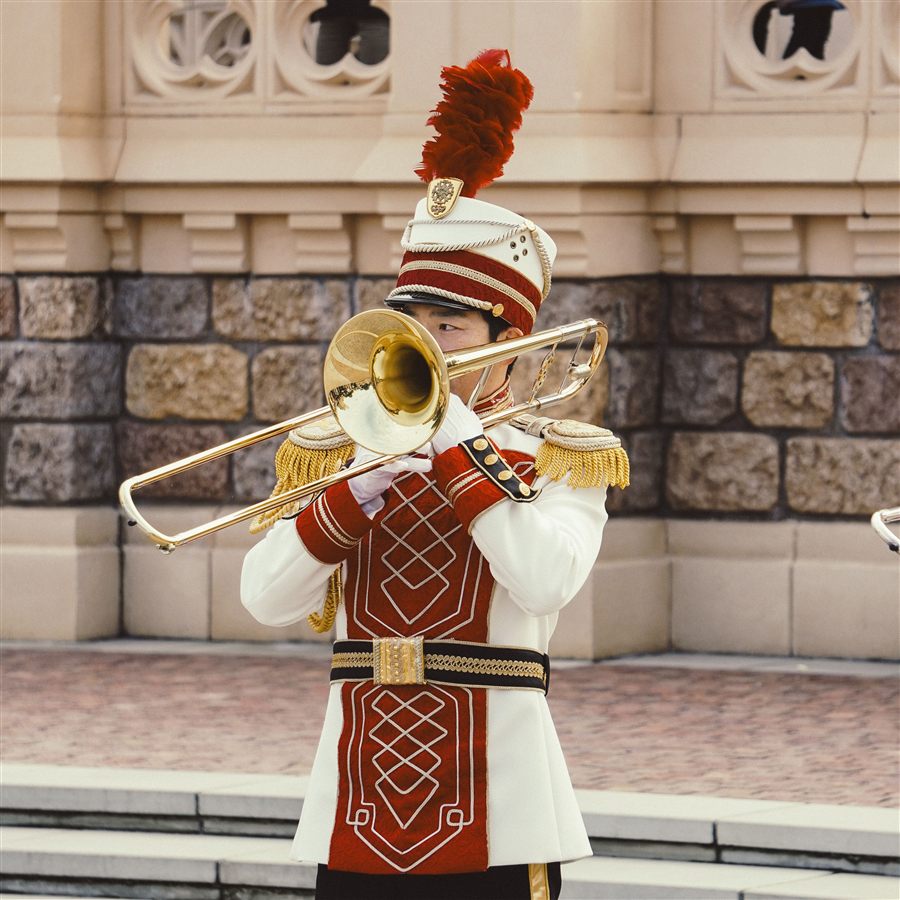
The F-attachment (also called a trigger or quart valve) is an extra loop of tubing that you switch in with a thumb lever to drop the trombone's pitch by a fourth. A beginner does not need one: a straight tenor trombone is lighter, cheaper and simpler to look after, and while the lever rests a trigger horn plays like a straight one. The attachment pays off if you are aiming at orchestral or bass trombone parts, or if you want to avoid buying a second horn later. Mutes are a separate question: a practice mute is the most useful first purchase for home practice, while straight and cup mutes come into play in ensembles and jazz.
What the F-attachment is and how it works
An additional loop of tubing, roughly three feet (0.9 m) long, sits around the bell section. When you press the lever with your left thumb, a rotary valve sends the air through that loop, lengthening the instrument so the fundamental drops from B-flat to F. The principle dates to the late 1830s and has been the most common extra valve on the trombone ever since.
The attachment has its own tuning slide. On most horns it can be pulled out far enough to lower the valve side by about a semitone, from F to E, which is what makes the low B reachable (see below). For everyday playing you set the valve tuning slide so that first position with the trigger agrees with your normal pitch, and then leave it alone.
Traditional wrap and open wrap
The loop can be wound tightly (traditional or closed wrap) or in wider, gentler bends (open wrap). Many players say open wrap feels freer. Flow measurements show no clear difference in actual resistance, and many experienced players say that build quality, leadpipe and overall balance matter more than the wrap. In practice, open-wrap tubing and braces stick out further and are more exposed to knocks in cases and tight spaces, while a traditional wrap can collect condensation that you drain by tilting the horn. For a beginner, wrap style is not a buying criterion.
What the F-attachment gives you
Low range
A straight tenor trombone reaches down to low E in seventh position in its normal range, and there is a gap between that and the pedal B-flat. With the attachment that gap closes, and with the valve tuning slide extended you also reach the low B. If your music contains those notes, as orchestral parts do, you need the attachment.
Alternate positions
A fourth is five semitones, i.e. five slide positions. That gives you a simple rule: a note found in position n on a straight horn sits in position n minus five with the trigger. A note that needs sixth position can be played in first with the trigger, and one from seventh in second. That shortens slide travel, makes fast jumps between distant positions easier and keeps your arm closer in the low register. Notes played through the valve often sound slightly darker and softer, so advanced players sometimes choose alternate positions for color as well as convenience.
Who really uses it
The attachment is standard in orchestral work and bass trombone writing. In jazz, big bands and many concert bands, plenty of players do fine without one because much of the repertoire stays above low E. Depending on the ensemble the attachment is essential, a convenience or unnecessary.
Do beginners need an F-attachment?
No. Most sources agree that a straight tenor is the standard starting instrument. In the first months you are working on embouchure, slide positions and tone, and a valve you do not yet use gives you nothing. Straight models also tend to have a smaller bore, which makes it easier for beginners to get a good sound.
| Straight tenor | Tenor with F-attachment |
|---|---|
| Lighter and better balanced | Roughly 1 to 2 lb heavier (rule of thumb), with weight sitting further toward the bell |
| Student models about $400 to $1,500 new (as of Oct. 2026) | Usually intermediate and up, from about $1,000 to $2,500 and beyond (as of Oct. 2026) |
| Only the slide needs regular care | Also a rotary valve and lever linkage |
| Lowest normal note is E | Reaches low B (with the valve slide extended) and offers more position choices |
| Fine for school band, church band, big band and jazz basics | Needed for orchestra and bass trombone parts |
When buying early still makes sense
- You want to play in an orchestra or a serious ensemble from the start.
- You are sure you will stay with the instrument and want to avoid reselling a first horn at a loss in two years.
- You can comfortably hold the extra weight for long stretches. For children and small players it can become a problem.
If you start with an attachment, you can simply ignore the lever for the first weeks and learn the alternate positions deliberately later. What matters is that the valve runs freely and seals well, because a sluggish or leaky valve costs response even when it is not engaged. When buying used, include it in your checks, see buying a used trombone.
Bore size belongs in the same decision. Narrow vs. large bore explains the trade-offs. Many horns with an attachment have a larger bore because they come from the orchestral tradition.
Price range for the US
Prices for new horns vary by source. As a broad frame, student trombones run about $400 to $1,500, intermediate horns about $1,000 to $2,500 and professional ones about $2,500 to $6,000 and up (as of Oct. 2026). Horns with an attachment sit mostly in the intermediate and professional tiers. Examples: an intermediate open-wrap model with F-attachment such as the Jupiter JTB1100FQ is priced around $2,250 (as of Oct. 2026), and an intermediate Yamaha YSL-448G with a larger bore is priced around $2,770 to $2,840 (as of Oct. 2026).
Used prices depend heavily on condition and maintenance history rather than age alone, and there is no reliable price list for used horns with versus without the attachment. Compare current listings for the exact model, and try the horn for several days if the seller allows it.
Looking after the valve
A rotary valve is a long-lived, forgiving part if it is oiled regularly. It is more tolerant than a piston valve, but it should never run dry.
Oiling
- Use only thin rotor oil or valve oil. Slide oil, cream or grease does not belong in the valve and gums up the mechanism.
- Take off the valve tuning slide (or the main tuning slide) and drip a few drops of rotor oil into the valve through the tubing. Work the lever several times to spread it.
- The bearings at the ends of the rotor and the lever linkage get a drop of thicker spindle oil if your horn has oil points for it. Oil on the linkage and spring keeps the lever quiet and smooth.
- Wipe away excess. Do not pour oil into the slide receiver, or it ends up in your slide.
Guidance on how often ranges from every two to four weeks, to roughly monthly, to whenever the valve feels scratchy, sluggish or noisy. Heavy daily players oil more often, about every week or two. Even if you rarely play, oil it now and then so it does not seize.
Signs you need to act
- The lever returns slowly or clacks loudly.
- The valve is reluctant to switch or hangs.
- A rattle points to worn or loose bumpers, springs or bearings.
- The tuning around the valve is off or the sound turns fuzzy whenever you use it.
What belongs in a shop
Never take the rotor apart yourself. Reassembly needs special tools and experience, and small mistakes in bearing play and alignment cause lasting damage. Replacing bearings, strings or linkage parts, removing dents and lapping also belong with a repair technician. A typical service cleans and laps the valves, cleans the interior, replaces bumpers and services the slide. One large shop lists a general service for a trombone with F-attachment at about $90 (as of Oct. 2026), and a full overhaul of a student F-attachment horn at about $950 and of a professional one at about $1,060 (as of Oct. 2026). Other shops differ a lot, and extra work such as bearings or dents is billed by effort, so get a quote that varies by shop.
The bell section with the valve tubing needs washing far less often than the slide; a thorough clean about once a year is usually enough unless the horn is very dirty. Slide care itself is covered in slide care: cream or spray.
Valve trombone or slide trombone?
A valve trombone replaces the slide with three valves, usually piston valves and sometimes rotary valves, fingered like a trumpet or baritone. It has a long history, notably in jazz (through players such as Bob Brookmeyer) and in parts of Europe and military bands, but today it is a niche instrument.
| Feature | Slide trombone | Valve trombone |
|---|---|---|
| Changing notes | Slide positions, continuously adjustable | Valve combinations, fixed pitches |
| Sound and response | The classic trombone sound, glissando possible | Noticeably different, no true glissando |
| Fast passages | More demanding | Easier, especially for trumpet and euphonium players |
| Orchestra and classical | Standard and expected | Not an equivalent substitute |
| Intonation | Corrected constantly with the slide | Valve combinations can drift sharp, needs lip control and valve slides |
| Market | Large, many used horns | Small, fewer choices |
| New price (as of Oct. 2026) | Student horns about $400 to $1,500 | Example Jupiter JTB700VQ about $1,820 new; open-box or demo units about $1,400 to $1,600 |
Who a valve trombone suits
- You already play trumpet, baritone or euphonium and want to cover trombone parts without learning slide technique.
- You need a double or second instrument for jazz, show or marching work.
- You play in a group where agility matters more than a classical sound.
If you are starting without brass experience, the slide trombone is the better choice: it is the instrument that schools, orchestras and curricula expect, and the slide trains your ear for intonation. The two do not replace each other; the valve version is a purpose-driven secondary or crossover horn.
Mutes for the trombone
A mute goes into or in front of the bell and changes volume and tone color. With mutes you can practice quietly, blend colors in an ensemble and create typical jazz effects. They are equipment rather than basics, though: the horn comes first.
The main types
- Straight: cone-shaped, filters out low frequencies and sounds bright, focused and piercing. The classical and concert band standard. Good intonation and a moderate volume drop.
- Cup: a straight mute with a cup that partly covers the bell. Softer, more covered and less bright. Popular in big band, jazz and show band. Adjustable models let you vary the cup.
- Harmon: a metal mute that nearly seals the bell. With the stem in, the well-known wah-wah effect, nasal and soft; with the stem out, brighter and sharper. Mostly jazz.
- Bucket: attaches to the bell and fills it like a pail; soft and velvety. Used mainly in jazz and big band.
- Plunger: a rubber cup you move by hand in front of the bell for wah effects and growls, mostly jazz and swing. Cheap and good for trying things out.
- Practice mute: usually aluminum with exhaust ports, bringing the volume down to room level. The price is weaker intonation in the high and low registers and a different feel; you have to support the tone more consciously.
Mute prices in the US
| Type | Rule of thumb (as of Oct. 2026) |
|---|---|
| Plunger | about $22 to $38 |
| Straight (aluminum) | about $54, premium versions can pass $110 |
| Cup | about $64 |
| Practice mute | about $41 to $92 |
| Harmon | about $95 |
| Bucket | varies by maker, check current listings |
What to buy first
If you practice at home, a practice mute makes sense, but keep in mind that it changes the feel, so do not practice only with it. For ensembles, concert bands or big bands, a straight mute is usually the first purchase, a cup mute later. Harmon and bucket mutes are worth it once you play jazz or matching pieces. Check the size when buying: tenor and bass trombone bells differ in diameter, so a mute fits one variant only. Replace worn cork or felt so the mute neither rattles nor slips.
Mutes often shift intonation slightly, so you usually have to correct by ear. Make a habit of checking your tuning with the mute in before you play in an ensemble.
Common mistakes and myths
- "An F-attachment speeds up learning": It does not replace technique. If you cannot hit the positions securely, you will not hit them with the valve either.
- "I can add one later": That would be a major rebuild that rarely makes sense. Plan the purchase around your goals.
- "Open wrap always sounds better": Not proven. A lot depends on the individual horn.
- "A valve trombone is easier to learn": Only for players with valve experience. Starting from zero, the slide is where you learn tone and intonation.
- The wrong oil: Slide oil or grease in the rotor is one of the most common mistakes and often needs a shop cleaning.
- Taking the valve apart yourself: tempting for small problems but risky. If in doubt, see a shop.
- Practicing only with a practice mute: The feel changes, so play without a mute regularly.
Checklist before you decide
- What music do you want to play: orchestra, jazz, concert band, church band?
- For orchestra or bass trombone parts, plan on an F-attachment from the start. Otherwise start on a straight tenor and decide later.
- Can you hold the extra weight for long periods?
- Does the valve run freely, switch cleanly and without noise?
- Budget time for oiling: rotor oil, spindle oil, a cloth and a reminder every few weeks.
- If you come from trumpet, consider a valve trombone as a second instrument, not a replacement.
- Mutes: practice mute or straight first, the rest later.