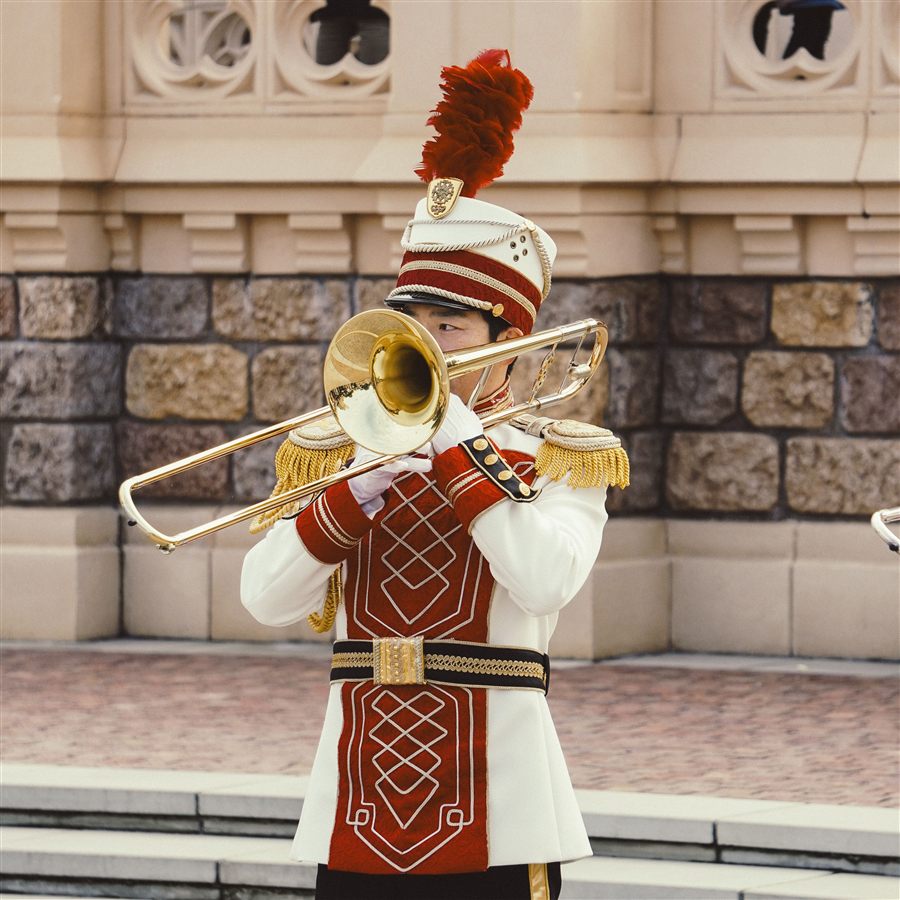
Bore is the inside diameter of the slide tubing, and it shapes response, tone color and how much air a trombone asks for. Small-bore tenors (about .481" to .508") are light and quick and suit jazz and big band; large-bore tenors (.547") sound bigger and darker and are the orchestral and symphonic band standard. For a first horn, a small to medium bore of about .500" to .525" is the safe pick, and the bass trombone (around .562") comes later as a second instrument.
What bore means and how it is listed
Most of a trombone is straight, cylindrical tubing, and the width of that tubing, especially in the slide, is the bore. American catalogs give it in thousandths of an inch (.500" equals 12.7 mm, .547" equals 13.89 mm). You will also see letter codes: M (medium), ML (medium-large), L (large) and, on bass trombones, extra-large.
Where "small" ends and "large" begins is not standardized. Some sources call everything up to .525" small bore, others draw the line near .510". As a working guide:
| Class | Bore | Typical bell | Typical use |
|---|---|---|---|
| Small | about .481" to .508" (12.2 to 12.9 mm) | about 7" to 8" | Jazz, big band, pop, young or small players |
| Medium to medium-large | about .500" to .525" (12.7 to 13.3 mm) | about 8" to 8.5" | School, beginners, all-round, concert band |
| Large | .547" (13.89 mm) | about 8.5" | Orchestra, symphonic band, chamber music |
| Extra-large (bass) | about .562" (14.3 mm) | about 9.5" to 10.5" | Bass trombone in orchestra, big band, brass ensemble |
Treat these as approximate. Catalog numbers vary slightly, and construction matters: a .500" horn can play much bigger than another horn with the same number. Dual-bore slides, where the inner slide is a bit narrower than the outer, give a tone somewhere in between.
Tone, response, endurance and volume
Tone
A small bore sounds brighter, more focused and edgier. A large bore sounds fuller, darker and rounder. A common comparison is a jazz or pop singer versus an opera singer: both sing, but the voice is built differently. Bell diameter, bell metal and the way the horn is made add their own color. Yellow brass leans bright, gold brass warmer, red brass mellow.
Response and air
Small bores offer more resistance. Notes speak quickly, fast articulation comes easier, but the tone gets edgy sooner at high volume. Large bores need more air and feel less lively under the tongue, but the sound stays even in the low register.
Endurance
Players often say a small bore makes the high range easier over a long session. That holds for many people but not for everyone. Some players reach higher and last longer on a big, deep mouthpiece in a large-bore horn. Embouchure, breathing and mouthpiece matter at least as much as bore.
Volume and dynamics
Large bores let you play loud without the sound turning harsh. Small bores light up at lower volume. Both can play softly. In big bands, sections are often graded by bore, with lead and second parts on the smaller side and the bass trombone on the largest, but there is no hard rule, and working players use all sizes.
The bell: an underrated part of the sound
Bell diameter on trombones runs from about 6.5" to 10.5" and rises roughly with bore. Jazz tenors usually have about 8" bells, orchestral tenors about 8.5", bass trombones 9.5" or more. A bigger bell projects more and widens the sound, a smaller bell concentrates it. Bore and bell together set the personality of the horn.
Tenor versus bass trombone
Both are pitched in B-flat and read in bass clef. They differ in build and role.
| Feature | Tenor | Bass |
|---|---|---|
| Bore | about .481" to .547" | about .562" |
| Bell | about 7" to 8.5" | about 9.5" to 10.5" |
| Valves | none, or one F attachment | usually two: F attachment plus a second (G-flat or D) |
| Weight (rough guide) | about 3 to 4 lb | about 5 to 6 lb or more |
| Mouthpiece | small shank, some large-bore tenors use large shank | large shank, larger and deeper cup |
| Role | melody, section parts, solos, every style | low parts, foundation, third trombone in orchestra |
The F attachment adds roughly 3 feet of tubing and lowers the horn from B-flat to F. The second bass valve drops further to G-flat or D. When the two valves work independently, every low note is reachable, down to the pedal tones, which speak more easily thanks to the wider bore, though they take a lot of air.
That is why nearly everyone starts on tenor: it is lighter, cheaper, has the most method books, and bass parts are rare in beginner repertoire. The bass trombone is almost always a second instrument for someone who wants to play low parts in orchestra or big band, and it asks for arm strength and lung capacity. Gauge whether you need a valve at all in F attachment, valve and mute questions for beginners.
Matching the mouthpiece
Mouthpieces are chosen by rim (diameter and contour), cup (depth and shape) and throat (the bore through the mouthpiece). Bach numbers run backward: the higher the number, the smaller the rim.
- Small (12C, 11C, 7C): rim inside diameter roughly 24 to 25 mm, shallow to medium cup. Easier on the high range, a match for small bores and jazz.
- Medium (6½AL, 5G): roughly 25 to 25.5 mm, medium depth, versatile. The 6½AL is the classic beginner choice.
- Large (4G, 3G, 1½G): roughly 25.5 to 28 mm, deeper cup, popular in orchestra.
- Bass trombone (1½G, 1G and similar): rims of roughly 27 to 29 mm, very deep cup, wide throat, large shank.
The cup mostly sets the tone color, shallow bright and deep dark. The rim is about comfort; one that is too wide or too small tires you early. A narrow throat speaks faster and sounds brilliant, a wide throat helps the low range and volume. Shank size has to fit the horn: small shank is standard on tenors, large shank on bass trombones and on some large-bore tenors. After changing mouthpieces, allow two to three weeks of adjustment before judging. On a used horn, a new mouthpiece is worth buying.
Bach 12C, 6½AL and 5G are common benchmarks. Standard models run about $85 (small and medium sizes) and up to $299 for gold-plated large versions (Oct. 2026).
Which bore for which job
Beginners
For beginners, especially young ones, a bore of about .500" to .525" works well: it takes less air and is easier to get a tone out of. Many school horns are .500". If you are tall enough and aimed at orchestra or symphonic band, a large-bore horn is also possible, but expect more air demand.
Jazz and big band
Jazz players usually choose a small bore of about .481" to .508", an 8" bell, a smaller to medium mouthpiece and often no F attachment. The horn is light, quick and cuts through the section. Playing jazz on a large-bore horn can feel clumsy, and playing classical music on a very small bore can feel too light.
Orchestra
Orchestral tenors are typically .547" with an 8.5" bell and an F attachment. First and second parts go to large-bore tenors, the third part to the bass trombone. Examples as data: the Bach 42B has a .547" bore and 8.5" bell, the Yamaha YSL-882 a 13.89 mm bore and 220 mm bell. For contrast, the Bach 36B is a medium .525" with an 8" bell and the Yamaha YSL-891Z a jazz-leaning 12.9 mm bore with a 204 mm bell.
Concert and school band
Medium to large bores are standard, and many have an F attachment because parts reach low. Whether it makes sense depends on the parts you will play. On weight it often makes less difference than expected: the attachment replaces the counterweight that horns without one carry in the tuning slide.
Price ranges in the US
Typical tenor ranges (Oct. 2026):
- Student: about $400 to $1,500.
- Intermediate: about $1,000 to $2,500.
- Professional: about $2,500 to $6,000 and up.
Used pro horns such as the Conn 88H and the Bach 42B hold their value well; example listings sit around $1,200 depending on condition and production era (Oct. 2026). Always compare asking prices with what comparable horns actually sell for, and check slide action, valve function and corrosion. More on this in buying a used trombone.
Bass trombones cost more. Dealer prices for the Yamaha YBL-421G are about $4,150 to $4,550, the Bach 50B3O about $6,770 (Oct. 2026). Beyond that, intermediate bass horns start around $2,500 and professional ones can reach $9,000 or more.
Common myths
- "Bigger is better." It is just different. Jazz players are usually happier on small bores.
- "Small bore always means more endurance." Not necessarily: breathing, embouchure and mouthpiece matter more.
- "Bore alone defines the sound." Bell, metal, valve design and mouthpiece contribute just as much.
- "You need a bass trombone for low notes." A tenor with an F attachment covers most low notes.
- "Tall players play large." No rule exists; professionals use very different sizes depending on the part and their sound concept.
Checklist before you decide
- Decide on the job: jazz, orchestra, band or learning.
- Confirm bore and bell in the specifications instead of judging by looks.
- Match mouthpiece and shank size to the horn.
- Play the horn for several days if you can, three to four days is a good span.
- Check and look after the slide and valve; see slide care: cream or spray.
- Test weight and balance while playing.