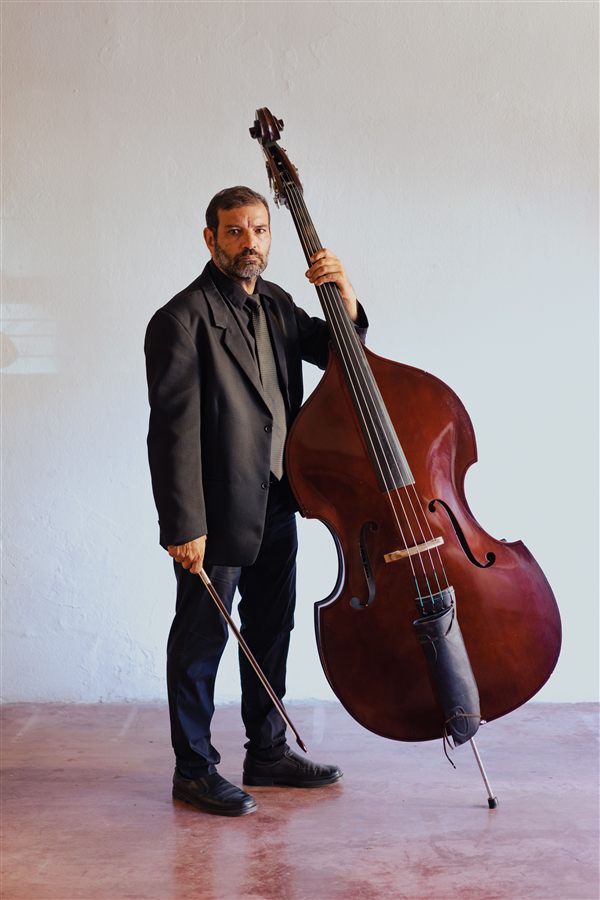
Double Bass
Kay S51 Upright Bass
No current price available
Availability: 0/10 (Very rare)
A historically significant American plywood double bass model that became a standard workhorse instrument for jazz and rockabilly bassists throughout the mid-20th century, marketed as the 'Chubby Jackson' model after the jazz bassist who endorsed Kay basses for over two decades.
About the Kay S51 Upright Bass
The S51 was one of Kay's top-of-the-line five-string models, sold alongside the S58 and S59, and marketed under jazz bassist Chubby Jackson's name during his roughly two-decade endorsement relationship with the company from the mid-1940s into the late 1960s. Like the rest of Kay's bass line, it's built from laminated plywood - five plies on the top and back, three on the ribs - with a maple neck, a construction choice that traded the resonance of a fully carved instrument for durability and affordability at a time when Kay's basses were outfitting working bands across America. Surviving examples show double purfling, violin-style corners, a genuine ebony fingerboard, nut and tailpiece, and nickel tuning machines with distinctive clover-shaped grips - details that mark it clearly as a premium model within Kay's own range rather than one of the company's more basic student instruments. Exact production dates are difficult to pin down with certainty: one dealer selling a 1943 example found it wasn't even listed in the known Kay bass serial registry, pointing to gaps in how thoroughly these instruments were documented at the time.
Where to buy
Unfortunately we can't currently find any offers for this instrument. Check back regularly - we update our listings several times a day.
Sound character of the Kay S51 Upright Bass
Forum consensus describes the Kay sound as more thump than growl - a percussive, immediate low end that many bluegrass players and some jazz players specifically prefer over the more refined, sustained projection of a fully carved instrument, and loud enough to cut through unamplified outdoor settings according to multiple accounts. One recurring description calls this the 'classic record tone' heard across decades of jazz and rockabilly recordings, a sound other makers still try to replicate rather than surpass. The clearest limitation raised is suitability for classical orchestral work, where the tone is described as lacking the subtlety and refinement that setting demands - positioning the Kay sound as a genre-specific strength (jazz, bluegrass, rockabilly, community ensembles) rather than a universally 'better' or 'worse' tone compared to a carved European bass.
What owners of the Kay S51 Upright Bass say
Independent, model-specific reviews of the S51 itself are scarce - available commentary comes mainly from forum discussion about Kay basses as a brand rather than this particular five-string flagship, and TalkBass, the most relevant English-language community, blocks direct page access, so only search-indexed summaries were available rather than full threads. Within that limitation, sentiment splits along fairly predictable lines: players who value Kay's thump-forward, historically significant tone and durable plywood build describe real satisfaction, including direct comparisons favoring a good Kay over cheaper laminated alternatives like Englehardt, while skeptics argue that a meaningful share of what collectors pay for vintage Kay instruments is reputation and nostalgia ('mojo') rather than measurably superior sound or construction compared to other plywood basses of similar vintage. Both views can be true simultaneously: the instrument's cultural and tonal legacy is real and well documented, but that doesn't mean every vintage example commands its asking price purely on merit.
Playability & handling of the Kay S51 Upright Bass
Forum discussion among upright bass players (TalkBass threads, accessible only through search-index summaries since the forum blocks direct page access) consistently describes the Kay sound as more of a thump than a growl - a percussive, present character that many bluegrass players and some jazz players specifically prefer over the more refined projection of a carved instrument. One jazz player reported that a well-preserved Kay sounded beautiful and was a clear upgrade over their Englehardt, while another described the 'classic record tone' of vintage Kay basses as a reference point other makers still try to imitate. The same discussions raise a real durability caveat with age: the plywood construction can develop delamination or sagging in its interior plies over decades, and repairs to that kind of damage tend to be both specialized and costly. One recurring critical voice argues the tone lacks the subtlety orchestral players look for, positioning these basses as better suited to community ensembles, jazz, bluegrass and rockabilly contexts than professional classical orchestra work - a genre-specific limitation rather than a quality complaint.
Recommended accessories & strings for the Kay S51 Upright Bass
No S51-specific accessory recommendations turned up in available sources. The practical upkeep concern that does recur across forum discussion is structural rather than accessory-based: the plywood body's interior plies can delaminate or sag with decades of age and humidity exposure, and specialized luthier repair for that kind of damage tends to be both harder to find and more expensive than routine upright bass maintenance like string changes or bridge adjustment.
Technical data for the Kay S51 Upright Bass
| Body | Laminated plywood (5-ply top/back, 3-ply ribs) |
|---|---|
| Neck | Maple |
| Fingerboard/nut/tailpiece | Ebony |
| Strings | 5-string configuration with high C |
| Tuning machines | Nickel, clover-shaped grips |
| Features | Double purfling, violin-style corners |
| Line position | Top-of-line 5-string model, alongside S58/S59 |
| Branding | Marketed as the 'Chubby Jackson' model |
| Production era | Approx. 1940-1969 |
| Controls | No controls in the amplifier sense - tone shaped entirely by bowing/plucking technique, string choice and the instrument's acoustic construction |
The history of the Kay S51 Upright Bass
Kay Musical Instrument Co. traces back to Chicago, where founder Henry 'Hank' Kuhrmeyer and an investor acquired the Groehsl Instrument Company (originally founded in 1890); a year after Kay's first electric guitar in 1936, the company began producing its well-known upright basses, hand-built using specialized machinery at its Walnut Street factory. Bass and cello production ran roughly from the 1930s until around 1969, when, according to one account, the manufacturing equipment was sold to Englehardt, which continued making laminated cellos and basses based on Kay's designs (reportedly ceasing production itself around 2020) - though a separate, conflicting claim holds Kay itself remained active in California producing both US-made and imported instruments, a contradiction available sources don't resolve. The S51 and its Chubby Jackson branding sat at the premium end of this production during Kay's peak decades, when the company's plywood basses became the default workhorse instrument for countless working jazz and rockabilly bands rather than a niche or budget option - a different Kay model, the Maestro M-1, carries the brand's single most famous individual instrument history: the bass Bill Black played behind Elvis Presley from late 1954 to early 1957, later passing through several owners before reportedly being acquired for Paul McCartney, who has called it one of his most prized possessions and used it on multiple recordings.
About Kay as a manufacturer
Kay built its reputation on being the working musician's choice rather than the connoisseur's: laminated plywood construction - chosen for durability and affordability over the resonance of a fully carved instrument - let the company equip touring and recording bands across jazz, rockabilly and early rock and roll at a price point far below hand-carved European-style basses. That positioning shows up clearly in the Chubby Jackson endorsement behind the S51: rather than courting classical orchestras, Kay built its top-tier models around jazz bassists who needed a durable, road-ready instrument night after night. The company's own later history grew murky after bass and cello production wound down around 1969, with conflicting accounts over whether manufacturing simply passed to Englehardt or whether the Kay name itself continued independently - a reminder that for a brand this historically significant, not every chapter of its story has been pinned down with certainty.
Notable players & recordings featuring the Kay S51 Upright Bass
Chubby Jackson, the jazz bassist whose name the S51 carried, endorsed Kay basses for roughly two decades from the mid-1940s into the late 1960s - the most direct documented player connection to this specific model, even if it reflects an endorsement relationship rather than a single, famously documented instrument the way some other Kay basses are tracked. The brand's single most celebrated individual-instrument story belongs to a different Kay model, the Maestro M-1: Bill Black played one behind Elvis Presley on nearly every concert, studio session and film appearance from late 1954 until early 1957, after which the bass passed through several owners before reportedly being acquired for Paul McCartney, who calls it one of his most prized possessions and has used it on multiple recordings. That history underscores the cultural weight Kay basses carried across jazz and early rock and roll more broadly, even though it attaches to a different specific model than the S51 itself.