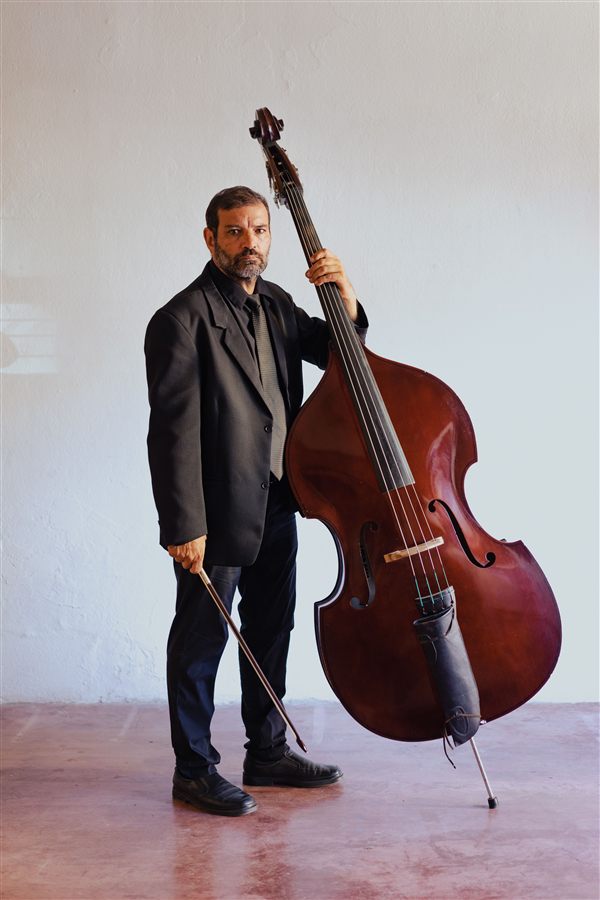
Short answer: Despite the name, the 3/4 double bass is the standard size for most adult players. It is easier to carry and reach around, and a well-built 3/4 does not sound meaningfully worse than a 4/4. Full-size 4/4 basses are mostly found in symphony orchestras and with very tall players. In the end the fraction matters less than how comfortably you can finger, bow and stand with the specific instrument in your hands.
What the size labels mean
The fractions (1/10, 1/8, 1/4, 1/2, 5/8, 3/4, 7/8, 4/4) are trade labels, not measurements. They describe a rough size class that makers, shops and rental programs use. A 1/2 bass, for example, is not half the length of a 4/4; it is only about 15% smaller.
The measurement that matters most under your left hand is the string length (scale length), the vibrating distance from nut to bridge. It decides how far apart your fingers must stretch. The body size, by contrast, decides how far your bowing arm has to wrap around the instrument, how much space it needs and how it travels.
Sizes at a glance
The table gives guide values. Figures differ by a few centimeters depending on maker and chart because there is no binding standard.
| Size | String length (guide) | Player height (guide) | Typical use |
|---|---|---|---|
| 1/10 to 1/8 | about 29.5 to 31.5 in (75 to 80 cm) | under about 3.5 ft | very young beginners |
| 1/4 | about 35.4 in (90 cm) | about 3.5 to 4.5 ft | children |
| 1/2 | about 38 in (96 to 98 cm) | about 4.5 to 5.5 ft | older kids, smaller adults |
| 5/8 | about 39.5 to 40 in (100 to 102 cm) | in-between size for smaller adults | specialty size, less common |
| 3/4 | about 41.3 in (104 to 106 cm) | about 5.5 to 6 ft and up | adult standard, jazz and orchestra |
| 7/8 | about 42.3 in (107 to 108 cm) | tall adults | in-between size, less common |
| 4/4 | about 43.3 in (110 cm and up) | over about 6 ft | orchestra, soloists |
Overall height from scroll to endpin averages about 71.6 in (182 cm) for a 3/4 and about 74.8 in (190 cm) for a 4/4. Typical body height is around 43.7 in for a 3/4, 45.7 in for a 4/4, 40.2 in for a 1/2 and 37.4 in for a 1/4. These are guide values too; they vary with the model and the endpin setting.
Sizes are not standards
Two basses sold under the same label can differ noticeably. Some instruments fit the measurements of two size classes at once, and especially for the body there is no reference model everyone follows. Makers also disagree on where one size ends and the next begins.
In practice, do not rely on the fraction in a listing or on a chart alone. Measure the string length on a used instrument and ask for the body dimensions. If the listing gives no numbers, "3/4" is only a rough hint. More on vetting listings is in buying a used double bass.
Why 3/4 is the standard
Reach and hand span
On a 3/4 a whole step in the lower positions fits comfortably between index and little finger. On a 4/4 the spacing is larger, which can tire the hand on long passages or fast shifts. For beginners the shorter string length is usually the friendlier choice.
Transport and everyday handling
A 3/4 fits more easily in a car, through doorways and into practice rooms. Cases, stands and strings are most widely available for this size, and resale demand is typically better than for very large basses.
Sound
A 4/4 tends to have more body volume and can have a stronger, more carrying low E string. Experience shows that build quality often outweighs this: a well-made solid-wood 3/4 can outperform a basic plywood 4/4. Top thickness, grain spacing, soundpost and bass bar matter at least as much as the fraction. Back shape alone (round versus flat) does not decide the sound either; many flat-back basses keep up with round-back ones. For the construction question see carved versus laminated basses.
Orchestra or jazz: which size when?
In a symphony orchestra, where an unamplified bass has to carry against many instruments, the 4/4 is common because projection and fullness count. In jazz, folk and pop the 3/4 dominates: it is easier to transport and, amplified, less prone to feedback. If you play both, a well set-up 3/4 usually gets you far.
If you play mostly orchestral repertoire and have large hands, try a 4/4 or 7/8 at least once. If you are unsure, a 3/4 is rarely a bad choice.
Tuning and size
Tuning does not depend on size; only the finger spacing changes.
- Standard (orchestral) tuning: E1-A1-D2-G2 in fourths, the same on every size.
- Solo tuning: every string a whole step higher, F#1-B1-E2-A2. It is used mainly for solo playing and sounds brighter.
- Five-string basses: add either a low B string (B0) or, less often, a high C string (C3).
- C extension: a mechanism at the scroll lengthens the E string down to low C (occasionally B). It is used mostly in orchestras.
- Fifths tuning: some players tune C1-G1-D2-A2, like a cello.
All double basses use geared machine heads with worm gears rather than friction pegs like violin or cello.
Height, arm length and standing position
Body height
Height is a guide, not a substitute for a test. As a rough orientation, a 3/4 suits players from about 5.5 ft (roughly 165 cm) up. Shorter players often consider a 1/2 because of the shorter finger span. Players around 6 ft generally do fine on a 3/4, and even a very tall player can use a 3/4 with a longer extended endpin.
Standing height and endpin
A common rule of thumb: standing, the bridge should sit about at the height of the large knuckles of your right hand. Adjust the endpin to get there. An endpin extended a few inches is normal and stable; very tall players may extend it much further. This way you avoid leaning forward or hunching your shoulders.
Arm length and hand size
There are no reliable numbers for arm length. A practical test: stand behind the bass, rest your left arm on the strings and check that you reach first position without twisting your shoulder, and that your right arm can bow comfortably around the lower bout. Small hands benefit from a shorter string length even when body height suggests a bigger bass.
Children and teens: growth and switching
Children should play a fractional size that fits their body, not their age. Typical guides: 1/4 for about ages 7 to 9, 1/2 for about ages 9 to 13, and 3/4 from around age 13 to 14 or a height near 5 ft 4 in. Some teens skip a size, going from 1/4 straight to 3/4. Age is a weaker guide than height and hand span.
An oversized bass wastes energy, encourages poor posture and takes the fun out of playing. For growing kids the most practical approach is one that allows switching.
Renting and rent-to-own
Because kids grow fast, renting is often smarter than buying. Student basses typically rent for about 48 to 80 USD per month (as of Oct. 2026); one provider charges about 65 USD for a 1/2 or 1/4 and about 90 USD for a 3/4, and another a flat 75 USD across sizes (as of Oct. 2026). Some programs bundle maintenance and insurance. Rent-to-own plans credit between roughly 80% and 100% of the payments toward a purchase, depending on the program. Read the terms: credit rules, repair coverage, insurance and return shipping differ from shop to shop.
Prices by size
Reliable prices by size are not available; price depends mainly on construction and condition rather than the fraction. Prices for new basses in the US vary by shop; get quotes for the same construction type (laminated, hybrid, solid carved) in each size you consider. A premium for size alone is not documented, so ask about build and condition. A professional setup after purchase is a normal extra cost; ask the shop for a quote.
Trying basses and choosing a size
Trying instruments is the most reliable method. Play several basses in different sizes, standing or on a stool, and check:
- Can you reach first position without twisting your arm or raising your shoulder?
- Does a whole step in the lower positions fit relaxed between index and little finger?
- Can you bow the low E string and the G string comfortably?
- Can you set the endpin so you stand upright?
- Do you like the sound at normal playing volume, not just a quick test in the shop?
Try several instruments of the same size, because setup (string height, bridge, soundpost) strongly affects playability. If possible, bring an experienced bassist or teacher. A bass with high string action feels too big even at the right size. More on this in buying a used double bass.
Common myths
- "4/4 is the better, professional size." No. Both sizes are played professionally; the choice follows repertoire and build.
- "3/4 is a student size." No, it is the standard adult size.
- "The fraction is the proportion of the length." No; the labels are trade classes, and a 1/2 is only about 15% smaller than a 4/4.
- "Bigger means louder and better." Only to a limited extent; build quality and setup matter more.
- "Size follows age." No, it follows body height and hand span.
Decision guide
- Adult beginners: usually 3/4.
- Under about 5 ft 3 in or very small hands: try a 1/2 or an in-between size (5/8).
- Over about 6 ft 3 in, long arms, orchestral work: try 7/8 or 4/4, but do not rule out a 3/4 with a longer endpin.
- Jazz, amplified, lots of travel: 3/4.
- Children: measure height, rent, switch as they grow.
- Solo or low orchestral notes: check tuning, five-string or C extension independently of size.
When several answers fit, the bass that feels best in your hands wins, not the number on the label.