On a used banjo, the neck, the pot and the way they fit together decide whether the purchase is worth it. A tired head, old strings or a missing bridge are cheap to fix and should lower the price rather than scare you off. This checklist walks through neck, pot, head, hardware and the playing test in a sensible order, with rough figures for prices and repairs.
Deal-breakers and bargaining chips
Sort the problems into two piles before you inspect details. Deal-breakers (or at least a serious discount) are damage that is expensive or changes the instrument for good:
- a neck that droops like a ski slope, with the strings climbing higher above the fingerboard toward the end,
- several misaligned or loose frets and deep grooves, especially in the first positions,
- a loose neck joint where the pitch changes when you move the neck against the pot,
- a pot that is no longer round, or cracks in the wood,
- heavy rust on the hoop and flange, or resonator veneer that is lifting.
Bargaining chips are missing or old strings, a missing or unsuitable bridge, a scuffed head and dirty hardware. Cleaning, restringing and adjusting a banjo that has changed hands is routine and, at older price levels, typically ran about $50 to $100 (as of Oct. 2026). If you are new to the instrument, bring an experienced player: sound and playability matter far more than scratches in the finish.
Neck, frets and truss rod
Neck straightness and truss rod
Sight along the neck from the nut toward the pot. It should run in a calm line with a very slight forward bow (relief) and no waves. An adjustable truss rod is a plus because it lets you correct small bends later. A banjo without one gives you no such option, so a straight neck matters even more. A common check for relief: capo at the first fret, hold a string down at the 22nd fret and look at the gap at the 7th or 8th fret. At a good setup the gap is only about 0.007 to 0.010 inch; the accepted range runs from about 0.005 up to 0.025 inch, and many factory setups sit around 0.009 to 0.010 inch. A feeler gauge is the right tool.
Frets and nut
Run a finger along the side of the fingerboard. Protruding fret ends stab, which happens when the wood shrinks in dry storage. Buzzing on single notes, especially in the lower positions, points to worn frets or grooves. The typical pattern is wear near the nut where players fret most often. A fret level and crown is common shop work, a full refret is the expensive version. Check also that the strings sit cleanly in the nut slots without pinching or sitting too deep.
Tuners
The tuners must hold pitch. Tune up and watch whether a string sags within minutes. Grinding or slipping gears usually mean replacement; parts are straightforward but not free. The short fifth string has its own tuner on the neck, and it should turn cleanly without play.
Neck angle and neck joint
The angle at which the neck meets the pot (neck angle) sets the bridge height. On an 11-inch head the angle is usually between about 1.5 and 3 degrees, and three degrees typically produces a bridge height between 5/8 and 11/16 inch. If the angle is too shallow, even a very low bridge leaves the strings poorly placed and the tone turns weak because the bridge presses too little on the head. If it is too steep, you need a very tall bridge and the strings stand far off the neck.
Practical test: set the string height to the usual figure (see the setup section below), then measure the bridge. If it has to be much taller or shorter than 5/8 to 11/16 inch to get there, the geometry is off. Correcting it means resetting the neck, an intervention in the structure: the joint is released and refastened at a new angle. That belongs with a professional shop. Quotes vary widely; one shop charges around $185, others $395 or more for a dowel-stick banjo, so get quotes (as of Oct. 2026).
Also look at the neck attachment itself: loose fasteners, gaps between neck and pot, or any wobble while playing are warning signs.
Pot, tension hoop, hooks and tone ring
The pot (rim)
The pot has to be round. An egg-shaped pot results from years of uneven stress by coordinator rods or the hoop and shows as a hoop that stands proud in one spot or lags in another. Look down into the pot: the edge should be even, without cracks or separating plies. On a resonator banjo, check the joint between flange and resonator as well: the resonator should be tight, with no bubbling veneer or peeling layers.
Tension hoop and hooks
The tension hoop presses the head over the rim. It should sit at the same level all the way around. If one side rides higher, the head may be stretched, the crown may not suit the banjo, or the notch in the heel may be too tight. Hooks and nuts must turn freely and not have lost threads or heads. Rust is unsightly, but what counts is whether the nuts still turn. Missing hooks can be replaced if you find matching parts.
Tone ring
On banjos with a tone ring (a metal ring between rim and head), the ring should sit flat all the way around. Gaps or rattles point to a poorly seated ring. A tone ring and resonator make a banjo heavy: bluegrass models can weigh up to about six kilograms (around 13 pounds), which you will notice standing with a strap.
Checking head condition and tension
Look and press
The head sits under constant tension, and its tightness directly shapes the tone: too loose sounds dull and flabby, too tight sounds thin and harsh and can split the head. Press gently with one finger in the middle: it should feel firm with only slight give. Look for dents, discoloration, frayed edges and for a head that has separated from its ring along the edge. Most heads today are synthetic (Mylar) and last many years. Older banjos may carry calfskin, which reacts more to humidity and costs more to replace.
Tap test and tension values
For the tap test, tap with a fingertip or nail about 1.5 inches from the hoop and listen to the pitch. As a rule of thumb, a note between G and G sharp sounds bright and round, A brighter still, and F, F sharp and G warmer and duller. Well above A the sound turns thin and the head may be overstressed. With a tension gauge (DrumDial), typical readings fall between about 88 and 92, measured about 1.5 inches from the hoop. Maple-neck banjos often sit near 92 and mahogany ones near 90. At the centre of the head you read three to five points lower than at the rim. More important than the absolute number is that tension is even all around: tap or measure at the 12, 3, 6 and 9 o'clock positions and watch for differences.
Tightening the head: do it yourself
You can tension the head yourself. With the wrench, turn each nut only about one eighth of a turn, in a star pattern (12, 6, 3, 9 o'clock, then in between) so the hoop travels straight down. Then tune, tap and repeat if needed. A new head settles over a day or two; tighten once or twice more by an eighth of a turn, and after that about once a year is usually enough. Never go beyond A and never crank suddenly, or the head can split.
Head replacement: DIY or shop?
A synthetic head is something a beginner can change: lay the head on, centre the hoop, hook up the four cardinal points, tighten evenly to avoid wrinkles, then let it settle as above. There is no fixed interval. Many players change after seven to ten years and some only after 20 or more; replace when the head tears, separates from the ring or stays dead. An old head that holds tension and sounds good does not need replacing. Calfskin belongs with a shop: it is mounted wet and dried, which takes experience. At the shop, a Mylar head typically costs about $90 to $125 for installation, parts not included, and a skin head about $150 to $175 (as of Oct. 2026).
Resonator and bridge
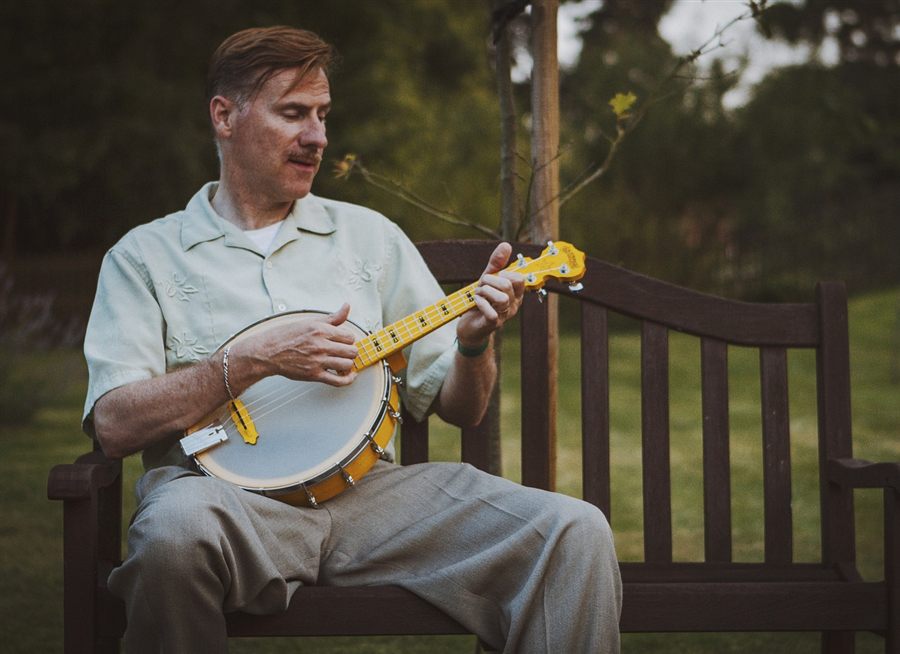
The resonator reflects sound forward and adds volume and overtones; it must sit tight with the veneer edges flat. Open-back banjos have none and sound softer. If you are still deciding between body styles, the comparison of 4-string and 5-string banjos helps, because the string count and playing style determine whether a resonator makes sense.
The bridge should stand upright without leaning toward the tailpiece, with both feet flat on the head. It is a small, cheap wear part, so a missing bridge needs no special discount beyond what you would expect anyway. Its position sets intonation: compare the fretted note at the 12th fret with the harmonic over the 12th fret; they should match. If the fretted note is sharp, the bridge goes slightly toward the tailpiece; if flat, toward the neck.
Setup: action, bridge and tuning
A clean setup often turns an average banjo into a good one. Rules of thumb:
| Item | Rule of thumb |
|---|---|
| String height at the 12th fret | about 1/8 inch |
| String height at the 22nd fret | about 9/64 inch |
| Relief (gap at the 7th fret) | about 0.007 to 0.010 inch; the range runs from 0.005 to 0.025 inch |
| Bridge height | 5/8 to 11/16 inch |
| Head pitch | G to A, usually G to G sharp |
The order is: tension the head first, then straighten the neck (truss rod in small steps), then bridge and action, intonation last. Everything is judged with the strings at pitch. The tailpiece shapes the tone: set higher it sounds mellower, closer to the head it sounds crisper, and it must not touch the head. On the coordinator rods, which join neck and pot, you turn only in tiny increments and check after each step. A medium set for a five-string uses gauges of .010, .012, .016, .023 and .010 inch.
Prices: new and used
In the United States, new beginner five-strings start around $315 (Gold Tone AC-1, as of Oct. 2026), with the Deering Goodtime starting at about $599, the Goodtime Two at about $849 and the Artisan Goodtime from about $949 (as of Oct. 2026). Used pricing follows a few patterns.
- A used banjo in like-new condition should cost no more than about 75 percent of a typical street price for the same new model; a reasonable price for a recent instrument in nice condition is often 20 to 30 percent below new.
- Expect at least a 20 percent loss in the first year or two. Buyers who resell usually receive about 40 to 60 percent of retail from a dealer, and above about $2,000 resale gets difficult unless the price is near half of retail.
- Professional instruments are often the better used deal: one example is a pro banjo bought for $1,000 that cost $2,600 new (38 percent), against a student banjo at $325 that cost $400 new (81 percent).
- Well-known brands hold value even with wear; an unknown brand has to stand on its tone and condition alone.
A banjo that sat unplayed for years often needs only a new head and a setup, and you should price that in.
Typical repairs and what they cost
Shop prices vary, so treat these as rough ranges and get quotes (as of Oct. 2026):
| Repair | Typical range |
|---|---|
| Basic setup | about $80 to $125; a full setup about $250, plus about $20 for a five-string |
| Mylar head installed | about $90 to $125 |
| Skin head installed | about $150 to $175 |
| Bridge | a few dollars for the part, up to about $80 installed at some shops |
| Single fret replaced | about $25 per fret |
| Full refret | about $270 to $425; some shops start at $500 |
| Neck reset | about $185 to $395, sometimes more |
For the work that touches the structure (neck reset, refret, fret levelling, cracks), use a luthier with real banjo experience: poorly done fret work can leave an instrument unplayable. On a cheap banjo, repairs add up fast and can exceed what the instrument will be worth afterwards, so calculate before you buy.
Warning signs when buying
- The seller gives no brand, model, age or repair history. Ask for the serial number and any repairs.
- The price is barely below new for a beginner model.
- No video or photos of the pot interior and neck joint.
- You cannot tune the banjo because tuners slip or strings will not hold.
- The hoop sits crooked, hooks are missing or rusted solid.
Get any promised condition in writing, ideally in the listing or the message history.
Care after the purchase
Wipe pot, neck and hoop dry after playing and store the banjo in its case, away from heaters and sun. Large swings in temperature and humidity stress the wood and change head tension; calfskin reacts most. In humid weather the head may go slack and in dry weather it may tighten too much, so check tension after weather changes. Ease the strings slightly for long storage, have a shop free up stiff hooks, and check regularly that the screws at the neck and tailpiece are tight. Write down the measurements and head pitch that work for your banjo so you can restore the setup later.