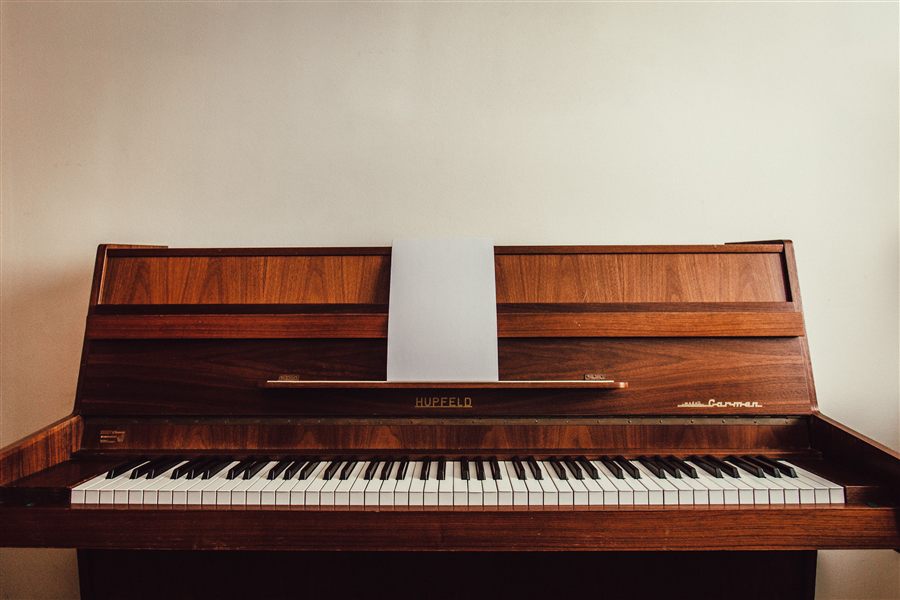
Upright Piano
Petrof 125 M1
No current price available
Availability: 0/10 (Very rare)
A mid-sized 125cm upright from Petrof's Higher Series, built with European components throughout - Röslau strings from Germany, a solid spruce soundboard with ten spherical ribs, and either a Petrof-original or Renner-sourced action depending on market. Experienced technicians who've played both action variants side by side found the real difference between good and exceptional examples wasn't the mechanism itself but how carefully the upper treble was voiced at the factory or by a tuner afterward.
About the Petrof 125 M1
At 125cm tall and 236kg, the P 125 M1 is built around a solid spruce soundboard with an active area of roughly 1.19 square meters, tapered from 9mm at the top to 7mm at the bottom across ten spherical ribs - a shaping approach meant to balance resonance across the full register. The cast-iron plate is wet-sand cast and finished with nitrocellulose paint and bronze dust, sitting over a multiplex beech pinblock dense enough (800-850 kg/m³) to hold tuning stability over time. Strings come from Röslau in Germany with copper winding from Degen, strung through 88 brass agraffes. Depending on the distribution market, the piano ships with either a Petrof-original action built in-house with Detoa parts, or a Renner-Petrof action using genuine Renner hammers from Germany on a Petrof action frame - both built around hornbeam action parts, aluminum wippen and hammer rails, and hammers from Abel or Renner on hornbeam shanks.
Where to buy
Unfortunately we can't currently find any offers for this instrument. Check back regularly - we update our listings several times a day.
Sound character of the Petrof 125 M1
Petrof markets the design as elegant, modern and minimalistic, and the tonal character leans toward a warm, full European sound rooted in its solid spruce soundboard and German Röslau strings. The one recurring technical caveat from experienced players is that the upper treble can come across brighter than ideal if the factory voicing hasn't been dialed back, meaning the piano's ultimate tonal balance depends noticeably on how carefully that top register has been treated rather than on the soundboard alone.
What owners of the Petrof 125 M1 say
Technicians who've engaged closely with this model split less into camps for or against the instrument itself and more into differing assessments of the two action variants - which overall speaks to a solid, fundamentally well-regarded piano where the choice of action matters less, by professional consensus, than correct factory voicing. The price gap between the two variants is described as small, which simplifies the decision for buyers without marking either option as a clear misstep.
Playability & handling of the Petrof 125 M1
Opinions on the two action variants diverge among experienced technicians rather than converging on a clear winner. One piano technician recalled the Renner-equipped version as clearly superior in performance to the Detoa-based action a few years back, while another professional who tested both side by side found neither markedly better-playing than the other. What both agreed mattered more was voicing: the gap between an ordinary example and a genuinely excellent one came down to whether the upper treble had been properly voiced down, not which action variant it carried - a reminder that factory-fresh intonation and post-sale adjustment by a technician matter as much as the hardware choice itself.
Recommended accessories & strings for the Petrof 125 M1
An optional adsilent system can be retrofitted for silent practice through headphones, a useful upgrade for shared living spaces or late-evening practice. Beyond that, standard upright-piano care applies: regular professional tuning and a stable room humidity to protect the solid spruce soundboard and beech pinblock from the dimensional changes that throw off tuning stability over time.
Technical data for the Petrof 125 M1
| Type | Acoustic upright piano, Higher Series |
|---|---|
| Height | 125 cm (49 1/4 in.) |
| Width | 145.6 cm (57 3/8 in.) |
| Depth | 58.7 cm (23 1/8 in.) |
| Weight | 236 kg (520 lb) |
| Soundboard | Solid resonance spruce, active area approx. 1.19 m², 10 spherical ribs, tapered 9mm-7mm |
| Cast-iron plate | Wet sand cast, nitrocellulose paint with bronze dust |
| Pinblock | Multiplex beech plywood, 800-850 kg/m³ density |
| Frame | Spruce, 3+2 posts; bridges in beech |
| Strings | Röslau (Germany) steel wire, Degen (Germany) copper winding, 88 brass agraffes |
| Action | Petrof-original (Detoa) or Renner-Petrof, market-dependent; hornbeam action parts, aluminum wippen/hammer rails |
| Hammers | Abel or Renner, hornbeam shanks |
| Controls | 3 pedals: left una corda, middle moderator, right damper/forte |
| Hardware | Castors, hydraulic slow-close fallboard |
| Finish | Gloss black, gloss mahogany, gloss walnut, gloss white (other finishes to order) |
| Optional | adsilent silent-practice system |
The history of the Petrof 125 M1
The P 125 M1 belongs to Petrof's Higher Series, the brand's tier aimed at serious home use, music schools, and chamber-ensemble playing rather than entry-level instruction. Its two-action-variant arrangement - Petrof-original or Renner-Petrof depending on the distribution market - reflects a broader, long-standing practice at Petrof of sourcing some action and hammer components from established German specialists like Renner and Abel rather than building every part in-house, a strategy also seen across the brand's grand pianos.
About Petrof as a manufacturer
Antonín Petrof (1839-1915) was born in Hradec Králové and learned piano making in Vienna under his uncle Jan Heitzmann before returning to Bohemia in 1864 to build his first instrument. In 1865 he converted his father's cabinetry workshop on the old town square into a piano-making operation, and in 1866 formally registered the company as A. Petrof. The firm expanded steadily - relocating to larger premises on the outskirts of Hradec Králové in 1874, opening an auxiliary factory in Temesvár (today Timișoara, Romania) in 1880, debuting its own keyboard and action design in 1881, and beginning series production in 1883, followed by its first exports and a Vienna warehouse in 1894-95. Today Petrof is Europe's largest manufacturer of acoustic pianos, exporting to more than 60 countries.
Notable players & recordings featuring the Petrof 125 M1
No verified, model-specific signature-player association was found for this piano.
Related guides
- Silent Piano Systems Explained View details
- Buying a Used Upright Piano: What to Check View details
- Determining a Piano's Age From Its Serial Number View details