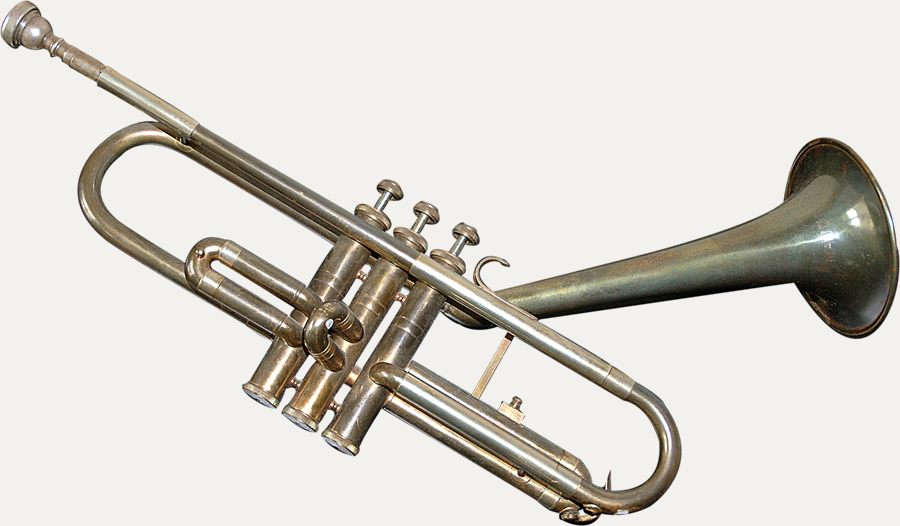
Short answer: On a used trumpet, function beats looks. What matters is smooth, well-sealed valves, slides that move freely, no red rot (brass corroding from the inside) and intonation that holds up across the range. Cosmetic dents and worn lacquer are tolerable; corrosion and worn-out valves are not. Whenever you can, go in person, play the horn, and bring an experienced trumpeter along.
How to run a viewing
Set aside 30 to 45 minutes. Bring a tuner, your own mouthpiece, a soft cloth and a flashlight. A good order is: look first, test the mechanics, then play, and only then talk about price and service. That way a pleasant sound can't distract you from damage you haven't spotted yet.
The body: dents, scratches, finish
Dents
Every dent changes the bore a little and therefore affects intonation, big dents more than small ones. Location decides how much it matters. A dent in the bell or on an easily reached bow is usually harmless. Dents in valve casings, the leadpipe or the slides can disturb airflow, valve action or slide travel. Removing dents is shop work: the metal is pushed back from the inside with specialized tools, and an inexperienced attempt can ruin tubing and finish. For anything larger, get an opinion on whether it can be fixed, and at what cost, before you buy.
Scratches, lacquer and plating
Tarnished silver is purely cosmetic and polishes off with silver cleaner. Deep scratches that reach bare brass are a different story, because they invite corrosion later. A relacquered horn may be hiding repairs or dents, so ask directly whether and why it was refinished. The everyday differences between lacquer and silver plate are covered in Silver-plated vs lacquered trumpets: care and sound.
Solder joints
Look at the joints between tubes, braces and the valve block. Neat, even seams are normal. Excess, gray or lumpy solder, cracks, and parts that can be wiggled all point to earlier emergency repairs or a drop. Soldering belongs strictly in a repair shop.
Spotting red rot and corrosion
Red rot (dezincification) happens when saliva and acids from sweat leach the zinc out of the brass, leaving a porous, copper-colored material. Use the flashlight to check the leadpipe, the valve bows, the water key and under the valve caps. Pink or reddish patches, rough or pimpled areas, and pitting around the valve casings are warning signs. Press gently on any suspicious spot: the metal should feel solid, never soft or crumbly.
Small surface discoloration can often be stopped. Advanced red rot usually means replacing whole sections of tubing, which rarely pays off on an inexpensive horn. Many buyers simply walk away from any instrument with visible progress, and that is a sensible rule of thumb. It also hints at how the whole instrument was treated.
Checking the valves: action and compression
The valves are the heart of the trumpet and the most expensive wear area. Test them in three steps, none of which needs tools.
Action
- Press each valve all the way down and release. It should return briskly and evenly, with no sticking, grinding or rattling.
- Run through all fingerings (1, 2, 3, 1+2, 2+3, 1+3, 1+2+3). A valve that is clearly slower or looser than the others stands out.
- Side-to-side wobble of the piston in its casing, or springs that bounce noticeably, indicate wear.
- Vertical wear lines on a piston can point to years of pressing at an angle.
Compression
A valve seals well when air doesn't leak past it. The usual test: pull the valve slide (the third, for instance) out as far as possible without taking it out, then press the valve. With good compression you hear a distinct pop as the air in the tubing is squeezed. If the air hisses past, or the valve gives way with hardly any resistance, the seal is poor. Test every valve and compare them with each other. A seller's promise of "great compression" is no substitute for the test.
Poor compression can come from dried-out or missing oil, but also from worn pistons and casings, or from dents. You can often narrow it down on the spot with a little valve oil: if oiling clearly improves things, dryness was probably the cause. If the loss remains, an overhaul is due. Lapping or refitting valves is firmly shop work.
Felts, corks and springs
The felts and corks that cushion the valves are wear items and cheap to replace. If they are hard, flattened or missing, the valves clack and notes can sound unclean. It's a bargaining point, not a dealbreaker.
Slides and the water key
Pull the main tuning slide and every valve slide out and push them back in. They should move without force and close smoothly. Stuck slides are common on horns that sat unused. Whether they can be freed without bending the tubing is a job for a shop that does it deliberately and without damaging the metal. Don't force them, not even when the seller urges you to.
The third-valve slide should be adjustable while playing (ring or trigger), since you use it to correct low notes. Check that it runs cleanly. The water key must seal: blow into the horn with the key closed and check whether air or spit escapes anywhere. A leaky cork or tired spring is cheap to fix, but the area is also a typical red rot spot.
Leadpipe and mouthpiece
Look into the leadpipe. The inside should be smooth, without deposits, rough spots or discoloration. Run a fingertip around the receiver for dents. If a mouthpiece is stuck, don't pry it out; specialized tools exist for that and a shop usually removes it quickly. The mouthpiece that comes with the horn is often worn or a poor fit. Check the cup for scratches and plating wear that would feel unpleasant on your lips, and budget for your own mouthpiece if you don't already have one that suits you.
Intonation and response while playing
Warm up on your own mouthpiece for a few minutes, then test:
- The open partials (C, G, C, E, G, C) against a tuner. Repeated deviations mean the horn isn't in tune with itself.
- A scale and a familiar tune through all registers. Listen for notes that are always sharp or flat.
- Response at soft dynamics and in the upper register, plus the blowing resistance. That decides whether the horn suits your endurance.
A horn that doesn't play in tune with itself will frustrate you for years, however pretty it looks. Two examples of the same model can feel noticeably different, so comparing a few is worth it. If you're weighing classes of instrument, read Student vs professional trumpets on the used market.
Serial number and approximate age
The serial number tells you the maker and roughly the age, and lets you check whether the horn has been reported stolen. On Bach trumpets it is stamped on the second valve casing. Before 1990 it sits on the front, upper part, stamped horizontally; after 1990 on the back, lower part, stamped vertically. As a rough guide for Bach: 12,000 is about 1953, 100,000 about 1974, 336,000 about 1990 and 500,000 about 1999. Other makers number differently, and some don't number sequentially. The year says little about condition, since a well-kept horn from the 1970s can beat a neglected newer one.
Questions for the seller
- How long have you owned it, and was it played regularly?
- Any drops, dent repairs, soldering or a refinish?
- When was the last service, and are there receipts? A professional check every three to five years is a common rule of thumb.
- Did it sit unused for a long stretch?
- Are the case and mouthpiece included, and is there a return window?
Get important promises in writing, for example in the listing or a message. For legal details about returns and warranties, check the rules that apply to your sale or ask a qualified adviser.
Buying online without playing it, or checking in person
What photos and descriptions can't show is exactly what matters most: valve compression, intonation across the range, and the individual feel of the resistance. Two trumpets with identical specs can play very differently. An in-person test is therefore the lowest-risk route. Buying unseen isn't automatically wrong, but it shifts the risk onto you, and that should show in your price and in the seller you pick.
- Risks without a test: no warranty on private sales, fraud, hidden defects, and shipping damage (dents, bent slides).
- Lowering the risk: choose a dealer with a clear return policy, or a seller with a good reputation, detailed photos (leadpipe, valve casings, insides) and a thorough description. A return window is the practical stand-in for an in-person test.
- When it arrives: run every check in this article right away and report problems immediately.
- Be wary of: blurry photos, vague listings, or a price far below the going rate.
Used-market price ranges
Prices vary widely with model, condition and timing. The ranges below are rough guides (as of Oct. 2026).
| Class | Typical used price | Note |
|---|---|---|
| Beginner / student | about $100 to $500 | Basic student horns often $100 to $350; a popular Yamaha student model commonly sells for about $200 to $500 |
| Intermediate | varies, compare current listings | Relatively uncommon on the used market |
| Professional | about $1,200 and up | A popular Bach Stradivarius model often sells for about $1,200 to $1,700; top-tier models from $2,500 and up |
Silver plate usually adds roughly $100 to $200 to the price. Search completed or sold listings rather than asking prices to see what a model really fetches. Timing helps too: more used student horns appear in February and March, when beginners quit, and in July through September, before college players upgrade.
Negotiating
- List flaws factually (felts, dents, compression) and fold the repair cost into your offer.
- Make a specific offer and mention cash on pickup when you're there in person.
- Knowing what similar horns actually sold for is your best argument.
- A return window or short warranty is often worth more than a $30 discount.
- Be suspicious of urgent "must go today" deals.
Service and valve overhaul costs
Plan for maintenance after the purchase. Shop prices vary, but a few examples show the scale (as of Oct. 2026, rough guides; parts usually extra). A chemical or ultrasonic cleaning runs about $130, and a "play condition" service that covers valve servicing, slide work, a couple of solder points, corks and felts and minor dent removal about $107. Individual jobs such as valve, slide or solder work come to about $53 per item, with each additional item around $22 more. Removing a minor, accessible dent is about $76. Shop labor rates run roughly $80 to $85 an hour. A full overhaul is often quoted at about $550 for student horns and about $845 for professional horns, and re-plating adds roughly $245. Major dent work, extensive soldering and refinishing depend on the instrument: varies by shop, get a quote. Some shops will free a stuck mouthpiece for little or nothing.
Get more than one estimate and ask for the hourly rate, since quotes for the same damage can differ a lot.
First check after you buy
- Take the horn out of the case, look it over inside and out, and photograph its condition.
- Check valves and slides and, if they feel dry, oil and grease them (see below).
- Give it one thorough cleaning (see hygiene) so you can see its real condition.
- Check the open partials and intonation with a tuner.
- If anything is off (compression, slide travel, corrosion), book a shop visit before it gets worse.
- Settle any return or complaint early, if one was agreed.
Hygiene: cleaning the horn and mouthpiece
A used brass instrument carries saliva, deposits and germs from its previous player. A thorough cleaning before the first session handles that well.
Mouthpiece
The mouthpiece touches your lips, so clean it first. Soak it in lukewarm water with a mild dish soap, then scrub the cup and bore with a mouthpiece brush. Rinse with clear water and dry it. Avoid hot or boiling water, harsh cleaners and abrasives, which attack silver or gold plating. Washing it weekly is enough as routine. If an old mouthpiece won't come clean or is badly scratched, replace it.
The horn bath
- Remove the valve pistons, valve caps and slides first and keep track of the order (the pistons are numbered and not interchangeable).
- Soak the body in a tub or basin of lukewarm water, roughly 86 to 104 °F, with mild dish soap or a brass soap. Put a soft towel on the bottom.
- Run a flexible snake brush gently through the tubing without forcing it around tight bends.
- Rinse thoroughly with clear lukewarm water until no soap residue comes out.
- Dry the outside, let the tubing air-dry, then re-oil the pistons and re-grease the slides and water key.
Don't use hot water on lacquered horns, and no abrasives. Strong chemicals, descaling agents and ultrasonic baths belong in the shop, as does removing stubborn deposits. A monthly bath is enough if you play regularly; after playing, a wipe with a soft cloth is all you need.
Oiling and greasing
- Valve oil: two or three drops after playing. Pull the piston halfway out, apply oil, reinsert it, screw the cap down firmly and work the piston up and down several times. The piston guide has to engage, otherwise the piston is in backwards.
- Main tuning slide and second slide: slide grease. The slides you adjust while playing (first and third) take slide oil.
- Don't mix: using different valve oils together can turn gummy.
Common mistakes when buying used
- Buying on looks instead of function.
- Writing off red rot or pitting as "just cosmetic."
- Playing only one register and never checking intonation.
- Going without a tuner, a plan, or a second opinion.
- Forcing stuck slides or mouthpieces.
- Not budgeting for service.
- Buying an unknown budget brand with no parts or support.
- Skipping the serial number and background check.
- Mistaking a polish for maintenance.
A trumpet with a few cosmetic dents, healthy valves and free-moving slides is usually a solid, fairly priced buy. If you're also considering other instruments in the family, see Trumpet, cornet and flugelhorn compared.