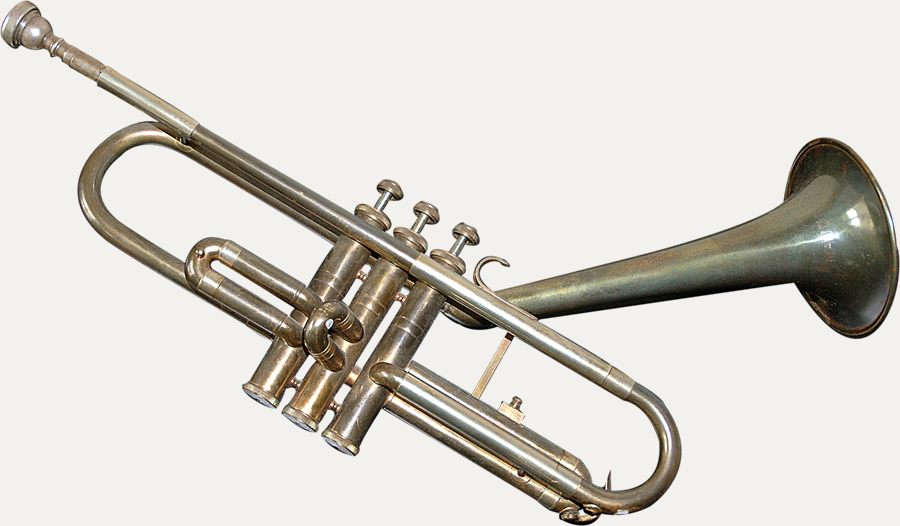
The short answer: Student trumpets are sturdy, affordable and forgiving. Professional horns use thinner, hand-finished parts, tighter valves and offer more tonal range, but cost several times as much. On the used market, professional models usually keep a larger share of their value. Still, how well a trumpet suits you depends less on the price tag than on how bore, bell, leadpipe and mouthpiece work together.
The three tiers at a glance
The boundaries between tiers are fuzzy and differ by maker. As a rule of thumb:
| Feature | Student | Intermediate (step-up) | Professional |
|---|---|---|---|
| Bell | usually yellow brass, often two-piece and welded | often gold brass, sometimes two-piece | usually one-piece, hand-hammered; yellow, gold or rose brass |
| Leadpipe | standard, sometimes reverse design | standard or reverse, often gold brass | offered in several sizes and materials: yellow brass, red brass or silver |
| Valves | nickel-plated or Monel, somewhat stiffer | Monel, good fit | Monel or stainless steel, very smooth and airtight |
| Construction | series production, thicker metal | more hand work, tuning-slide braces | mostly hand work, tight tolerances |
| Case | gig bag or basic case | hard case | sturdy case, often a choice of bore and finish |
| Typical player | beginners, returning players, kids | advancing students, school and community bands | serious players, college, orchestra, studio |
What a professional instrument does better
Build quality and durability
The biggest difference is not material alone but precision. On professional trumpets the solder joints are clean, threads hold firmly and the pistons move airtight and evenly. The valves do not feel mushy, and the third slide, often the first as well, can be adjusted on the fly to correct intonation. Student trumpets favor thicker, more tolerant metal, simpler construction and forgiving intonation. They are sturdier against knocks and school life, but that does not mean they last longer in total: a professional horn can serve for decades if it is cared for.
Response, sound and feel
Professional models usually have a slightly more open leadpipe and bell and blow more freely. Student models often offer a bit more resistance, which can give beginners something to lean on. Thinner bells respond quickly and sound shimmery, thicker bells keep the tone focused at forte and outdoors. How large the audible difference really is remains debated. Most sources online agree that a good player sounds convincing on a well-adjusted student horn, but that a professional instrument leaves more headroom for dynamics, articulation and tonal color.
Bore size: ML, L and what it does
Bore is the inside diameter of the tubing, measured at the middle valve. It is the figure quoted most often in listings.
- M (medium): a narrower bore. The tone locks in with little air but is less flexible. Popular for lead playing and fast passages.
- ML (medium-large): the common standard, around .459 in (about 11.65 to 11.68 mm). Most student and step-up models use it, and so do many professional trumpets.
- L (large): wider, mostly on professional horns, around .462 in (about 11.7 mm) on common models. Some sources quote slightly higher values. It takes more air before the tone saturates and often sounds softer and fuller.
For beginners ML makes the most sense, since it does not yet demand the breath support of a large bore. A larger bore rewards strong airflow but tires amateurs faster in long rehearsals or gigs. Players report intonation trouble after a couple of hours on a large-bore horn while a medium-large one stayed stable. Bore never acts alone: a narrower bore with a big bell can feel like an ML, and within the same model line the tonal gap between ML and L is often smaller than expected. Always test the whole instrument with your own mouthpiece.
The bell: size and material
Size
Bell diameter on common student and step-up models is around 4.8 in (123 mm); professional models are a bit smaller or larger depending on the variant. For example, a popular professional model uses a 4 7/8 in bell. A larger bell tends toward a darker, broader tone, a smaller one toward a more focused sound. As with bore, the overall design counts.
Yellow brass, gold brass, rose brass and bronze
Yellow brass contains roughly 60 to 70 percent copper, gold brass about 80 to 90 percent (figures vary by source). More copper means a slightly warmer, darker, more controlled tone and better resistance against aggressive saliva. A test with interchangeable bells found a clearer start and cleaner decay of notes with gold brass, and a broader spectrum with more sparkle from yellow brass. The gold brass bell weighed about ten percent more (278 versus 250 grams).
The common cliché "gold brass for classical, yellow brass for jazz" is too crude: personal taste, mouthpiece and the individual horn matter more. Rose brass and bronze bells appear mostly on higher-end models and often sound darker still. Nickel silver is very hard and more common on slides and fittings.
Leadpipe
The leadpipe connects the mouthpiece to the valve block and strongly shapes response, resistance and intonation. On student trumpets it is usually fixed. Some models use a reverse design, in which the tube is routed differently and offers somewhat less resistance. Professional trumpets often come with several leadpipe sizes and materials (yellow brass, red brass, silver). Red brass is considered more corrosion-resistant. Swapping a leadpipe or bell belongs in a repair shop: it involves solder joints and fits, and intonation changes noticeably. Cost varies by shop, so get a quote.
The mouthpiece: the last link in the chain
The mouthpiece often shapes sound and response more than any detail of the horn. The Bach naming system is a widely used reference:
- Number: inner rim diameter. The lower the number, the larger the rim. A 7C is medium-small, a 3C medium-large and a 1½C large.
- Letter: cup depth from A (very deep) to F (shallow). C is the standard.
Deep cups sound warmer and darker (orchestral), shallow cups brighter and more focused (lead, commercial). Wider and deeper generally means darker. The backbore adds to resistance and upper-register response. A 7C or 5C is a typical start; advancing players often move to a 3C or 1½C. Change only one variable at a time, otherwise you cannot tell what made the difference.
Hygiene
A clean mouthpiece is a matter of both hygiene and sound. Rinse it about every two weeks with lukewarm water and a mouthpiece brush, working from the back. An occasional soak with a little dish soap helps. Avoid hot water, which can damage the lacquer on the instrument. Mouthpiece disinfectant sprays are also sold. If you buy a used mouthpiece, clean it thoroughly before playing.
Pitch: B-flat or C
The B-flat trumpet sounds a major second lower than written and is the standard for school, bands and jazz. The C trumpet sounds as written, is a little shorter and tends to sound brighter. It is more common in orchestral playing, especially in the US. For beginners B-flat is the clear recommendation: bigger selection, cheaper models and what most teachers expect. Many players find the tonal difference depends more on mouthpiece and player than on the instrument. If you add a C trumpet, practice on it well before performances, since the feel and resistance differ and intonation next to several B-flat trumpets can be tricky. For the sister instruments see trumpet, cornet and flugelhorn compared.
Prices in the US
New prices from typical retailers:
- Student, e.g. Yamaha YTR-2330: about $500 (as of Oct. 2026); budget student horns start around $150, better ones run $500 to $1,500
- Step-up, e.g. Yamaha YTR-4335GII: about $735 (as of Oct. 2026); step-up horns in general run about $1,000 to $2,000
- Professional, e.g. Yamaha YTR-6335: roughly $1,500 to $2,750 (as of Oct. 2026)
- Professional, e.g. Yamaha YTR-8335: roughly $2,600 to $3,000 (as of Oct. 2026)
- Professional, e.g. Bach Stradivarius 18037 (ML bore, .459 in): roughly $3,100 to $3,800 (as of Oct. 2026)
Used prices vary widely. Used student trumpets typically sell for about $100 to $500, with a used YTR-2330 often at $200 to $500. A used Bach Stradivarius Model 37 commonly sells for about $1,200 to $1,700, around $2,300 in mint condition, versus roughly $3,000 new. Used Yamaha Xeno models range from about $1,200 to $2,800, serviced examples around $2,200 to $2,500 (as of Oct. 2026). Used intermediate and professional horns often go for 50 to 70 percent of the original retail price. Silver plate usually adds $100 to $200 over a lacquered version. Demand peaks around September and in the summer marching season; February and March, when new players quit, are a good time to buy. Details on checking a used horn are in buying a used trumpet.
Value retention on the used market
Professional models of established lines usually hold a larger share of their value, because demand from serious players stays steady. Student models exist in huge numbers and lose value faster, though the absolute amount stays small since the entry price is low. Condition, lacquer or plating (see silver-plated vs. lacquered), a complete case and mouthpiece, and valve compression all affect price. A professional horn is therefore often a good choice if you plan to keep it long or want to resell it with little loss. If you only want to test the waters for a year or two, a cheap used student horn is usually the better route.
When is the upgrade worth it?
An upgrade generally makes sense when your instrument is holding you back: when dynamics, articulation or intonation hit limits that technique alone cannot solve, or when you regularly play in groups that demand more tonal reserve. A professional horn will not automatically make you better; if you are still working on embouchure and breathing, you will hear less of the difference. A sensible middle step is an intermediate model with a gold brass bell and a hard case. Used, it is often the best value between student and professional tiers. Whatever you consider, the final decision comes from playing several instruments.
Choosing by level and style
- Beginners, kids: B-flat trumpet, ML bore, student tier, as light as possible. Used from a known brand rather than new from an unknown one.
- Advancing players, bands, school: intermediate with gold brass, ML bore, a mouthpiece around 5C or 3C.
- Classical and orchestral: ML or L, one-piece bell, a darker character; a C trumpet as a second horn.
- Jazz, lead, commercial: ML or narrower bore, shallower cup, brighter orientation.
- All-round: an ML professional trumpet with a standard leadpipe is the usual compromise.
Myths and common mistakes
- "A pro trumpet makes you sound better": It widens what is possible but does not replace technique.
- "Bigger bore is better": It demands more air and stamina and does not suit every mouthpiece.
- "Expensive means it fits": Two horns of the same model can feel different.
- "Gold brass is only for classical": A cliché that undersells the range of sound.
- Mistake: buying from the spec sheet alone. Play several instruments, ideally over several days and with an experienced player beside you.