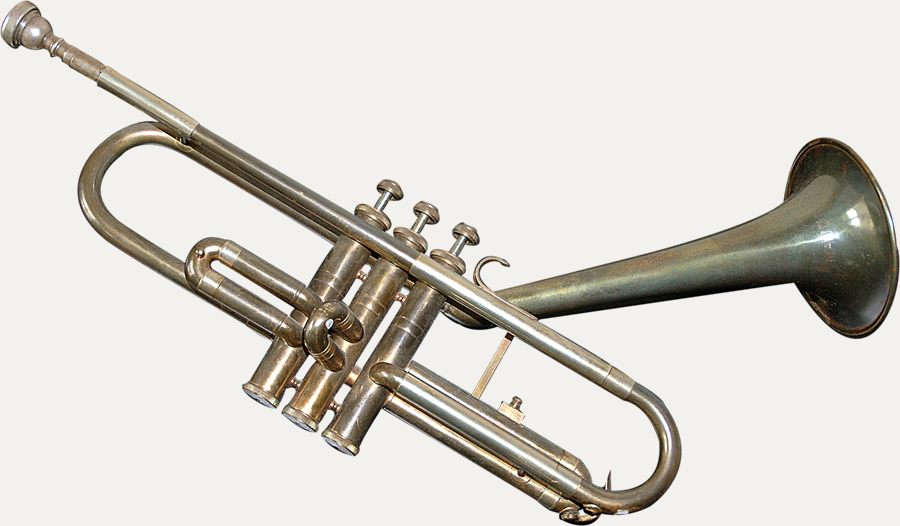
Trumpet, cornet and flugelhorn are usually pitched in Bb, have three valves and share the same fingerings. What separates them is the bore: the trumpet is mostly cylindrical and sounds bright and projecting, the cornet is more conical and sounds mellower, and the flugelhorn is the most conical and sounds darkest. Most beginners start on trumpet, or on cornet (especially children and anyone heading for a brass band); flugelhorn is normally added later as a second instrument. Mutes are a separate topic: a straight mute comes first, and a real practice mute if you need to keep the neighbors happy.
The three instruments at a glance
All three are brass instruments with a cup mouthpiece, valves and roughly the same tubing length. A Bb trumpet has about 1.3 to 1.5 m (4 to 5 ft) of tubing depending on how it is counted, and sounds a major second below written pitch. Cornet and flugelhorn in Bb share that basic pitch and the same fingerings; the tubing is simply wrapped and flared differently.
| Feature | Trumpet | Cornet | Flugelhorn |
|---|---|---|---|
| Bore | mostly cylindrical (roughly two thirds), then the bell flare | about half cylindrical, half conical | mostly conical (roughly one third cylindrical) |
| Shape | long, stretched out, weight toward the front | compact, more tightly wound, weight closer to the player | compact, much wider bell (about 130 to 170 mm) |
| Tone | bright, brilliant, projecting | soft, velvety, rounded | dark, warm, mellow |
| Mouthpiece | shallower cup, longer shank | deeper cup, shorter and narrower shank | deep, funnel-shaped cup |
| Typical use | orchestra, big band, concert band, jazz, pop | brass band, concert band, first instrument | jazz ballads, brass band, concert band, soft-toned arrangements |
The bore percentages are rule-of-thumb values; every maker uses its own taper, and sources quote slightly different proportions.
Bore and tone
In the cylindrical part of the tubing the diameter stays constant, which favors strong high overtones and a bright, direct sound. In conical sections the tube widens gradually, so the upper overtones weaken and the sound rounds off. The longer the conical share, the softer the tone. That is why the three always line up the same way in brightness and carrying power: trumpet first, cornet in the middle, flugelhorn softest.
Feel and response
High notes and loud playing come easier on trumpet. The cornet is generally regarded as a little more agile in fast passages and is easier to hold because of its compact shape, which helps small hands. The flugelhorn responds comfortably but takes more air, and the upper register is harder to play cleanly and in tune because the wide bore gives less definition.
Trumpet: the standard for orchestra, big band and jazz
The Bb trumpet is the default instrument for school bands, concert bands, big bands and pop. Orchestral writing also calls for the C trumpet, and for Baroque pieces and works by composers such as Stravinsky, Ravel or Britten for D and Eb trumpets as well. Most trumpets use piston (Perinet) valves; rotary-valve trumpets are found mainly in continental European orchestral and band settings.
As a starter instrument the trumpet offers the biggest used market, the most method books and the shortest route into school ensembles and big bands. For what to check on a used horn, see buying a used trumpet; for the difference between lacquer and silver plate, see silver vs. lacquer.
Cornet: the softer, more compact sibling
The cornet appeared in the 1820s, developed from the post horn by adding valves. Because it could play chromatically while the natural trumpet was still limited to the harmonic series, nineteenth-century composers sometimes wrote separate parts for trumpets and cornets. In British-style brass bands it was never replaced by the trumpet; it is the lead voice there, topped by a high Eb cornet. It also appears in many concert bands.
Two shapes
The traditional shepherd's-crook cornet is short and squat. The "American wrap" is longer and looks much like a trumpet. The mouthpiece has a shorter, narrower shank than a trumpet piece, so the two do not swap without an adapter.
Who it suits
Young players often find the cornet easier to hold because there is less weight out front. If you are heading for a brass band or a band with cornet parts, it is the obvious choice. If you later move to big band or orchestra, switching to trumpet is easy because the fingerings are identical.
Flugelhorn: warmth for ballads and band music
The flugelhorn descends from hunting and military signal horns; the first valved versions date to roughly 1828 to 1832. Its sound sits between trumpet and horn. In jazz it became famous through players such as Miles Davis, Clark Terry and Shorty Rogers, and it is a fixture in brass bands.
It comes in two designs: the jazz flugelhorn with piston valves and the concert flugelhorn with rotary valves, common in traditional continental European band music. Most are in Bb, some in C. The deep mouthpiece cup makes the tone warm but demands clean air. Many players recommend a dedicated flugelhorn mouthpiece because cup and backbore are shaped differently; some band players use a trumpet piece when they want a brighter sound. Check the shank type (for example American or French) when buying.
Piccolo and Eb trumpet in brief
The piccolo trumpet sounds an octave above the Bb trumpet and has about half the tubing length. Most have four valves (the fourth lowers the pitch by a fourth, helping low notes and intonation) and can be switched between Bb and A with different leadpipes. It is played in Baroque works such as Bach's Brandenburg Concerto No. 2 and in occasional pop solos. It needs a shallower mouthpiece and a secure embouchure, so it is not a beginner instrument. The Eb (and D) trumpet is a smaller orchestral trumpet for high parts and is also a second instrument.
Mouthpieces and switching between instruments
Mouthpieces are named by a combination of number and letter, but makers label differently, so comparisons are approximate. Players who double on several instruments generally do best with mouthpieces of similar rim width and rim shape. Experiences vary: some players handle trumpet and flugelhorn side by side without trouble, others need longer to re-settle after a switch. Warm up a few minutes after each change and put most of your practice on your main instrument first.
Because the fingerings are the same, switching mainly means relearning embouchure and air: the cornet feels more compact, the flugelhorn swallows more air, and the trumpet asks for slightly more precision.
Prices for beginner and intermediate models
All figures are rough guides for the US market (as of Oct. 2026); retailer prices vary widely:
- Trumpet and cornet: Student Bb models from major brands commonly list somewhere between about $700 and $1,900, depending on brand and seller. A student Yamaha YCR-2330III cornet is around $735 at some online retailers. Intermediate trumpets such as the Jupiter JTR1100S sit around $1,750.
- Flugelhorn: Student models such as the Eastman EFG412 are around $1,200; professional flugelhorns such as the Yamaha YFH-631G are around $2,700.
- Piccolo trumpet: varies by shop, get a quote.
Used buying is covered in student vs. professional trumpets on the used market.
What should you buy first?
For most people the Bb trumpet is the safe choice: widest selection, most playing opportunities, easiest resale. The cornet is better if you are learning for a brass band or a children's program where a lighter instrument helps. Buy a flugelhorn once you have a stable embouchure on trumpet or cornet. When in doubt, ask your teacher or ensemble what part they need.
Trumpet mutes: types and effect
Mutes change tone and volume by controlling how sound leaves the bell. There are tone mutes for performance and practice mutes for quiet playing.
Straight mute
Cone-shaped and held in the bell by cork strips. It filters out low content and sounds bright, cutting and slightly nasal. Aluminum sounds brighter and more brilliant, copper warmer and rounder, fiber or plastic softer. It is the mute most often called for in band and orchestral parts and usually the first one a student needs. Prices run about $20 to $80 (as of Oct. 2026); sub-$20 models are best avoided.
Cup mute
Similar in build but with a cup that partly covers the mute's end. The sound is darker, more muffled and rounder, with the upper overtones pulled back. Very common in big band and jazz writing. Prices run about $22 to $70 and up (as of Oct. 2026). Some models have an adjustable or removable cup.
Harmon mute and wah-wah
A two-piece metal mute with a bulb-shaped body and a removable stem, sealed all around by cork against the bell. With the stem in it sounds buzzy, nasal and piercing; with the stem out or partly pulled it sounds more distant and vocal. Cupping a hand over the opening gives the classic wah-wah effect. Miles Davis popularized the stem-out sound from 1946. It is a jazz mute, not a standard requirement of band repertoire. Prices run about $35 to $60 (as of Oct. 2026).
Bucket mute
Hangs on the outside of the bell with absorbent material inside. The sound is very soft and padded, almost horn-like. Used in big band section writing.
Plunger
A rubber plunger held in front of the bell and moved to open and close it, producing speaking, vocal effects. In scores "+" means closed and "o" open. A clean household plunger (about $8) is enough to start; specialist versions for musicians exist.
Practice mute
A practice mute cuts volume dramatically, by roughly 20 to 30 dB according to several sources, so you can practice in an apartment or hotel without disturbing neighbors. It is unsuitable for performance because it changes the sound. Some are acoustic chambers, others electronic systems with headphone output. Prices vary by model and shop.
Important: ordinary tone mutes such as straight, cup and Harmon reduce volume only a little. If neighbors are a concern, you need a real practice mute, and you should practice at agreed hours.
Mutes and intonation
Every mute changes the air resistance and therefore the tuning a little. Good models are built to push as little as possible; cheap ones can throw individual notes clearly out of tune. Practice mutes often raise pitch by about 10 to 30 cents. In practice, tune with the mute in, pull the main tuning slide out somewhat, and check against a tuner. There is no fixed number because the shift depends on model, fit and register.
Mute care and hygiene
- Wipe the mute inside and out with a soft, dry cloth after playing; moisture on the corks affects fit and pitch.
- Store mutes dry and protected from pressure, for example in a mute bag or case; dents in the metal body change the sound.
- Worn cork strips no longer seal and may slip. Cork can be replaced at home; if you are unsure, ask a repair shop.
- Clean metal mutes only on the outside with a slightly damp cloth, dry thoroughly and avoid harsh cleaners.
- Do not share mutes casually: if a mute touches hands or lips while playing, wipe it before passing it on. Care for the trumpet and mouthpiece as usual: rinse, oil the valves, grease the slides.
Common mistakes
- Buying several instruments too early: Switch only once one instrument feels stable.
- Using a trumpet mouthpiece on a flugelhorn without a plan: It sounds brighter, loses warmth and can worsen intonation.
- Practicing only with a practice mute: It can encourage pressure and altered embouchure tension. Alternate between muted and open playing, roughly 70 to 30.
- Seating the mute badly: If it sits crooked or loose it sounds harsh, rattles or adds intonation problems.
- Expecting a budget mute to sound like a professional one: Very cheap models often distort individual notes.
- Using a straight mute as a practice mute: It barely lowers the volume.
Myths
- "A flugelhorn is just a big trumpet." No: bore, mouthpiece and response differ, and it takes more air.
- "A cornet is easier to play." It is easier to hold, but not inherently easier to play.
- "Mutes make you quiet." Tone mutes mostly change color; only practice mutes make a big difference in volume.
- "A Harmon always sounds like Miles Davis." The sound depends on stem position, hand movement and playing style.
- "Practicing with a mute ruins your tone." With open airflow and regular unmuted breaks, most players find it unproblematic.
Buying checklist
- Which part does your band or orchestra need?
- Does the mouthpiece fit the instrument (shank and cup depth)?
- Mutes: straight first, then a practice mute if neighbors can hear you; cup and Harmon only when your music calls for them.
- Check valves, slides and sealing when test-playing; repairs to mechanics and tubing belong in a shop.