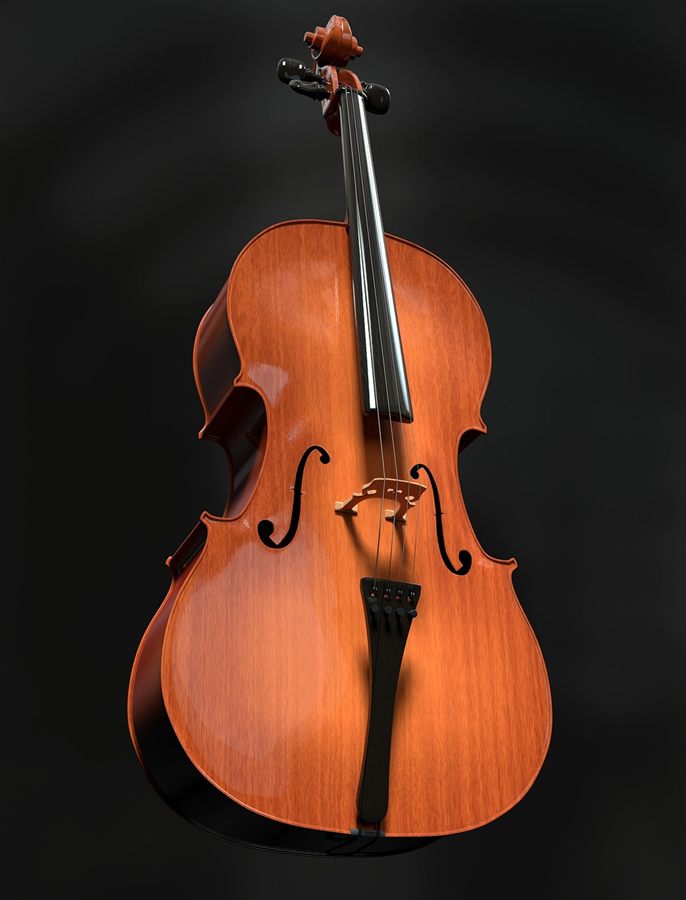
A cello is happiest at a relative humidity of roughly 40 to 55 percent, and the danger zone is mostly the heating season, when indoor air can fall to 30 percent or less. The wood then shrinks, glue seams open, and in the worst case the top cracks. A digital hygrometer, a room humidifier, the closed case and some discipline when traveling prevent most of this.
Why wood reacts to humidity
A cello is built from thin, glued wooden plates. Wood absorbs moisture from the air and releases it again, swelling or shrinking as it does, mostly across the grain. The top and back are only a few millimeters thick and glued to ribs that do not move to the same degree. When the plates shrink, tension builds at the joints: either the seam gives way and opens, or the wood splits, usually along the grain near the soundpost or bridge.
An open seam is therefore usually a warning sign rather than a disaster, while a crack in the wood is the more serious stage. In summer the risk of cracks is lower, but glue seams can weaken gradually.
One point matters more than most owners expect: it is not only the absolute number but the speed of change. Experience shows that many injuries to instruments come not from constantly dry or damp air but from abrupt swings, for example when a cello goes from a cold car into a heated room. A large share of all cracks in violin-family instruments is considered weather-related, and the change between seasons is especially hard on them.
Which humidity level is right
Recommendations differ by source. Commonly quoted targets are 35 to 50 percent, 40 to 60 percent, 45 to 55 percent, and some care sheets go as high as 50 to 70 percent. The warning thresholds are more consistent: below 35 percent you should act, below 30 percent the risk is serious, and workshops report that readings under 30 percent can cause cracks within days.
| Relative humidity | Assessment (rule of thumb) |
|---|---|
| well above 60% | too damp: mildew on the case and lining, swelling wood, loosening joints |
| 40 to 55% | target zone where most recommendations overlap |
| 35 to 40% | borderline: humidify, check placement, watch the instrument |
| below 35% | alarm zone: act quickly, check seams after playing |
| below 30% | critical: high crack risk, especially if it drops quickly |
The goal is less a perfect number than a steady range without big jumps. Room temperature plays a part as well: turning the heat down from about 73 to 64 degrees Fahrenheit raised relative humidity noticeably in one practical example (from 40 to about 54 percent) without adding any water. That does not replace humidifying, but it is an easy lever.
Hygrometers: measure, do not guess
Without a measurement, humidity is a guess. A digital hygrometer with a thermometer costs about 15 USD (as of Oct. 2026) and is cheaper than the smallest repair.
- Measure in the room: Put it where the cello lives and is played, not next to the heater or on a window sill. During heating season, a daily glance is enough.
- Avoid dial gauges: Analog devices are often inaccurate and tend to stick at around 50 percent.
- Read case hygrometers with caution: Small units inside a closed case often show delayed or skewed readings because air barely circulates. They work as a trend indicator but do not replace a room unit.
- Check accuracy: Put two units side by side. If they differ by more than a few percent, at least one is unreliable.
Winter and heating air
Cold outdoor air holds very little water. When it is warmed to room temperature, relative humidity drops sharply even though the absolute amount of water stays the same. Many heated homes end up at 20 to 30 percent, and with radiant floor heating sometimes less.
Placement in the room
- Keep the cello away from radiators, fireplaces, vents and direct sunlight.
- Radiant floor heating is especially risky: a cello or case sitting directly on a warm floor dries out from below. Drying cracks in the top or back are a typical result. A stand that keeps it off the floor helps but does not replace humidifying.
- Avoid exterior walls and windows, where temperature swings the most.
Airing out
In winter the rules pull against each other: fresh air prevents mildew but dries heated indoor air even further. Brief, full airing is better than windows left tilted open for hours.
Humidifying
A room humidifier is the most effective measure because it stabilizes the whole room and also protects the cello when it is outside its case. Room units cost roughly 30 to 150 USD new (as of Oct. 2026, rule of thumb). Simple extras are bowls of water near heat sources, damp towels, or laundry drying in the room. If readings fall below about 20 percent, a room humidifier is clearly needed.
Case and instrument humidifiers add to that:
- Sponge in a rubber tube (product example: Dampit): slipped through the f-hole into the instrument, it releases moisture over one to two days. Opinions are mixed, and for a cello that is played daily its effect is sometimes judged small.
- Case humidifiers (gel, packs, regulated humidity pouches): slow the swings inside a closed case. As soon as the cello leaves the case, the effect ends.
- Green plastic snakes with a sponge: widely criticized because water can collect and drip. Moisture in the wrong place softens glue and encourages rot.
Use any system exactly as directed and check it regularly. Leaking cartridges and over-humidified cases cause damage of their own.
Summer, heat and too much moisture
In summer, heat softens glue, and stretched metal strings let the pitch sink. Cold tightens strings and raises the chance that they snap.
- Avoid direct sun on the cello and case, as well as window spots and attics.
- Air conditioning or a dehumidifier helps in hot, damp regions. When humidity is high, check the case lining for mildew.
- Too much humidifying harms more than too little, according to experience. Stay inside the target zone and avoid sitting above 55 to 60 percent for long.
- In summer, check the seams and the neck-to-fingerboard joint after playing, because weakening glue shows up gradually.
Transport and the car
The car is where cellos most often meet abrupt climate changes. A closed vehicle heats up massively in summer and chills in winter. Everyone agrees on the rule: a cello does not belong in a parked car.
- In the vehicle: Lay the case on its back across the rear seat and buckle it in. Do not stand it upright on a seat, where it can tip, and do not lay it flat in the trunk, where luggage gets piled on top. Rolled towels stop it from sliding.
- After the cold: Leave the closed case in the room for about 30 minutes, then lift the lid and wait a while longer before taking the cello out. This lets temperature and humidity equalize slowly. Plan to arrive early so you do not have to play right away.
- Flying: A separate seat for the cello is the safe option. Take photos of its condition beforehand and check the airline's rules.
- Before long trips: Some players slacken the strings slightly, about a half step. It is not required and not universal. Never slacken them completely, so the soundpost does not fall, and ask the shop if you are unsure.
- Spare strings: Bring them when traveling, especially in cold weather, because strings need frequent retuning.
Choosing a case
The case is the cello's climate buffer. Modern cases are well insulated and slow down changes in temperature and humidity markedly.
- Hard case: Rigid outer shell, dense padding, solid latches. The better choice for transport and storage. Lighter carbon or composite models save weight but cost more.
- Soft case (gig bag): Light and handy for short trips but offers little protection against pressure, knocks and climate. Take the bow out first when packing.
- When packing: Never lay the cello bridge-down in the case, and secure it so nothing shifts. Bumps can damage the varnish, open seams or break the bridge.
- Features: A spot for a hygrometer and humidifier, good insulation and a tight lid are worthwhile. The case must fit the cello size, see cello sizes for children and adults.
Spotting cracks and open seams
Check your cello regularly, ideally after playing. The earlier damage is found, the simpler the repair.
Typical symptoms
- Buzzing: A rattle on certain notes often points to an open seam. Loose parts such as the tailpiece, bridge or fine tuners can buzz too, so narrow down the cause.
- Open seam: A thin gap appears between the rib and the top or back. A fingernail test shows whether the edge noticeably lifts.
- Rattling purfling: The inlaid edge strips can come loose as well.
- Crack along the grain: Mostly in the top, often near the soundpost, beside the bridge or around the f-holes. It shows as a fine line, sometimes only in raking light.
- Neck changes: Unusually high string height, jamming pegs or a shifting fingerboard joint are a job for the shop.
What you can do right away
- Move the cello to a cooler, steadier spot and keep humidifying.
- With open seams, slacken the strings a little to take tension off the body.
- Do not fill the gap with household glue. Foreign glue can make the later professional repair harder.
- Book a visit to a violin shop soon, even if the cello is still playable.
A clean seam or a fresh crack is routine for a shop. If a crack keeps opening from repeated movement or gets dirty, the repair becomes more involved.
Repair and rough costs
Regluing seams and gluing cracks is work for a professional shop. It takes experience, the right glue and sometimes special tools, so there is no do-it-yourself guide here, only the overview. A buzz caused by an open seam only goes away with the repair.
| Work | Rough guide |
|---|---|
| Reglue an open seam | from about 36 USD per opening (as of Oct. 2026) |
| Glue a crack in the top | from about 84 USD without removing the top (as of Oct. 2026); varies by shop and crack, get a quote |
| New soundpost | about 68 USD (as of Oct. 2026) |
| Student-grade bridge | about 150 USD (as of Oct. 2026) |
A small, clean crack costs less than a long one that reaches the soundpost or a structurally loaded zone. Cello repairs often cost more than the same work on a violin because the surfaces are larger and the tensions higher, and the starting prices above rise quickly with the work involved. Ask for a written estimate and check whether insurance applies.
Storage and care
- After playing: Wipe with a clean natural-fiber cloth, especially under the fingerboard and tailpiece and between the strings.
- Rosin: Remove dust and residue right away, since rosin can dull the shine of the varnish for good. Special fingerboard cleaners help there.
- Polish: Use only a thin polish made for string instruments, sparingly, at most once or twice a year. No furniture polish (wax clogs the pores), no harsh cleaners and no rubbing alcohol on the varnish.
- Strings: Clean with a cloth lightly moistened with alcohol, keeping it off the varnish. More on strings in cello strings compared.
- Hands: Wash before playing. Sweat leaves lasting marks on varnish.
- Bow: Loosen it after every session. More in wood or carbon cello bows.
- Storage: Upright on a stand or in the closed case, away from exterior walls, radiators and windows. For long breaks, the case in a climate-stable place is best. A comfortable room temperature of roughly 60 to 70 degrees Fahrenheit is a common recommendation.
- Shop check-up: Once or twice a year depending on use, at least every year or two. Good timing is before and after heating season. For checking the bridge, soundpost and endpin see checking endpin, bridge and soundpost.
Common mistakes and myths
- "The cello is in its case, nothing can happen." The case slows changes but does not keep room climate out for good. Without humidifying, the case dries out too.
- "A case humidifier is enough." As soon as the cello sits outside or is played, only the room climate counts.
- "More humidity is always better." Too much leads to mildew, swollen wood and loosening joints.
- "The crack is small, it can wait." Cracks and seams keep opening under renewed dryness. An early repair is cheaper.
- "A cheap hygrometer in the case is enough." It usually shows trends, not reliable values.
- "Airing the room well helps." In winter, long airing dries heated air out further.
- "The car is only for a short while." A few hours of heat or cold in a closed vehicle can already stress the seams and bridge.
If you are buying a used cello, look for signs of earlier cracks and seam repairs, see buying a used cello.