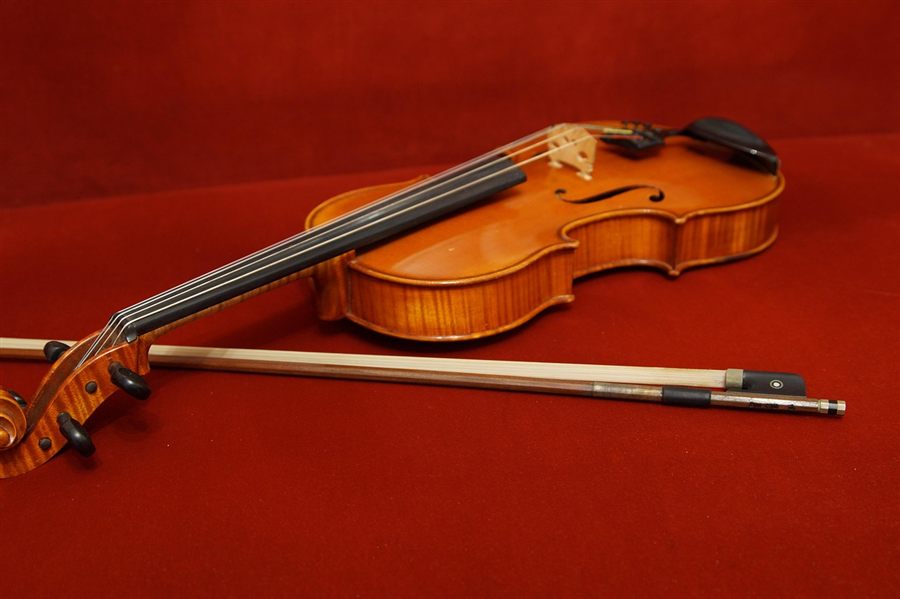
A viola needs its own strings, its own setup and its own bow: what works on a violin does not simply carry over. What matters is the right string length (scale), the thicker strings, and a bow that weighs about 70 to 74 g, clearly heavier than a violin bow at about 58 to 61 g. Get these right when buying and maintaining, and even a modest viola often sounds noticeably fuller.
How a viola differs from a violin
The viola is tuned C, G, D, A, exactly a fifth below the violin. Three string names are shared (G, D, A) but sound lower, and the strings must be much thicker to vibrate cleanly at that length. The vibrating string length, from bridge to nut, ranges from roughly 13.5 to 15.5 inches (about 34 to 40 cm) depending on the instrument. Between quarter-size and full-size violins the difference is only about 1.5 inches, while violas vary far more and are not standardized.
The practical consequences:
- Finger spacing is wider and the hand has to stretch more.
- The thicker strings need more arm weight and a little more pressure; the stroke often starts slightly earlier and with firmer contact.
- The body is larger (typically 15 to 17 inches), the viola is somewhat heavier, and so is the bow.
- Music is written in alto clef.
More on the differences for switchers can be found in switching from violin to viola.
Understanding viola strings
The three core materials
- Gut: warm, complex tone, slower response, unstable pitch and a high price. Usually not recommended for beginners.
- Synthetic (nylon-type core): sounds quite similar to gut but holds pitch much better. Today's standard for students and classical players.
- Steel: very stable, bright and direct, fast response. Popular in non-classical styles and on student instruments because they are durable.
As rough guidance: beginners do well with responsive steel strings or basic synthetics, ensemble players with a balanced mid-priced synthetic set, and soloists with premium synthetic or gut. You can mix strings from different sets, for example to upgrade only the A, as long as tensions match.
The C and G strings: the viola sound
The violin has no C string. It is wound over a thick core. Its tone is strong to rough, especially in loud passages, while the A string tends to sound sharp and slightly oboe-like. A dull, weakly speaking C string on an older viola is often simply worn out and fixed by a new set. The C and G shape the dark character of the viola, so skimping on them is a false economy.
Steel strings differ in their winding: some sound clear and direct, others warmer, and silver windings are generally brighter. It is a matter of taste, best judged by comparing on your own instrument.
Gauge, tension and scale
Viola sets come in light, medium and heavy tension, and some in short, medium and long scale. Because violas are not standardized, the right choice depends on your instrument's string length: the same string is under more tension on a long scale than a short one, so a "light" set can feel like a "medium" on a large viola. Too much tension feels stiff, sounds pinched and makes fingering tiring. Too little sounds weak and buzzes more easily. Above about 15 inches of string length (38 cm), the risk of a harsh tone and high string load also rises. If unsure, give a shop your string length and size and ask for a suitable set.
Violin strings are not a good solution on a viola. The reverse works: a viola A on a violin gives a warmer sound. On a very small viola, a violin C can work as a supplement. These are special cases to settle with a luthier.
String prices
Typical US retail prices per viola set (Oct. 2026):
| Class | Typical | Price per set |
|---|---|---|
| Student, steel | responsive steel sets | about 80 USD |
| Premium synthetic | widely used orchestra and soloist sets | about 180 to 210 USD |
Prices vary widely by gauge, scale and core type, and some basic sets are cheaper (about 20 USD and up for budget options, Oct. 2026). Compare a few shops.
Changing strings step by step
- Every 6 to 12 months, sooner with heavy playing. Typical signs: the tone turns dull and flat, notes respond poorly, the string sounds false or the winding frays.
- Change one string at a time and keep the others at pitch. That way the bridge does not slip and the soundpost stays put.
- Graphite from a soft pencil in the grooves of nut and bridge helps the string slide.
- New strings stretch: retune several times over the first days, in small steps.
- Check the bridge: it tends to lean toward the fingerboard as you tighten. It should stand upright. If it is clearly crooked, take it to a shop rather than experimenting.
Setup: bridge, soundpost and string height
What bridge and soundpost do
The bridge carries the strings, sets their height above the fingerboard and transmits vibration to the top. The soundpost is a small spruce dowel inside that connects top and back, supports the top and shapes the tone. Both are cut and placed for the individual viola, since body size, arching and string length differ on every instrument. A setup based on violin logic will not balance a viola properly.
Cutting, fitting and moving bridge and soundpost are shop work: a small error can worsen the sound or damage the top. You can observe and check yourself:
- Does the bridge stand straight and upright, or lean forward?
- Do both feet sit fully on the top without a gap?
- If the viola suddenly sounds dull or lifeless, or you hear a rattle inside, a fallen or shifted soundpost may be the cause. That is a job for a luthier.
Rough costs in the US (Oct. 2026): a new bridge is typically around 140 to 200 USD depending on the quality grade. For soundpost work: varies by shop, get a quote. Ask for a full setup (bridge, soundpost, string height, fine tuning) as a package.
String height and fingerboard
String height is the distance from strings to fingerboard. As a rule of thumb, at the end of the fingerboard it is about 3 to 4.5 mm with steel strings and 4 to 6 mm with gut, larger toward the low C. Too high: playing tires you and intonation suffers. Too low: strings buzz, especially the widely swinging C. The height is set by the bridge and the nut grooves and adjusted by a shop. You can measure and judge it yourself with a small ruler.
Chinrest and shoulder rest
The viola is thicker and heavier, so chinrest and shoulder rest are often dimensioned differently than on a violin:
- Viola chinrests are usually a bit larger, with longer clamp barrels and thicker cork so they fit over the taller ribs.
- A shoulder rest is often set lower than on violin because the thicker body already creates distance. Some players use none.
- A chinrest centered over the tailpiece can help smaller players but makes the G string feel farther away. Side-mounted styles with a higher cup fill the gap between chin and instrument.
The height is right when the viola sits securely without a raised shoulder or a clenched head. Try several models, ideally with your own viola.
Wolf tone
A wolf tone is a fluttering, throbbing wobble on one particular note. It occurs when the played pitch sits very close to a strong natural resonance of the body. On the viola it is usually found on the G or C string. Options:
- Play the note in another position or on another string, if musically possible.
- A wolf eliminator: a metal tube with a rubber insert fitted on the string length below the bridge. It works only when tuned to the wolf note, and often sits on a different string than the one where the wolf is heard.
- An adjustment to the setup (soundpost position, bridge, strings) in a shop if the wolf is a problem.
A wolf tone is not a defect but a trait of the instrument, more pronounced on some violas than others.
The viola bow
Weight, hair and construction
A viola bow looks similar to a violin bow but is built differently:
- Weight: about 70 to 74 g versus about 58 to 61 g for a violin bow, roughly 10 to 15 g more.
- Hair: a wider ribbon, especially at the frog, for more contact on the thick strings.
- Stick and frog: a thicker stick, a larger and slightly more rounded frog; overall length is often a bit shorter.
- Sizes: a 4/4 bow goes with violas of about 15 to 16.5 inches, a 3/4 bow with about 13 to 14 inches.
The reason: the thick C and G strings need more weight and contact to speak without you forcing it with pressure. A violin bow on a viola often sounds thin, especially on the C, and feels unbalanced. Conversely, a viola bow on a violin feels sluggish. Experienced players sometimes use the other bow deliberately for special colors.
When buying used, check that a bow sold with the instrument is truly a viola bow; if in doubt, have it weighed. Wood (pernambuco, brazilwood) stands for traditional warmth, carbon is sturdier and less sensitive to weather. The choice depends on budget and use. More on buying: buying a used viola.
Rehairing and care
Bow hair wears and turns slick even while it still looks fine. As a rule of thumb, rehair every 6 to 12 months, more often with heavy playing. Signs you need it:
- The hair slips and no longer grips the string, even with rosin.
- Single hairs break, especially on one side, and the bow becomes unbalanced.
- You have to tighten the stick very hard for the bow to work.
- The hair looks dark, dirty or shiny.
A rehair at US shops typically costs about 60 to 95 USD (Oct. 2026), depending on the shop. Rehairing is shop work.
Everyday care:
- Loosen the hair after playing so the stick does not stay under load.
- Do not touch the hair with your fingers; skin oil makes it slick.
- Wipe rosin dust off stick, strings and top with a soft cloth.
- Store the bow dry; do not leave it in sun or in a car.
Rosin
For violin and viola, a harder, lighter rosin usually fits. Dark rosin is softer and stickier, suits cool, dry air and turns gummy in warmth. The amount matters: you do not need fresh rosin every time you play; a few strokes every four or five sessions is enough. If you have to rosin constantly, a rehair is more likely due than a different rosin. Because of the thick strings, some violists like a slightly grippier rosin; try two or three kinds.
When buying used: questions about strings, setup and bow
- When were the strings last changed, and are they meant for this string length?
- Was the setup done by someone who knows violas, not just violins? The difference shows in the low register.
- Does the bridge stand straight, are the feet tight, is the string height even?
- Is there a wolf tone, and can setup or an eliminator tame it?
- Is the bow a genuine viola bow, and what shape is the hair in?
In a trial, the C string is especially telling. A dull tone can often be fixed with fresh strings or a new setup, while a wolf tone belongs to the instrument. More checkpoints in buying a used viola: what to check.
Common myths
- "Viola strings are just thicker violin strings." Wrong: they are matched to the viola's scale, tension and tonal character.
- "A violin bow will do to start." It works technically but thins the tone and makes playing harder.
- "You only change strings when they break." They sound dull and false long before.
- "More rosin, more sound." Too much makes the tone scratchy and dirties strings and top.
- "A wolf tone means the viola is broken." No, it relates to the body's resonance and can often be reduced.