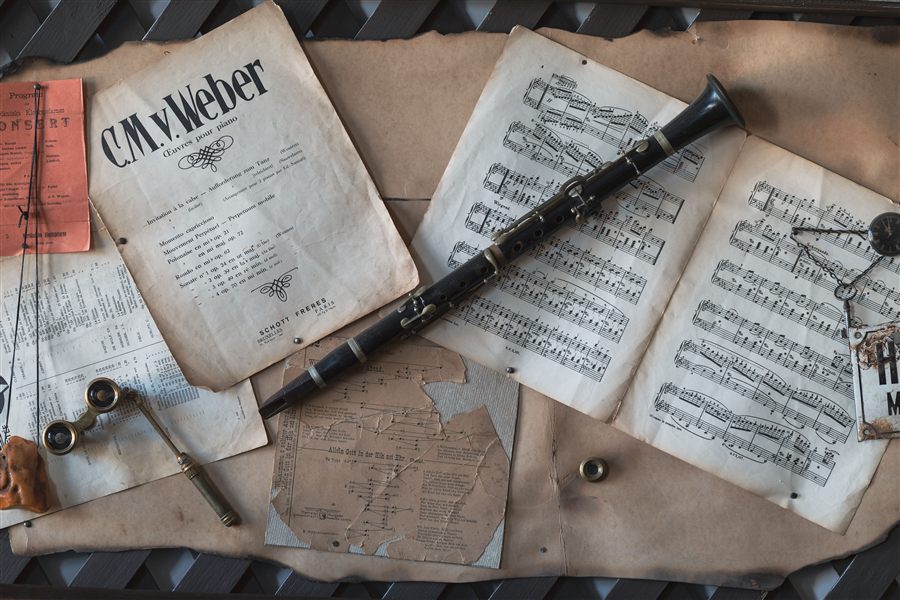
A bass clarinet fingers like a Bb clarinet but is a different kind of purchase: more keywork, more weight, a lot more money and a small used market. When you inspect one, the priorities are cracks, the alignment of the low keys, the condition of the neck and bell, and the endpin. If the horn has been sitting unused for years, budget for an overhaul.
How a bass clarinet differs from a Bb clarinet
The bass clarinet is a Bb instrument that sounds a major ninth (an octave plus a whole step) below the written note. The fingerings are essentially those of the soprano clarinet, which is why most players add it after a few years on Bb clarinet. Nearly all bass clarinets use the Boehm system; the older Oehler fingering variant is rare. See the comparison of fingering systems for background.
Construction
- Mouthpiece and reed: Both are larger than on a Bb clarinet and the reeds are not interchangeable.
- Neck instead of a barrel: A curved metal tube joins the mouthpiece to the upper joint. Many are two-piece to fine-tune pitch and playing angle. Older horns often have no tuning slide, so you must pull the whole neck out of the body to tune.
- Body: Usually two sections, in grenadilla or ABS resin.
- Bell: Metal and upturned. Wooden bells exist but are less common.
- Endpin: The bell has a slot for an adjustable peg that carries the weight on the floor while you sit. Standing, you need a neck strap or harness.
Size and weight
Expect roughly 1.2 to 1.4 m in length, about 2.5 to 4.5 kg depending on model and material, a bore around 24 to 26 mm, and somewhere between 20 and 25 keys. These are ballpark figures; models differ a lot.
Low Eb or low C
Shorter models stop at low Eb; longer ones extend to low C. Both turn up used.
- Low Eb: Lighter, easier to hold standing and cheaper. It covers school band, jazz and most ensemble needs, and it is the usual choice for students and intermediate players.
- Low C: Longer and heavier, with a larger, more flared bell and extra mechanism. It matters when orchestral or clarinet-choir parts actually go down to those notes. For serious orchestral work, a horn that stops at low Eb is a limitation.
Check which parts you will really play first. If it is jazz or small ensembles, low C often adds weight and cost you will not use.
What to check on a used bass clarinet
The general checks (looking down the bore, corks, leak testing, trying it with your own mouthpiece) are covered in buying a used clarinet. These points are specific to the bass.
Cracks
Shine a light down the bore and look closely at the tone holes, tenon sockets and around the key posts for hairline cracks. A crack running through a tone hole is a walk-away sign. Crack repair (pinning, banding or filling) is shop work; the cost depends on the length and position of the crack, so get a quote. A plastic body mostly avoids crack risk but can chip if dropped.
Keywork, pads and springs
The long rods and many low keys drift out of adjustment more easily than on a soprano. Technicians often report that the lowest keys are the first to stop sealing properly. Check these:
- Every key must cover its hole fully and not stick, especially the bell and lower-joint keys.
- Pads that are hard, discolored, swollen or shredded leak. A full set is costly because the pads are big.
- Springs should snap keys back promptly; sluggish keys suggest tired or gummy springs.
- Bent rods, dents or rattling keys add to the bill.
- Worn silver or nickel plating is cosmetic, but replating is expensive.
Regulating keys, repadding and replacing springs belong in a repair shop. What matters to you is spotting the need and building that cost into your offer.
Corks
Tenon corks should not be warped, bulging or chewed. Joints should fit snugly without wobbling and turn easily with cork grease. The metal neck usually carries no cork itself; apply grease only to cork, never to bare metal.
Neck and bell
Metal parts can be dented or bent, and a bent neck can hurt both the seal and the tuning. Do not try to bend it back yourself; straightening is shop work. Also check that the neck seats firmly yet turns and adjusts without force, and that any tuning slide moves smoothly.
Endpin and strap
The peg should extend, lock securely and not wobble, and its foot should not be worn through. A strap or harness is not an optional extra on a horn weighing several kilograms if you play standing. A missing one is an added cost.
Mouthpiece
Stock mouthpieces on student horns are often basic. Check the tip and rails for chips. A better mouthpiece is widely seen as one of the most effective upgrades; see the article on barrel and mouthpiece upgrades. Note that the bass has no barrel to swap; its counterpart is the neck.
Playing test
- Play every register slowly, including trills and slurs in the low range, and listen for notes that do not speak or sound airy.
- Test the lowest notes softly and held; leaking pads show up there first.
- Use a tuner and check that pitch stays steady across register changes.
- Bring a bass clarinet reed of your own and, if you can, an experienced player.
What a bass clarinet costs
Bass clarinets cost far more than Bb clarinets, and prices spread widely with maker, material, range (low Eb or low C) and condition. The used market is thin and prices change from listing to listing, so no reliable range can be given here; compare several current listings of the same model, and check what the seller includes (case, mouthpiece, strap).
Repair costs are the part buyers underestimate. A bass clarinet has large pads, long rods and many keys, so an overhaul costs considerably more than on a soprano clarinet, and shop prices differ a lot. Ask for a written quote before you buy, and subtract it from what you are willing to pay. Case, mouthpiece and strap prices vary by shop, so get a quote for those too.
For an old estate-sale horn, the full restoration (pads, corks, cracks, tone-hole work, possibly an aftermarket neck, mouthpiece and case) can add up to a large sum. If instrument plus restoration comes close to the price of a new horn, the new one is usually the better buy.
Models and entry levels
- Student class: ABS body, low Eb, plated keys, pads and a case included. Two standard school models are the Yamaha YCL-221II and the Jupiter JBC1000N. Plastic tolerates temperature swings and cracking but is hard and can chip if dropped.
- Intermediate: Wood body, low Eb or low C, better keywork and response.
- Professional: Grenadilla, usually low C, elaborate mechanism and a large bell, noticeably heavier and pricier.
- Older horns: Quality varies. Some have weaker intonation, no tuning slide and parts that do not fit modern accessories. Have them checked first.
Beginners are often advised to rent until it is clear the bass will stay in their playing.
Care and hygiene
After every session
- Take the horn apart and swab each piece separately. Drop the weighted cord through neck, upper joint, lower joint and bell and pull it out gently, never through the assembled horn, or the cloth catches on keys and tone holes.
- Remove the reed, rinse it, dry it and store it flat in a ventilated case. A wet reed in a sealed plastic sleeve grows mold.
- Wipe the metal keys with a soft cloth so sweat does not leave deposits.
- Do not leave a damp swab in the case.
On a schedule
- Cork grease: Weekly or as needed on the tenon corks, sparingly, never on bare metal.
- Mouthpiece: Clean weekly in lukewarm water with mild soap and a soft brush. Never use hot water, which can discolor and warp hard rubber, and never pull a swab through it. No acetone, no abrasives.
- Ligature: Wipe roughly monthly.
- Key oil: A few drops on pivots about monthly. Wipe off excess and keep it off the pads.
- Wooden bore: Occasionally treat with acid-free bore oil, only when the bore is completely dry, never on pads or corks.
- Yearly: A professional service with a leak test. On a big instrument with many large pads, it pays off.
Hygiene when sharing
Avoid sharing mouthpiece, reed and ligature. When a horn changes hands, a thoroughly cleaned or new mouthpiece should go with it. If you buy used, clean the old mouthpiece well or replace it right away.
Crack prevention for wood
Rapid temperature and humidity swings are the main cause. Let a cold horn warm up before playing, play a new horn in short sessions at first, avoid dry heater air and leave the case open to dry after use.
Transport and case
A fitted case with separate slots for neck, upper joint, lower joint and bell is a must, because the metal parts bend when knocked. Always disassemble, even for short trips, and make sure the neck is not under pressure. Retract the endpin before packing the bell. Never leave the horn in a hot car or next to a radiator. If a used horn comes without a sturdy case, include one in your budget; prices vary widely, so get a quote.
Common mistakes
- Buying online without a trial or inspection when repair bills can be high.
- Playing only mid-range notes and never testing the lowest keys.
- Paying for low C when low Eb would do.
- Underestimating the weight and playing standing without a strap.
- Choosing too hard a reed. Many players go about half a strength softer than on Bb clarinet; beginner advice ranges from 2 to 3.
- Using the neck as a lever or forcing it in.
- Cleaning the mouthpiece with hot water.
Use in orchestra, ensemble and jazz
In the orchestra, the bass clarinet gives the woodwinds a deep foundation and appears in works by Stravinsky, Debussy, Strauss, Mahler and Ravel. In clarinet choirs and chamber music it carries the bass line. In jazz it is a strong solo voice, famously in the hands of Eric Dolphy and Bennie Maupin. Many players treat it as a second instrument alongside the clarinet.
Because the used market is thin, give yourself time to search and judge condition before price.