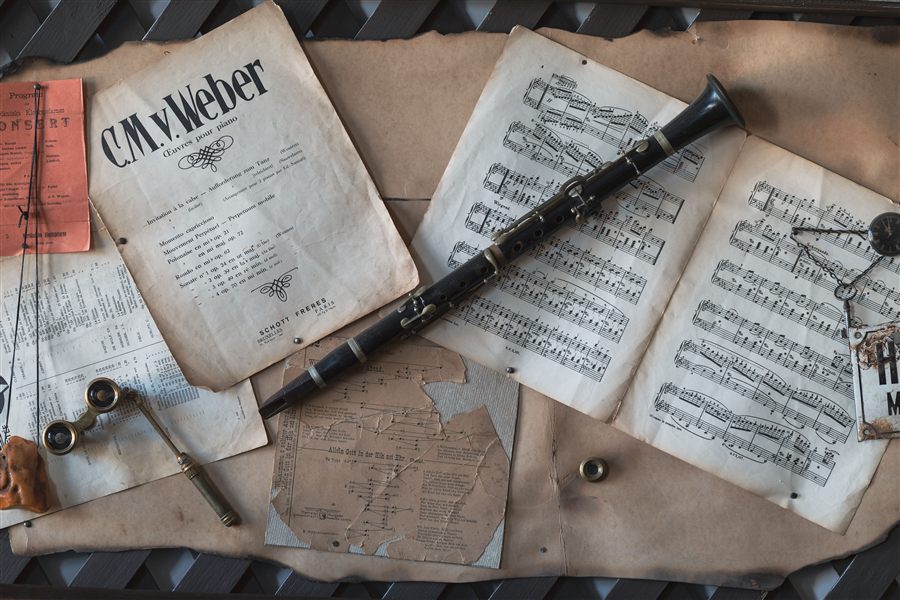
Three things decide whether a used clarinet is a good buy: a body without cracks, a mechanism that seals, and a price that already accounts for the maintenance it needs. Cracks in a wooden body are the serious risk; worn corks and old pads are ordinary wear that a repair shop can fix. Check in a fixed order, bring your own mouthpiece, and take a second person along, and you will catch most problem instruments on the spot.
Before you go to the viewing
Find out whether the instrument is wood (usually grenadilla) or plastic, what key it is built in, and which fingering system it uses. Most school and orchestra players use a Bb clarinet with the Boehm system; the article Boehm system and other fingering systems on the clarinet covers the alternatives. A bass clarinet raises some different questions, which buying a used bass clarinet explains.
Bring:
- your own mouthpiece, ligature and several reeds, so you judge the instrument with familiar equipment,
- a tuner or tuning app,
- a flashlight or phone light for the bore and tone holes,
- if possible, an experienced clarinetist or teacher. Two people see and hear far more, and a teacher has no financial stake in the sale.
If the instrument has been somewhere cold, let it come to room temperature before you assemble it. Sudden temperature change is the main cause of cracks.
The body: finding and judging cracks
Why wood cracks
Grenadilla is dense and hard but reacts badly to quick changes in temperature and humidity. Warm, moist breath hits cold wood, the inside swells while the outside does not follow, and stress builds. Very dry heated air, a spot beside a radiator or in a hot car, and playing a cold instrument all raise the risk. Plastic clarinets are not affected, which is a strong argument for student models.
How to look
- Take the instrument apart and inspect each section in bright light: barrel, upper joint, lower joint and bell.
- Shine a light through the bore and look for fine lines running lengthwise, especially around the tone holes and at the top of the upper joint, where stress concentrates.
- Run a fingertip along the tone holes and the ends of each section. A crack is often easier to feel than to see.
- Check the metal rings at the joints. A loose ring can point to wood shrinkage or stress.
- Look for signs of earlier repairs: a row of small metal pins, bands or discolored glue lines.
What a crack means
- Superficial hairline: stays in the outer layer and often does not affect tone or seal. Have a technician look at it anyway, because it can grow.
- Crack through to the bore: leaks air, dulls tone and disturbs response, and usually spreads without repair. It belongs in a shop.
- Crack at a tone hole or tenon: more serious than one in the plain wall, since the keywork and sealing surfaces are involved.
Treacherous detail: some cracks close up in dry storage and open again when the instrument is played. A seller who calls a crack harmless or purely cosmetic should be able to show that. If you are unsure, have a repair shop look before you pay.
What a shop does is not a job for the kitchen table. A crack is typically pinned with small threaded rods set across it or stabilized with a band, and minor ones are filled. Costs vary by shop and by the damage; a pin repair is priced per pin (about $20 per pin at one shop, Oct. 2026) and a carbon band around $100 (Oct. 2026), but the total depends on how long the crack is. Do not glue it yourself: a botched fix makes the professional repair harder. When you negotiate, a known crack justifies a clear discount; there is no flat figure, because location and length decide the work involved.
Corks and joints
The sections connect through tenons wrapped in cork. The cork seals each joint airtight and cushions the fit. It is a classic wear part.
- Feel when assembling: firm, even resistance with no play. A joint that wobbles usually has compressed cork. If you have to force and twist, the cork is too thick or the wood has moved.
- Appearance: cracked, flaking, uneven or flattened patches mean a replacement is due, even if the joint still holds.
- Air seal: a loose joint leaks air even if every pad is perfect, and the symptom is easily blamed on something else.
- Small key corks: these quiet the keys and limit their travel. If several are missing, the instrument will clatter.
On a used instrument this is no red flag, only a normal maintenance item. Replacing tenon corks is routine bench work; one shop lists $25 for the first tenon cork and $15 for each additional one (Oct. 2026). The material matters less than the condition: the joint has to fit firmly and seal.
What you can do yourself
- Apply a thin layer of cork grease before every assembly. It makes joining easier and keeps the cork supple.
- Push the sections together straight with a gentle twist rather than levering them. Hold the wood, not the keys and levers.
- If the cork is merely dry, grease and time help; if it is cracked or crushed, it needs replacing in a shop.
Mechanism: keys, pads, springs
Each key must close its tone hole completely, and the pad inside the key makes the seal. What you can check without touching anything:
- Pad appearance: old, frayed, swollen, hard or discolored pads are probably leaking.
- Action: each key should go down easily and snap back at once. Sticking or sluggish keys point to dirt, bending or weak springs.
- Noise: clicking and clacking often come from missing key corks, bent keys or worn lever connections.
- Looseness: wobbly screws or rods mean a worn mechanism.
- Bent keys: after knocks, key arms bend. A key that sits crooked over its hole is a warning sign.
Suction test on the upper joint
- Take the upper joint apart from the rest.
- Finger the lowest C of that joint and seal the open bottom end with the palm of your hand.
- Suck in firmly three times as though through a straw, then release.
- If the joint holds the vacuum for about five seconds, or pops when you break the seal, the pads on it are largely sealing. If the suction fades at once, there is a leak.
The lower joint is harder to test this way. Playing tells you more: start low, soft notes slowly. If they are rough, unfocused or will not speak, the mechanism is probably leaking.
Adjusting keys, replacing pads and springs, and regulating the mechanism are shop work. To understand them: pads seal the holes, springs return the keys, and regulation aligns all keys so they close together. Ask the seller when the instrument was last serviced, because even a structurally sound clarinet plays badly if the mechanism has drifted out of regulation.
Tone holes, bore and mouthpiece
- Tone holes: the rims should be smooth and crisp. Chipped or dirty rims keep a pad from sealing.
- Bore: shine a light in and look for scratches, deposits and cracks. A dull, dry bore points to long neglect. The bore diameter is roughly 0.575 to 0.585 inch; you cannot see deviations without gauges, but you can see damage.
- Barrel and bell: carry no keywork and cost much less to replace than the upper and lower joints. Barrel and mouthpiece shape the sound noticeably, as barrel and mouthpiece upgrades for clarinet tone explains. A cracked barrel is easier to live with than a cracked upper joint.
- Mouthpiece: inspect the tip and the table for chips, scratches and cracks. A damaged mouthpiece is cheaper to replace than any body problem. For your trial, bring your own.
Playing it
Playing every note is necessary but not sufficient. Pay attention to:
- response in the low register and across the break into the clarion register,
- pitch with a tuner; the instrument should be tunable to roughly 440 to 442 Hz with a normal embouchure,
- quiet playing in every register, where leaks show first,
- evenness from note to note, with no jumps and no dead single notes.
Accessories, age and serial number
Case, mouthpiece cap, ligature, swab and cork grease affect the price. A sturdy case protects against knocks. If pieces are missing, budget for replacements.
The serial number helps you estimate age. Using two well-known makers as examples: on Buffet Crampon clarinets, number 1 corresponds to 1929, 10,000 to about 1933, 58,834 to about 1957 and 408,001 to 1996. On Selmer Paris, the series is a letter inside the number: L1000 is about 1931, M1000 about 1939, N1000 about 1947 and S1150 about 1960. Records for 1946 to 1957 are incomplete, so dating that period stays approximate. Compare the number in an ad or bill of sale with the instrument itself; if the numbers on separate sections do not match, parts have been swapped.
New versus used: judging the price
New clarinets range from simple plastic student models to wooden professional instruments, and prices depend heavily on maker, material and equipment. Very cheap instruments are often poor value because of tone and mechanics. Compare several current listings of the model you are considering.
Used prices vary too much by model, age, condition and seller to give a reliable range, so compare several current listings of the same model. Used instruments usually lose noticeable value early on, but do not rely on a rule of thumb. A well-kept instrument with documented servicing is generally worth more than a cheaper one that still needs an overhaul.
Always add the maintenance a used instrument may need: a seemingly cheap clarinet that needs an overhaul can end up costing more than a pricier one in good shape. Get a quote from a shop beforehand.
Repair shop costs
An overhaul typically includes: disassembly, cleaning and treating the wood, new pads, corks and felts, often new springs, polishing and regulating the keys. Turnaround runs from about a week to several weeks depending on the shop.
| Service | Examples from published shop price lists, USA (Oct. 2026) |
|---|---|
| Overhaul, plastic student soprano | about $270 to $350 |
| Overhaul, intermediate wood soprano | about $385 to $500 |
| Overhaul, professional wood soprano | about $525 to $850 |
| Student repad only | about $195 |
| Crack pinning | about $20 per pin, plus the work involved |
| Single pads, key corks, springs | varies by shop, get a quote |
These are figures from two individual shops, so prices differ by shop, region and the instrument's condition. A heavily played older clarinet will likely need an overhaul; one that was gently used or just serviced may not.
Buying private or from a dealer
- Dealer or repair shop: the instrument is often checked and serviced before sale, you have someone to contact, and warranty and return terms are usually better. The price is higher.
- Private sale: cheaper but unchecked. Have an experienced player look it over.
- Online without seeing it: a gamble, especially with private sellers and auction listings. For questions about returns and warranty, ask a qualified advisor.
Get condition, repairs and serial number confirmed in writing and put the details in the bill of sale. For an instrument worth several thousand dollars, instrument insurance is worth a look.
Hygiene and care after the purchase
With a used instrument, start with the mouthpiece: replace it or clean it thoroughly, since it is the only part that touches your mouth.
Swabbing and drying
- After playing, remove reed and ligature and lay the reed flat on a clean surface.
- Take the clarinet apart into its sections.
- Drop the swab weight through the bell and pull the swab gently through each section, two or three times, until the bore feels dry. Never swab the mouthpiece; rinse it separately.
- Blow sharply through the tone holes so no moisture collects there.
- Wipe the metal keys with a soft cloth so hand sweat leaves no marks.
- Do not put a damp swab back in the case. Leave the case open now and then so everything can dry.
Cleaning the mouthpiece
Wash the mouthpiece about once a week in lukewarm, never hot, water with a little mild soap and a soft brush. Rinse well and let it air dry. Reed and ligature do not belong in the soap bath. Wipe the ligature about monthly. After each session a short rinse in lukewarm water keeps saliva from drying on.
Oiling
On wooden clarinets the bore is occasionally treated with acid-free bore oil, only when it is completely dry, and sparingly. A common rhythm is once or twice a year; the upper joint needs it most. Apply a thin film to the bore only, never on pads, keys or cork, and wipe off excess. Too much oil does more harm than too little. Plastic clarinets are not oiled.
Break-in and warm-up
New and freshly serviced wooden instruments should be played only briefly in the first days, with breaks, so the wood adapts to warm, moist breath. The same caution suits a used instrument that was stored for a long time. In cold weather let it acclimate before playing (open the case 20 to 30 minutes ahead) and, if needed, hold it briefly against your body. Never warm it with a hair dryer or on a radiator. Store it away from heaters, open windows and bathrooms.
A basic care kit contains a swab, a polishing cloth, cork grease, bore oil, a mouthpiece brush, a stand and a reed case.
Common mistakes when buying used
- Only playing through the notes and skipping the visual and seal checks.
- Underestimating cracks or taking the seller's word for them.
- Buying a rock-bottom instrument that is hard to rescue in tone and mechanics.
- Not budgeting for an overhaul.
- Testing without your own mouthpiece and without a second person.
- Buying online without seeing the instrument and not getting details in writing.
- Assembling a cold instrument and playing it hard at once.