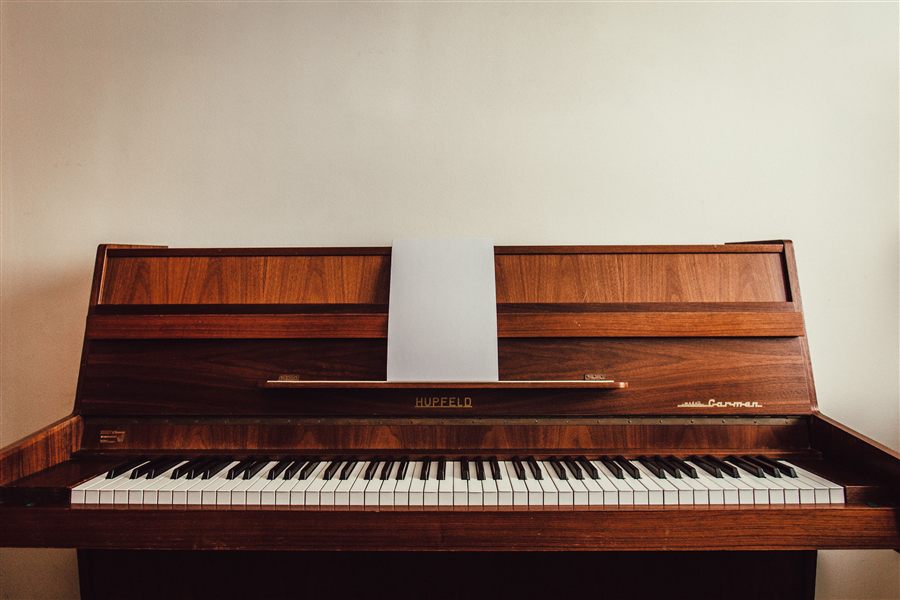
Short answer: A used upright piano is a good buy when the pinblock, soundboard and action are sound and the instrument can hold a tuning after the move. Looks, brand name and age tell you much less than those three things. For anything above a bare-bones starter piano, an independent inspection by a registered piano technician before you buy is cheap insurance, often around $125 (as of Oct. 2026). A "free" piano is rarely free: moving, tuning and repairs often cost more than a carefully checked instrument.
Which Type of Upright Fits
Used uprights fall into four rough height classes. Height is a useful clue to sound and touch, because longer strings, a larger soundboard and a longer action give more volume and finer control.
- Spinet (under about 36 in): very compact, with a low-set "drop" action that is awkward to service. Usually a second choice for serious practice.
- Console (roughly 40 to 44 in): the common living-room compromise, with a lighter, brighter tone and a smaller action.
- Studio (roughly 45 to 50 in): noticeably richer tone and better repetition, the sensible minimum for advancing students.
- Full-size upright (about 50 in and up): the best tonal development, but it needs space and is heavy to move.
The height limits are rules of thumb, and shops draw the lines slightly differently. If you want to learn seriously, the tallest piano that fits your room is usually a better choice than a spinet.
Price Range New and Used
Prices vary widely by region and dealer. As a rough US guide (as of Oct. 2026):
| Price tier (as of Oct. 2026) | What you typically get |
|---|---|
| Up to about $1,000 | Free or heavily discounted used uprights, often with unknown problems |
| About $1,000 to $3,000 | Recent or lightly used pianos from reputable brands in fair condition |
| About $3,000 to $7,000 | Better used instruments and new economy pianos (new entry-level models start around $5,400) |
| About $7,000 to $10,000 | New quality production uprights and strong used pianos |
| About $10,000 to $20,000 | Premium production brands and high-end used handbuilt pianos |
| Above $20,000 | Luxury and handcrafted uprights, new ones up to roughly $50,000 |
Condition moves the price more than age does. Local competition also matters: what a model sells for in one city says little about another, so compare listings near you.
Dealer or Private Seller
A dealer charges more but usually sells a reconditioned piano with a warranty, delivery and often a first tuning. Some dealers also offer trade-up programs. A private seller is commonly 25 to 30 percent cheaper (rule of thumb), but the piano is sold as-is: you arrange inspection, moving, tuning and repairs. A private purchase works well if you follow a few rules:
- Get brand, model, serial number and service history in writing.
- Have a technician look at the piano before you pay for the move.
- Add moving, tuning and a first service to the total price from the start.
Legal questions about returns and warranty are best settled in writing before you buy, since general rules vary.
Step-by-Step Used Piano Check
Exterior
Check the cabinet, legs, casters and pedal area. The piano should stand firm and not rock. Lifting veneer, swollen edges, water stains or a musty smell point to moisture damage or poor storage. A nice finish does not prove a good interior, and scratches in the lacquer are usually just cosmetic.
Looking Inside
Open the top lid and front panel, and the lower panel if you can. Look for:
- Strings: Light surface rust is normal. Heavy rust on strings and coils points to coming breakage. Many new strings among old ones or several splices suggest a history of breaks.
- Felts: Moths eat hammer and damper felt. Bare patches, chewed areas and fine webbing are a serious warning, because replacing felt is labor-intensive.
- Hammers: Deep grooves at the strike points mean heavy wear. Hard, flattened hammers sound harsh, which can often be improved by reshaping and voicing.
- Wood-boring insects: Small round holes of 1 to 2 mm with light-colored dust below indicate active infestation. Old dust is darker and crusted. A simple test: put dark paper underneath for a few days and see if fresh pale powder collects. Treatment is a job for a professional.
- Smell: A musty or cellar smell nearly always means moisture in the instrument.
Playing Test Across the Whole Range
Play every key from the lowest to the highest, loud and soft. Listen for sticking or sluggish keys, buzzing, rattles and notes that sound dull or metallic. Test fast repeated notes: a good action repeats quickly and reliably, even at soft touch. Do not judge tone too early. An out-of-tune piano sounds worse than it is, and a freshly tuned one sounds better than it will stay. What counts is whether it holds its tuning.
Tuning Pins and Pinblock
The pinblock is the layered wooden block that holds the tuning pins. It carries the combined string tension of several tons. If the pins are loose, the piano will not hold a tuning. That is one of the most consequential faults because it is expensive to fix. Signs include:
- The strings of one note (usually three per key) are badly out of tune with each other.
- The piano sits well below standard pitch (A 440 Hz) and cannot be brought up stably.
- Dark brown, gummy stains around the pins can indicate a chemical treatment that only temporarily tightens loose pins.
- Mismatched pins or cracks in the pinblock.
- Less than about 1/8 inch of clearance between the pin coils and the pinblock.
A restringing job with new pins starts around $2,500 (as of Oct. 2026) and goes up with the size of the job. A new pinblock is usually only worth it for high-quality instruments.
Soundboard and Bridges
The soundboard is the large wooden panel behind the strings that amplifies the sound. Hairline cracks are common in instruments that are decades old and are often harmless, especially if they are tight or have not grown. Worrying signs are open cracks, ribs coming unglued (they cause buzzing) and a loss of the slight arch (crown) together with cracking. A pluck test helps: the note should ring clearly for at least about five seconds. Less than three seconds suggests a tired soundboard.
Small hairline cracks in the bass bridge are common. Many cracks, loosened bridge pins or a loose bridge make the bass uneven. Repairs to bridges and soundboards are laborious and often cost as much as the piano. That is a job for a technician, not for DIY.
Action
Hammers should sit firmly and not wobble sideways. Dampers should stop the sound cleanly and lift evenly with the right pedal. Check the small bridle straps in the upright action for cracks or missing pieces. Original early plastic action parts in pianos made before about 1960 are a risk because the material ages and breaks. Older overdamper uprights (pre-1900 design) are especially costly to maintain, and instruments with a Viennese-style action from before about 1920 often play at a lower pitch and feel dated. Both are unsuitable for beginners.
Uneven key heights, sluggish keys or notes that skip at soft touch are mostly regulation jobs, not replacement jobs. Tuning, regulation and voicing are three separate services, and a tuning visit does not automatically include the other two.
Pedals
The right pedal lifts the dampers, and the left pedal moves the hammers closer to the strings to reduce volume. A middle pedal is, depending on design, a practice pedal or a sostenuto, which is a sign of a higher-quality upright. All pedals should work smoothly, without play or squeaks, and do something audible.
Finding the Age and Serial Number
The serial number tells you the year of manufacture, not the value or the model. It has no fixed location. It is often visible at the top end of the side wall when you open the lid, stamped on the cast iron plate, or on the soundboard. Sometimes it is printed or glued on.
With brand and number you look up the maker's table. A few examples for orientation (rough values):
| Brand | Serial number | Approximate year |
|---|---|---|
| Steinway & Sons | 100,000 | 1901 |
| Steinway & Sons | 400,000 | 1967 |
| Schimmel | 3,300 | 1900 |
| Schimmel | 180,000 | 1978 |
| Blüthner | 145,000 | 1945 |
| Blüthner | 180,312 | 1990 |
Reference works list thousands of makers, many manufacturers publish their own tables, and technicians often check the number during an inspection. If the number is missing or unreadable, other clues help: date stamps on hammer heads and action parts (suppliers usually stamped about a year before installation), handwritten dates from past tuners on the keys or action, and the key covering material (ivory up to roughly the 1920s, increasingly plastic afterwards).
This check is worthwhile because an understated age shows up at once. But age never replaces a condition check: a well-kept 50-year-old piano can be better than a neglected one half that age.
Which Years Are Worth Considering
Most sources agree that pianos from roughly 1960 to 2000 often offer the best value, because many European and Japanese makers built to a high standard in that period. Instruments from before 1900 are only rarely worth restoring, and of pianos from 1900 to 1950 only some can be overhauled economically. Pianos over 40 to 50 years old often need major restoration unless meticulously maintained. Be wary of pianos with fantasy brand names from mass production and of budget imports not built for longevity.
As a rough lifespan, mass-produced pianos last about 50 to 65 years, and high-end ones considerably longer, in both cases with good care (rule of thumb).
The Free Piano From Classifieds
Classified sites are full of free pianos. Often the owner just wants the space back, but equally often the repairs would cost more than the instrument is worth. The piano itself is then not the problem; the follow-up cost is.
Where the Money Goes
- Moving: A typical local upright move with professional movers costs about $150 to $300, more with stairs, which can add roughly $40 to $130 per flight (as of Oct. 2026). Add insurance, since standard mover liability rarely covers a piano's value.
- Tuning: A tuning costs roughly $135 to $240 depending on the region, and a piano left untuned for years may need several in the first year, plus extra for raising the pitch.
- Cleaning and repairs: Cleaning the interior runs about $100 to $300, and regulation and repairs run from hundreds to thousands of dollars. Technicians commonly estimate $1,000 or more for the first year.
- Refinishing: A new finish costs several thousand dollars, comparable to a new piano.
When to Walk Away
- The listing gives no brand, model or serial number and has no interior photos.
- The seller pressures you ("must go today") or asks for payment before you have seen the piano, or posts from far away.
- The piano stood in a basement, garage or damp room, smells musty or shows water stains.
- A technician considers it untunable or the repairs out of proportion.
- It is a very old instrument with overdamper action or unknown origin.
A piano from family or friends, where you know its history and can judge it honestly, is a different case. If in doubt, have it inspected first and book the movers second. An honest calculation compares the "free" piano to the price of a checked instrument.
Moving and Acclimating
A piano should not be moved by unprepared helpers. A professional crew usually brings two or three strong movers with a piano dolly and straps. The piano is padded and not moved on its side, and loose parts such as the music desk are secured. Check the route, door widths, stairs and turns in advance. Stairs and other obstacles add surcharges, so get a quote.
After the move, the piano needs time to settle. Wait at least 24 hours, ideally two to four weeks before tuning, because wood, felt and strings adjust to the new room climate. If you tune too early, the tuning is soon gone again. A stable climate afterwards is key; see humidity and placement as a value factor for pianos. For how often and why to tune after purchase, see piano tuning: costs and when it is needed.
Inspection by a Piano Technician
Only a professional reliably spots damage to the plate, soundboard and pinblock. An inspection reports the condition, expected repair costs and a fair price range. A service call to evaluate a piano without tuning costs around $125 at some shops (as of Oct. 2026), and rates vary by region and by the time needed. A registered piano technician is a good choice, and it is best to hire one who is independent of the seller.
Ask specific questions: Can it be tuned? What would it cost to fix the problems found? Does that make sense compared with the asking price?
Costs After You Buy
Plan with these rough values (as of Oct. 2026):
- Tuning: about $135 to $240, more for a piano that needs its pitch raised.
- Repairs and regulation beyond a normal service call: often billed at around $75 per hour, depending on the shop.
- A single replacement string costs about $50, several strings about $30 each.
- Restringing with new pins: from about $2,500, depending on the job.
- Silent system retrofit: see retrofitting a silent system.
The principle: repair costs should stay in proportion to the instrument's value. For uprights, expensive work on the soundboard, bridges and pinblock is often uneconomical.
Common Buying Mistakes
- Deciding on price or looks. A low price with hidden faults often turns into the most expensive option.
- Judging the tone before tuning. Do not be put off by an out-of-tune sound; look at the action, the touch and whether tuning holds.
- Skipping an independent inspection. Closed cabinets hide many areas, and uprights are not simpler just because they look compact.
- Forgetting follow-up costs. Moving, tuning, insurance and repairs belong in the calculation.
- Ignoring room climate. A good piano loses value quickly in a dry or damp room.
- Confusing age with value. Old is neither automatically valuable nor worthless; condition, design and brand decide.
- Not writing down what the seller says. Brand, year and repairs should be recorded in writing.
If you go step by step, first settle on type and budget, then view, have it inspected if appropriate and plan the move properly, you have a good chance of a piano that will give you decades of pleasure.