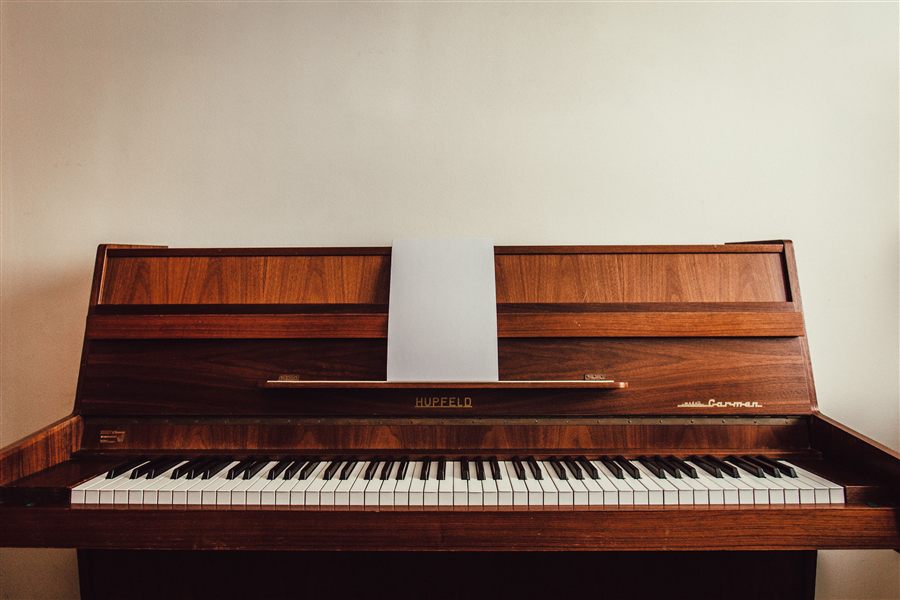
A silent system turns an acoustic upright into an instrument you can switch to near-silent headphone practice at the flick of a lever: a hammer stop catches the hammers before they reach the strings, sensors under the keys read your playing, and a sound module produces the tone. Retrofitting usually makes sense only for an upright in good mechanical shape that you plan to keep. For many beginners a digital piano is the cheaper answer, but if you want a real action and quiet practice in one instrument, a silent system is a serious option.
What a silent system is and how it works
A silent system is an add-on that is either installed at the factory or retrofitted by a piano technician. The piano stays a fully acoustic instrument with strings, a soundboard and a real action. When you want quiet, you engage silent mode, and instead of the strings you hear a recorded piano sound (a sample) through headphones.
The four building blocks
- Hammer stop (mute rail): A switchable bar, usually felt-covered, swings into place between the hammers and the strings. The hammers travel their normal path but are caught a few millimeters short of the strings. Depending on the system, you engage it with a lever, a button or the middle pedal.
- Sensors: A sensor strip sits under the keys. Modern systems are non-contact (optical) and measure the speed, depth and release of every key, often the pedals too. Older systems with mechanical contacts affected the touch and could click audibly.
- Sound generation: A sound module turns the sensor data into notes. Several grand and upright piano sounds are typical, plus electric piano, organ or harpsichord. Sample quality and the number of dynamic levels differ noticeably between systems.
- Connections: A headphone jack, usually MIDI and USB, and on newer systems Bluetooth and an app to adjust tone, reverb and metronome.
What you hear and feel in silent mode
The keys feel like those of an acoustic piano because the action works normally. One difference remains: the hammer hits the stop instead of a string. That missing rebound and the slightly different let-off point show up mostly in very soft playing. A faint mechanical thud and key noise are also still audible. The room is never completely silent, just far quieter than in acoustic mode.
Retrofit, buy new with silent, or go digital
Retrofitting your existing upright
This makes sense if you have an upright you like and its action is in good order. As a rule of thumb, uprights from about 42 inches (108 cm) tall are considered retrofittable; whether your model qualifies is something the technician decides on site. The condition of the action matters: heavily grooved hammer felt or corroded strings can degrade the sensor signal and the dynamics. In that case the action should be put in order first, which raises the total cost.
Buying new with a factory system
Factory-installed systems are matched to the action of that particular model and cannot be added to a different piano later. When buying new, you pay a premium over the same model without the silent function; as a sample point, one dealer example puts it at roughly 2,000 USD (Oct. 2026). It is the right route if you are shopping for a new piano anyway.
Hybrid pianos
Hybrid systems go a step further: besides the hammer stop, transducers make the soundboard vibrate with the digital sound. The tone then comes from the instrument itself, and you can control the volume without hammers striking strings. Again, these are factory-built, not retrofittable, and pricing varies by dealer, so get a quote.
A digital piano as the alternative
A digital piano is cheaper, lighter and stays playable without tuning or regulation. But it has no strings and no soundboard, and even good hammer-action keyboards feel different. If you mostly practice quietly and do not own an acoustic piano, a digital often serves you better. If you already own the upright or explicitly want both worlds, a silent system is the choice.
| Option | Strength | Weakness |
|---|---|---|
| Retrofit system | Keep your own piano, real action | Quality depends on installation and condition |
| New with silent | Matched complete system | High price, depreciation in the first years |
| Hybrid | Sound comes from the soundboard | Factory only, expensive |
| Digital piano | Inexpensive, low maintenance | Not an acoustic instrument |
Types of systems
Retrofit systems differ mainly in their sensors and sound module. Product names such as adsilent, Genio or PianoDisc QuietTime come up often; these are product designations, not endorsements.
- Optical systems with a sensor per key: They measure keys and pedals without contact and are the standard approach. What matters is that they track fast repeated notes cleanly. Higher-end systems often use several measuring points per key for this.
- Simpler systems: Cheaper, but weaker on dynamics and fast repetition.
- App-enabled systems: They let you pick sounds, reverb and recordings and receive software updates from a smartphone, so they age more slowly.
- Let-off extension: Some providers offer an additional adjustment that gives the hammer more room in acoustic mode. On uprights this is not always possible.
When comparing, the brand name matters less than these questions: How well does the system capture soft playing and fast repetition? Are updates and spare parts available? How carefully are both modes set up?
Costs in the United States
Retrofit kits are commonly quoted at about 2,500 to 5,000 USD plus roughly 500 to 1,000 USD for professional installation (Oct. 2026). Some installers advertise all-in prices for an upright of around 2,250 USD, a premium rail system around 2,500 USD (kit) and a higher-end system from a dealer around 4,250 USD installed on a dealer piano. Grands run higher, around 4,000 USD for a retrofit example. Possible extras:
- Delivery and pickup if the work is done in the shop, or a house-call fee.
- Prep work on the action if it is not in good shape.
- Regulation after installation so both modes work cleanly.
- A let-off extension or add-on module, if you want one.
Prices depend heavily on your region and on the piano; varies by shop, get a quote. Ongoing tuning costs do not change because of the system; see piano tuning costs and when it is needed.
Installation: why it belongs with a professional
A piano technician does the installation, on site or in the shop. It typically takes one to two working days, longer for complex jobs (rule of thumb). In essence: the keys are removed, the sensor strip is mounted on the keybed, the stop rail goes into the action, and the sound module and wiring are placed. The technician then sets up the action so the hammer is caught cleanly in silent mode and the piano still plays well in acoustic mode.
This is not a do-it-yourself project. A badly adjusted system can permanently hurt touch and dynamics, and working on the action and the electronics takes experience and measuring equipment. After installation you check for yourself: do both modes work, do all keys respond evenly, are there dropouts on fast repeated notes?
Effects on the action, tuning and resale
Touch and action
Silent mode feels different because the hammer is stopped earlier. To fit the stop, many retrofits move the let-off point, where the hammer releases from the key, further from the string. Reports vary: some technicians describe noticeable loss in very soft playing, while other owners find no difference in acoustic mode. It probably depends on the piano, the system and the setup. Play your piano deliberately before the installation and compare afterwards in acoustic mode.
Tuning
The system does not touch the strings or the pinblock. Your piano still needs the same tuning and care as without it. What affects tuning most is climate and humidity; see humidity and placement for pianos. If you mostly play in silent mode, you should still have it tuned regularly and the action checked.
Resale
Dealers report that a working system can add roughly 6 to 10 percent to a piano around ten years old, and more like 0 to 5 percent beyond 20 years (rule of thumb, Oct. 2026). After that, the electronics turn into a liability: spare parts get scarce, and buyers tend to view a dead system as a defect. A retrofit is therefore usually an investment in your own use, not in value. The market for used silent pianos is small, and individual listings can sit for a long time.
Using it with MIDI, recording and apps
Most systems output your playing as MIDI data. That lets you:
- record on a computer or tablet and edit later, without setting up a microphone;
- drive learning apps, notation software and virtual pianos;
- depending on the system, record audio directly via the app or module, often into several slots.
Keep in mind that MIDI records only the note, its length and the pedal, not the sound of the strings. If you want to capture the real piano tone, you still need microphones. With software sounds the delay between key press and tone is small on good systems; over wireless links such as Bluetooth it can be noticeable, while wired connections are usually unproblematic. Try this before you buy.
Neighbors and quiet hours
Consideration for neighbors and housemates is the most common reason for a silent system. Quiet hours and rules about instruments differ by building, city and lease or HOA, so check yours before you assume anything. This is not legal advice; when in doubt, ask your landlord or property manager.
Silent mode lets you practice during those hours. Two things remain: the thud of keys and stop rail is faintly audible in quiet buildings, and structure-borne sound through floors and walls (for example from firmly pumping the pedals) travels on. A rug or pad under the piano helps.
Common mistakes
- Installing into an upright with a poor action: Action first, electronics second.
- Deciding on price alone: Simple systems lose out on dynamics and fast repetition.
- No test in both modes: After installation, play acoustic and silent, soft and loud, with fast repeated notes.
- Doing the installation yourself: The risk of damage to action and electronics is high.
- Treating silent as a substitute for care: Tuning, regulation and climate control remain necessary.
- Expecting too much added value: See resale above.
- Neglecting headphones: Good headphones make up a large part of the sound impression.
Myths about silent pianos
- "Silent turns the piano into a digital piano." No. In acoustic mode everything stays as before; only in silent mode does the sound come from the module.
- "The installation changes nothing about acoustic playing." Not always true. With careful installation the difference is small, but it can exist.
- "Any piano can be converted." No, height, construction and condition matter.
- "Silent means completely quiet." Mechanical noises remain audible.
- "The system lasts a lifetime." The electronics age faster than the action.
Buying a used piano with a silent system
When buying a used piano with a silent system, the electronics come on top of the normal inspection (see buying a used piano: what to look for):
- How old is the system? After about ten to fifteen years the risk of failure rises, and spare parts get scarce.
- Do all keys and pedals work in both modes, including very soft playing and fast repeated notes?
- Is there proof of professional installation, and who can service the system? A missing manufacturer or service network is a risk.
- Is the hammer stop set cleanly? A defective or never properly adjusted system may need re-regulation.
- How does the piano play acoustically? Test it without silent mode, because that remains the main instrument.
Price it so that a working system is a plus but does not justify a big premium, and a dead system earns a discount. Have the seller's statements about age and condition put in writing.