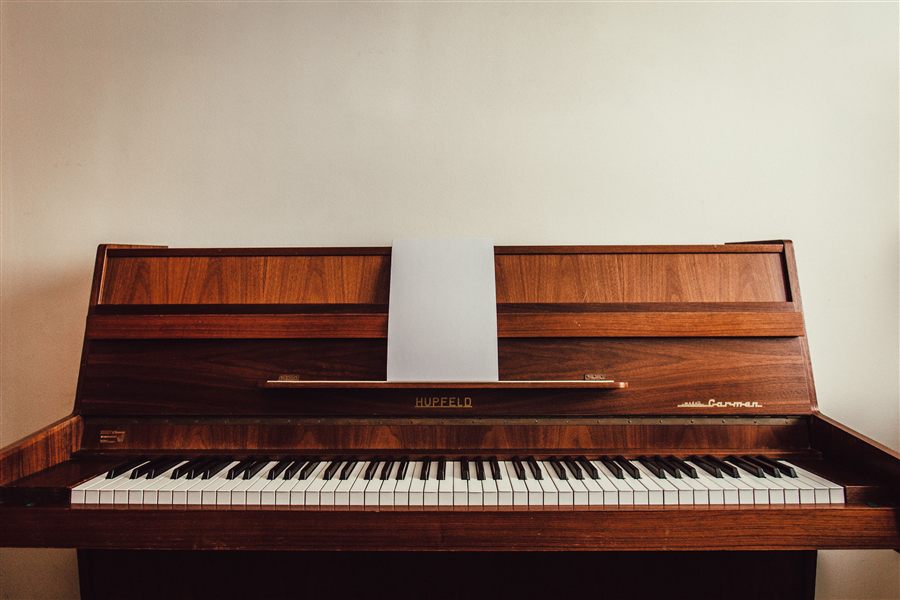
Upright Piano
C. Bechstein Upright (2005)
No current price available
Availability: 0/10 (Very rare)
A German upright piano from one of the oldest names in piano building, historically prized for a warm, singing tone - though with instruments this old, sound and condition depend heavily on how well a given example has been restored.
About the C. Bechstein Upright (2005)
Bechstein built its uprights under two naming systems across more than 170 years of production: Roman numerals I through V before 1902, standing between roughly 48 and 57.5 inches tall, followed by Arabic numbers 6 through 12 (plus specialized 118 and 124 designations) from 1902 onward. A serial-number chronology running from 1853 to 2012 lets a specific instrument be dated fairly precisely - serial number 138345, for instance, corresponds to 1932, while 189243 points to the year 2000. Early models came finished in rosewood or ebony with the full 88-key compass standard across the line. Today's catalog organizes uprights under the premium Concert line (Classic R4 through Concert 8) and the more accessible Academy line (A2 and A6), while Bechstein-designed but externally manufactured siblings - W. Hoffmann from the Czech Republic and the entry-level Zimmermann, built in China - extend the name into lower price brackets without claiming the same construction as instruments made at Bechstein's own factory.
Where to buy
Unfortunately we can't currently find any offers for this instrument. Check back regularly - we update our listings several times a day.
Sound character of the C. Bechstein Upright (2005)
Bechstein uprights are generally described as warm and rich-sounding, with a deep, resonant bass and a clear, singing treble - the Model 10, for instance, is often characterized as having a sweet, mellow voice with real dynamic expressiveness, helped by its straight-strung construction, though that warmth only comes through fully on an instrument that's been properly restored. Modern catalog models take a somewhat different approach, with lines like the Concert 8 praised for a clear fundamental tone and well-balanced harmonics that stay distinct even at louder volumes - a reminder that Bechstein's upright sound has evolved across generations rather than staying fixed to one character.
What owners of the C. Bechstein Upright (2005) say
Discussion around Bechstein uprights, especially older ones, centers less on whether the brand is good and more on how to judge a specific used instrument - a sign of how much condition and restoration history matter here. The brand's broader reputation rests mainly on its concert grand tradition, where pianists including Wilhelm Kempff, Wilhelm Backhaus, Leonard Bernstein, Jorge Bolet and Dinu Lipatti were closely associated with the name, Claude Debussy reportedly insisted piano music should only be written for a Bechstein, and a Bechstein concert grand at London's Trident Studios became one of the most-recorded pianos in rock history, used on recordings by the Beatles, Elton John and David Bowie - none of that is specific to the upright line, but it explains why the Bechstein name still carries real weight among anyone shopping for one.
Playability & handling of the C. Bechstein Upright (2005)
On a well-restored older Bechstein upright, owners and technicians describe a nuanced, expressive touch with real dynamic range - but that outcome depends entirely on restoration quality, and a specialist dealer puts it bluntly: two Bechstein uprights of the identical model can differ enormously after a century of use. Anyone considering an older example is advised to ask specifically who carried out any restoration, which structural and action parts were actually replaced, how stable the tuning has proven, and whether the instrument has been properly prepared and voiced for the room it will occupy. Many older uprights also shipped without a built-in practice (soft) pedal mechanism, though a technician can sometimes retrofit one depending on how the action was originally built.
Recommended accessories & strings for the C. Bechstein Upright (2005)
For an instrument this old, the single most valuable thing an owner can arrange isn't an accessory at all but a relationship with a technician who knows the brand - someone who can assess restoration history, action condition and tuning stability before committing to a purchase or a major service. Beyond that, stable room humidity and temperature matter more for protecting the soundboard and case of a decades- or century-old piano than they would for a new instrument, since wood this age has far less tolerance for swings in moisture.
Technical data for the C. Bechstein Upright (2005)
| Historical model naming | Roman numerals I-V (pre-1902), Arabic 6-12 plus 118/124 (post-1902) |
|---|---|
| Dating | Serial number chronology available from 1853 to 2012 |
| Early finishes | Rosewood or ebony, 88-key compass |
| Current upright lines | C. Bechstein Concert (Classic R4-Concert 8), C. Bechstein Academy (A2, A6) |
| Related brands | W. Hoffmann (Czech Republic, mid-tier), Zimmermann (China, entry-level) |
| Controls | Standard acoustic upright controls - sustain and soft/practice pedals (practice pedal not present on all older models); no electronic controls |
The history of the C. Bechstein Upright (2005)
C. Bechstein, manufacturing pianos since 1853, remains one of Europe's most respected piano makers, known for a clear, singing tonal character.
About C. Bechstein as a manufacturer
Carl Bechstein founded the company in Berlin on October 1, 1853, after training as a craftsman in France and England, setting out specifically to build pianos sturdy enough to survive the demands virtuosos like Franz Liszt placed on an instrument. Hans von Bülow performed Liszt's B minor Sonata on a Bechstein grand in 1857, and by 1870 endorsements from both men had put Bechstein alongside Blüthner and Steinway & Sons among the leading piano names of the era. Queen Victoria became a customer from 1881, and the firm eventually held royal warrants across several European monarchies; a London showroom opened on Wigmore Street in 1885, followed by Bechstein's own concert hall there in 1901. Annual production reached roughly 5,000 pianos by 1913 with 1,200 craftsmen on staff - a peak abruptly ended by World War I, when Britain's 'Trading with the Enemy Amendment Act' forced the London operation to close in 1916 and confiscated the concert hall, which reopened as Wigmore Hall in 1917. The interwar years brought a notable technical detour: a 1930 collaboration with Siemens, led by Nobel laureate Walther Nernst, produced the Neo-Bechstein, an early electric grand using electromagnetic pickups. Edwin Bechstein, who led the firm through this period and maintained close ties to Nazi leadership, died in 1934 and received a state funeral attended by Hitler - a documented, uncomfortable chapter in the company's history. Allied bombing destroyed the Berlin factory and its soundboard-wood stores in 1945, and recovery was slow; the Berlin Wall's construction in 1961 complicated operations further before Baldwin Piano Company bought the firm outright in 1963. German piano maker Karl Schulze acquired Bechstein in 1986, built a new Saxony factory in 1992, and steered the company through a near-bankruptcy in 1993 before taking it public in 1996; a Czech factory producing the mid-tier W. Hoffmann line followed in 2007, and Stefan Freymuth succeeded Schulze as CEO in 2017. The brand is equally known for one-of-a-kind art-case pianos finished in gold leaf and hand-carved ornamentation, some of which are now museum pieces.