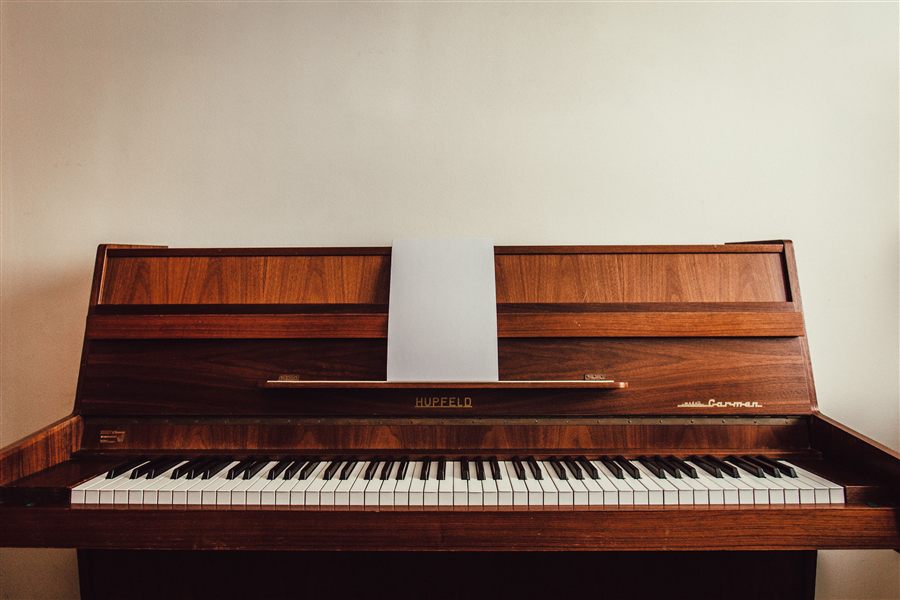
Short answer: An upright piano is happiest at roughly 40 to 60 percent relative humidity and about 68 °F (20 °C), with as little swing as possible. Put it on an interior wall, away from radiators, vents, windows, direct sun and basements. Where a piano has lived often matters more to its condition and value than its age, because climate damage to the soundboard and pin block is expensive and rarely reversible.
Why wood and pianos are such a delicate pair
A piano is mostly wood, plus felt, leather, glue and iron. Wood takes up moisture from the air and gives it back: it swells when the air is humid and shrinks when it is dry. Two parts are affected most.
- Soundboard: This thin wooden panel is built with a slight upward arch (the crown) that presses against the bridges carrying the strings. In humid air the crown grows, string tension rises and the pitch goes sharp. In dry air the panel flattens and the pitch drops. Large swings over many years lead to cracks and a lost crown.
- Pin block: The layered wooden block holds the tuning pins. When it swells or shrinks, the grip on the pins changes. Once pins no longer hold firmly, strings cannot keep their tension and the piano drifts out of tune quickly.
With several tons of string tension on the frame, small climate changes are audible. A sharp humidity swing over just a few days can noticeably detune a piano. Tuning more often does not fix the problem as long as the room climate is the cause.
Ideal humidity and temperature
Figures differ by source. A range of 40 to 60 percent relative humidity is the most common recommendation, some sources go lower (30 to 50 or 35 to 55 percent), and built-in climate systems typically aim for about 42 percent. As a rule of thumb for a home: aim for the middle of the range, roughly 42 to 50 percent, with room temperature from about 68 to 78 °F (20 to 25 °C).
Stability matters more than the exact number. Short deviations are harmless as long as the yearly pattern stays calm. A piano that falls from 55 to 25 percent every winter and rebounds every summer suffers more than one that sits at 40 percent all year.
Winter and summer
- Winter: Heated air is very dry. If indoor humidity stays below about 40 percent, a room humidifier helps. In hard freezes, too much indoor moisture can condense on cold windows and walls, so a somewhat lower target is safer then.
- Summer: Muggy weather pushes values up. Air conditioning or a dehumidifier keeps them in range. Above about 65 percent the risk of mold rises sharply.
A hygrometer: measure instead of guessing
A hygrometer costs about 30 to 40 USD at hardware or electronics stores (as of Oct. 2026) and is the single most useful purchase. Place it near the piano, but not directly on a heat source, in an air stream or in the sun. For a week, read it at set times and note how heating, ventilation and weather change the numbers.
The right spot in your home
Good
- An interior wall in a room that is heated evenly all day
- A few inches of space behind the piano so air can circulate
- Away from drafts and exterior doors
Bad
- Radiators and heating or cooling vents: Warm, dry air dries the exposed side of the case unevenly, a classic cause of cracks and finish damage.
- Floor heating and fireplaces: Rising heat puts extra stress on soundboard and pin block.
- Windows and direct sun: UV light fades and cracks finishes, and sun warms the instrument unevenly.
- Exterior walls: Usually fine in well-insulated modern houses; in older, thin-walled buildings temperature and humidity swing more, so an interior wall is better.
- Basements and unheated rooms: High, fluctuating humidity leads to rust on strings and pins, sticking keys and mold. Garages and other unconditioned spaces are no better.
- Kitchens: Steam and temperature swings are hard on the wood.
Typical damage and how to recognize it
Too dry
- Soundboard cracks, a dull or thin tone, rattling from loose ribs
- Cracks in the pin block, loose pins, a piano that will not hold pitch
- Opened glue joints, a sluggish or noisy action
Too humid
- Sticking or slow keys, hammers that do not return
- Rust on strings and pins; rusty strings break easily, especially during tuning
- Musty smell, stains, mold on wood, felt and leather
- Dull-sounding, damp felt
Moths and felt damage
Moths and other pests eat the felt on hammers, dampers and under the keys. Pianos that are rarely played are most at risk. Signs include eaten felt, webbing and droppings inside the case. Regular playing keeps the action moving and discourages pests. If you find an infestation, call a technician: control methods use products that should not be used casually inside a piano.
Reading soundboard cracks
Fine hairline cracks are common in older pianos and usually harmless as long as nothing buzzes and the ribs are tight. Wide cracks, rattling, a clearly flattened crown or a large number of cracks point to a long history of poor climate. Repair is extensive because the instrument has to be largely taken apart.
Humidifiers, dehumidifiers and climate systems
Room units
The most effective approach for the effort is controlling the room itself: a humidifier in winter, a dehumidifier or air conditioning in muggy weather. Place the unit across the room, not next to the piano, and keep it clean. Evaporative units are generally considered more hygienic than ultrasonic ones, which can spread germs in the mist.
In-piano climate systems (Dampp-Chaser type, Piano Life Saver)
These systems mount inside the piano, on an upright usually out of sight at the back below the action. They combine a low-wattage heater that dries the air, a humidifier with a water tank and pads, and a humidistat that holds the area around the soundboard near a steady level, typically about 42 percent.
- Cost: Roughly 700 to 1,100 USD installed for an upright, depending on the technician (as of Oct. 2026).
- Operation: The unit must stay plugged in all year, the water tank has to be refilled regularly and the pads replaced about once a year. Without water, it does nothing.
- Limits: It works locally. Room climate remains the first priority; the system makes most sense where the room cannot be controlled well enough.
- Installation: Only by a piano technician, since it involves electrical work and work inside the instrument.
Moving and acclimating
After a move, a piano is almost always out of tune. That is less about the bumps than about the climate change between old home, truck and new room. The common advice: wait two to four weeks, longer after a big climate difference, then have it tuned. Acclimation tends to go faster in summer than in winter. Tuning too early often means paying for a second tuning.
Never leave a piano outdoors or in the cold during the move. Afterwards, have a technician check for loosened screws, pedal noises or a stiff action. If you must store the piano temporarily, choose a climate-controlled space.
Effect on tuning stability and value
A steady, evenly humid room keeps a piano in tune longer. How often to tune is covered in Klavier stimmen: Kosten und wann nötig. Tuning prices vary by shop and region, so get a quote.
Climate damage weighs heavily on value because it hits the core of the instrument. Soundboard repair ranges from a few hundred to several thousand dollars depending on the extent, roughly 750 to 3,500 USD for repairs and 3,500 to 9,000 USD or more for replacement. Replacing a pin block typically runs from about 2,350 to 3,950 USD depending on construction (as of Oct. 2026). On an inexpensive used upright those numbers can exceed the instrument’s worth. For high-end instruments, repair can make sense. For more on what to check before buying, see Klavier gebraucht kaufen: Worauf achten. If you plan a silent system, first make sure the instrument is sound; more in Silent-Klaviersystem nachrüsten.
What to check when buying used
- Where and for how long did the piano stand: basement, garage, unheated room, right at a radiator?
- Is there rust on strings and pins, staining or a musty smell?
- How does the soundboard look: how many cracks, how wide, does anything rattle?
- Does it hold pitch, or are individual strings clearly off (a sign of loose pins)?
- Are there signs of moths or webbing in the felt?
A piano’s placement history is rarely documented in full, but the instrument itself usually shows it. If in doubt, an independent inspection by a technician is worth it.
Myths and common mistakes
- "A glass of water in the piano humidifies it": Open containers in or on a piano do little and risk spills, rust and mold. The same goes for vases on the lid.
- "Tuning more often compensates for the climate": Tuning without fixing the room means paying again and again.
- "A climate system replaces the room": It supports, but does not replace, good placement.
- "Soundboard cracks mean a dead piano": Hairline cracks are often cosmetic. What counts is whether the crown is intact and nothing buzzes.
- "A cool basement is good for wood": It is cool, but usually damp and variable, which does more harm than a warm living room.
- Mistakes: tuning right after a move, never installing a hygrometer, putting a humidifier next to the piano, placing the piano on floor heating or in front of a window.
Cost overview
| Item | Rule of thumb (as of Oct. 2026) |
|---|---|
| Hygrometer | about 30 to 40 USD |
| Climate system (Dampp-Chaser type), installed, upright | about 700 to 1,100 USD |
| Soundboard repair | about 750 to 3,500 USD |
| Soundboard replacement | about 3,500 to 9,000 USD or more |
| Pin block replacement | about 2,350 to 3,950 USD |
| Tuning, room humidifier, storage | varies by shop, get a quote |