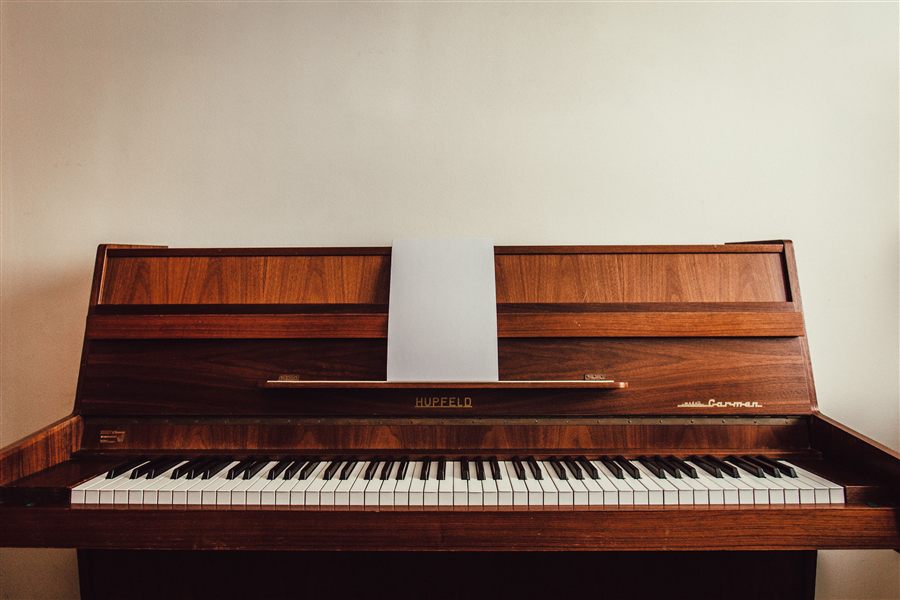
Short answer: An upright piano should be tuned at least once a year, twice if it is played a lot or your home's climate swings through the seasons. A routine tuning in the US typically runs about $100 to $200 (as of Oct. 2026). Tuning, regulation and voicing are three different jobs: tuning fixes pitch, regulation fixes the mechanics and touch, and voicing shapes the tone of the hammers. A few listening and feeling tests will tell you which of them your piano needs.
What happens during a tuning
Depending on the register, an upright has one, two or three strings per note, and together they pull with many tons of tension on the cast-iron plate. A technician changes the tension of each string with a tuning lever turned on the tuning pin until the pitch is right and the strings of one note sound as a single clean tone.
The process step by step
- Set the temperament: The technician first tunes a middle octave, usually around A4, which sits at the standard 440 Hz. Felt strips mute the strings that are not being tuned so only one string sounds at a time.
- Extend to the octaves: From that octave, every other octave above and below is tuned note by note.
- Tune the unisons: The second and third strings of each note are matched to the first until the wavering beats disappear.
- Check: Finally intervals and chords are tested and small corrections made.
Modern pianos use equal temperament: the octave is split into twelve equal semitones so every key works equally well. The price is that some intervals, such as thirds, are deliberately a little wide and beat slightly. That is intended, not a flaw.
Octaves are also stretched slightly, tuned a touch wider than the theoretical 2:1 ratio. The reason is inharmonicity: stiff strings, especially the short, thick bass strings of an upright, have overtones that vibrate a little higher than the pure math predicts. An electronic tuner can assist, but it does not replace an experienced ear that judges that stretch.
A tuning in a piano in decent shape usually takes about an hour to an hour and a half. A neglected piano can take two to three hours.
Why tuning it yourself is not recommended
Tuning takes real skill. The pin has to be set so the string does not drift back within days, and heavy-handed turning can snap strings or loosen the pins in the pin block, damage that costs far more than years of professional tunings. Phone apps show a frequency, not technique. Watching a technician and asking questions is a great way to learn; doing it yourself is not advised. This article describes the process, it is not a how-to.
How often to tune
Sources vary: some say at least every two to three years, but most technicians and makers recommend at least once a year, ideally twice. A practical rule of thumb:
- New piano: more often at first, often three to four tunings in the first year, because strings stretch and the instrument settles.
- Regularly played home piano: once a year, twice if you care about tone or your climate has big seasonal swings.
- After a move: let the piano acclimate first. Two to four weeks is a commonly quoted wait, then tune.
- Left untuned for years: have the condition assessed first; see pitch raises below.
The best time is when temperature and humidity are as stable as possible, for example after a season change. Spring and fall are popular choices.
Why pianos go out of tune
The main cause is humidity. The wooden soundboard swells in damp air and pushes the strings upward, so pitch rises. In dry air the wood shrinks, the pin block grips the pins less firmly, and pitch drops. This happens whether or not anyone plays. New strings also stretch, and in old pianos the pins loosen.
How to manage placement and room climate is covered in humidity and placement for pianos. A common target is 40 to 60 percent relative humidity, away from radiators, windows and exterior walls, and not in damp basements or garages.
What tuning costs
| Service | Typical range in the US (as of Oct. 2026) |
|---|---|
| Routine upright tuning | about $100 to $200, often $150 to $200 in practice |
| Pitch raise plus tuning | about $180 to $300 |
| Badly neglected piano | about $200 to $400 and up |
| Technician hourly rate for extra work | about $60 to $180, depending on credentials and region |
Prices vary by region, with big metro areas on the high end, and by technician. Ask whether travel is included and what the extra charge is if the piano is far below pitch. Some shops sell bundles that include small voicing or regulation tweaks, which cost more than a plain tuning.
Pitch raise: when the piano has sunk below pitch
If a piano goes untuned for years, its overall pitch sinks below the 440 Hz standard. Simply tuning it once is not enough, because every string you raise adds tension to the plate and pulls the already tuned strings back down.
So the technician does a pitch raise first: all strings are brought roughly up to pitch, and a fine tuning follows, often in a second pass. This takes longer and costs more. If a piano is very far down, well below 400 Hz, several visits may be necessary, and the technician will first judge whether the plate, strings and pins can take it.
Older instruments were sometimes tuned lower, and occasionally a technician advises against raising an old piano all the way to 440 Hz because aged strings may break. That is a judgment call on the individual piano.
Tuning stability
How long a tuning lasts depends mostly on room climate and pin condition. A piano that is clearly out of tune again soon after tuning, in a room with stable humidity, points to loose pins in the pin block or a structural problem. Tuning then only treats the symptom, and when buying used, this should factor into your negotiation (see buying a used upright: what to look for).
Tuning, regulation and voicing compared
| Job | What changes | Typical symptom |
|---|---|---|
| Tuning | Pitch (string tension) | Notes sound off, chords beat unpleasantly |
| Regulation | Action and keyboard (touch) | Keys uneven in depth or weight, notes lag or will not repeat |
| Voicing | Tone color of the hammer felt | Some notes too harsh, bright or dull |
Regulation
Regulation involves roughly eight separate adjustments per key, for example key height, key dip (how far the key travels down), let-off (the point where the hammer leaves the action and flies freely to the string; played slowly, the hammer typically stops within a few millimeters of the string) and the damper travel. The goal is an even touch across all 88 keys and reliable repetition. On the keyboard itself, spacing, guides and key height are evened out, and in the action the hammers are aligned.
Signs regulation is due: individual keys sit lower or higher than their neighbors, feel heavier or sluggish, a note will not repeat quickly, or it triggers unreliably. A piano that feels uneven despite a clean tuning is a regulation case.
Voicing
Voicing changes the felt, not the mechanics. A technician pricks overly hard hammers with needles to soften and warm the tone, or treats overly soft hammers to brighten them, evening out tone color across the keyboard. This is delicate work for a professional. Poking at the hammers yourself usually ruins the felt for good.
Order matters: tune first, then regulate, then voice. Voicing an unregulated action does little, since it refines tone and cannot solve mechanical problems. Voicing is also needed after any hammer reshaping, because the tone changes, often brighter after filing.
Costs for regulation and voicing
| Service | Typical range in the US (as of Oct. 2026) |
|---|---|
| Voicing | about $100 to $200 for simple work; voicing plus regulation about $180 to $600 |
| Regulation | about $200 to $700 for routine work |
| Full action reconditioning with regulation | about $300 to $1,700, depending on scope |
The spread is wide because it depends on condition, scope and region, so get a written quote. Regulation and voicing often go together with a tuning but are not needed every year; a more thorough regulation is more of a once-per-decade job for a normally played piano, depending on how much it is used.
Checking the action and hammers yourself
A technician judges the action better than you can, but as an owner or buyer you can see and hear a lot. Open the top lid and, if it comes off without tools, the front panel so you can see hammers and dampers. Work gently, and keep dirty fingers off strings and felt.
Hammers
- Shape: Healthy hammers are round and even. Flattened or squared-off tips often mean a harsher, brighter tone.
- Grooves: String grooves pressed into the felt show how much the piano has been played. Shallow marks are normal; deep, wide grooves point to heavy use.
- Moths and insects: Look for small holes, loose felt dust or powdery residue on hammers and other felt parts, especially in pianos that sat unplayed for a long time.
- Loose hammer heads: A common cause of clicking when a key is struck.
Touch and response
Play slow, quiet scales and chords across the whole keyboard. Every key should dip equally, feel equally heavy and return cleanly. Also try quick repeated notes: a note that stops speaking when the key only partly returns is often a regulation case. Touch weight tends to increase with wear; after 10 to 15 years of heavy use a noticeably heavier touch is not unusual.
Dampers
Play a note, hold the key, then release: the sound should end immediately. If a note keeps ringing, the damper is not closing cleanly, perhaps from hardened felt, a broken spring or a misadjusted action. A buzz on release can also come from damper felt.
Pedals
The right pedal lifts all dampers so notes keep sounding. On an upright, the left pedal moves the hammers closer to the strings, which makes the touch softer and quieter. The middle pedal does different things depending on the model, such as a bass sustain or a muffler. All pedals should move without squeaks, catching or a sticky feel. Squeaks often come from dry pivot points, which a technician can usually fix in minutes.
Rattles, buzzes and sticking
- Rattles or buzzes: often loose screws on rails, foreign objects behind or under the keyboard (coins, pencils), or loose cabinet parts. Check whether the noise only appears on certain notes.
- Sticking keys: usually dust or swollen wood from high humidity.
- Notes that keep ringing: see dampers.
If you cannot place a noise, write down the key and the situation and show your technician. Turning screws or adjusting parts inside yourself is best avoided, since wrong settings make the touch worse.
Hammer rework, re-felting and overhaul
Hammers wear because they strike steel strings with every note. The technician decides what is needed, but here are the options at a glance:
- Filing (reshaping): The hammer surface is sanded back to a round profile. It is the cheapest option.
- Re-felting: New felt is applied if enough substance and sound wooden cores remain.
- Replacing hammers: A full new set.
Prices for hammer rework and replacement vary by shop, get a quote. Technicians commonly cite refiling hammers after roughly five years and replacing them after 10 to 15 years of heavy playing. Voicing is needed after each of these jobs because the tone changes.
Full overhaul
A full overhaul typically covers the action, hammers, dampers, strings and, depending on condition, the tuning pins and the finish. Costs vary by shop, get a quote. It rarely pays off: older uprights sell for low prices, so an overhaul can easily exceed what the instrument is worth. It makes most sense for a high-quality, historic or sentimentally valuable piano. Old does not automatically mean valuable, and uprights built before 1900 are often not worth restoring. Technicians generally describe an overhaul as something that comes up every 40 to 60 years, sooner with heavy use.
Care between appointments
- Room climate: steady 40 to 60 percent relative humidity, not directly beside a radiator, window or exterior wall. A hygrometer in the room tells you when to act.
- Placement: if you move the piano around the house, have it tuned again afterward.
- Cleaning: use a dust cloth and an antistatic brush on the case; wipe fingerprints with a slightly damp cloth and no harsh cleaners. Do not use vacuums or sprays inside.
- Keep the lid closed when not playing to keep dust out; it does not protect against humidity.
- Do not set things on top: drinks, plants and vases are a danger to the finish and to the inside.
If you are thinking of adding a silent system, note that the acoustic action still needs care and tuning. More on that in retrofitting a silent system.
Common mistakes and myths
- "If nobody plays it, it stays in tune." False. Tuning stability depends on humidity, not on playing. An unused piano still drifts.
- "Tuning too often is bad for it." No. Staying close to standard pitch puts less long-term stress on the instrument, and each later tuning holds better.
- "Tuning, regulation and voicing are the same." They are not. A perfect tuning does not cure an uneven touch or a harsh tone.
- "Old means valuable." Not automatically. A restoration can cost as much as a modest new instrument.
- Waiting too long: the further pitch sinks, the more work and cost it takes to recover.
- Tuning right after a move: the piano needs time to adjust to the new room first.
- Choosing the cheapest tuner: ear and experience decide how well a tuning holds, not the price.
What do you need when: a quick guide
- If the piano sounds off or has not been tuned in a while, it needs a tuning, possibly with a pitch raise first.
- If keys feel uneven or notes respond late, it needs regulation, ideally alongside a tuning.
- If individual notes sound too harsh, bright or dull even though tuning and action are fine, it needs voicing.
- If hammers are deeply grooved, dampers are faulty or many parts are worn, get a quote for rework or an overhaul before buying a used piano or continuing to use it as is.
When buying used, bring a piano technician along to the viewing. They spot wear and follow-up costs that a layperson will miss.