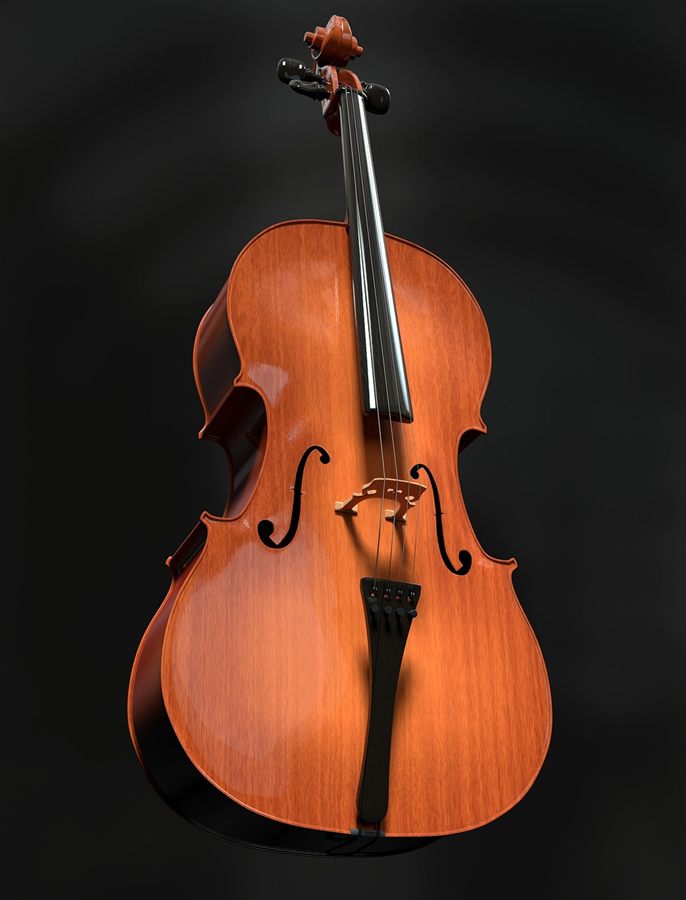
Short answer: Cello strings come with a steel core, a synthetic core (nylon or perlon-type fibers) or a gut core. Steel is tough, stays in tune and costs the least; synthetic is the all-rounder with a warm sound; gut is the most complex-sounding but moody and expensive. A beginner does well with a solid steel or synthetic set, and you can change strings yourself as long as you replace only one string at a time.
The three core materials compared
A cello string is a core that carries the vibration, wrapped in metal that adds mass and colors the tone. The core shapes response, warmth, tuning stability and lifespan more than anything else. No string is best at everything: short break-in, the richest sound, easy response and perfect tuning stability partly exclude one another in practice, and every cello reacts a little differently.
| Core | Sound | Response | Tuning stability | Lifespan | Price level |
|---|---|---|---|---|---|
| Steel | clear, direct, powerful; cheap sets can sound metallic | fast | very high | long | low to mid |
| Synthetic | warm, round, rich in overtones | soft to medium | high | medium | mid to high |
| Gut | very warm, complex, nuanced | soft, sensitive | low, reacts to climate | short to medium | high |
Steel core
Steel strings respond quickly, hold pitch even when room humidity swings, and survive a lot of playing time. The tone is clear and focused. Very cheap sets can sound tinny and sharp, while better steel strings with a finer core and better winding sound noticeably warmer and rounder. The low strings are often wound with tungsten, which adds brilliance and projection at a higher price. Steel is the standard choice on student instruments and for anyone who wants a no-fuss cello.
Synthetic core (perlon, nylon)
Synthetic cores made of nylon or polyester fibers try to combine the warmth of gut with the stability of steel. They are far less sensitive to climate than gut, settle in within a few days and give a round, soft, overtone-rich sound. In exchange they usually last less long than steel, and some players report that even high-end synthetic sets turn noticeably dull after a few months. For intermediate students and amateurs, synthetic is typically the first choice.
Gut core
Gut strings are made from twisted animal intestine, mostly sheep. They sound warm and layered, which is prized in solo playing and period-style performance. The price is high: gut reacts to temperature and humidity, swells in damp air and loses tension, and often needs frequent retuning after installation. Reports on break-in time range from one to three days up to about a week. Professionals sometimes replace gut every one to two months, while a set typically lasts around a year. Some players say gut holds its tension longer than synthetic once it has settled. Gut is mostly not recommended as a first set for a beginner.
Hybrid and mixed sets
Besides pure sets there are hybrid combinations and free mixes. It is common to take the upper A and D strings from one line and the lower G and C from another, for example synthetic A and D for warmth and tungsten-wound G and C for depth and power. This is normal practice and not a defect on a used cello.
What this means for sound and feel
- Response: How easily the note speaks. Beginners benefit from easy-responding strings because a clean bow stroke comes sooner.
- Tone color: Between warm and brilliant. Warmth helps a cello that sounds bright or edgy; brilliance helps one that sounds dull or lacks projection.
- Tension: Higher tension often gives more power and focus, lower tension more softness and flexibility, but can feel less direct.
- Instrument dependence: Every cello responds differently. A string that shines on one instrument can be a poor match on another, so more expensive does not automatically mean better for your cello.
Full set or single strings?
A set contains four strings (A, D, G, C) and is the simplest choice because the strings match in tone and tension. If only one string breaks, you can replace it alone as long as it belongs to the same line as the others. If the rest are old, a single new string often sounds louder and different from its neighbors, so a full set keeps the tone balanced. Single strings are also the way to build a mixed set on purpose.
Prices in the US
Prices vary by brand and retailer; these are rough ranges (as of Oct. 2026):
- Entry-level student sets start at roughly $65, with simple sets up to about $90.
- Common brand-name steel and synthetic sets run roughly $145 to $155.
- A single entry-level A string costs about $17 to $19.
- Premium synthetic and mixed sets run roughly $300 to $485, depending on the line and retailer.
What a shop charges to install strings varies by shop, so get a quote.
Which strings for whom?
Beginners
A new player does well with an inexpensive to mid-priced steel-core set or a solid synthetic set. Both hold their tuning, forgive mistakes and need little care. More important than the brand is that the strings are fresh and the cello is set up properly (see checking endpin, bridge and soundpost). Gut is impractical at the start because it demands constant retuning.
Intermediate and advanced players
Players in orchestra or chamber groups usually move to synthetic or to mixes of synthetic and tungsten. Experimenting pays off here: changing the brand or tension often alters response and tone more than expected. Soloists in a stable room climate also try gut or high-end synthetic for a direct, projecting sound.
A used cello
A dull-sounding used instrument may simply have old strings: stretched, discolored or fraying strings are a common and cheap-to-fix cause. Budget for a fresh set before you judge the cello for good (more under buying a used cello).
How often to replace strings
Figures differ: a general range of 6 to 12 months is common, and for about an hour of daily playing, 3 to 5 months. Hobby players often change once a year, professionals much more often, and gut sometimes every one to two months. Steel lasts longest, gut the shortest, with synthetic in between.
Time for new strings when:
- the cello will not tune cleanly or keeps drifting,
- the sound turns dull and lacks overtones,
- vibrato and response become harder or you need more pressure,
- the winding looks frayed or discolored,
- a string breaks. Then a complete set is the sensible move.
Strings last longer if you wash your hands before playing and wipe strings and body with a soft dry cloth afterward. A spare set in the case is handy, and the old set works as an emergency backup.
Changing strings yourself, step by step
Golden rule: Change one string at a time. The bridge is held in place only by string pressure, and the soundpost inside is held by that same pressure. If you take all strings off at once, the bridge can fall and the soundpost can topple, and a luthier must reset it.
- Order: It does not matter much; many players start with the C string and work toward the A.
- Slacken the string: Turn the fine tuner on the tailpiece back, then turn the peg to release tension. Take the string out of the pegbox and pull it out of the tailpiece.
- Lubricate the grooves: A little soft pencil graphite in the bridge and nut grooves lets the string glide. Worn or sharp grooves cause string breakage and should be fixed by a luthier.
- Attach the new string at the tailpiece: If it has a ball or loop end, hook it over the fine tuner and run the string toward the bridge. It must sit in its bridge groove.
- Wind it on the peg: Pass the end through the peg hole, leave a short tail and wind evenly with the coils side by side. Push the peg into the hole while turning so it does not slip.
- Bring it up to pitch: Tune slowly and watch the bridge.
- Realign the bridge: String pull often tips the bridge slightly toward the fingerboard. It should stand straight, with its back face perpendicular to the top, and sit centered between the f-holes. Experienced players make small corrections carefully; otherwise ask a luthier.
- Next string: Repeat for the remaining strings.
Pegs and fine tuners
Slipping pegs can be improved temporarily with a little candle wax, sticking pegs with graphite. Pegs that stay stiff or leak belong at a luthier. Fine tuners make small corrections easy; do large pitch changes at the peg instead.
Bridge and soundpost position
The bridge stands on the top between the f-holes, and the soundpost is a small wooden dowel inside the body connecting top and back. Both strongly influence tone and response. A sudden change in sound, rattling or a crooked bridge suggests something has shifted. Only a luthier should set the soundpost.
Break-in time
New strings stretch under tension, so pitch drops at first. That is normal. Leave the strings under tension for a few hours or overnight, then fine-tune. A set needs a few days to roughly a week to become truly stable, depending on the material; synthetic and steel usually settle sooner than gut. Regular playing speeds it up. Do not schedule a change right before a concert or exam.
Strings and the wolf tone
The wolf tone is a howling, fluttering wobble on certain notes, usually somewhere between D and G, often on the G string around fourth position. It happens when the played pitch comes close to a resonance of the cello body. Good cellos often have a stronger wolf than mediocre ones. String choice can influence it: lighter strings or lower tension sometimes help, though a string change may also simply move or alter it. Other remedies include a small added weight on the string below the bridge (a wolf eliminator, in the simplest case a rubber mute) or a bridge and soundpost adjustment by a luthier. Basic rubber mutes cost roughly $0 to $5 and small brass suppressors roughly $16 to $50 (as of Oct. 2026). Every fix dampens the sound a little, so the rule is to use as little intervention as possible.
Common mistakes
- Removing all strings at once: the bridge falls and the soundpost topples.
- Mixing old and new strings by accident and wondering why the tone is unbalanced.
- Expecting stable tuning right after a change and judging the set too early.
- Leaving the bridge tilted after the change.
- Replacing strings when the real cause of tuning trouble is the pegs, the climate or the grooves.
- Using gut in dry or swinging humidity. Stable humidity and temperature help (protecting your cello in winter).
- Putting the priciest strings on a poorly set-up cello without having the bridge and setup checked.
Myths
- "Gut always sounds better." It sounds different, often warmer and more complex, but not on every cello and not in every room.
- "Steel always sounds metallic." That applies mostly to cheap sets; good steel strings sound much rounder.
- "More expensive means better." Fit to the instrument and playing style counts for more than price.
- "Strings last until they break." They lose brilliance and tuning stability long before that.