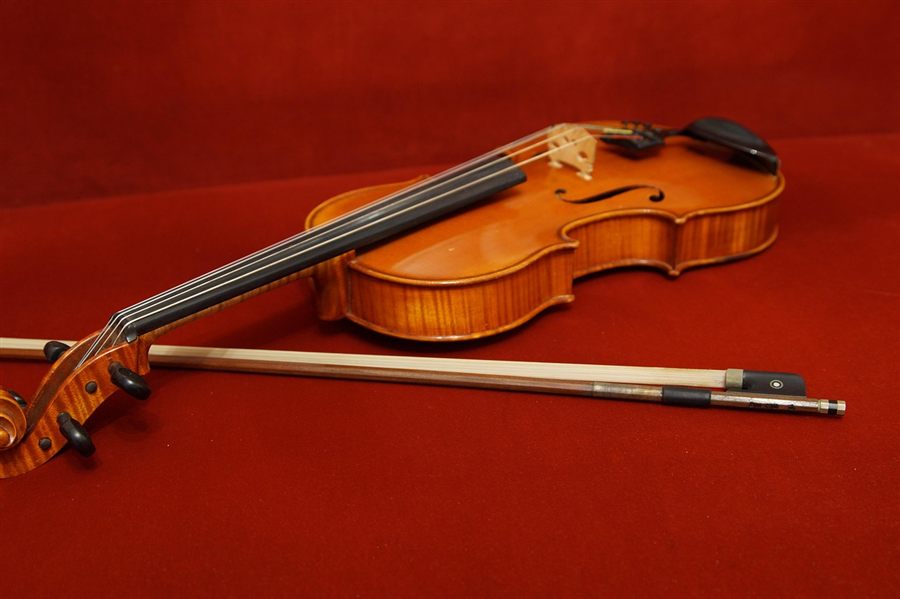
You buy a viola by arm length and feel, not by a fractional size: adults usually play 15.5 to 16.5 inches (roughly 39 to 42 cm body length), children from about 11 or 12 inches. Trying several sizes matters more than any chart. A used viola is worth it when size, condition (no cracks near the soundpost, open seams properly reglued) and setup are right. For beginners and growing children, renting is often the smarter route.
Why viola sizing differs from the violin
The violin comes in a fixed fractional system (1/16 to 4/4); a full-size violin has a body of about 35.5 cm. Violas have no equally clear system. Size is quoted in inches or in cm of body length, and adult violas run continuously from about 38 to over 42 cm. Makers draw the lines between small (about 38.5 to 39.5 cm), medium (about 40.5 cm) and large (about 42 cm) a little differently. A listed "16 inch" is also a nominal size: two 16-inch violas can differ noticeably in body shape, width and neck.
String length often matters more than body length
For the left hand, what counts most is the string length (mensur), the vibrating length from nut to bridge. Violas turn up with anywhere between about 34 and 40 cm. Around 36 to 36.5 cm is a common range for demanding playing; up to about 37.5 cm adds brilliance and projection, while beyond that string tension and effort become a problem. Shorter string lengths sound darker and softer and respond more easily, which is why amateurs often like them.
Two violas of the same body length can therefore feel very different: if shorter middle bouts put the bridge higher, the string length ends up shorter despite a long body. Width also tends to shape the tonal fullness more than half a centimeter of length. When trying instruments, ask about the string length, or measure from the nut to the center of the bridge.
Finding the right size
The arm-length method
The standard test: hold the viola in playing position with your chin on the chin rest, then reach your left arm out under the viola. The scroll should sit in your palm and your fingertips should curl comfortably around it with a slight bend in the elbow. If the arm has to be fully straight or your fingers do not reach the scroll, the instrument is too big.
Alternatively, measure with the left arm stretched out sideways from the neck to the wrist (comfortable size) and to the center of the palm (largest usable size). As a rough guide:
| Viola size | Arm length (neck to wrist) | Typical age |
|---|---|---|
| 12 in (about 30.5 cm) | up to about 20 in (50.8 cm) | 6 to 7 years |
| 13 in (about 33 cm) | up to about 22 in (55.9 cm) | 7 to 9 years |
| 14 in (about 35.5 cm) | up to about 23 in (58 cm) | 9 to 12 years |
| 15 in (about 38 cm) | up to about 24.5 in (62 cm) | about 10 to 12 years, small adults |
| 15.5 in (about 39.5 cm) | up to about 25.25 in (64 cm) | average adult |
| 16 in (about 40.5 cm) | up to about 26 in (66 cm) | larger adults |
| 16.5 in (about 42 cm) | about 26 in (66 cm) and up | larger adults, by preference |
Treat the chart as a guide; sources differ in the details, and hand, finger and shoulder build play a role. If you fall between two sizes, the smaller one is usually the better choice, especially for children.
Children and switchers from violin
Many children start on violin and move over later. Small violas exist down to very small sizes (a scale starting at 1/16 is usual), and common children's violas run from 11 to 14 inches. An adult viola is nearly unplayable for a child. If you are coming from the violin, our guide to switching from violin to viola covers the practical differences.
Bigger is not automatically better
A larger body generally means more air volume and therefore a fuller, darker tone, especially on the low C string. The price is bigger stretches, more weight, and a hand that tires sooner. A smaller instrument plays more comfortably but can sound a little thinner in the low register. Many players deliberately choose a compromise instead of the largest size they can barely manage. A common piece of advice sums it up: a player who struggles will not play well.
Test playing: how to try an instrument
- Play the same piece on several sizes and instruments so you can compare.
- Play scales across all four strings and all positions, slowly and fast. Check that the C string speaks cleanly without buzzing or a wolf tone and that the A string does not turn thin or harsh.
- Try different bows, since the bow shapes the sound considerably.
- Have someone else play while you listen from across the room. Projection sounds different at a distance than at your ear.
- If possible, bring a teacher or an experienced violist.
Wood and origin influence character: European woods often sound warmer and sweeter, cheaper woods tend to sound brighter. Very cheap mass-produced instruments sold online often stand out for poor workmanship and tone.
Buying used: checking the condition
The construction and typical damage of a viola match the violin, so the same checks apply. Ask the seller for a written condition report if possible, and ask to look at the interior and any repair spots.
Cracks and seams
- Open seams are not true cracks. They happen when the glue in a joint lets go, for example through climate swings. A shop can reglue them, but while open they dull the sound and often buzz. Cost is roughly $20 to $40 for a simple seam, more for several (Oct. 2026 estimate, varies by shop, get a quote).
- True cracks in the top or back should be professionally repaired, recognizable by clean reinforcements inside. Check whether a crack still gaps or vibrates when touched.
- Soundpost cracks, meaning cracks under the soundpost foot or under the treble bridge foot, are especially critical. On quality instruments they can cut the value by roughly 40 to 60 percent. On an entry-level instrument they are usually a reason to walk away.
- Patches inside the back or top signal bigger past repairs. Ask why.
- Check whether the varnish is original. Large areas of new varnish reduce value.
Bridge, soundpost, fingerboard and pegs
- Bridge: It should stand straight and upright, with string grooves that are not cut deeply. A warped bridge is easily straightened or replaced. A new bridge runs about $75 to $150 (Oct. 2026 estimate, varies by shop, get a quote).
- Soundpost: The small wooden dowel inside sits under the bridge and shapes the tone. Buzzing or a hollow tone can mean it has shifted. Only a shop should set it. A new soundpost is roughly $45 to $80 (Oct. 2026 estimate).
- Fingerboard: Check that it is even and free of deep grooves. Worn boards are dressed by a luthier; a full replacement costs far more. Varies by shop, get a quote.
- Pegs: They should turn smoothly and hold. Fitting pegs is a shop job; varies by shop, get a quote.
- Neck and neck angle: The neck should not look tilted back, and the bridge should not sit strangely high or low. Anything involving the neck belongs in a professional shop.
Tone and the C string
The C string reveals a lot. It should speak round, dark and strong, without dullness or buzzing. A hollow, nasal or wolfy C string can partly be improved with strings and setup, but sometimes it is simply a trait of the instrument. If a viola sounds thin or feels stiff, strings or the bridge are often the cause rather than the instrument. For details see our guide to viola strings and setup.
Dealer, luthier or private sale
From a luthier or specialist dealer you get a checked, set-up viola, often with advice, size exchange options and sometimes credit for earlier rental payments. Prices are higher. Private sales can yield bargains, but condition and setup are often unknown. Get seller statements about the condition in writing, compare them with the real instrument, and have a shop look at it before buying if in doubt. Involving your teacher also helps.
The used market for violas is much smaller than for violins. Plan for patience and do not buy hastily just because a viola is within reach.
Rent or buy?
For beginners and children who are still growing, renting often makes sense, since the right size changes and rental programs usually make size swaps easy. In the US, monthly rents typically fall around $18 to $36 for a student viola, depending on size and shop, with a few outfits higher (Oct. 2026 estimate). Many programs credit some or all of the rent toward a later purchase during the first year, and often offer optional insurance. Check the terms in each case.
Buying is better once you are an adult, sure of your size and planning to keep playing. Do the math: $30 a month is $360 a year, which already reaches the price range of a basic student instrument.
Prices in the US
| Tier | Price range (Oct. 2026 estimate) | What to expect |
|---|---|---|
| Student outfit | about $595 to $800 | Viola with bow, case and rosin, set up by a dealer |
| Intermediate | about $800 to $2,000 | Better wood and workmanship, clearer response |
| Professional | about $2,000 and up | Hand-finished, individual tone |
Other price guides run much wider (from a couple of hundred dollars up into the thousands for student instruments), so treat these as orientation, not fixed prices. Very cheap instruments of around $70 are rarely worth setting up.
Complete outfit and bow
An outfit usually includes viola, bow, case and rosin, which is economical for starting out. The viola bow is slightly shorter and heavier than a violin bow (roughly 70 to 72 g versus 60 to 62 g for a violin) and has wider hair. As a rough match: violas from 15 to 16.5 inches take a 4/4 bow, 13 to 14 inches a 3/4 bow, 12 inches a 1/2 bow and 11 inches a 1/4 bow. When buying a used viola, check that the bow is really a viola bow and not a violin bow slipped in.
Setup and repair costs
Even a cheap viola needs a proper setup (bridge, soundpost, strings, pegs). Setup is especially worthwhile on budget instruments, because it decides tone and playability. Rough guides for the US (Oct. 2026 estimate): new bridge about $75 to $150, new soundpost about $45 to $80, gluing an open seam about $20 to $40, crack cleat repair from about $50, soundpost patches from about $75 and far more for larger repairs. Prices for violin and viola are similar; the shop quotes the exact cost after seeing the instrument. Work on the top, neck or inner bracing, and setting the soundpost, belongs in a professional shop even if it looks simple.
Common buying mistakes
- Choosing size from a chart or age instead of by test playing.
- Buying too big because the child will grow into it.
- Buying a cheap instrument without setup and then despairing over the sound.
- Missing cracks under the soundpost or fresh repairs.
- Mixing up viola bow and violin bow.
- Ignoring string length and looking only at body length.
If you want to try a viola without committing, a rental is a good fit. Before buying, a session with your teacher is always worth it.