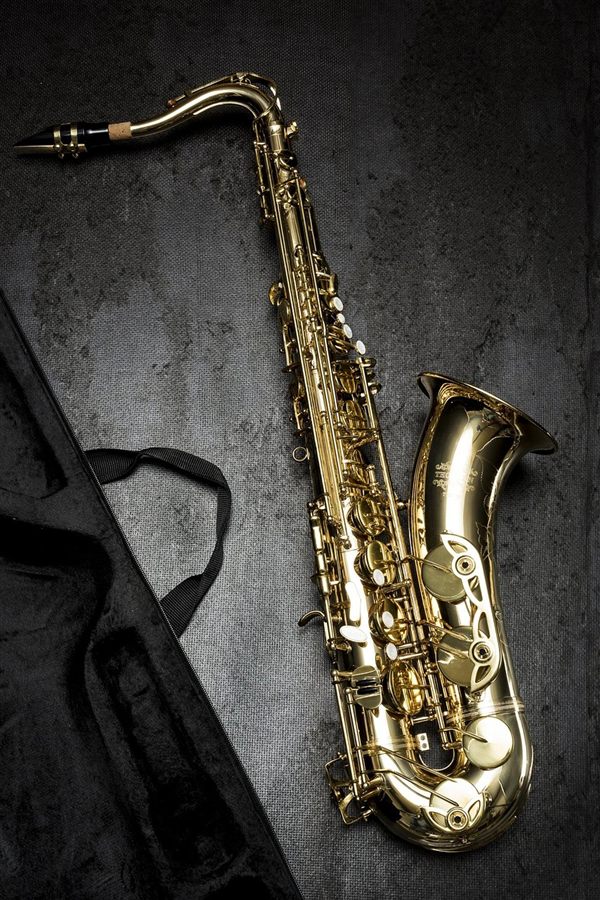
For most beginners the alto saxophone is the best first horn: it is light, forgiving of embouchure and intonation slips, and has the widest supply of lessons, music and used instruments. Tenor makes sense if the deeper, huskier sound is what pulls you in and you are comfortable with the extra weight. Soprano is usually a second horn, because tiny changes in embouchure and air shift its pitch noticeably.
The saxophone family at a glance
Adolphe Sax, a Belgian instrument maker, developed the saxophone in the 1840s and received his patent in 1846. He planned two series of instruments, and the E-flat and B-flat series is the one that took over. All of them have a conical tube, a single reed on the mouthpiece and nearly the same written range of a little over two and a half octaves. The fingering is the same on all four common sizes, so switching between them is mostly a matter of embouchure, air and feel.
| Type | Key | Sounds compared with written music | Weight (rule of thumb) | Length (rule of thumb) | Tone |
|---|---|---|---|---|---|
| Soprano | B-flat | a major second lower | about 2.5 to 3.5 lb | about 29 to 31 in | bright, piercing, slightly nasal |
| Alto | E-flat | a major sixth lower | about 4.5 to 5.5 lb | about 25.5 in | clear, bright to mid-focused, versatile |
| Tenor | B-flat | an octave plus a major second lower | about 6 to 7.5 lb | about 36 in | warm, deep, huskier |
| Baritone | E-flat | an octave plus a major sixth lower | about 12 to 14 lb | about 48 in | very deep, big and round |
Weights and lengths vary by model. Sopranos come straight or with a curved neck or curved bell. The baritone is not a beginner instrument because of its weight and price, and it mostly plays the bass line in ensembles such as big bands and saxophone quartets.
Which saxophone should you start on?
Alto as the standard
Alto is the usual standard for starting out, for several reasons:
- At roughly 5 pounds it is light enough for a neck strap to carry comfortably.
- Air demand is moderate and the embouchure is less demanding than on soprano or tenor.
- Pitch is easy to control, so beginners get usable notes sooner.
- Method books, band parts and school programs are built around alto, and there are plenty of used instruments and rental options.
- The keys sit closer together than on tenor, which helps smaller hands.
When tenor makes sense
No fixed age decides it. Three questions matter more: which part does your teacher or ensemble need, can you hold and handle the horn comfortably, and does the pitch range appeal to you? If you are tall or strong, love jazz, blues, rock or soul and want the tenor sound above all, starting on tenor is realistic. Expect more air demand, a larger mouthpiece and reed, more weight and a higher price. A comfortable strap or harness is close to mandatory.
Why soprano is usually a second horn
Soprano looks small and handy, so it seems like the easy option. In practice it is often the hardest to play:
- The short, narrow bore reacts very sensitively to embouchure and air. Even unconscious small changes in lip pressure or air stream push the pitch up or down right away.
- Intonation problems that would hardly show on alto stand out on soprano, which can be discouraging before you have a stable embouchure.
- The embouchure is more focused and the mouthpiece smaller. Biting down too hard quickly makes the tone thin and sharp.
- One octave key serves several notes, so the upper register is considered the tricky part.
Most soprano specialists started on alto or tenor and added soprano once tone production and embouchure control were established. If soprano repertoire is what excites you, you will generally do better to build fundamentals on alto first rather than learn saxophone basics and soprano's pitch sensitivity at the same time.
Straight or curved
Straight and curved sopranos have the same keys and range. The straight soprano is the classic shape but is held out in front, which feels unfamiliar to some. Curved models and ones with an angled bell sit closer to the feel of an alto, and some players find their sound warmer and less nasal. That is a matter of taste, not of skill level.
Body size, age and kids
- For children, alto is the rule. Around age ten is when most kids are big enough, and many start between nine and twelve. Younger children often begin on recorder to practice fingerings and breathing.
- An alto hangs from the neck strap rather than from the arms, so body height matters less than you might expect.
- Small hands are not a deal breaker. Many fine players have small hands, and the alto's keys are closer together.
- Adults can start at any age. For older players or anyone with back or shoulder trouble, the lighter alto is usually the more comfortable choice over tenor.
What does getting started cost?
New prices
Prices vary by shop and sale. Reliable beginner saxophones from established makers typically cost about 500 to 1,200 USD. Some entry-level altos start at around 650 USD.
| Class | Example | Rule-of-thumb new price (as of Oct. 2026) |
|---|---|---|
| Student alto | Yamaha YAS-280 | about 900 to 1,065 USD, some shops up to about 1,100 USD |
| Student tenor | Yamaha YTS-280 | about 1,500 USD |
| Entry-level alto | BetterSax alto | about 650 USD |
| Intermediate | various makers | varies by shop, get a quote |
Why very cheap horns are risky: beginners cannot compensate for poor intonation the way experienced players do and may learn wrong pitch habits. Soft metal, leaking pads and mechanics that are hard to repair are common on instruments around 200 USD, and fixing leaks can cost 75 to 300 USD or more soon after purchase. For beginners, good intonation and easy response count for more than a special tone.
Used prices
Used student altos run from around 300 to 950 USD. A used Yamaha YAS-23 usually sits at about 300 to 650 USD, a YAS-26 at about 760 to 950 USD. Condition and included accessories change the numbers a lot. Used can save money but may bring worn pads, springs, corks or dents and costly repairs. A checklist is in buying a used saxophone. If you want an older horn restored later, see saxophone overhaul costs and process. For historic models, read vintage saxophones and well-known makers.
Rent or buy?
Renting is smart when a child may not stick with it. Alto rentals in the US typically run about 30 to 56 USD a month, with offers from about 25 to 85 USD depending on the shop and instrument level (as of Oct. 2026). Many programs credit rental payments toward a purchase, often for the first year. Check minimum terms, insurance or repair coverage, and whether the horn has had a technician setup. Buy once the teacher and the commitment are clear.
First-time accessories
A new saxophone normally ships with a case and mouthpiece. You will also need:
- Reeds: they wear out and chip. A box of 10 for alto starts around 25 USD (as of Oct. 2026). Buy several and rotate them to make them last.
- Neck strap: it carries the instrument. Basic straps cost about 15 to 30 USD, premium ones 50 USD or more. On tenor and baritone, a harness is worth it.
- Swabs: one each for mouthpiece, neck and body (pull-through swab). Expect about 15 to 20 USD. Without them moisture stays inside the horn.
- Cork grease: about 5 to 10 USD. It keeps the neck cork supple so the mouthpiece fits cleanly.
- Stand: folding stands start around 25 USD. A stand keeps the horn off the floor and chairs.
- Music stand, tuner, metronome: useful but secondary.
A starter set of accessories usually adds up to roughly 80 to 250 USD. For mouthpiece and reed choices see choosing mouthpiece and reed strength. As a rule of thumb beginners start on fairly soft reeds; recommendations range from strength 1.5 to 2.5 depending on the mouthpiece tip opening. Reeds that are too soft sound shrill and make the later move to a fuller tone harder, while ones that are too hard cost unnecessary effort.
Learning path and timeline
A good path starts with posture, breathing and tone on the mouthpiece and neck alone, then moves to long tones and simple scales, then short pieces. With regular practice the basics are in place after about two years. A teacher saves a lot of frustration, especially on embouchure and breathing. Before you buy, talk to an experienced player and try the horn if you can.
Transposition in brief
Saxophones are transposing instruments: you read the same fingerings, but the sounding pitch differs from the written one. A written C sounds as E-flat on alto and as B-flat on tenor and soprano. For starting out it hardly matters because method books are already written in the right part. It becomes relevant when you play with C instruments such as piano or guitar, where the part must be transposed. Alto and baritone read in E-flat, soprano and tenor in B-flat, and when you switch horns you keep the fingerings and only the part changes.
Common beginner mistakes
- Biting: too much jaw pressure on the reed damps vibration and makes the tone thin. Pressure should come from the ring of the lips.
- Shallow breathing and no support: breathing only into the chest runs out of air quickly. Breathe low and support the air stream.
- Arms carrying the horn: the weight belongs on the strap; the arms only position it.
- Tense fingers and shoulders: the keys need no force, a light touch is enough.
- Wrong mouthpiece position: either too far forward, with the lips on the thick part of the reed, or not far enough in. Both make tone harder.
- Imprecise tongue: a short, clear "ta" gives a clean attack.
- Too cheap an instrument or the wrong reed: see above.
- Accepting squeaks as normal: squeaks often come from a dry, chipped or badly seated reed, too much mouthpiece in the mouth or dirty pads.
Hygiene and cleaning after playing
A saxophone collects your moisture, so hygiene matters for tone, health and the life of the instrument. A simple routine after every session:
- Loosen the ligature, take off the reed and pull the mouthpiece off.
- Gently dry the reed and store it in a reed guard so it dries flat, not left on the mouthpiece.
- Dry the inside of the mouthpiece with a small swab, taking care not to scratch the thin tip.
- Remove the neck and dry it with a fitting swab.
- Drop the weighted end of the pull-through swab through the bell and pull it through the body toward the neck opening. Repeat a few times.
- Lay the horn in its case on the intended support without bending any keys.
These habits help too:
- Rinse the mouthpiece every week or two with lukewarm water and mild soap, never hot water or abrasives, and dry it well.
- Keep the neck cork lightly greased when needed.
- Sticky pads can be cleaned with pad cleaning paper: slide a sheet lightly between pad and tone hole, close the key gently and pull the paper out. This reduces deposits and squeaks.
- Wipe fingerprints off the outside with a soft, dry cloth.
- Do not leave the horn in humid air or direct sun.
- With shared instruments (school, rental), clean the mouthpiece thoroughly before switching or use your own.
Mechanical work belongs in a shop: replacing or re-seating pads, straightening dents and bent keys, replacing springs and taking the horn apart. A technician also fixes notes that respond poorly, rattling keys or sticky mechanics. For a beginner a checkup at a shop about once a year is usually enough.
Myths and mix-ups
- "The small soprano is the easiest": false. Small means more sensitive, not easier.
- "Tenor is only for men": false. Handling and the sound you want decide, not gender. It needs more air and carries more weight, but with a strap or harness it is workable for many.
- "Alto is a kids' instrument": false. It is the most played saxophone, including by professionals.
- "Beginners don't need a good instrument": beginners benefit most from clean intonation and easy response because they cannot compensate for faults.
- "Used is always cheaper": only if the condition is right. Repairs can eat the saving.
- "An expensive mouthpiece makes you better": a solid standard mouthpiece is enough to start; technique matters more than gear.
Decision guide
- Want the standard and the safe choice? Alto saxophone.
- Drawn to the deep sound and happy to carry the weight? Tenor.
- Want to play soprano? As a second horn, once the basics are solid on alto or tenor.
- Unsure you will stick with it? Rent or rent-to-own.
- Small budget? A well-kept, checked used student model beats a new horn of unknown quality.
- Before buying: play it if possible or have an experienced player check it.