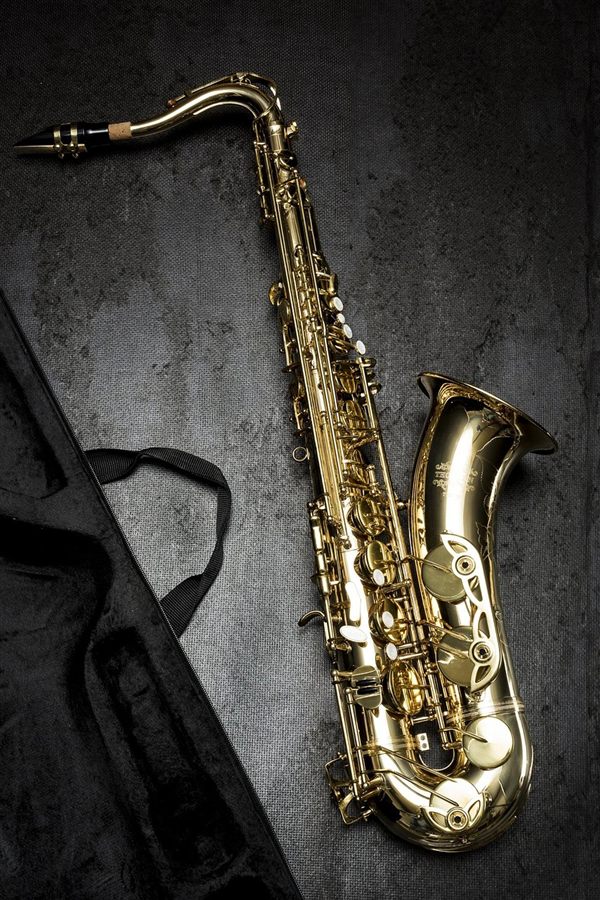
Short answer: "Vintage" usually means a saxophone built before the 1980s. The names players hunt for are Selmer (Balanced Action, Super Balanced Action, Mark VI), Conn, Buescher, King and Martin. Condition, originality, lacquer and playability decide the value, not age on its own. A serial number tells you roughly when a horn was built, but it is not an appraisal and not proof of authenticity.
What "vintage" means for saxophones
There is no official cut-off. In practice the word covers horns from the 1920s to roughly the 1970s, before mass production took over. Age by itself guarantees nothing. What older horns share is different manufacturing methods, different brass alloys, different key work and often a different response than a modern instrument.
It helps to be clear about why you want one. If you want to play, you need an instrument that can be adjusted reliably, plays in tune and has all its parts. If you collect or invest, originality, rarity and preservation matter more. The two do not always overlap: a pristine collector piece with a tired mechanism can play worse than a properly overhauled, slightly worn horn.
Well-known makers and models
Selmer Paris: Balanced Action, Super Balanced Action, Mark VI
The Balanced Action (introduced around 1935, built until roughly 1947 to 1948) was the first Selmer with the balanced key design. The Super Balanced Action (SBA, about 1947 to 1954) added offset tone holes in the key stacks, which improved ergonomics noticeably, plus a removable bell section held by screws and adjustment screws on the key work. Nearly every maker copied that layout later.
The Mark VI arrived in 1954 as the SBA's successor. For alto and tenor, production wound down around 1974 to 1975 when the Mark VII went into full production; soprano, baritone and bass models ran somewhat longer. Bore, neck and bow designs changed several times over the years, and on altos the bow was lengthened in the 85,000 serial range to improve intonation. Early examples are generally described as darker, later ones as brighter. It is well documented that the Mark VI used standard 66/34 yellow brass; the story about melted-down shell casings is not.
Opinion is split on the best serial ranges. Some valuation guides put the highest values on early numbers, roughly 21,000 to 99,999 (SBA and early Mark VI), while others favor horns from roughly 140,000 to 180,000. Both are market opinions, not measurements.
Conn
C. G. Conn founded the company in Elkhart, Indiana in 1876, built a first American saxophone prototype in 1888 and began regular production around 1892. Around 1920 Conn introduced rolled tone hole rims, meant to seat pads better, and kept them until 1947. The 10M tenor appeared in 1934, and players such as Charlie Parker and Johnny Hodges used Conns in the 1940s. The series from about 1934 to 1962 goes by the nickname "Naked Lady". By the 1950s Conn had lost ground in the professional market, and moving production in 1970 hurt the reputation further. That is why the best Conns come from the 1930s and early 1940s.
Buescher
Buescher built saxophones from 1894 and was Conn's main rival for decades. Known for the True Tone brand, snap-in pads (patented 1921) and above all the Aristocrat and the 400 "Top Hat & Cane" (from 1940). Selmer bought the company in 1963 and retired the brand in 1983. Post-1963 horns are generally less sought after.
King (H. N. White)
King began by importing French saxophones (from 1908), built its own woodwind plant in 1917 and acquired Cleveland in 1925. The Zephyr line (from 1935) and the Super 20, which grew out of the Zephyr Special in 1945, mark the high point. The Zephyr has a reputation for a lovely sound with sometimes tricky intonation. After the sale to Seeburg in 1965 the brand changed hands several times.
Martin
Martin (Elkhart, founded 1905) made saxophones from the 1910s into the late 1960s. The most wanted lines are the Handcraft Committee (1936), Committee II (1939), Committee III (from 1945) and the Magna (from 1956). Quality fell after Wurlitzer took over in 1964, and the brand ended in 2007.
Keilwerth and Yamaha
Julius Keilwerth started around 1925 to 1926, first as a supplier to other brands, and relocated to Nauheim after World War II. European horns of this kind also turn up as stencils under other names. Yamaha has made band instruments since 1965; the YAS-61 (from 1967) was its first professional alto and the YAS-62 followed in 1979. The earliest 62s carry a purple logo. On the 61 the pillars are mounted individually, on the 62 on straps.
Reading a serial number to find the build year
Most saxophones have a stamped serial number, usually on the body; the exact spot depends on the maker and model. Published charts match numbers to years. As a rough guide (figures vary slightly by source):
| Model | Period (approx.) | Serial range (approx.) |
|---|---|---|
| Selmer Modèle 22 | 1923-1926 | 1,130-4,500 |
| Selmer Modèle 26 | 1926-1928 | 4,400-8,100 |
| Selmer Balanced Action | 1935-1945 | 20,630-33,250 |
| Selmer Super Balanced Action | 1946-1955 | 33,250-61,260 |
| Selmer Mark VI | 1954-1975 | approx. 54,000-241,000 |
| Selmer Mark VII | 1975-1981 | 239,700-317,880 |
| Conn "Transitional" | 1931-1934 | 244,700-259,999 |
| Conn M series ("Naked Lady") | 1934-1962 | 260,000-949,464 |
| Buescher Big B | 1940-1951 | 292,000-336,999 |
| Buescher 400 "Top Hat & Cane" | 1941-1963 | 296,000-360,000 |
| King Zephyr | 1935-1975 | 180,000-511,000 |
| King Super 20 | 1945-1998 | 275,000-800,000 |
Important limits: makers sometimes held back batches and released them years later, and models overlapped, so transitional horns with features of two generations exist. A serial number therefore mainly shows approximate age. It does not prove authenticity, and it says nothing about value or condition. Sellers often mask part of the number in listings; before buying, ask for the full number and check it against stolen-instrument databases.
Original lacquer, relacquer and value
On sought-after vintage models the price rises noticeably when the original lacquer survives, even if it is worn. Relacquered horns are valued lower; estimates of the discount range from about a quarter to around half depending on the model and the quality of the work, and the gap is widest on the most desirable Selmers. American engraving is also said to bring a premium over European or unengraved examples. Engraving, pearls, key guards and neck strap ring all count toward originality.
How can you spot a relacquer?
- The engraving feels rounded under your fingertip instead of having crisp edges, a sign the surface has been treated at least once.
- A flawless finish on a horn whose mechanism shows clear signs of heavy use.
Stripping and relacquering involves heat, chemicals and shop equipment, so it belongs in a repair shop, not the garage. If a horn is going in for work anyway, ask first whether a refinish will cut its collector value. For a pure player a bare or newly lacquered body can be perfectly acceptable, and lacquer has no proven tonal benefit.
Price ranges on the US used market
Asking prices and dealer reports (as of Oct. 2026) put Selmer Mark VI altos and tenors mostly at about $4,000 to $9,000. At the low end are late-serial, relacquered horns with old pads; examples with early serials, original lacquer and a quality overhaul can reach $16,000 to $18,000 or more. Early Selmers such as the Modèle 22 and Balanced Action are typically quoted around $2,000 to $6,000. A Conn 10M usually runs about $1,300 to $3,500, with dealer-checked examples around $2,800 to $3,300. King Super 20 listings range from about $2,500 to $5,250, with dealer prices of $6,200 to $6,950 for better examples. A Buescher 400 is listed anywhere from about $450 to $1,500, with well-maintained dealer examples up to about $2,950. Treat all of this as a rough guide: asking prices are not sale prices, and condition and originality move them a lot.
Plan for an overhaul unless the horn was recently serviced. A good overhaul on an alto or tenor is commonly quoted at $1,000 or more, and a seller usually does not recoup that in a higher price. For details see Saxophone overhaul: cost and process.
Playability or collector value?
A vintage saxophone can be both, but does not have to be. If playing comes first, look at models without a collector premium: the Conn 10M, King Zephyr, Buescher 400 and Martin Committee have long been named as good value, though prices of the sought-after ones have risen. If you are investing, decide by originality, completeness and serial range.
- Intonation: Horns from before about 1930 often have uncertain tuning and are better treated as collectibles for modern ensemble work. Things improved clearly afterward.
- Ergonomics: Key layout and hand position differ from modern horns, and opinions vary widely. Play before you buy.
- Mouthpiece: Modern high-baffle pieces often do not suit vintage horns. Take time to test; see choosing a saxophone mouthpiece and reed strength.
- Completeness: Missing original parts are close to impossible to replace. Avoid incomplete horns.
Overhaul needs and typical age wear
After decades, pads, corks and felts are almost always due, and the mechanism often is too. The horn may "work" but not seal well. A few simple checks during a viewing:
- Play in the key stacks: wiggle keys sideways on their rods; noticeable play points to wear.
- Pinched or bent tubing (swedging) suggests earlier repairs.
- Pads should be smooth and flexible without rough edges; worn pearl keys or holders show heavy use.
- Dents, solder joints and distortion on the body, especially the bow and bell.
The repair itself is shop work: repadding, dent removal, soldering posts and regulating the mechanism take specialist tools, heat and experience. You should understand what is being done and why, and get the scope confirmed in writing. When selling, an overhaul adds cost but the price rarely rises by the same amount. When buying an unserviced horn, build the overhaul into your budget.
Spotting fakes, stencils and conversions
Stencils and second-line models
A stencil is a saxophone a major maker built for another customer, such as a music store, which put its own name on it. A second-line model is a cheaper line from the maker itself, for example Conn's Pan American or Buescher's Elkhart. Many American stencils are stripped down and carry serial numbers that do not follow the maker's professional charts. European stencils (for example from Keilwerth or Kohlert shops) mostly match their brand-name equivalents. A stencil is not a fraud, but it is priced differently from the original.
Counterfeit Mark VIs
Counterfeit Selmers circulate mostly as "Mark VI" and "Mark VII". Engraving proves nothing: there are many legitimate engraving styles (French with butterflies and flowers, British and Canadian with a medallion, American with scrolls), and some bells are plain and were engraved later. Warning signs:
- Colored lacquers in red, blue, green or purple; Selmer Paris horns with such finishes are not known from the factory.
- A price far below market with no plausible explanation.
- A serial number that does not fit the model (outside its range).
- Poor workmanship, mechanism or materials; photos are not enough for a safe verdict.
Conversions and mixed parts
Replacement bells, added engraving, swapped necks or foreign parts lower collector value and are hard to see in photos. Ask about origin and invoices for earlier work. For an expensive purchase, have a shop that knows vintage horns inspect it; more on inspection in buying a used saxophone: what to check.
Buying risks and practical rules
- Online purchase without a trial: High risk on expensive horns, since condition and sealing are hard to judge from photos. Inspect in person or have it inspected.
- Get the seller's claims in writing: year, lacquer, overhaul history and condition.
- Shipping: Vintage horns are delicate; bow, bell and mechanism can be damaged in transit.
- No appraisal: A market price is a negotiation; only an expert with the instrument in hand can value it properly.
- Think about replacements: Missing parts (posts, pearls, original necks) are hard to find.
Myths about vintage saxophones
- "Older sounds better." Older sounds different. Earlier alloys, bores and construction shape the tone, but a poorly maintained vintage horn sounds worse than a good modern one. Most of the result comes from the player, mouthpiece and reed.
- "Every Mark VI is a masterpiece." Bore and design changed over the years; horns from different ranges sound and feel different, and condition often matters more than the number.
- "Engraving and serial number prove it is genuine." Both can be imitated or added later.
- "An overhaul raises the value." At sale you rarely get the cost back.
- "Originality does not matter, a fresh lacquer is fine." True for playing, false for the market value of sought-after models.
How to proceed
- Decide whether you want to play or collect.
- Estimate the build year from the serial number, without treating it as proof of value.
- Check lacquer, engraving, completeness and key play.
- Budget for an overhaul unless one is documented.
- Play it yourself, or have a repair shop inspect it before an expensive purchase.
If you are still looking for a first horn, see alto, tenor or soprano: which saxophone to start with.