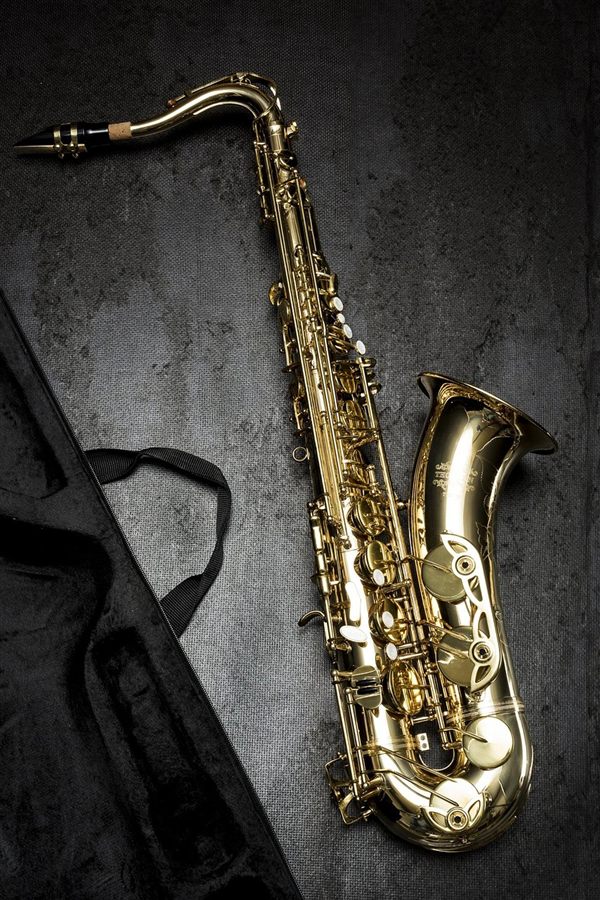
On a saxophone, the mouthpiece and the reed work as one unit: the tip opening (the gap between the mouthpiece tip and the reed tip) and the reed strength have to suit each other. Most beginners do best with a fairly close mouthpiece and a soft reed in strength 2 to 2.5. The wider the tip opening, the softer the reed usually needs to be, and every time you change mouthpieces you should re-test your reed strength.
How a saxophone mouthpiece is built
The mouthpiece is a small part with a big effect. The reed vibrates against the tip rail, air flows through the gap into a chamber and from there into the horn. Knowing the parts makes product listings much easier to read.
Facing, tip opening and facing length
The facing is the gently curving surface the reed rests on. Two measurements matter: the tip opening at the end, and the facing length, meaning how far from the tip the reed is free to vibrate. A long facing allows more tonal shaping but demands more control. A short facing responds with less effort and makes the upper register easier, but it limits vibrato and dynamics somewhat. Most mouthpieces also have a slight entry curve that makes them easier to start a note on.
Chamber and baffle
The interior is called the chamber. A large, round chamber generally sounds darker and softer, a small or square-edged one brighter and richer in overtones. The baffle is the rise between the tip and the chamber. A low baffle slows the airstream and gives a fuller, rounder tone. A high baffle speeds the air up, so the sound becomes brighter and cuts through more but loses some body. Facing, chamber and baffle work together, so you can rarely read a mouthpiece's sound from a single feature.
Tip opening: numbers and brand scales
Tip openings are given in millimeters or in thousandths of an inch (for example 0.070"), but many makers use their own codes. As a rough frame (guideline values, as of Oct. 2026):
| Saxophone type | Typical tip openings |
|---|---|
| Soprano | about 0.90 to 2.50 mm (0.035" to 0.098") |
| Alto | about 1.40 to 2.80 mm (0.055" to 0.110") |
| Tenor | about 1.60 to 3.80 mm (0.065" to 0.145") |
| Baritone | about 1.80 to 3.90 mm (0.071" to 0.154") |
The codes are not comparable between brands. Some use letters (such as C through F), others numbers from 5 to 10 or from 90 to 120. A model labeled 7 equals roughly 2.05 mm at one maker and about 2.3 mm at another. Always go by the millimeter or thousandths figure, not the digit. Even 0.1 mm changes the response noticeably, which is why published numbers are best treated as guidance rather than guarantees.
What close and open mean for the sound
- Close opening: easier to blow, focused tone, precise articulation and secure intonation. The trade-off is a smaller dynamic range. Typical for classical playing and for beginners.
- Medium to open: more volume and body, more overtones and more air in the sound, but more effort and a stronger embouchure needed, especially in the low register. Typical for jazz, funk and pop.
Mouthpiece material: hard rubber, metal, plastic
Hard rubber (ebonite) is the classic choice and is generally considered balanced and unobtrusive in an ensemble. Metal (brass, bronze, steel or alloys) is often associated with a brighter sound and wider dynamic range and is common in funk, rock and pop. Plastic is mostly found on inexpensive student mouthpieces and is durable, cheap and easy to produce consistently.
A word of caution on the usual shorthand "metal is bright, rubber is dark": it is only partly true. With identical inside dimensions, mouthpieces in different materials differ very little, and bright and dark sounds can be built in either. Chamber, baffle and facing decide the result. Material mostly changes feel, weight, durability and looks. Glass and other materials remain niche.
Reed strength: the scale and brand differences
Reeds are graded in steps, usually from 1.5 up to 4 or 5, in half or quarter steps. A higher number means a stiffer reed. Alto reeds do not fit a tenor mouthpiece and vice versa, even at the same strength number.
The number is a guideline only: the same printed strength feels different between brands. Some cane reeds play noticeably softer than comparable models from others, so when switching brands a half step lower is often the right move. Synthetic reeds deviate too, and even different series or cuts from one maker vary. On top of that, cane is a natural material, so reeds in the same box differ from one to the next.
The cut matters as well: cuts with a thinner tip area respond more easily and are popular in jazz, while classical cuts with more material in the middle tend to sound more compact.
Choosing tip opening and reed strength together
The rule of thumb: wide opening, softer reed. Close opening, harder reed. A reed that is too hard for a wide mouthpiece is hard to control and the tone turns airy and strained. A reed that is too soft on a close facing tends to shut off (the tip closes against the mouthpiece) and sounds thin, buzzy or bright. Softer reeds speak more easily but often cost tonal stability, while harder reeds offer more resistance and can deepen the tone.
Treat the rule only as a starting point. Try a couple of combinations: test two or three strengths on the same mouthpiece and listen for response in the low and high register, the clarity of the tone, and how quickly your embouchure tires. A mouthpiece change always means re-checking reed strength instead of carrying the old number over.
Beginner recommendations by saxophone type
Without an established embouchure, a close opening and a soft reed take you furthest. Soft reeds respond easily and forgive an unsteady embouchure, which counts most in the first weeks. A reed that is too hard from day one makes even the first clear tone difficult. The values below are guidelines:
| Type | Starter tip opening (guideline) | Starting reed strength |
|---|---|---|
| Alto | about 1.55 to 1.90 mm (0.061" to 0.075") | 2 to 2.5 |
| Tenor | about 1.7 to 1.8 mm, later 2 to 2.5 mm | 2 to 2.5 |
| Soprano | on the close side, check values per model | usually 1.5 to 2 |
| Baritone | close to medium | usually 2 to 2.5 |
Opinions differ for soprano and baritone because both instruments often tolerate somewhat harder reeds in the long run. For the start, though, soft still applies. A very close student mouthpiece such as the Yamaha 4C is the classic alto starter; the 5C and the Selmer C* are also widely used. As embouchure strength grows, many players move up to 3 to 3.5 over months, not days. There is no fixed target strength. To decide which horn suits you in the first place, see the comparison of alto, tenor and soprano.
Matching your style: classical, jazz and pop
- Classical: medium to close opening, often a longer facing and a somewhat harder reed. This helps intonation control, articulation and a compact tone.
- Jazz: medium to open tip with a softer reed and often a higher baffle. That allows tonal color, note bending and dynamic range.
- Pop, funk, rock: often metal pieces or hard rubber with a higher baffle for projection. Here too, get comfortable on a standard mouthpiece first and then switch deliberately.
If you do not yet know where your playing is heading, a neutral medium mouthpiece serves well. Specialized pieces pay off only once embouchure and listening habits are settled.
Cane or synthetic reeds
Cane reeds are inexpensive and sound warm, but quality varies and they need breaking in. With regular playing and rotation they last roughly two to four weeks. Synthetic reeds need no breaking in, stay consistent for months and barely react to humidity and temperature. A single one lasts as long as several dozen cane reeds but costs much more per piece, can feel slightly different and needs its strength worked out again. A cane reed in strength 2 to 2.5 is perfectly adequate for starting; if you travel a lot or replace reeds often, synthetic may make sense later.
Mounting, breaking in, checking and storing reeds
Mounting the reed correctly
The reed sits centered on the table, with its tip flush with the mouthpiece tip or showing only a hair-thin edge. The ligature grips the back part of the reed, not the thin tip. Overtightening dampens vibration, so tighten only enough to hold the reed securely. A suction test helps: put the mouthpiece with the reed on in your mouth, seal the back opening with your palm or finger and draw in. If the vacuum holds, the reed seals well.
Breaking in new reeds
New cane reeds are broken in gently. A common routine: play only a few minutes, softly, on the first day, then raise playing time, volume and register over about a week. Before putting the reed away, stroke the flat of the reed with your thumb in the direction of the grain, from heel to tip. This keeps the surface even.
Rotating and storing
Rotating at least four broken-in reeds extends their life because each one gets time to recover. Keep reeds in a proper reed case rather than the plastic sleeves they came in, which can let damp reeds warp. After playing, rinse briefly with water, dry and lay flat. Do not mix up alto and tenor reeds.
When to replace a reed
Replace a reed with a chipped tip, a crack, a warped surface that no longer sits flat, or one that suddenly feels thin, sluggish or tiring. An old reed is a frequent cause of poor response, more often than the horn.
Hygiene and cleaning in detail
Mouthpiece and reed are in direct contact with saliva. Regular cleaning prevents odors, build-up and poorer vibration.
- After every session: take the reed off, rinse, dry and lay it flat in its case. Pull off the mouthpiece, shake out moisture and dry the inside with a suitable swab. Swab the horn body and dry the pads with pad paper.
- Regularly: wash the mouthpiece by hand in lukewarm water with a mild liquid soap, for example with a soft mouthpiece brush. Rinse thoroughly and let it dry.
- Monthly: a more thorough clean of the mouthpiece, especially hard rubber, which can pick up odor over time.
- Swabs and ligature: wash swabs regularly, weekly with heavy use. Wipe the ligature and the table now and then.
Avoid water that is too hot or ice cold, since it can discolor or warp plastic and hard rubber. Never boil, never use a dishwasher. Skip harsh cleaners and disinfectants unless a maker explicitly approves them. Do not eat or drink sugary drinks while the mouthpiece is in your mouth. On a shared horn, each player should have their own mouthpiece and reeds.
When a mouthpiece needs professional work
With wear, chips at the tip or a warped table, specialists can refinish mouthpieces, meaning they flatten the facing or alter the tip opening. This is precision work: even tenths of a millimeter change the response, and a wrong cut cannot be undone. It therefore belongs with a specialist shop. You can tell work may be needed if reeds will not seal even after checking, a note squeaks constantly, the tip is chipped, or the tone stays dull despite fresh reeds. Cost: varies by shop, get a quote.
Common mistakes
- Reed too hard: strained, airy tone and a tired lip.
- Playing just one reed: it wears out fast and changes the response.
- Reed crooked or overhanging: squawking or squeaking notes.
- Ligature too tight or in the wrong spot: damped vibration.
- Keeping the old number after a mouthpiece change: same strength figure, different feel.
- Jumping to a specialty mouthpiece too early: a wide opening without the embouchure strength is frustrating.
- Mixing up alto and tenor reeds: they do not fit, even at the same number.
What it costs in the US
Prices vary by dealer and series. Guideline values (as of Oct. 2026):
| Item | Guideline price |
|---|---|
| Cane alto reeds, box of 10 | about $24 to $38, depending on series (as of Oct. 2026) |
| Synthetic alto reed, each | about $24 to $38 (as of Oct. 2026) |
| Student alto mouthpiece (such as Yamaha 4C) | about $39 to $50 (as of Oct. 2026) |
| Premium mouthpieces | from about $50 up to several hundred dollars (as of Oct. 2026) |
A used saxophone often comes with its mouthpiece; treat it as a starting point rather than the final answer. When trying a horn, test several reed strengths rather than judging it on one mismatched reed. More about what to look for is in buying a used saxophone.