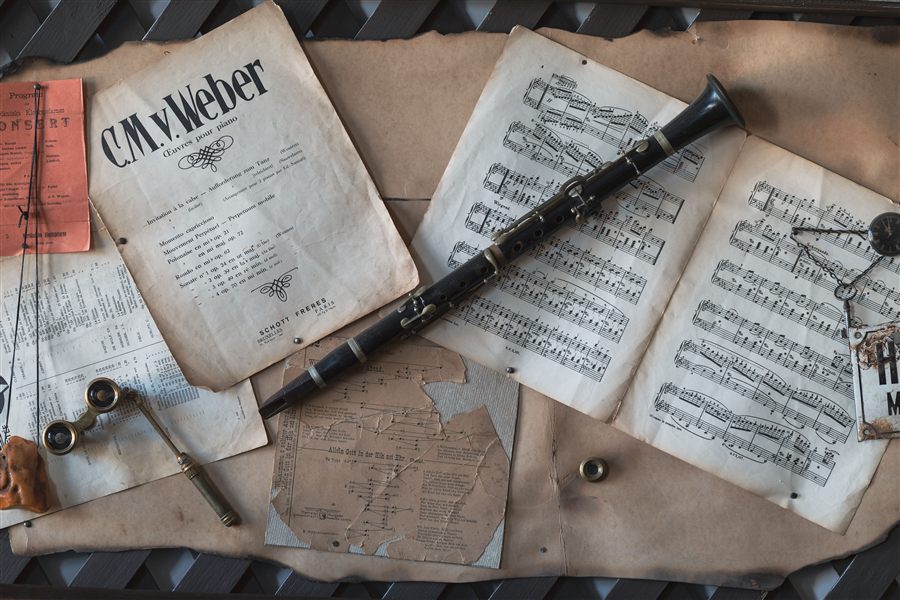
Clarinet
Selmer CL300
Price: 141 EUR – 441 EUR
Price history
Cheapest seen
Most expensive seen
Availability: 6/10 (Common)
An American-made plastic student clarinet with nickel-silver keywork, built as a durable, affordable entry point for beginners starting on the Boehm system.
About the Selmer CL300
The CL300 uses a one-piece plastic composite body instead of grenadilla wood, which keeps the instrument resistant to cracking from temperature and humidity swings that would worry an owner of a wooden clarinet. Selmer paired it with nickel-silver keywork chosen for its resistance to bending under everyday student use rather than for refined feel. The barrel is made of ebonite and built noticeably shorter than on professional models, a deliberate choice meant to make intonation more forgiving for players who are still learning to control their embouchure. An adjustable thumb rest accommodates different hand sizes, a small but practical detail on an instrument aimed squarely at first-time players rather than seasoned clarinetists.
Where to buy
Platforms
Price
–
-
eBay Gebrauchte Selmer USA CL300 Bb Klarinette | Ev-Entz Music 141 EUR Best price View details
-
Reverb Selmer CL300 Clarinet Black 163 EUR View details
-
Reverb Selmer CL300 Soprano Clarinet, USA 176 EUR View details
-
Reverb Selmer Clarinet CL300 186 EUR View details
-
Reverb Selmer CL300 Soprano clarinet, USA, with case and mouthpiece 204 EUR View details
-
Reverb Selmer CL300 Bb Clarinet, USA, With Case 220 EUR View details
-
Reverb Selmer CL300 Model Bb Clarinet, USA 220 EUR View details
-
Reverb Selmer CL300 clarinet, USA, with case and mouthpiece 220 EUR View details
-
eBay H SELMER B Klarinette CL300 gebraucht 294 EUR View details
-
eBay H SELMER B Klarinette CL300 gebraucht 364 EUR View details
-
eBay Selmer CL300 Bb Klarinette Vintage mit Mundstückschaden funktioniert nicht 441 EUR View details
No platform selected – pick at least one above.
Some links below are affiliate links. We may earn a commission at no extra cost to you.
Source: https://reverb.com/item/92806483-selmer-cl300-student-clarinet-with-hardshell-case
Sound character of the Selmer CL300
Compared to a grenadilla-wood clarinet, the plastic body of the CL300 tends toward a brighter, somewhat less mellow sound - plastic transmits vibration differently than wood and generally produces fewer of the warmer overtones a denser wooden body reinforces. That brighter edge is offset by surprisingly accurate intonation for the price class, attributed to the poly-cylindrical bore design. Like any modern Boehm-system clarinet, its closely spaced, larger tone holes (roughly 1 cm apart, versus about 2 cm on pre-Boehm instruments) favor a more open, vibrant projection over the more veiled character of older fingering systems.
What owners of the Selmer CL300 say
The general consensus treats the CL300 as a sound choice for a complete beginner on a tight budget, though opinions diverge on how long it stays satisfying. One assessment leans cautious - it flags the keywork as a little uncomfortable over long practice sessions and suggests budgeting for a mouthpiece or reed upgrade fairly soon, positioning the clarinet as a stepping stone rather than a long-term instrument. A more enthusiastic take, coming from someone who has reconditioned multiple units, goes further: the intonation is described as catching them off guard, standing up well against instruments costing considerably more, and the keywork as unusually durable for the price. That same assessment calls it a clear step up from the Vito line and specifically recommends it to budget-conscious parents shopping for a child's first clarinet. A refurbished example with fresh pads and a shop check typically changes hands for around 299 USD on the used market.
Playability & handling of the Selmer CL300
Reviewers describe the CL300 as beginner-friendly and needing only minimal tuning adjustments out of the case, which matters for a student instrument that often gets handed over without a teacher nearby to set it up. The tone holes are reported as somewhat demanding to seal fully for smaller or less practiced fingers, a common hurdle on entry-level clarinets generally. More experienced assessment from a technician who has reconditioned several examples paints a notably more favorable picture: the poly-cylindrical bore reportedly delivers intonation accurate enough to be compared with far pricier Ridenour clarinets, and the keywork is praised as unusually sturdy, closing in on the build quality normally associated with the Noblet line. That same assessment places the CL300 clearly ahead of the Vito line for intonation at a similar price point.
Recommended accessories & strings for the Selmer CL300
A used CL300 typically comes with the basics already in the case: a standard mouthpiece and cap, a metal ligature, and a Rico Royal reed in strength 2 - exactly the reed strength generally recommended for beginners on a Boehm-system Bb clarinet, since it responds more easily than stiffer strengths. Players usually progress to 2.5 or stronger as embouchure strength builds. Beyond spare reeds, worthwhile additions are a leather swab for moisture control, cork grease for the joints, a spare ligature or reed clamp, and a small screwdriver for minor key adjustments - none of which are exotic, but all of which extend the life of a budget instrument that will see heavy daily use in a school setting.
Technical data for the Selmer CL300
| Body | Plastic composite, one-piece construction |
|---|---|
| Key material | Nickel-silver |
| Key system | Boehm system (standard configuration: 17 keys, 6 rings) |
| Bore | Poly-cylindrical |
| Barrel | Ebonite, shorter than professional models for easier intonation |
| Pitch | Bb |
| Weight | Approx. 710 g (1 lb 9 oz) |
| Successor model | CL301 (high-tech composite body, drop-forged nickel-plated keys) |
| Controls | No controls in the amplifier sense - tone production is governed entirely by the Boehm-system key and ring mechanism (17 keys, 6 rings) operated by the player's fingers |
Price history for the Selmer CL300
Cheapest seen: 141 EUR · Most expensive seen: 441 EUR
Cheapest seen
Most expensive seen
The history of the Selmer CL300
The CL300 traces its design back to the original student clarinets developed under George Bundy, who took over Selmer's American business after founder Alexandre Selmer returned to France and eventually became the company's full owner. Surviving examples turning up on the resale market suggest production ran mainly through the late 1980s and 1990s, with at least one unit carrying a serial number dated to 1982, though no official Selmer production-year chart for this specific model could be confirmed. The CL300 was eventually succeeded in the lineup by the CL301, built with a more modern high-tech composite body and drop-forged, nickel-plated keywork - the CL300 is generally regarded as that model's direct predecessor.
About Selmer as a manufacturer
Selmer's American branch began in 1904 in New York, founded by Alexandre Selmer - brother of Henri Selmer, whose Paris workshop remains the family name's flagship. When Alexandre returned to France, he left the business to his student George Bundy, who kept the French connection alive by continuing to import professional models from Henri Selmer Paris. As American music education expanded through the twentieth century, Selmer positioned itself as the brand that could support a musician from first note to professional stage, and by the 1960s had grown into a major domestic wind instrument manufacturer, shifting production to Elkhart, Indiana. The company describes its instruments today as built for 'smooth, balanced response, precision keywork, and enduring quality for developing musicians' - a philosophy aimed squarely at the student and school-band market the CL300 was designed for.