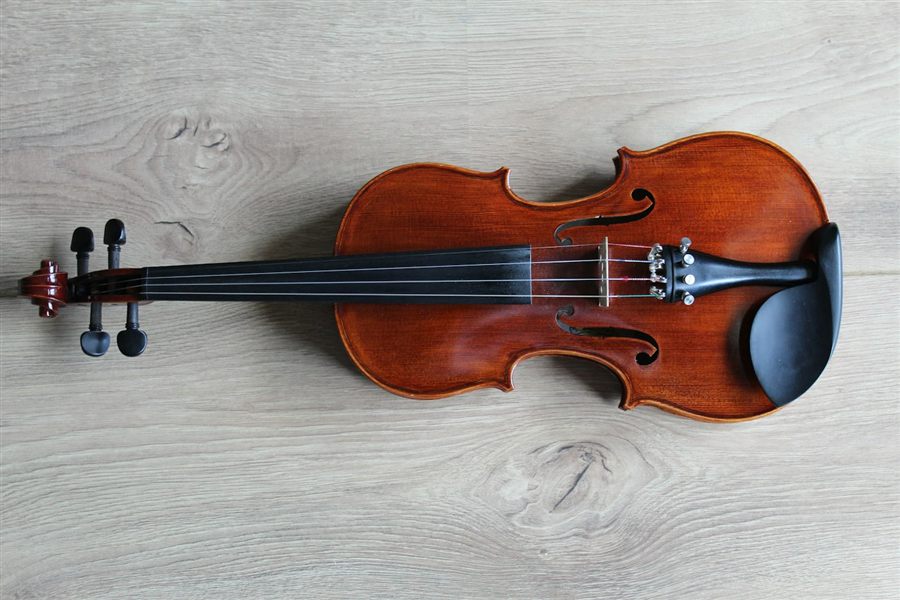
Violin size is chosen by arm length, not by age: with the left arm held straight out to the side, measure from the base of the neck to the middle of the palm. As a rule of thumb, a child with an arm length of roughly 20 inches fits a 1/2-size violin, and full 4/4 size starts at about 23 inches or more. When a measurement falls between two sizes, choose the smaller one, because an oversized violin causes more problems than a slightly small one.
Which violin sizes exist
Children's violins are built as separate instruments in fractional sizes: 1/32, 1/16, 1/10, 1/8, 1/4, 1/2, 3/4 and 4/4. The fractions are not exact mathematical ratios of a full-size violin but a historical standard sizing system, so a 1/2 violin is not half as long as a 4/4. Not every maker offers 1/32 or 1/10, and they are rare used. For very small children, 1/16 or 1/8 is the usual starting point.
A 7/8 size also exists for adults and teens with small hands and shorter arms. It has a slightly shorter body and string length than a full-size violin and is stocked less often.
Size overview
The table combines typical published values. Charts differ by an inch or two depending on where the arm is measured and on the maker, so treat every value as a rule of thumb (as of Oct. 2026). Arm length decides; age and height are only a rough guide, and overall length varies by model.
| Size | Arm length (neck base to palm center) | Typical age | Overall violin length (approx.) |
|---|---|---|---|
| 1/32 | under about 14 in | 2 to 5 years | about 13 in |
| 1/16 | about 14 to 15.5 in | 3 to 5 years | about 14 in |
| 1/10 | about 15 to 16.5 in | 4 to 5 years | about 15 in |
| 1/8 | about 16.5 to 18 in | 4 to 7 years | about 17 in |
| 1/4 | about 18 to 20 in | 5 to 7 years | about 19 in |
| 1/2 | about 20 to 21.5 in | 6 to 9 years | about 20 in |
| 3/4 | about 21.5 to 22.5 in | 9 to 12 years | about 22 in |
| 7/8 | about 22 in, small hands | small adults, teens | about 22 in |
| 4/4 | about 23 in and up | 11 or 12 years and up | about 23 in |
Some charts measure further out and list larger arm lengths, for example about 25 inches or more for 4/4. That is why a chart only works together with its own measuring method. Height is a weaker predictor: a child around 5 feet tall is usually ready for full size. For body length (without neck and scroll), common spec sheets list roughly 14 inches (about 35.5 cm) for a 4/4.
How to measure at home
- The child stands upright and holds the left arm straight out to the side, parallel to the floor, palm facing up.
- Measure from the base of the neck to the middle of the palm. For small children some guides measure only to the wrist.
- Compare the number with the chart. If it lies between two sizes, pick the smaller.
The scroll test
Place the violin in playing position under the chin and have the child reach the left arm under the instrument toward the scroll. The fingers should curl comfortably around the scroll with a slight bend left in the elbow. The test is only a first check: a teacher or shop should also watch wrist, elbow and shoulder while the child plays a few notes and moves the bow. Growth rate and proportions vary, and some six-year-olds have the arm length of ten-year-olds. The goal is a violin that fits now, not one to grow into.
Signs the size is wrong
Too big
- The scroll can only be reached with a fully straight arm, the elbow is almost locked.
- The wrist bends sharply to reach notes.
- The shoulder rises to hold the instrument up.
- The violin feels heavy after a short practice, and the child complains about neck, shoulder or arm.
An oversized violin forces awkward positions of the left hand and bow arm, causes tension and may cement poor habits that are hard to unlearn. "They'll grow into it" is a common misconception.
Too small
- The left arm stays strongly bent and the instrument looks cramped against the body.
- The elbow bend is very pronounced.
A slightly small violin is less of a technical problem, but the child will need to change size sooner.
When to move up a size
Young children typically need a new size about every one to two years. Move up when the arm length has grown past the range of the current size or when the left arm is fully straight while holding the scroll. Re-measure every few months and ask the teacher at lessons. Skipping a size, for instance from 1/2 to 3/4, is fine as long as the new size fits after measuring and a test play.
Bow and accessories in the right size
The bow grows with the violin. Typical lengths are about 16.75 in (1/16), 19.25 in (1/8), 22.5 in (1/4), 24.5 in (1/2), 27 in (3/4) and 29.5 in (4/4), with small variations between makers. Children's outfits normally include a matching bow; when buying separately, match the bow size to the violin size. More on bows in Violin bow quality: what to look for.
Shoulder rests and chin rests come in sizes too. A rest that does not match the violin size sits loosely and supports poorly, and the smallest violins have their own mini models. When your child changes size, check the shoulder rest and chin rest as well.
Rent or buy for a growing child
Because children pass through several sizes on the way to full size, renting is the most common approach for the small sizes. Rentals typically include the violin, bow and case, the instrument has been set up, and size exchanges happen under the same contract.
Rental prices in the US
Prices vary by shop (as of Oct. 2026): basic fractional rentals of used instruments start at about $14 per month, standard outfits run about $19.95 to $28.47 per month, and premium instruments can be about $45 per month. Extras can add up: one-time setup fees of about $19, optional insurance or damage waivers (about $6 per month in one example) and, at some shops, a fee of about $19 per size exchange. Others advertise free size changes. Some shops ask for a refundable deposit of about three months of rent.
Credit and exchange
- Many shops credit rent toward a purchase: from about 2/3 of one year's rent up to 100% of the first 12 or 13 monthly payments, in some cases a smaller share of later years.
- Free size exchanges are common, usually only if payments are current and there is no damage beyond normal wear.
- Some shops offer trade-in credit toward the next size on instruments bought from them; others take fractional violins only on consignment.
- A minimum term of about three months is common.
Example: at $25 per month, two years of rent come to about $600, of which a share may be credited toward a later purchase. Renting pays off most while the child is growing fast and it is unclear whether they will stick with it. For 3/4 and 4/4, buying gets more attractive because those sizes fit longer. For price tiers of beginner instruments see Used violin budget tiers and prices.
Buying used for children
Fractional violins are often played for only a year or two, so there is a large used market. Used 1/2-size outfits turn up online in a range of roughly $159 to $325 (listing prices, as of Oct. 2026). New 1/2-size violins range from about $300 up to $1,000 or more depending on quality, and 3/4 sizes cost somewhat more. These are asking prices, not final sale prices.
- Have a teacher or a shop play-test the violin before you buy, since children cannot judge a poorly set-up instrument.
- Check bridge, sound post, pegs and string height, see Checking bridge and sound post position.
- Cracks, lifting edges and rattling parts mean a repair shop visit or a dealbreaker. A full checklist is in Buying a used violin: what to look for.
- A bow, case, shoulder rest and rosin belong to a complete outfit.
On resale, plan on losing roughly half the price. Dealers often take fractional violins only on consignment and not the bow, case or accessories. Buying used therefore loses less value than buying new.
Adults with small hands
Adults normally play 4/4. With very small hands and short arms, a 7/8 size can make sense. It has a slightly shorter body and string length, so the fingers sit closer together. Choice is smaller than for 4/4. A trial with a teacher or at a shop shows whether it is worth it.
Quick answers
Can I skip a size to save money?
Yes, if arm length and a test play support it. What matters is how the violin fits, not the order of the fractions. If the next size is still too long, stay with the smaller one.
My child is tall for their age. Which size?
The one that matches the arm length. Tall children often need a bigger violin earlier, but hand size matters too. With a value between two sizes the rule stays: choose the smaller one.
Is a measurement at home or in a shop enough?
Both are a good start. The final decision comes from a test play: only then you see whether arm, wrist and shoulder stay relaxed.
Does size affect the sound?
Smaller violins have shorter strings and do not sound like a full-size violin. In the early years it matters more that posture is right and playing is fun.
Common mistakes
- Buying by age instead of arm length.
- Choosing an oversized violin to grow into.
- Changing only the violin but not checking bow and shoulder rest.
- Never re-measuring.
- Spending a lot on an instrument that will be outgrown soon.