Short answer: When you buy a used ukulele, three things matter most: a bridge that sits flat with no gap, a straight neck with clean frets, and a tone that still sounds alive after every other check passes. Small issues such as stiff tuners, old strings or high action are usually cheap to fix and make good bargaining points. Structural damage to the top, bridge or neck can cost more than the instrument is worth.
The checks that matter, in order
A ukulele is small, lightly built and under relatively low string tension. That makes it forgiving in daily use, yet sensitive to climate: the thin tops and backs move with the humidity. So check structural health first, and cosmetics and accessories afterwards.
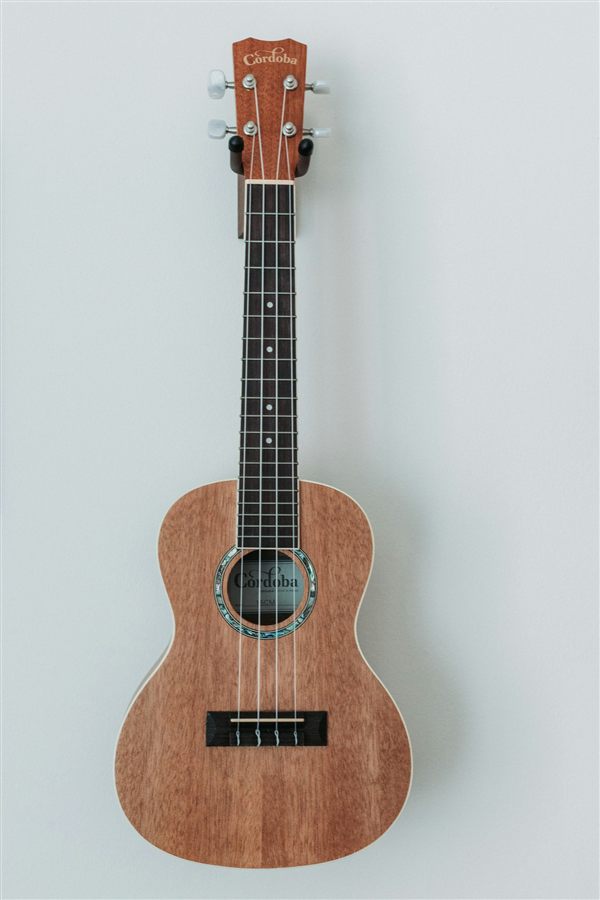
- Bridge and top: does the bridge sit flat, with no gap underneath?
- Neck: straight, with no visible twist, and a solid neck-to-body joint?
- Frets and fretboard: no sharp fret ends, no deep grooves?
- Nut and saddle: intact, with strings seated cleanly in their slots?
- Action and intonation: comfortable to play and in tune up the neck?
- Tuners: do they hold pitch?
- Tone: lively, with sustain, even on the upper frets?
The body: top, back, sides and cracks
Spotting cracks and distortion
Tilt the ukulele against a light and run a fingertip over the top, back and sides. Hairline cracks usually follow the grain, especially around the bridge, the soundhole and the edges. A properly glued crack is not automatically a deal-breaker, but an open crack or one that keeps reopening is. Also look for waves or dips: a top that has sunk behind the bridge, or one that bellies inward, points to dry-air damage or loosened bracing.
Seams and binding
Inspect the joints between sides and top or back, and the binding around the edges. Lifting edges or small gaps mean the glue has let go. That often follows storage in dry rooms and is frequently the first step toward bigger damage. Give the ukulele a gentle shake next to your ear: rattling inside can mean a brace has come loose.
Finish and surface
Scratches and dings are cosmetic and mostly a price argument. Finish cracks running across the grain can hint at a problem in the wood beneath. A look through the soundhole shows whether the inside is clean and dry, free of mold or water stains.
The bridge: catching lift early
The bridge is glued to the top and carries the whole string load. When the glue fails, the bridge usually lifts at one edge first. A visible gap between the bridge edge and the top, one that a thin sheet of paper slides into, shows that it is already letting go. On tie-bar ukuleles, where strings are knotted through holes in the bridge, the glue joint alone holds the tension. Bridge lift is therefore a common problem, especially on older instruments or after dry storage.
A slightly lifted bridge is a manageable repair: the shop cleans the glue surface and reglues it. This is not a home job, because alignment, clamping pressure and glue choice decide how long the repair lasts. A crooked or twisted bridge shows in the string path: if the strings do not run evenly toward the nut, something is off.
Neck, frets and fretboard
Checking the neck
Sight along the neck from the bridge. It should be straight or have a gentle bow, with no kink and no twist. Severe warping is uncommon on ukuleles but does happen, and it is a real warning sign because neck corrections are involved work. A crooked neck can hardly be rescued by simple adjustment. Also check where the neck meets the body: a gap or visible shift means the joint is giving way.
Frets and fretboard
Run a finger along the side of the fretboard. Sharp fret ends sticking out are a typical sign of dried-out wood: the wood shrinks, the metal frets do not. A shop can dress them, but it tells you how the instrument was stored. Look at the first few frets, which take the most wear. Deep grooves cause buzzing and imprecise notes. A dry, grayish fretboard can often be refreshed with a little care. Dressing or pulling frets, however, belongs in expert hands, because material is removed and mistakes are hard to undo.
If a string buzzes in one area only, a single high fret may be the cause. That is a typical shop job and no reason to turn down an otherwise good instrument, but it should be reflected in the price.
Nut, saddle, action and intonation
Nut and saddle
The nut at the headstock and the saddle in the bridge set the string height. The slots should guide the strings cleanly: slots that are too wide let strings wobble and buzz, slots that are too deep let strings rest on the first fret. Pressed strings must not bind in the nut, or the tuning jumps. Cracks in these parts are rare, and replacing them is simple and inexpensive.
Checking the action
As a rule of thumb, action at the 12th fret usually lies between about 1.5 and 3 mm on ukuleles, with around 2.5 mm considered comfortable. At the nut, only a hair of space should remain between the string and the first fret when you hold down the third fret. Action that is too high makes fretting tiring and chords sound out of tune. Action that is too low causes buzzing. Adjusting the saddle is usually a do-it-yourself job: a saddle that is too tall is shortened in small steps, and removed material cannot be put back. When in doubt, let a shop do it.
Intonation
Tune the ukulele carefully with a tuner. Then compare an open string with the same string fretted at the 12th fret: it should sound exactly one octave higher. If it is clearly off, or chords sound sour higher up the neck, the intonation is wrong. Causes include a misplaced bridge, a shifted saddle, a nut that is too high, or worn strings. Try a fresh set before you reject the instrument.
Tuning machines: friction pegs versus geared tuners
How each type works
Friction pegs are the traditional type and resemble violin pegs. The peg turns 1:1 with the post, and the string is held by friction. A small screw in the middle sets how stiffly the peg turns. Geared tuners work as on a guitar: a ratio of about 4:1 on planetary designs up to around 14:1 on classic open-gear tuners means that several turns of the knob move the post only a little. Tuning becomes finer and less prone to overshooting.
Tuning stability in daily use
Good friction pegs hold pitch as reliably as geared tuners. The trouble comes from cheap versions with uneven friction, which jerk, slip or seize. Typically the string goes too sharp, then too flat, until you creep up on the note. That takes practice and a delicate touch. Geared tuners make this easier and suit beginners. In return they weigh more, which can shift the balance toward the headstock on small soprano and concert ukuleles. The size differences are covered in comparing ukulele sizes.
Checking tuners on a used ukulele
Turn each peg both ways. It should move smoothly without jerking, hold pitch after tuning and not unwind on its own. Loose pegs can often be fixed by snugging the adjustment screw slightly, so try that before you count them as a defect. If the thread is stripped or the screw damaged, replacement is due.
Replacing tuners: DIY or shop job
Switching to geared tuners is a common upgrade, but it is not a pure drop-in swap: friction pegs sit in larger holes than the posts of geared tuners need, and geared tuners also need small screw holes on the back of the headstock. If the new parts fit the existing holes, the swap takes about fifteen minutes with a screwdriver. If holes must be plugged and redrilled, a shop is the better choice, because mistakes on the headstock cannot be corrected. The same goes for swapping to premium friction pegs.
Costs
Prices run from roughly $15 for a basic open-gear set to around $55 to $60 for premium friction or planetary sets (as of Oct. 2026). Installation at a shop varies by shop, get a quote. On very cheap instruments, an upgrade rarely pays off, since the parts cost more than the ukulele is worth used.
Tone: judge the whole picture
Play every string in every position, including high on the neck. Listen for buzzing, notes that die quickly, and volume. An instrument that looks flawless but sounds thin, quiet or dead often has a problem in the wood or construction that is not easy to repair. If possible, compare it with a ukulele of the same size. Check whether it is solid or laminate: laminate is rugged and climate-proof but limited tonally, while solid tops vibrate more freely and keep developing with play. Beginners often hear little difference.
Humidity and care
As a rule of thumb, aim for 40 to 60% relative humidity. Below that, you risk sunken tops, loose braces, buzzing from low action, protruding fret ends, binding separation and cracks. Most ukulele damage comes from air that is too dry, especially in winter with indoor heating. Above 60%, bridges and braces can loosen, action rises and frets corrode.
- A simple hygrometer in the room or case shows where you stand.
- When the air is dry, a humidifier in the soundhole or case helps. Follow the maker's directions and do not overdo it.
- Keep the ukulele in its case or gig bag, not next to radiators, in front of windows or in a car.
- Equalize big temperature swings slowly: let a case that has been out in the cold warm up in the room before opening it.
- Wipe the fretboard and body with a dry cloth. Harsh cleaners and heat (radiators, hair dryers) are off limits.
Changing strings
Used ukuleles often carry old strings. If they sound dull, feel rough or will not tune cleanly, change them before you judge the instrument: old strings distort tone and intonation, and they often play sharp. A set typically costs about $8 to $14 (as of Oct. 2026).
- Change the strings one at a time so the bridge and nut stay under tension.
- Loosen the string at the tuner and undo the knot at the bridge.
- Thread the new string through the bridge hole and tie it securely, often with a double knot on tie-bar bridges.
- Pass the other end through the post and wind about three to four turns without kinking the string.
- Tune up in small steps, give the string a gentle stretch by hand and retune. Repeat two to three times.
Nylon strings stretch a lot at first and need retuning over several days. Fluorocarbon strings are thinner, sound brighter and settle faster. Changing every three to twelve months is typical, depending on how much you play. Standard tuning is g-c-e-a, with the g string pitched higher than the c string. A baritone ukulele is tuned D-G-B-E, like the four highest guitar strings.
Prices: new, used and depreciation
New laminate ukuleles run about $50 to $150, instruments with a solid top about $150 to $250, and fully solid models from about $300 (as of Oct. 2026). A used instrument is often priced 15 to 30% or more below its original price (rule of thumb, as of Oct. 2026). The price-to-condition ratio varies widely. For entry-level instruments, the saving is often so small that buying used only makes sense if the condition is very good or the model is no longer made.
Repair and setup costs
Shops usually treat ukuleles like small acoustic guitars. As a rough guide from US luthiers (as of Oct. 2026, varies by shop, get a quote):
| Job | Rough price in USD |
|---|---|
| Restring (labor, strings extra) | about 40 |
| Full setup | about 95 to 200 |
| Bridge reglue | from about 175 |
| Crack repair | about 150 to 250, depending on length |
| New nut | about 125 |
| New saddle | about 100 |
| Refret | about 325 |
Some of these prices cover guitars and ukuleles alike. Add the repair to the used price and compare the total with a new instrument.
Warning signs and deal-breakers
- A gap under the bridge or a crooked bridge
- A sunken or bulging top
- Open cracks that move under pressure
- A warped neck or a shifting neck joint
- Many sharp fret ends and deep grooves on several frets
- A musty smell or mold inside
- A dull, quiet instrument despite good looks
- A seller who dodges questions about storage and repairs
Before buying remotely, ask for photos of the bridge, the back, the headstock and the inside, have flaws noted in writing, and ask how it was stored. Shipping should be well packed and come with a return option.
Common myths
- Laminate always sounds bad: A good laminate ukulele sounds quite decent to a beginner and is tougher. Solid wood pays off mainly if you play regularly.
- Friction pegs are outdated: Quality friction pegs tune very precisely. Cheap parts are the problem.
- Geared tuners are always better: On small ukuleles they load the headstock and shift the balance.
- More expensive means better: Price and tone do not always go hand in hand. Playing it beats reading the spec sheet.
- New strings change nothing: They noticeably change tone, feel and tuning stability.