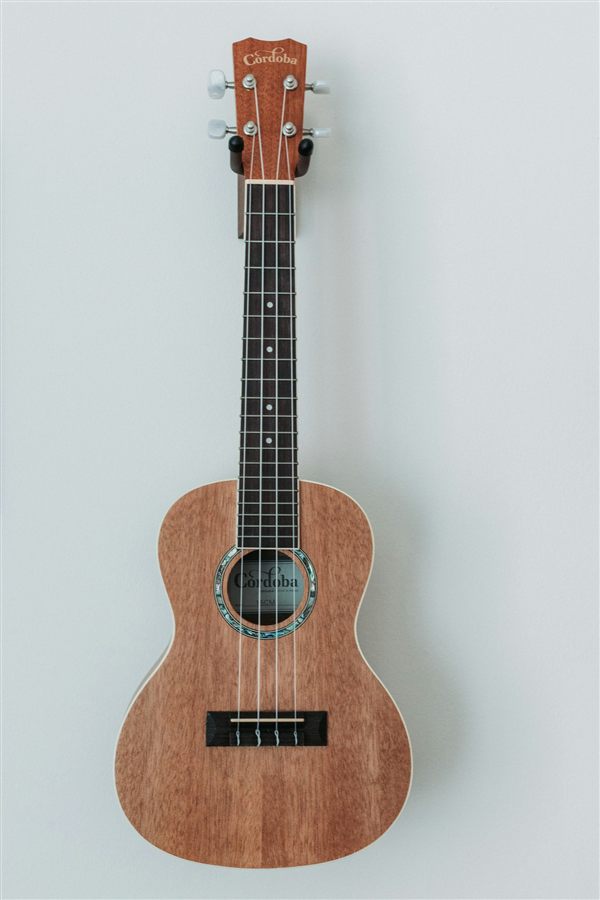
For most adult beginners a concert ukulele is the safest pick: it keeps the classic ukulele sound but gives your fingers a little more room than a soprano. Soprano is the traditional, smallest size, tenor sounds fuller and suits larger hands, and baritone is tuned differently and behaves more like a small guitar. On materials, laminate is perfectly fine to start on and more robust, while solid wood pays off once you play regularly and can hear the difference.
The four standard sizes at a glance
Ukulele size is defined by scale length, the vibrating string length from nut to saddle. Sources differ by a centimetre or two, so treat the figures below as approximate.
| Size | Scale length | Overall length | Frets | Usual tuning |
|---|---|---|---|---|
| Soprano | about 13.8 in (35 cm) | about 21 in (54 to 55 cm) | 12 to 15 | G-C-E-A (re-entrant) |
| Concert | about 15 in (38 cm) | about 23 in (59 to 63 cm) | 15 to 19 | G-C-E-A (re-entrant) |
| Tenor | about 17 in (43 cm) | about 26 in (66 cm) | 15 to 20 | G-C-E-A (re-entrant) or low G |
| Baritone | about 19 to 21 in (48 to 53 cm) | about 30 in (77 cm) | about 19 | D-G-B-E (linear) |
The bigger the instrument, the louder, fuller and more guitar-like it sounds, and the wider the fret spacing becomes. That is more comfortable for big fingers but a longer stretch for small hands. "Re-entrant" means the g string sounds higher than the c string, which creates the bright, bouncy ukulele character.
Soprano
The original size from which the others developed. It sounds bright, lively and compact, the classic "plinky" tone. The fretboard is tight, so larger fingertips can accidentally mute neighbouring strings. Soprano is light, travels well and is a common choice for kids.
Concert
Introduced in the 1920s as a slightly larger variant. It sounds a little fuller and deeper than a soprano while keeping the typical ukulele character, and the frets sit farther apart. Most online sources agree that it is easier to play with larger hands and tends to intonate a bit more cleanly than a soprano. That makes it the usual compromise for adult beginners.
Tenor
A tenor has noticeably more volume and depth and works well for fingerpicking and performing. It is often strung with a low g string ("low G") to extend the range downward. With small hands the wide fret spacing can feel demanding at first.
Baritone
A baritone is tuned like the four highest guitar strings (D-G-B-E), so without the high g string of the smaller sizes. It sounds like a small, mellow guitar rather than a classic ukulele. That is ideal for guitarists who want to reuse chord shapes they already know. But if you follow ukulele lessons, songbooks or chord charts written for standard tuning, a baritone gives you the wrong chords: everything sounds a fourth lower than the chart shows.
Sopranino and bass in brief
The sopranino, with a scale of roughly 11 in (28 cm), is smaller than a soprano and is usually recommended to experienced players as a second instrument. The bass ukulele (scale about 20.5 in or 52 cm, tuned E-A-D-G like a bass) is a specialist instrument for ensembles, not a starter.
Which size suits whom
- Adult beginners: concert; tenor if you have larger hands or want a fuller sound.
- Small hands and children: soprano or concert. No firm age limit is documented; what matters is that the fingers can reach the frets comfortably.
- Guitarists: baritone if you want to keep guitar chords. If you like the classic ukulele tuning, concert or tenor work fine too, and your guitar experience still helps.
- Travel and second instrument: soprano or concert, happily in laminate.
- Fingerstyle and stage: tenor, often with low G.
Chord shapes on soprano, concert and tenor in standard G-C-E-A tuning are identical, so you can change size later without relearning anything. Only the fret spacing takes getting used to. This does not apply to baritone.
A practical rule of thumb: play the ukulele for a few minutes before buying. If your hand cramps in the higher positions or you keep muting neighbouring strings, the size is wrong for you.
Woods and their sound
Wood species affects tone, but less than marketing often suggests. Some guides even call it almost secondary compared with construction, bracing and workmanship. As a rough guide:
- Koa: the traditional Hawaiian wood, with warm, clear mids and smooth overtones. Often described as slightly brighter than mahogany, and usually pricier.
- Mahogany: warm, woody and direct, with emphasised mids and few overtones. Very common thanks to good value for money.
- Spruce: bright, loud and dynamic, versatile for strumming and fingerpicking.
- Cedar: warmer, softer and rounder than spruce, lovely with a light touch and fingerstyle.
- Acacia: sounds similar to koa and is often cheaper, though quality varies from instrument to instrument.
- Maple: dense and fairly neutral to bright.
Even within the same species and size, individual instruments differ audibly. Where possible, compare by playing instead of deciding by spec sheet.
Solid wood versus laminate
Sound
With solid wood, the top vibrates freely as one piece, which usually gives a richer, more layered, warmer tone with more sustain. Solid instruments need a break-in period and change as they are played; over the years they often sound fuller. Laminate consists of several glued layers with crossed grain direction. That restricts vibration and gives a clear but flatter sound with less sustain, which stays essentially the same over the years. For back and sides the difference matters less, since they mostly reflect sound, so the top is the most important place to have solid wood.
Good laminates sound better than their reputation, and many listeners hear little difference in everyday settings. Laminate is not a sign of junk. You also cannot reliably tell the two apart by looks alone; rely on the spec sheet, a look inside and your ears. More on this in buying a used ukulele: what to check.
Durability and humidity
This is laminate's strength: it reacts far less to swings in humidity and temperature, making it a good choice for travel, cars and everyday knocks. Solid wood tolerates heat and dry heating air less well. A common target range is 40 to 60 % relative humidity.
- Above 60 %: the wood swells, action rises, frets can corrode and in extreme cases bridges loosen.
- Below 40 %: top or back can sink or separate from the sides, braces loosen, action drops and buzzes, fret ends protrude and in the worst case cracks form.
A simple hygrometer in the case plus an instrument humidifier during the heating season keeps this under control. Consistency matters more than perfection. Laminate also benefits from stable conditions but is much more forgiving. A solid-wood ukulele does not need constant monitoring, just a minimum of attention. Cracks, lifted tops or loose bridges belong with a repair shop.
Price and the solid-top middle ground
Solid wood costs noticeably more than laminate. A middle path is the solid-top model with a solid top and laminate back and sides. It delivers much of the tonal improvement at a smaller premium.
When to upgrade
Typical signs: you have played regularly for roughly six to twelve months (several times a week), your instrument feels limiting, you hear clearly better tone when trying instruments in a shop, or you perform for others. If solid wood feels too delicate and you would play the instrument less, a laminate instrument that actually gets played is the better answer.
Strings in brief
- Nylon: soft on fingertips with a classic warm tone, but stretches a lot in the first days. Expect several days of retuning before new strings settle.
- Fluorocarbon: holds pitch better and sounds a little brighter, with a firmer feel.
- Nylgut: a synthetic alternative to gut with a warm tone and good tuning stability. The Super Nylgut variety stretches less.
- Low G: a lower-pitched g string, most common on tenors. It extends the range downward but takes away some of the bright character of re-entrant tuning.
Never fit steel strings; ukuleles are built for nylon-type strings. Buy sets matched to your size.
New prices in the US
All figures are approximate (as of Oct. 2026):
- Very cheap starter ukuleles start around $40. A typical entry-level soprano costs about $60 to $75, a concert about $95 to $120 and a tenor about $110 to $140.
- Laminate ukuleles generally run about $50 to $150; solid wood about $150 to $500 and up. Solid-top models often start around $300, with exceptions below that.
- Many buyers find the best value between about $150 and $250, where gains per dollar start to flatten out.
Budget for a clip-on tuner as well, and a hygrometer if you choose solid wood.
Recommendation for beginners
For starting out, a laminate concert ukulele in the range of about $95 to $150 (as of Oct. 2026) is a good choice: enough room, robust and affordable. Look for a straight neck, clean frets, stable tuners and a ukulele that tunes accurately across the whole fretboard. Once you know you will stick with it, a solid-top concert or tenor is the next sensible step.
Common myths
- "Solid wood is always better." Not automatically. A badly built solid-wood ukulele can sound worse than a good laminate.
- "The wood species decides the sound." Construction and workmanship weigh at least as much.
- "Laminate gets better with age." After years it sounds essentially like day one. Solid wood, by contrast, develops.
- "Solid wood needs constant monitoring." Stable conditions and a humidifier in dry months are usually enough.
- "Big hands need a tenor." A concert fits many adults; comfort is what counts.
- "A baritone is just a big ukulele." It is tuned differently, so ukulele chord charts do not work.
Typical wrong purchases
- The cheapest model without trying it: poor intonation and unstable tuning slow your progress. A solid model around $90 usually makes a better base than a no-name one at $35.
- Choosing size by looks or price instead of by your hands.
- Buying a baritone without realising the tuning is different.
- Fitting steel strings.
- Storing a solid-wood ukulele unprotected in dry heating air.
- Choosing by wood species rather than by sound and playability.
If you can, handle the instrument before buying, check that every string sounds buzz-free and compare several examples of the same model line. Small differences between individual instruments are normal.