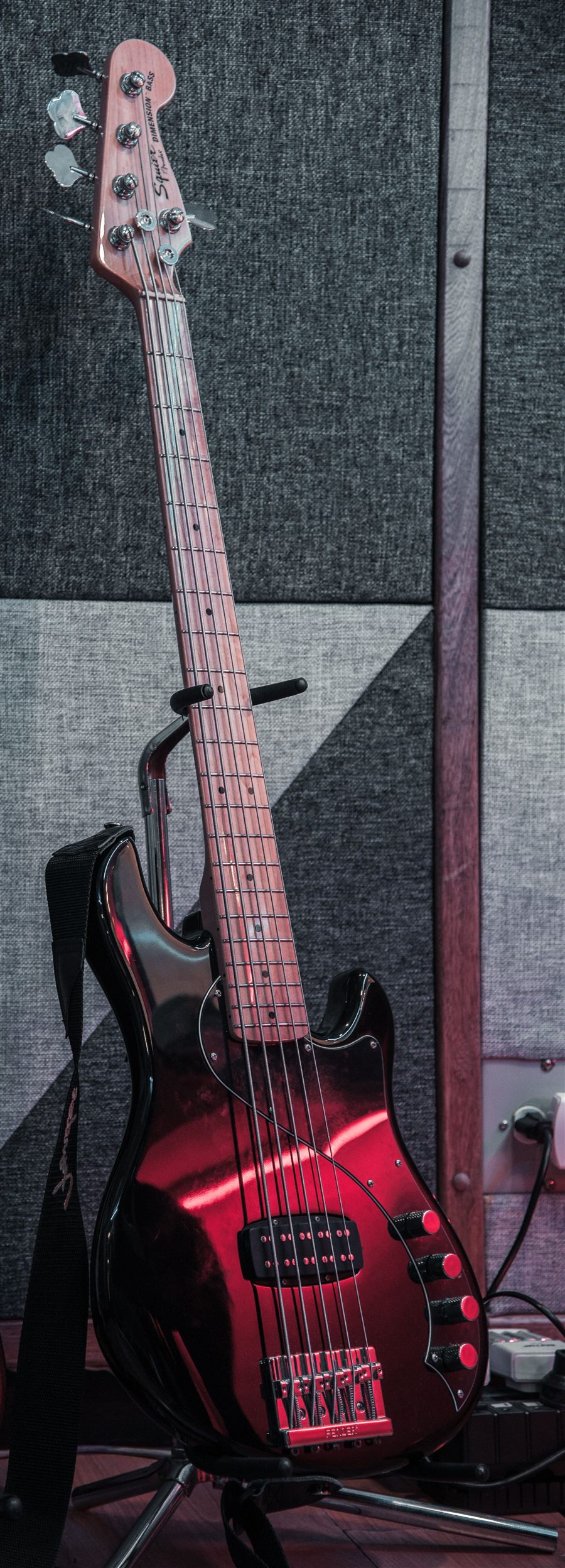
For a first bass, a 4-string with a 34-inch (long) scale is the safe choice: it is the standard, has the narrowest neck, covers most of the repertoire and is the easiest to resell. A fifth, low B string pays off only if your music genuinely needs notes below low E. A short scale (30 inches) makes sense mainly for kids, teens and small hands, and it is not a toy format but a distinct design with a sound of its own.
String count: four, five or six strings
A standard electric bass has four strings tuned in fourths, E-A-D-G, one octave below the four lowest guitar strings. Low E vibrates at about 41 Hz. Bass music is usually notated an octave higher than it sounds.
Four strings: the standard
The four-string is the reference instrument for pop, rock, funk, blues, soul and jazz. Many defining bassists in these styles played almost exclusively on four strings, so string count says nothing about skill. For a beginner it has clear advantages: a narrower neck, fewer strings that can ring out and need muting, and a slightly lighter body. Lesson material and courses almost always assume four strings.
Five strings: extra depth
The five-string adds a low B (B-E-A-D-G), about 31 Hz, a fourth below the E. This layout became common from the mid to late 1970s. An early outlier existed as far back as 1965, the Fender Bass V, but it added a high C instead of a low B (E-A-D-G-C). The low B is asked for in metal, gospel, modern worship, R&B and some funk and studio work. A second benefit is reach: many low notes sit within one hand position, where a four-string would need a long slide up the neck.
There are trade-offs a beginner should know about:
- The low string needs active muting or it rumbles along with everything else. Fingerstyle players typically rest the thumb or fingers on it, pick and slap players use the palm. That is an extra skill to learn.
- The neck is wider (roughly 1.77 inches at the nut against 1.5 inches on a typical four-string, as a rule of thumb), and string spacing at the bridge is often tighter. Both ask for more precision from the fretting hand.
- Many five-strings use a 35-inch scale so the B string stays firm enough. Fret spacing is slightly wider as a result.
- Not every amp and cabinet reproduces frequencies below 40 Hz cleanly. If the rig turns the B string to mush, that is not a player problem.
- A flabby B string on the instrument itself is often a setup issue. String gauge, scale length and action matter more for a focused low string than the price tag of the bass.
Six strings: low and high range
The six-string (B-E-A-D-G-C) adds a high C as well. It appeared in the mid-1970s as a commissioned instrument for a bassist who wanted to combine chords and solos in one position. The neck is considerably wider (often 1.9 inches or more) and muting is demanding. It is common in fusion, progressive music and among soloists. As a first instrument it is generally not recommended. Seven or more strings are extended-range specialist instruments.
Scale length: short, medium, long and extra long
Scale length is the vibrating string length between nut and bridge. It sets string tension, fret spacing, how long the neck feels and the character of the notes.
| Name | Length | Typical use |
|---|---|---|
| Short scale | about 30 in (762 mm), some models 30.5 in | Kids, teens, small hands, round tone |
| Medium scale | 32 in (about 813 mm) | Compromise, rare |
| Long scale | 34 in (864 mm) | Worldwide standard |
| Extra long scale | 35 in (889 mm), occasionally 36 in | Mostly five-strings and up, firm B string |
The 34-inch standard traces back to the 1951 Precision Bass. Earlier electric basses took their cue from the upright bass, whose scale is around 43 inches.
Tension, tone and feel
At the same pitch and with the same string, tension grows with the square of the scale length. On paper, a 30-inch string carries roughly 22 percent less tension than a 34-inch string; online figures usually say about 20 percent. In practice:
- Short scale: a loose feel, strings that fret and bend more easily. Frets sit closer together (the first fret is about 1.7 inches from the nut on a 30-inch scale, about 1.9 inches on 34). The tone is often round, warm and "fat" with somewhat less definition. With too-thin strings or very low tunings it can turn floppy; heavier strings help.
- Long scale: firmer strings, more attack, a clearer and more focused sound, especially on the low strings. The trade-off is wider fret spacing, a longer neck that is often more headstock-heavy, and more stretching for beginners.
- Medium scale: in between. Choice is smaller, but it is worth a look for small hands if 30 inches feels too slack.
- Extra long scale: an especially firm, strong B string on five-strings. The low positions are farther apart and more physically demanding.
Kids and small hands
For children and teens with small hands, 30 inches works well: a shorter neck, closer frets, lighter tension. The stretch shrinks by roughly a tenth (rule of thumb). Short-scale basses are not just beginner instruments: they have been in use since the 1950s (the Hofner 500/1 at 30 inches from 1956, the Gibson EB-3 at 30.5 inches from 1961, the Fender Mustang Bass at 30 inches) and experienced players still choose them for the sound. Current 30-inch examples include the Fender Player II Mustang Bass PJ and the Squier Bronco line. Always check the spec sheet before buying: a photo rarely reveals the scale, and a small body does not guarantee a short scale.
Neck width and string spacing
Scale length and string count are not the only factors for comfort. Nut width, string spacing and neck profile matter as well.
- Four-strings: nut width mostly about 1.5 inches (38 mm), ranging from roughly 1.4 to 1.8 inches depending on the model. Jazz Bass-style necks are narrower and are seen as friendly for beginners; Precision-style necks are somewhat wider.
- Five-strings: usually about 1.77 to 1.8 inches (45 mm), with narrower and wider designs up to about 2 inches.
- Six-strings: from about 1.9 inches upward.
- String spacing at the bridge is often about 19 mm on four-strings and about 17 mm on five-strings (rules of thumb, models vary). More strings on only a little more width means less room for the plucking hand.
For more on the neck profiles of the two classic designs, see Precision Bass vs. Jazz Bass.
Which bass for which player
- You are starting out and do not know your style yet: 4 strings, 34 inches. The neck is the "normal case", and everything you learn transfers to any other bass.
- You are a kid or teen, have small hands or discomfort when fretting: 4 strings, 30 inches (or 32), slim neck.
- You play metal, gospel or worship and want to go below E: 5 strings, ideally 35 inches, and an amp that can reproduce low notes. This is workable for a beginner because the basic technique is the same, but plan on extra muting practice.
- You only occasionally need a low D or C: a four-string can drop its lowest string (drop D, E to D). It is often the simplest fix, but it costs tension, so heavier strings make sense. Some players fit a lever device that lowers the lowest string a whole tone at the push of a button.
- You want chords, soloing and high positions: six-strings are for advanced players, not a first instrument.
Tuning and drop tuning
The principle is the same on all variants: fourths from the lowest to the highest string. A five-string adds a B below, a six-string a C above. If you tune a string down, it needs more weight or it sounds slack: loosely strung strings buzz more easily. On short-scale basses this effect is stronger. After large tuning changes it is worth checking action and intonation (octave accuracy at the 12th fret).
A down-tuned E string that is not strung for it often sounds worse than a real B string. If you use drop D regularly, use a string set made for it.
Beginner setups and costs
New
Starter packs with a small amp, strap, cable and tuner start around 80 dollars (as of Oct. 2026) for the very cheapest kits, and these often come with very basic instruments. A common starter bass, the Squier Sonic Precision Bass, sits around 270 dollars on its own (as of Oct. 2026), with bundles including a tuner and strap around 290 dollars. The Squier Affinity Precision Bass PJ costs up to about 370 dollars, and a pack with an amp is around 500 dollars. A 30-inch step up such as the Fender Player II Mustang Bass PJ costs around 850 dollars (as of Oct. 2026, street prices vary). Five-strings often cost roughly 100 to 300 dollars more than comparable four-strings, and six-strings several hundred more (rule of thumb).
Used
Used Squier Affinity P-Bass PJ examples start from about 180 dollars (as of Oct. 2026, rule of thumb from retailer listings). Used five-string prices vary too widely by brand and condition to give a reliable range. Whether buying used pays off depends on whether the instrument is properly set up: a cheap bass that first needs a shop visit (setup, electronics, fretwork) can cost as much as a new entry-level model. What a setup costs varies by shop, get a quote. How to check condition and electronics when buying used is covered in Buying a used bass: what to check.
Resale value: four vs. five strings
Four-strings are more common, demand is broader and they usually hold their value somewhat better. Five-strings find buyers more slowly unless they fit a clear style. For short-scale models the brand decides: popular classics resell well, niche models need patience.
Left-handed players
Left-handed basses come in a much smaller selection and often at a surcharge, commonly around 100 dollars or more; some lines no longer offer them. Many players therefore choose a regular right-handed bass on purpose, since both hands matter equally on bass and the selection is far bigger. If you want a left-handed model, check availability of the exact model and expect resale to be slower.
Common first-purchase mistakes
- Buying a five-string "for later" when the music does not need the low string. You learn on a wider neck with extra muting and gain nothing right away.
- Not checking the scale. A "kids' bass" with 34 inches brings no advantage, and a short scale with unsuitable strings sounds slack.
- Looking only at the price. Accessories (amp, cable, strap, tuner) and a setup belong in the budget.
- Buying online without playing. Neck profile, weight and neck dive show up only in your hands. If you can, try at least two necks.
- Overlooking high action. High action makes any bass feel harder than it is and can usually be fixed with a setup.
- Buying used blind as a beginner. It can work, but faults in the neck, electronics or frets are hard to spot without experience.
- Forgetting the electronics. Active and passive circuits change the impression a lot, see active vs. passive electronics.
Myths
- "More strings make a better bassist": False. Many defining recordings were made on four strings, and most players switch by style.
- "Short scale is just for kids": False. It is a sound of its own with a long history and experienced players still value it.
- "A five-string automatically sounds deeper and fatter": Not automatically. A poorly set up or too-short-scale B string sounds cloudy. Clarity depends on scale, strings, setup and amp.
- "Beginners learn wrong on a five-string": You can start on five strings, and skills transfer. The four-string is just the more comfortable path.
- "Long scale always sounds better": It sounds different: clearer and firmer. Warmth and roundness on a short scale are a matter of taste, not a flaw.
Checklist before you buy
- What music do you want to play, and do you need notes below low E?
- How big are your hands, and who is playing (child, teen, adult)?
- Check scale length and nut width on the spec sheet.
- Budget for amp, cable, strap, tuner and a setup.
- Hold at least two necks, and if possible a short and a long scale.
- If you buy used, check condition and setup, see buying used.