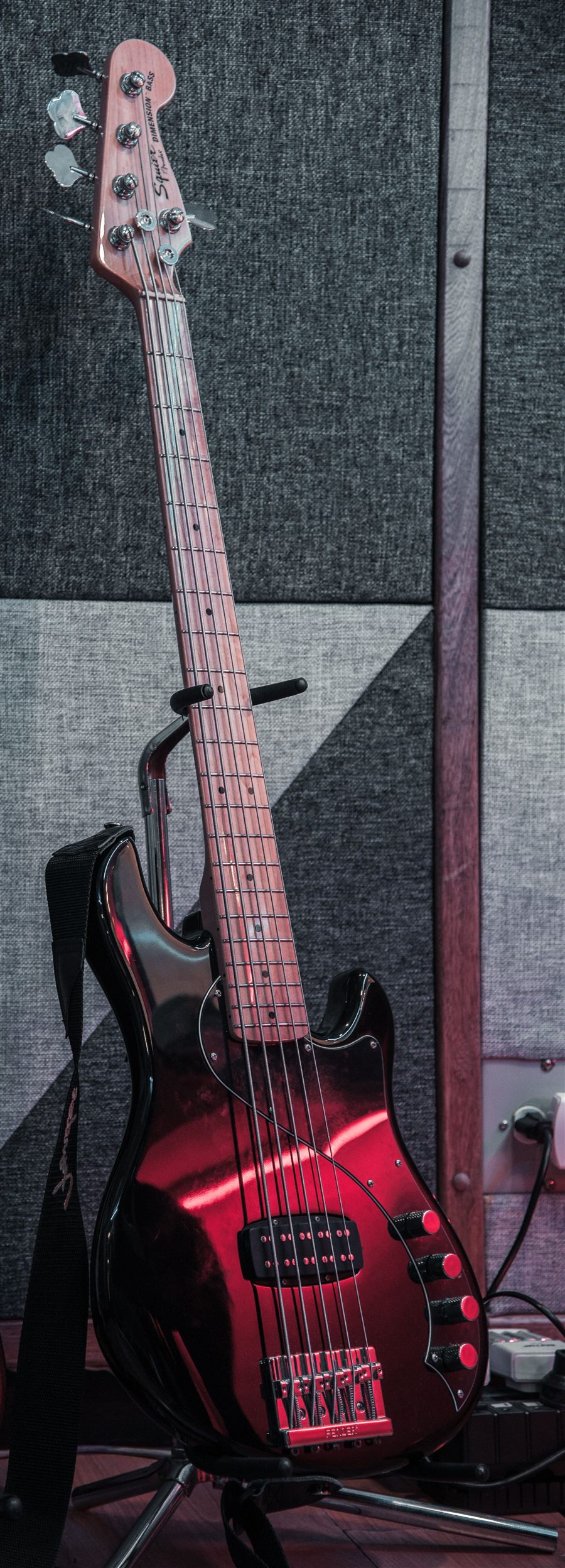
Short answer: Passive electronics are just a volume and a tone control with no battery, and they can only cut frequencies. Active electronics add a battery-powered preamp that can also boost frequencies and delivers a stronger, low-impedance signal, at the price of depending on a battery. Neither is inherently better: passive suits warm, dynamic classic tones, active suits tonal variety and modern, defined sounds. If you are a beginner with no fixed tonal goal, a passive or switchable bass is an easy, low-maintenance choice.
What active and passive mean
The terms describe the electronics, not the whole instrument. A bass can have passive pickups and still run through an active preamp, which is in fact the most common combination.
Passive: subtract only
A passive bass typically has a volume control, a tone control and, on two-pickup models, either a second volume or a blend knob. The tone control acts like a filter that rolls off highs as you turn it down; it cannot add anything. The volume control only makes the signal quieter. The bass therefore never delivers more level than the pickups generate. With no electronics in between, the tone responds directly to your touch: play gently and it gets rounder, dig in and it gets more aggressive.
Active: a preamp on board
In active electronics a small amplifier sits between the pickups and the output jack. It does two jobs. First, it converts the weak, high-impedance pickup signal into a stronger, low-impedance one. That signal stays stable over long cables, pedals and stage runs because far fewer highs are lost. Second, it provides tone controls that can both cut and boost frequency ranges. The preamp draws power from a 9-volt battery; some basses use two for 18 volts.
Active pickups are something else
Active pickups have their preamp built into the pickup and are also battery powered. They are usually quiet and deliver a consistent level. Still, active electronics on the bass and active pickups are not the same thing: an active/passive switch only bypasses the tone circuit, it does not turn a pickup passive. Combining active pickups with an additional preamp can in theory raise the noise floor and reduce headroom, because two gain stages are chained.
Tone controls at a glance
Tone and blend on passive basses
The tone knob removes highs until the sound turns dark and mellow. Many players deliberately leave it nearly closed for a jazz or Motown sound. On basses with two pickups a blend knob mixes them, or two separate volume knobs do the same job. That is pure mixing, not boosting.
Two-band, three-band and sweepable mids
- Two-band: bass and treble. Simple and direct, common on entry-level and mid-priced models.
- Three-band: adds a midrange control at a fixed frequency. Mids largely decide how well the bass cuts through in a band.
- Three-band with selectable mids: a switch offers two or more midrange frequencies.
- Sweepable mids: a second control sets which midrange frequency is affected. This is the most flexible layout, and also the easiest one to dial in badly.
On boost/cut controls the center detent is neutral. On boost-only controls fully counterclockwise is neutral and turning up adds. If you push bass and treble all the way up, you get the familiar scooped sound that impresses solo but quickly disappears in a band mix. Starting from a flat setting and making small corrections is almost always more musical.
Output level, impedance and noise
Active basses deliver a stronger, more even signal. That helps when recording through an interface or DI box and over long cable runs. Passive basses have a weaker, high-impedance signal. With very long cables you lose highs, and basses with single-coil pickups pick up more hum. With a decent cable and an amp input that is set up properly, this is rarely a problem in everyday use.
Two practical notes:
- Cheap active preamps can hiss audibly or make the tone thin. A good passive circuit often sounds better than a weak active one.
- Some effects (fuzz pedals, for example) react differently to a low-impedance active signal than to a high-impedance passive one. Try your pedals with the bass you plan to play them with.
Active basses often sound slightly more compressed because the output level stays more constant regardless of how hard you play. If you love the dynamics of your attack, that is a drawback; if you need a steady, defined tone, it is an advantage.
Battery, headroom and lifespan
Single or double battery voltage
A 9-volt system is the standard. Two batteries (18 volts) give the preamp more room before the signal distorts (headroom), around 6 dB more on some preamps. The sound does not change fundamentally, and an 18-volt bass is not louder, just cleaner when you play hard or boost heavily. An 18-volt system also usually lasts longer because the usable voltage window is wider. For most players 9 volts is enough; 18 volts is a matter of taste.
How long does a battery last?
Figures vary widely because every preamp draws a different amount of current. A commonly reported rule of thumb is 300 to 350 hours of actual playing time (as of Oct. 2026). For regular players that works out to a change every few months up to about once a year. If you have to swap batteries every week, something is wrong: usually the cable stays plugged in, there is a fault, or the battery is poor quality.
Unplugging the cable saves the battery
On active basses the output jack is a stereo jack. A mono plug completes the battery circuit, and the preamp draws current as long as the cable is plugged in, even when you are not playing. Pull the cable and the circuit is open. This is the single most effective way to save battery. Switching to passive mode or turning the volume down usually saves nothing, because the circuit often stays powered.
Changing the battery step by step
- Unplug the cable and lay the bass on a soft surface.
- Open the battery compartment (cover on the back or under the pickguard, depending on the model). This compartment is meant for battery changes.
- Pull off the battery clip and take out the old battery. The clip fits only one way round.
- Snap on the new battery, insert it, plug in the cable and play a few notes.
- On 18-volt systems always replace both batteries together and use the same type.
Practical tips: write the change date on the battery with a marker. Carry a spare to every gig. Never leave dead batteries in the compartment, because they can leak. Many players avoid rechargeable 9-volt cells because they can leak or self-discharge. A weakening battery often shows itself first through a changed tone: the bass sounds distorted, thin or scratchy before it goes silent. Change it straight away.
Active/passive switches and hybrid setups
Many active basses can be switched to passive operation with a mini switch or push/pull knob, which bypasses the tone circuit. That is handy when the battery dies, because depending on the model the bass remains playable and you get a touch of passive character. Keep in mind that the switch does not turn the bass into a true passive bass, and not every active bass makes sound without a battery. When trying a bass, listen to it in both positions.
Sound examples by genre
- Jazz, blues, soul, Motown, classic rock: the warm, round tone of passive basses is the ideal here. Classic Precision and Jazz Bass designs are passive; more in Precision Bass vs. Jazz Bass compared.
- Funk and slap: both work. Active basses give a crisp, defined attack with plenty of sparkle, passive basses a round, gritty tone.
- Metal, hard rock, fusion: often active, because the constant level and targeted midrange work cut through a wall of guitars.
- Pop, gospel, cover bands: active or switchable is practical when you need many styles in one evening.
There are classics in both camps: many defining basses in soul and rock history are passive, the Music Man StingRay line was an early example of active electronics in the 1970s, and plenty of studio recordings today are made with passive basses.
Pros and cons at a glance
| Passive | Active | |
|---|---|---|
| Tone controls | Cut only (highs) | Cut and boost, often several bands |
| Tonal character | Warm, dynamic, touch dependent | Defined, even, often a little more compressed |
| Output level | Weaker, high impedance | Stronger, low impedance |
| Long cables | Some loss of highs possible | Largely lossless |
| Battery | None needed | 9 V or 18 V, risk of failure |
| Technology | Simple, low maintenance | More complex, more things that can fail |
| Cost | Usually cheaper | Often a bit more expensive |
Buying used: checking active basses
With a used active bass there is one extra step on top of the normal electronics check. A full buying checklist is in Buying a used bass: what to look for. For the electronics:
- Open the battery compartment: white or greenish crust, discoloration or residue from a leaked battery is a warning sign. The battery clip and its wires are also a common weak point. Check that everything sits firmly and the insulation is intact.
- Test with a fresh battery: bring a new 9-volt battery. Even a supposedly fresh one can be weak.
- Turn every control through its range: each pot should move smoothly without crackling or scratching, and each control must audibly change something. Scratchy pots are the most common weakness; turning them back and forth sometimes quiets the noise only temporarily. Persistent scratching points to wear or corrosion.
- Check center detents and switches: boost/cut controls should click into place in the middle, and the active/passive switch must clearly switch.
- Listen for noise: with the active circuit on, turn bass and treble up. Strong hiss or hum is not normal.
- Wiggle the output jack: if it is loose or the sound cuts out when you touch the cable, the jack is worn.
Visual inspection and playing tests are as far as a buyer should go. Opening, soldering or modifying electronics is a job for a qualified repair shop, not least because components and finish are easily damaged.
Prices and premium in the US
A blanket premium for active electronics cannot be named, because active and passive models usually differ in wood, pickups and hardware as well. One example of an active entry-level bass: the Yamaha TRBX304 is priced at around 419.99 USD new (as of Oct. 2026). At the other end of the market, a new Music Man StingRay starts at roughly 2,749 USD (as of Oct. 2026). Used prices vary widely by condition, age and offer and cannot be stated reliably.
For installing or converting to a preamp, shop quotes range widely, roughly 50 to 300 USD for labor depending on the work involved (as of Oct. 2026, rule of thumb; varies by shop, get a quote). If wood has to be routed or drilled, for example for a battery compartment, it costs more. Parts for a conversion are typically listed at around 80 to 150 USD.
Retrofitting and repair
Active electronics can be added to many passive basses, and an active circuit can be replaced by a passive one. This is not a home project. Pots, preamp, battery and jack must all work together, cavities and holes often have to be created, and mistakes lead to hum, noise or dropouts. Have a qualified repair shop do this. You can tell repair is due when the bass keeps eating batteries, crackles or hisses constantly, individual controls do nothing, or the sound cuts out when you wiggle the cable.
Common myths
- Active is more professional: False. Many professional recordings are made with passive basses. Active is a different tool, not a higher class.
- Passive sounds more natural: That is taste. An electric bass is an electrical instrument anyway, and passive pickups color the sound too.
- Active never hisses: Good active circuits are quiet, cheap ones can hiss audibly.
- 18 volts is louder: No, 18 volts gives more headroom, not more volume.
- The battery dies without warning: Usually a changed sound announces it. A spare in the gig bag does the rest.
- Active pickups and an active preamp are the same thing: No, see above.
Decision guide
- You want the classic sound and like things uncomplicated: passive.
- You play many styles or want a lot of tone shaping on the instrument: active or switchable.
- You are a beginner and do not know what you want: a passive bass is simpler. With active entry-level models, listen carefully for hiss.
- You play live a lot and want no battery trouble: passive, or an active bass with a passive switch plus a spare battery.
- You are also deciding on string count or body style: that has nothing to do with the electronics; see 4-string vs. 5-string bass.
The most reliable method is to play a passive and an active bass back to back through the same amp. Then you hear whether the direct, dynamic character or the targeted tone shaping suits you better.