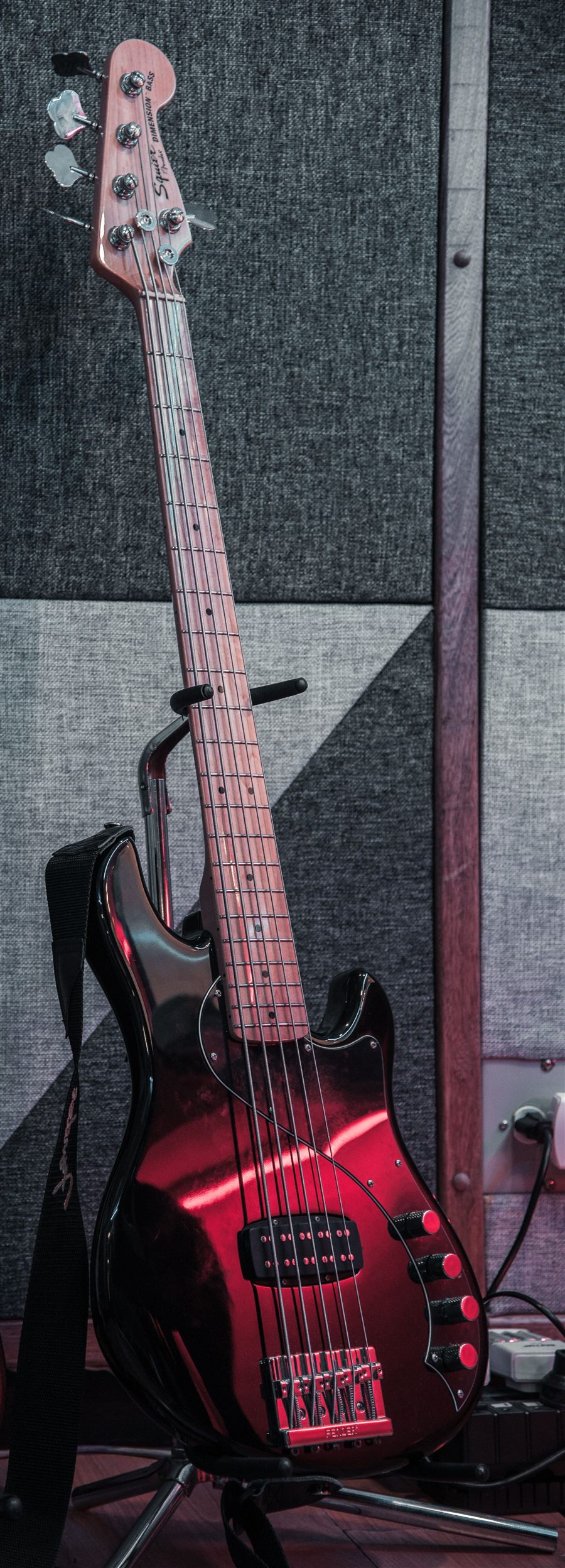
The Precision Bass has one split-coil pickup and sounds warm, direct and weighty in the low mids, on a wider neck. The Jazz Bass has two single-coil pickups, sounds clearer and growlier, and can be shaped much more through its blend control, with a slimmer neck and an offset-waist body. Both work in almost any style. The choice depends less on genre than on how the neck feels in your hand and whether you prefer one dependable sound or more ways to shape it.
How the two designs came about
The Precision Bass arrived in 1951 and was the first industrially produced solid-body electric bass; a prototype existed in 1950. The original had a single-coil pickup with four pole pieces, a bolt-on maple neck with 20 frets and a 34-inch scale, which later became the standard for long-scale basses. The hum of that first pickup was a weakness. The big revision came in 1957: the Precision received the split-coil, hum-cancelling pickup it still uses, a new headstock and pickguard, strings loaded through the bridge, and four individual saddles for intonation.
The Jazz Bass followed in 1960, initially as the "Deluxe Model". It had a narrower, more rounded neck, an offset-waist body, two single-coil pickups and, at first, stacked knobs. Late in 1961 the controls changed to three separate knobs. More dates are not needed for a comparison, particularly because finishes, necks and hardware changed over the decades, so details depend on the year of the individual instrument.
Pickups: one split coil versus two single coils
Precision: a split pickup
The Precision pickup consists of two coil halves, each covering two strings. They are wound in opposite directions and wired in series, so outside interference (the typical mains hum) largely cancels out. It sits roughly midway between neck and bridge, where the string delivers a lot of fundamental. The result is a dense, warm tone with plenty of push in the low mids.
Jazz: two single coils and the blend control
The Jazz Bass has one pickup near the neck and one near the bridge. The neck pickup sounds rounder and deeper, the bridge pickup brighter, sharper and more midrange. With the two volume knobs you mix them continuously: neck alone gives a soft, almost Precision-like tone, bridge alone a nasal, throaty sound, and both at equal level the classic Jazz Bass voice, with strong mids and slightly thinned low mids. A tone control completes the circuit.
On hum: a single single-coil picks up interference. In practice, Jazz Basses are quietest when both pickups are on together, because much of the noise then balances out. Solo one pickup near monitors, dimmers or fluorescent lights and you may hear buzz. That is not a fault, it is how the design works.
Tonal differences in practice
- Precision: more percussive and precise, pushes more in the lows. In a band mix it usually holds its place without much fiddling because it delivers a fixed, full tone.
- Jazz: growlier, with more upper mids and bite. It gives you more shaping, but asks for more decisions about blend and tone.
- Both together: in a direct listening comparison of matching 1970s instruments, the differences were clearly audible, yet both basses fit neo-soul, funk, pop and rock. The differences are audible, but they do not rule out a genre.
Technique, strings, amp and mix often shape the sound more than the body style. A Jazz Bass with flatwounds and the neck pickup favored can sound like a Precision, and a Precision with fresh roundwounds and a hard attack can sound surprisingly bright.
Neck, nut width and body
| Feature | Precision Bass | Jazz Bass |
|---|---|---|
| Nut width | usually 1.625 in (41.3 mm); older and some vintage-style specs up to 1.75 in (44.5 mm) | usually 1.5 in (38 mm), slim and tapered |
| Neck feel | substantial, "chunky", constant thickness, more room between strings | slimmer, strings closer together, easier for fast runs across several strings |
| Body | symmetrical double cutaway, straight design | offset waist, mass shifted forward, often more comfortable seated |
| Pickups | one split coil in the middle | two single coils (neck and bridge) |
| Controls | volume and tone | two volumes (blend) and tone |
| Scale | 34 in (standard) | 34 in (standard) |
These figures are guide values. Widths and profiles vary with series and year (C, D and U shapes appear on both). If in doubt, measure the nut or ask for the nut width. Weight shows no reliable difference between the two styles; it depends mostly on the wood and the individual instrument. Bodies are commonly alder or poplar, with basswood on cheaper models.
Typical genres and use
The Precision is tied to Motown, soul, rock, punk and pop, with players such as James Jamerson, John Entwistle, Steve Harris and Sting. The Jazz Bass stands for funk, fusion and jazz, with names such as Jaco Pastorius, Marcus Miller, Geddy Lee and Flea. These are leanings, not rules: Precisions are played in funk and Jazz Basses in rock. For slap, the Jazz Bass is often the easier fit because the bridge pickup and narrow string spacing emphasize the attack; for a solid rock foundation or song-serving pick playing, the Precision gives a finished result quickly.
Hybrids and alternatives
- PJ bass: the Precision split coil in the middle plus a Jazz-style single coil near the bridge. You get the weight of the P and can blend in definition with the bridge pickup. A common compromise, especially on entry-level models.
- Music Man StingRay: on the market since 1976, designed with Leo Fender and Tom Walker. One active humbucker near the bridge, with a preamp powered by a 9-volt battery and tone controls. It sounds fat and tight and is common in funk, disco and rock. For electronics, see active vs. passive electronics on electric bass.
- Other body styles: many makers build their own variants with humbuckers, active circuits or other body shapes. If you simply want a classic Fender sound, P, J or PJ will serve you well.
Cost new and used in the US
The classic starter choice is the Squier Classic Vibe '60s Precision Bass at a regular price of about $529.99 (as of Oct. 2026), with the basic Squier line starting around $210. A Fender Player II Precision or Jazz Bass is listed at about $849.99 new (as of Oct. 2026). On the used market, entry-level instruments can be found for under roughly $300 to $400, mid-range American-made basses mostly between about $800 and $1,500, and 2008 to 2016 American Standard Precisions averaged about $900 to $1,300 based on 2020 data (guide values). Vintage Fenders start around $3,495 and go far beyond $39,000 depending on year and condition. Prices vary by model, year, condition and country of manufacture, so compare current listings for the exact model.
Copies, Squier and what to check when buying used
Both designs have been copied for decades. Legitimate options are the budget imitations and Squier line. Problem cases are counterfeit instruments with a Fender logo and parts-built basses ("partscasters") assembled from unrelated parts. What to look at:
- Serial number: if it is missing entirely and there is no country of origin anywhere, that is a clear warning sign. On older instruments it is stamped into the neck plate; on newer ones it is usually on the headstock.
- Headstock: compare logo, lettering size and position; deviations are a warning sign. A Fender logo alone is no proof of authenticity.
- Neck plate: a loose "F" neck plate is a common replacement part found on parts basses.
- Body shape: imitations and some Squier bodies are slightly slimmer or differ subtly in contour.
- Identifying the style: you can tell P from J without a brand name: one split pickup in the middle and a symmetrical body mean Precision, two pickups and an offset waist mean Jazz. The nut width confirms it.
- Neck profile: old 1950s Precision necks can be very thick. Check that it suits your hand.
A full condition checklist is in buying a used electric bass: what to check. If you doubt authenticity, the manufacturer can provide information from the serial number.
Myths and mix-ups
- "Precision is only for rock, Jazz Bass only for jazz and funk": both run in nearly all styles; the genre split is a tendency.
- "A Jazz Bass always sounds brighter": with the bridge pickup turned down, the tone rolled off and flatwounds it can sound very round.
- "A Precision has no tonal range": it has fewer controls, but strings, attack and tone control change it a lot.
- "Jazz Basses hum": only with a single single-coil on its own. Both pickups together are much quieter.
- "The build year decides the sound": older is not automatically better. Condition, setup and strings count too.
When P, when J? Decision guide
- Small hands or a neck that feels too thick? Try the Jazz Bass first. If you have large hands or like room between the strings, the Precision may feel better.
- Little time to dial in a sound? The Precision delivers a finished tone with little effort.
- Want tonal shaping, slap or solo playing? That favors the Jazz Bass.
- Want a bit of both? A PJ bass is the compromise.
- Beginner? Both suit you; the neck decides. For string count and scale, read 4-string vs. 5-string.
Accessories: strings change the sound
Roundwound strings have a round outer wire, sound brighter, with more attack and overtones, but more finger noise. Flatwound strings have a flat ribbon wrap, sound warmer and more muted with more fundamental and fewer highs. They are the classic sound for Motown, soul and vintage rock. On a Precision, flatwounds emphasize the dark, thick character; on a Jazz Bass they take off the edge and move it closer to the Precision. Try string types one after another with fresh sets, because old strings fake differences. For more on how electronics shape tone, see active vs. passive electronics on electric bass.
Common mistakes
- Buying by genre instead of by how it feels in the hand.
- Comparing only sound clips without holding the neck.
- Taking the logo on the headstock as proof of authenticity.
- Comparing instruments with different strings and crediting the instrument for the difference.