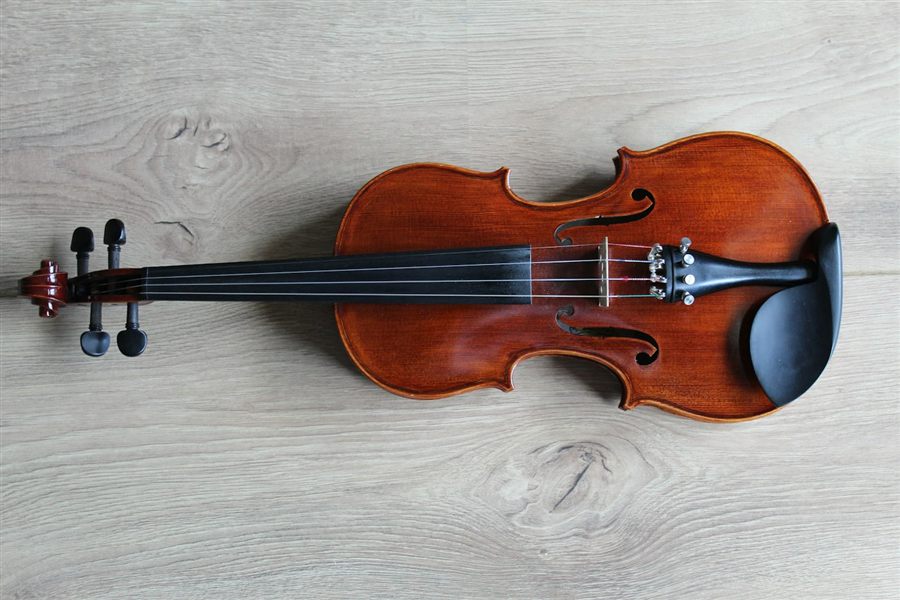
The short answer: The label inside a violin tells you very little about who made it, an appraisal is a reasoned expert opinion rather than proof, and value comes mostly from maker, condition and originality, not from age or loudness. For instruments in the low four figures a formal certificate rarely pays off. The higher the price and the bigger the name on the paper, the more an independent check before buying matters.
What the label inside a violin really tells you
Looking through the f-hole at the back plate, you will usually see a small paper label with a name, a town and a year. Many buyers read it as the answer to who built the violin. In most cases it is not.
Why "Antonius Stradivarius" is glued into so many violins
In the 19th and early 20th centuries, stringed instruments were made in enormous numbers. Roughly seven million bowed instruments left the Saxon town of Markneukirchen alone between 1880 and 1914, and other European centers such as Mittenwald, Bubenreuth and Mirecourt (and today China) produced millions more. Makers glued in labels carrying the names of famous masters: Stradivari, Guarneri, Amati, Steiner. This was usually not an attempt to deceive but a model designation, meaning "built on the pattern of this maker." Buyers at the time knew they were getting an inexpensive violin. A century later that knowledge is gone and the label reads like a promise of authenticity.
Real fraud exists too. As early as 1685 a court violinist went to court after discovering that his supposed "Amati" hid the label of a student maker. Original labels of great masters often did not survive: they were removed and reused in lesser instruments or copies, and genuine instruments were sometimes given facsimile labels because the workmanship itself identified the maker. A label can be accurate but unimportant, genuine but in the wrong instrument, misleading or invented outright.
What you can still read from a label
- A printed "Made in ..." country line at the bottom edge (for example a European country of manufacture) are a sure sign the violin is not by the master named in the text. Country-of-origin marking was required on imports into the US.
- As a rough dating guide, labels before about 1890 usually carry no country of origin; later ones show country marks that changed over the decades.
- A cleanly machine-printed label fits a trade violin. A handwritten label is no proof either, since those can be imitated.
- To find out who really built a violin, look at the construction itself: arching of top and back, shape of the corners, purfling, varnish and scroll carving. That is what a violin maker judges, not the paper.
Factory, workshop and master violins compared
Violin prices span an unusually wide range for a single instrument type. The groups differ less by one visible feature than by how they are made, set up and how much labor goes in.
| Category | How it is made | Typical new price in the US (as of Oct. 2026) | What matters |
|---|---|---|---|
| Budget factory violin | Industrial, often sold online as a complete outfit | about $299 to $395 for outfits | Frequent problems: thick uneven varnish, rough carving, weak fittings, misaligned bridge, stiff pegs |
| Factory violin, professionally set up | Series production, then adjusted by a shop | about $700 to $1,200 | Setup decides whether it is playable and stays in tune |
| Step-up or workshop violin | Smaller shop, more hand finishing, some parts bought in | about $1,250 to $1,500 and up | Individually graduated plates, cleaner work, one person accountable. Some workshop instruments are priced like factory ones |
| Master violin | Built largely or entirely by one maker | well above that, depending on the maker; get a quote | Wood, arching and setup from one hand; price reflects reputation and time |
These tiers are rules of thumb. The boundaries blur, and a good workshop instrument can cost about as much as a factory one.
How to spot factory work
- Thick, uneven varnish that hides grain and arching instead of showing them.
- Rough scroll and f-hole carving, uneven purfling.
- Especially thick wood, often to survive shipping, which makes the violin look and feel "coarse."
- Basic fittings (chin rest, tailpiece, pegs) and a setup that was not adjusted to the instrument.
What differs in sound
Good student violins with a professional setup sound serviceable but limited: tone stays simpler in depth and shading. In the range up to roughly $1,500 you typically gain tonal depth, a more differentiated response and better projection. Above that, personal taste becomes decisive, for example a warm versus a brilliant sound and how the violin responds across registers. That is a practical rule of thumb, not a law: a badly set-up expensive violin sounds worse than a well-adjusted cheaper one. For more on price levels see our overview of budget tiers for used violins.
What determines a violin's value
Four criteria come up again and again in valuations: the maker (or school), the age, the condition, and quality relative to comparable instruments by the same maker or from the same period. Provenance and rarity add to that.
- Maker and attribution: The famous name makes the biggest difference, but only if it is supported. A violin attributed to a famous maker without solid evidence is often worth a fraction of that.
- Provenance: Documented previous owners, invoices and earlier appraisals raise value.
- Rarity: Stradivari made about 1,100 instruments, of which about 650 survive; Guarneri del Gesù made only about 200 violins. That scarcity drives prices.
- Condition and originality: Best-preserved instruments with original varnish and little restoration are most sought after. Improper repairs reduce authenticity and value.
- Tone: It plays a surprisingly small role in market value. A valuation judges maker and construction, not sound, and even specialists regard tonal judgments as largely subjective.
How value develops
Factory-made instruments lose value in their early decades. Dealers' experience is that they roughly regain their inflation-adjusted purchase price after about 50 years and rise afterward with good care. Handmade master instruments tend to hold value and gain over decades, but only if played often and well and cared for properly. A violin that sits in a closet is not an investment.
Cracks and repairs
Cracks are the most common cause of lost value. Soundpost cracks are especially serious because the soundpost presses on that spot permanently. For valuable instruments, a rough rule of thumb is a loss of about 10 to 15 percent for a crack in the top and 40 to 50 percent for a crack in the back, because the maple there is thicker and needs larger patches. For contemporary instruments the discount tends to be even steeper, since buyers can get a flawless one straight from the maker.
Gluing cracks, setting patches and revarnishing belong strictly in a professional shop and can keep an instrument off the market for months. What you need to know: a crack can change the sound audibly (buzzing, rattling) and must be clarified before purchase. Repair costs vary by shop, so get a quote. On cheap violins, repair quickly exceeds the instrument's value. On a good violin it is worth it. More on what to check when buying used is in buying a used violin, and the bridge and soundpost relationship is explained in checking bridge position and soundpost.
Varnish
Varnish shapes the look and protects the wood. For valuation, what counts is whether it is original or has been reworked, because retouching and refinishing reduce collector value. A "secret" varnish that makes old Italian violins sound better is not scientifically supported (see the myths below).
Appraisal, certificate, valuation: what is the difference?
Terms are used differently from shop to shop. Usually three kinds of documents are meant:
| Document | What it states | Typical cost in the US (as of Oct. 2026) |
|---|---|---|
| Verbal opinion | First orientation on origin and value range, nothing in writing | varies by shop, get a quote |
| Written appraisal | Description, condition and estimated value, for insurance, sale or estate | commonly about $125 to $300 for typical instruments; some high-end dealers start at $500 or charge by the hour, and some only appraise above a minimum value |
| Certificate of authenticity | Origin, description and photos; states who made it and when, but usually gives no value | often a flat fee (around $300) or a percentage of value, commonly in the range of about 4 to 10 percent |
All figures are rough guides and vary widely. Some dealers include a certificate in the price when you buy from them. Dendrochronology is billed by effort, so ask for a quote.
What an appraisal is and is not
An appraisal is the written opinion of an expert. It assigns the instrument to a maker, school or period and estimates a value. It is not scientific proof: recognized experts can assign the same instrument differently. The values also differ: the insurance (replacement) value is usually higher than what you would get selling. Appraisers often add roughly 10 to 20 percent to the purchase price to allow for appreciation, so an insurance appraisal gives a higher number than a realistic sale price. And an appraisal says nothing about how the violin sounds.
Who should write it
- Choose someone who regularly deals in instruments of your type and price range and therefore knows current market activity.
- The paper is worth only as much as the name beneath it: appraisals by widely recognized experts carry far more weight in the trade than those from unknown sources.
- Be wary when the seller writes the document or picks the appraiser. An independent second opinion costs little compared with an expensive mistake.
- For substantial sums, two opinions from independent experts are normal.
Dendrochronology explained
This method measures the growth rings of the top plate wood, directly on the instrument, from photographs or by CT. The pattern of wide and narrow rings, which reflects weather and climate in the growing years, is compared with already dated ring sequences from the wood's source region. It needs at least about 50 to 70 rings, which a violin top barely provides. A double bass is easier to date than a cello, and a cello easier than a viola.
The result is the earliest possible date: the year the youngest measured ring formed. It does not say when the violin was actually made, because wood was often stored for years, outer rings are lost during shaping, and some makers used very old timber. The wood's origin can also be determined, but not who used it.
Where it helps is exposing problems: a viola attributed to a maker who died in 1609 turned out to contain wood grown in the 17th century. That is impossible, and the value dropped to about a tenth. It is not infallible, though: depending on which rings are measured and how the data are read, famous instruments have produced conflicting results that needed further scientific work to settle. A formal appraisal therefore usually combines dendrochronology with an optical check of varnish, glue joints, cracks and material changes.
Common misconceptions about violin value
"Older automatically means more valuable"
Age alone says little. An old, badly made or heavily damaged instrument is worth less than a well-made newer one. Many old violins from attics are trade violins from around 1900. They are old but not rare, and their value depends heavily on condition and workshop.
"The label tells you who made it"
See above: at best a hint, usually a model designation.
"A louder violin is a better violin"
Loudness is only one factor. Projection, complexity, evenness across all strings and how the violin responds to your playing matter at least as much and are a matter of taste that shows only when you try it yourself.
"A high price guarantees a good instrument"
The price shows what the seller asks, not an independent assessment of quality. Overpriced instruments exist at every level, and so do well-adjusted bargains.
"Old Italian violins sound better because of a secret varnish"
Several blind tests with experienced soloists comparing old instruments, including Stradivari violins, against new ones found that many players preferred new instruments and often could not reliably tell old from new. In one test, six of ten soloists chose a new violin. The lead researcher put it roughly this way: there is no secret except in people's minds. High prices are explained by collector status, rarity, provenance and prestige, much like classic cars, which cost more even though a new car drives better.
"An appraisal makes a violin valuable"
It documents value; it does not create it. For student instruments, the cost easily exceeds the benefit.
How to judge authenticity and value before you buy
- Read the label as a clue, not proof, and ask the seller where the attribution comes from (invoices, previous owners, earlier appraisals).
- Play the instrument and compare it with at least two others in your price range. Have a violin maker go over it: setup, cracks, repairs, soundpost.
- Watch for warning signs: a strikingly low price with a big name, a seller who allows no returns, an appraisal written by the seller, no photos of the interior.
- Get all of the seller's claims (maker, age, repairs) in writing.
- For instruments in the low four figures, a verbal opinion or a short written appraisal is often enough. At five figures or with big names, a certificate and possibly dendrochronology are worth it, ideally from more than one expert.
- If a violin is attributed to a well-known maker, check whether the price fits the market: someone who knows the value of a documented instrument does not sell it cheaply.
Auction prices are only a rough guide
Auctions are a price barometer, not a shop price. The low estimate roughly matches what a dealer would pay, the high estimate sits closer to retail. Hammer prices often come in well below retail because dealers subtract repair costs and their margin before bidding. The seller's reserve is confidential. If you buy at auction, request condition reports ahead of time, talk with the specialist in charge about the attribution, and read the terms closely: an authenticity guarantee typically covers only instruments definitively identified as by the named maker, and only for a limited period (for example 20 days at one major house).
A sense of scale: auction results for one lesser-known Italian maker from Bologna ran from a few hundred dollars in the 1950s to a record of about $103,700 in 2021, with sales in the 2000s and the 2010s to 2020s mostly between roughly $27,000 and $88,000. Record prices for famous master violins are well beyond ten million dollars. These are rough orders of magnitude, not prices you can count on.
For everyday decisions: before paying for an appraisal, make sure the violin's value justifies it. If you are shopping for a child, getting the right size matters more, see violin sizes for children.