An electric guitar's neck is joined to the body in one of three ways: bolted on (bolt-on), glued in (set neck) or running through the body (neck-through). The audible difference is much smaller than the folklore suggests. What matters more is a clean fit, the neck wood, the profile, radius, scale length, and how easily the guitar can be repaired later. For comfort, the shape of the back of the neck counts most, and you only find your preference by playing.
The three constructions at a glance
Bolt-on
The neck sits in a precisely routed pocket in the body and is usually held by four wood screws through a metal plate at the heel. "Bolt" is slightly misleading, since these are normally wood screws, not bolts with nuts. Fender adopted the method in 1950 because it was simpler and cheaper to build and service than a glued neck. It is still the most common approach, used on Stratocasters, Telecasters and most beginner models.
Advantages: the neck can be removed, replaced, or finished and worked on separately. On some models thin shims in the pocket correct the neck angle slightly. Drawbacks: the pocket must fit tightly and cleanly. A poor fit makes the joint unstable, which can show up as dead spots or wandering tuning. The thick heel also limits access to the highest frets, although many makers soften it with rounded or sculpted heels.
Set neck
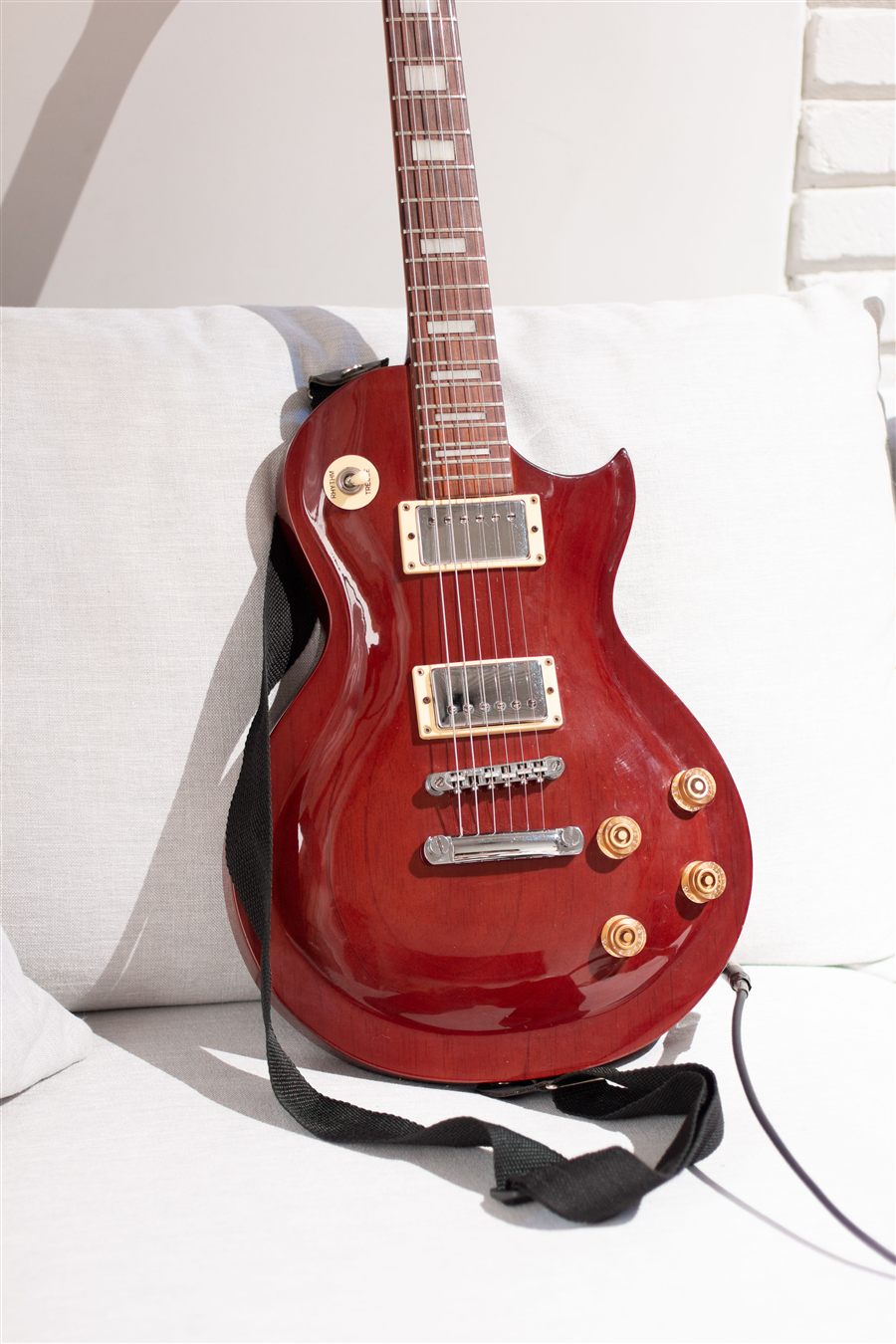
The neck is glued into a pocket, either with a mortise-and-tenon joint or a dovetail. You know it from the Les Paul, the ES-335, many PRS models and archtops. The large glue surface is considered very stable, and the design is a little more forgiving of small fit errors. The transition to the body is usually slimmer, so you often reach high positions more easily, especially with a cutaway.
The trade-off: the neck cannot simply be unscrewed. A luthier needs steam or a heated knife to release it, and any angle correction belongs in a professional shop.
Neck-through
A continuous piece of wood, usually laminated from three, five or more strips, forms both the neck and the core of the body. Body wings are glued to each side. Many Ibanez, Schecter and ESP models use it, as does the Gibson Firebird. Access to the top frets is excellent because there is no heel in the way. If the neck is damaged or warps, repair is considered difficult to nearly impossible, since the neck cannot be separated from the body. There are no documented repair prices for this construction, so get a quote.
Hybrids: set-thru
Some makers glue the neck into a very long pocket and deep into the body. It is a blend of set neck and neck-through, with repair options somewhere in between.
Does the neck joint change the sound?
The common rule of thumb: bolt-on sounds snappier, brighter and twangier with slightly less sustain, set neck warmer and fuller, and neck-through has the most sustain. Most sources online agree that any difference is small, and the attack claims are disputed.
A frequently cited experiment tested this: a builder made a guitar as neck-through, sawed the neck off and bolted it back on, then glued it again. Measured sustain was longest on the bolted version and shortest on the through-neck version. In a listening test, participants could not tell the variants apart. One experiment is not proof, but it supports the view that joint stiffness and a clean fit matter more than the construction type. A note of caution: unplugged sound says little about the amplified sound, where pickups, strings, the amp and the neck wood itself dominate. A neck-through guitar can even sound bright and compressed if its neck wood does.
The takeaway: buy for feel, access, repairability and condition, not for the promise of more sustain. For the wider picture, see electric guitar tonewoods: the debate and the facts and the comparison Stratocaster or Les Paul.
Repair, access and cost compared
| Feature | Bolt-on | Set neck | Neck-through |
|---|---|---|---|
| Neck replaceable | Yes, unscrew it | Laborious, pro shop | Practically no |
| Angle correction | Sometimes shims, otherwise a shop | Pro shop only (neck reset) | Barely possible |
| Upper-fret access | Often limited, depends on heel | Usually good, better with cutaway | Usually very good |
| Repair cost | Usually lowest | Medium to high | No documented values, get a quote |
Price guide
Shop price lists (as of Oct. 2026) show a setup starting around 70 USD and up to about 190 USD for a full setup. A bolt-on neck reset is listed at roughly 360 USD plus setup, a dovetail reset at about 540 USD plus setup, and another shop quotes 600 to 750 USD for a neck reset. Fret work: a fret level about 150 USD, a refret roughly 380 to 575 USD. A headstock repair runs about 90 USD for a minor break and 180 USD or more for a major one, with reglue jobs often 200 to 400 USD. Prices vary by shop, so get a quote.
Neck wood and fretboard
Fender necks are classically maple, a Les Paul neck is mahogany. The fretboard is either a second wood or maple, which then is part of the neck.
- Maple: usually finished, so it feels smooth and fast, and is often described as brighter and snappier.
- Rosewood: usually unfinished and slightly oily, feels organic and is often described as warmer and rounder.
- Ebony: very hard and smooth, seen as premium and often described as the brightest.
- Pau ferro: often described as sitting between rosewood and ebony.
These tonal descriptions are subjective; the feel of the surface matters more. For an unfinished fretboard, a drop of suitable fretboard oil during a string change, used sparingly, is enough.
Roasted maple
Roasting treats maple in a low-oxygen oven at roughly 200 to 300 °C (about 390 to 570 °F). It breaks down components of the wood, so it absorbs less moisture and stays more stable, and the truss rod needs adjusting less often. Downsides: the wood gets more brittle (chipping, screw holes), costs more, and its colour varies. A better tone is unproven and would be smaller than the effect of amp, strings or pickup height.
Neck profiles: C, U, V, D and slim
The profile is the cross-section of the back of the neck. It does not change the sound, only the feel in your hand. Listings rarely state the neck shape, so ask in the shop or check the spec sheet.
- C: half-round, today's standard and a good middle ground for most hands.
- U: deeper and fuller with steeper shoulders ("baseball bat"), popular with large hands.
- V: with a ridge down the back, common on vintage-style models and suited to a thumb over the top. Some players find it restrictive.
- D: a wider C with a flattened back, giving the thumb a rest.
- Slim and wizard: flat and wide, often with a large radius, common in metal and fusion. Thin necks are often easier for beginners and small hands, but fast playing does not require a wizard neck.
- Asymmetric and transition: the treble side is thinner, or the profile changes from a C at the nut to a D at the heel.
Some history for vintage Gibsons: from 1950 to 1965 the nut width was about 42.9 mm (1 11/16 in), from 1965 about 39.7 mm (1 9/16 in). In the 1950s the profiles were medium to full round, in the 1960s thinner. Necks were hand-shaped then, so there are exceptions. The letters A, B, C and D on Fender necks of the 1960s and 70s denoted nut width, not profile, a common mix-up.
How do you find your profile? Play the guitar, ideally chords, barre shapes and bends in several positions. Bring a reference guitar whose neck you like. Expect a break-in period. A shop can also reshape a neck later, but that is work for professionals and varies by shop, so get a quote.
Radius, scale length and nut width
Fretboard radius
The radius tells you how strongly the fretboard curves across its width. The smaller the number, the rounder. Typical values: vintage Fender 7.25 in, modern Fender 9.5 in, Gibson 12 in, PRS 10 in, and Ibanez, Jackson and Charvel mostly 15 to 17 in. Compound radii start round and flatten toward the body, for instance 10 to 16 in. A rounder radius is comfortable for chords and barres but can make notes choke (fret-out) on heavy bends with low action. A flatter radius eases low action and bending, while chords feel less natural.
Scale length
Scale length is the vibrating string length. The Les Paul uses 24.75 in (628 mm), the Stratocaster 25.5 in (648 mm). The shorter scale feels softer and puts the frets closer together, the longer one gives more string tension. Short scales of about 480 to 580 mm suit children aged six to eleven.
Nut width and hand size
Usual widths are 42 to 43 mm; Fender-style models about 42 mm, Gibson-style about 43 mm. For fingerstyle, 45 to 46 mm feels comfortable, and some beginner models sit near 41 mm. Large hands often profit from a wider nut and fuller profiles, small hands from slimmer profiles and shorter scales.
Truss rod, neck angle and neck reset
The truss rod is a steel rod inside the neck that counters string pull and sets relief, the slight curve of the neck. It was first patented for Gibson in 1921. As a rule of thumb, sources give about 0.007 in (0.18 mm) of relief at the 7th fret for electric guitars. On bolt-on Fender necks it is adjusted at the heel or behind the nut, on Gibsons behind a cover on the headstock. Adjust it only in small steps and only when the guitar has changed (buzzing, high strings). If you feel resistance, stop and see a shop.
A neck reset is a different matter. With a failing neck angle the angle between neck and body is no longer right: the action cannot be adjusted any more, the bridge sits all the way down, and the strings stay too high. On a glued neck it must be released, the angle corrected and reglued, which only a professional shop does. On bolt-on necks the angle can sometimes be adjusted with shims or by a shop.
Common myths
- "Neck-through sounds best": the construction does not guarantee better tone; quality and fit matter more.
- "A narrow neck is faster": that depends on the hand, not the width.
- "Roasted sounds better": the benefit is stability; a tonal advantage is unproven.
- "The fretboard wood sets the tone": it shapes feel and looks, the tonal influence is small and subjective.
What to check when buying used
On a bolt-on, the neck should sit tight and without play in the pocket; on a glued neck it should be cleanly aligned. Also check that the action is adjustable and the neck does not look warped. More in buying a used electric guitar and setup explained.