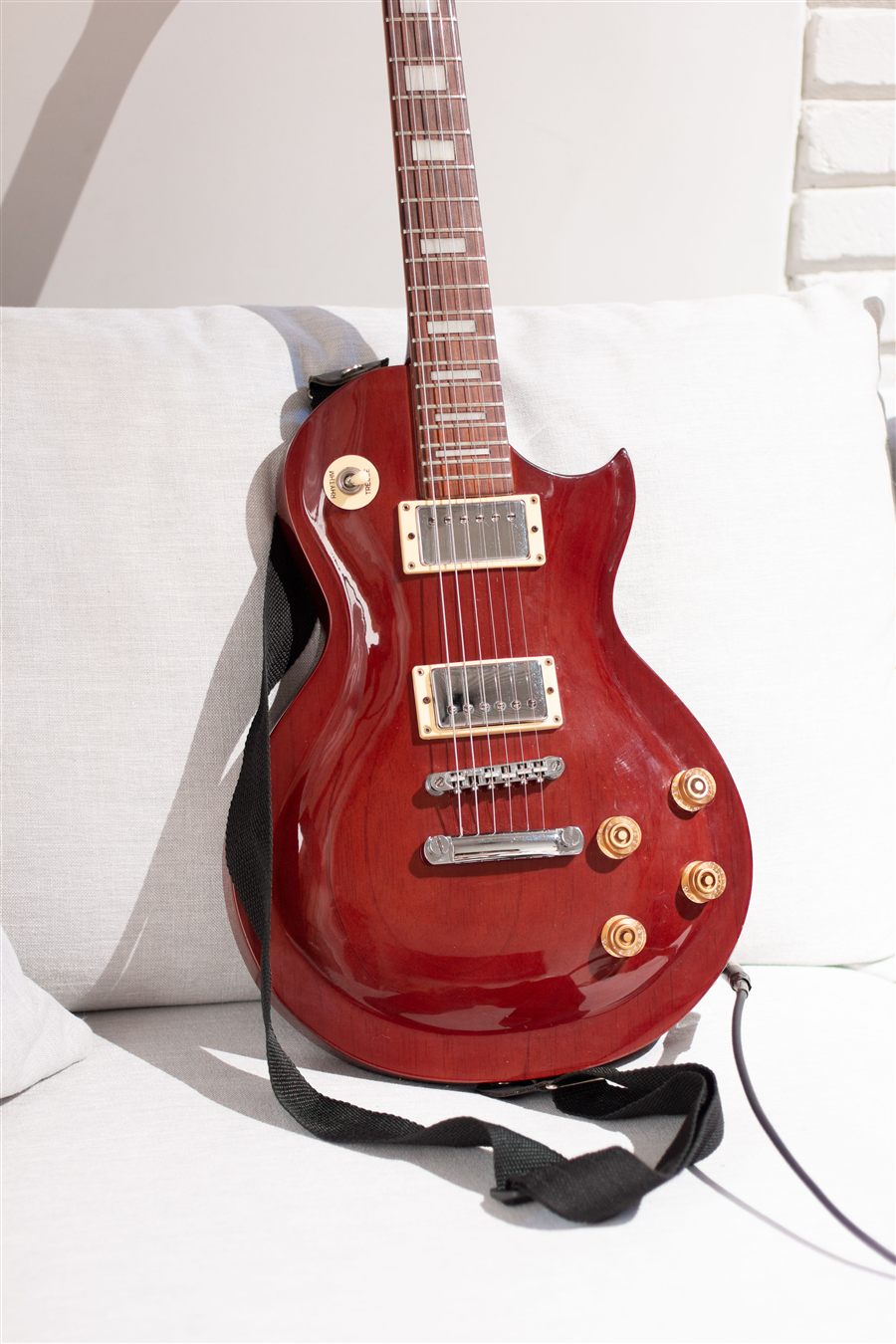
When you buy a used electric guitar, five things matter most: a straight neck with some truss rod adjustment left, frets with enough material remaining, an original finish without surprises, clean electronics, and hardware without pulled-out parts or play. Cosmetic wear is negotiable; structural damage is not. And always add the repair bill to the asking price and compare the total with the market value before you commit.
Before you go: preparation
Look up the typical market price for the exact model and year, and compare several current listings, not just one. Before the appointment, ask for the serial number, any changes to the guitar (swapped pickups, refinish, repairs) and whether a case is included. If possible, bring an experienced player, your own cable, a tuner and an amp you know well. A familiar amp makes noise and tonal quirks much easier to hear.
Checklist in person
Work through the guitar in a fixed order so you do not skip anything. Play it standing with a strap as well as sitting, because balance and neck dive only show up that way.
Neck and truss rod
The neck is the most expensive part that can go wrong. Hold the guitar at eye level and sight down the fretboard from the nut, along both the low and high E string. The neck should run evenly with a slight concave curve. Warning signs include a kink at the neck joint, a wavy "roller coaster" profile, visible twist (bass and treble sides do not sit level), or a drop-off in the last frets. A badly twisted neck is generally considered uneconomical to repair.
A common check for curvature uses the string as a straightedge: press a string down at the first fret and at the last fret and look at the gap near the middle. If the string touches the frets, the neck is back-bowed; if the gap is very large, it is bowed forward. A working truss rod can often correct either.
That is the key question: does the truss rod still have room to move? Ask the seller if you may check it gently and have the adjustment point shown to you. A rod that spins freely, does not move, or is already at its end of travel counts as a deal breaker, because an expensive neck repair may follow. If you adjust a rod yourself, do it only in small steps (no more than an eighth to a quarter turn, then let the neck settle) and never force it. If it is stiff, has no effect, or the bow does not go away even with a slackened rod, the guitar belongs in a shop. For how adjustments work in general, see setup explained: action, intonation and truss rod.
Construction matters too: with bolt-on necks the neck angle can usually be corrected cheaply, while with glued-in necks it is a costly job and often uneconomical. More in neck construction: bolt-on, set neck and neck-through.
Headstock and neck joint
Check the headstock for wrinkles, ridges or finish cracks that point to a past break. A repaired headstock break typically cuts the value by around half, even when the repair is clean. Small cracks near the neck joint tend to get worse over time. Also check that the gap between neck and body is even and, on bolt-on guitars, that the neck pocket fits cleanly.
Frets and fretboard
Frets are wear parts. Some wear is normal for a used guitar; what counts is how much material is left and whether the wear is even. Look for dents under the strings, especially in the first positions, for protruding fret ends, sharp edges and uneven fret height. A "ramp" in the last frets (the neck falls away toward the body) indicates warping that can mean a partial refret or more.
Play notes in every position and on every string and listen for buzzing, notes that choke out, or strings that die when you bend. Also check octave intonation: the harmonic at the 12th fret should match the fretted note at the 12th fret. After stretching the strings, the guitar should hold its tuning. If it does not, the cause is in the tuners, nut, bridge or tremolo.
Electronics and noise
Plug into an amp and check every position of the pickup selector, every control through its whole range and in both directions. Typical problems are:
- Scratching and crackling when you turn a knob: usually dirty or worn pots, often cheap to fix.
- A wobbly output jack or cutting out: move the cable in the plug while you play. Dropouts point to a loose or worn jack.
- Hum or buzz: to a degree normal with single-coils (see single-coil vs. humbucker); a very loud hum that disappears when you touch the metal parts may indicate shielding or grounding problems.
- A weak or thin-sounding position: a pickup may be wired out of phase or be faulty.
- A loose selector switch: if the switch wobbles, a replacement is due.
Do not open the guitar or solder anything yourself. If the seller allows it, take a look into the control cavity: a tidy, clean layout suggests a well-kept instrument, a tangle of improvised wiring suggests later tampering. Electronics repairs are a shop job, and the cost is usually manageable (see the repair cost section).
Finish, refinish and body
Fine finish checking does not reduce value, especially on nitrocellulose, where it is normal with age (background in nitro vs. polyurethane). Stains, discoloration and cracks that go through to the wood do. Scratches and wear are cosmetic and should hardly matter in the price.
A refinish ("refin") is different. A refinished guitar is often worth only about half as much as the same guitar with its original finish, even if the new paint looks flawless. Typical clues: finish in the routed cavities (control cavity, pickup routes) is unusually thick or has runs, screw heads have paint on them, the colour inside the routes differs from the outside, edges at the neck joint look rounded. Ask directly whether the guitar was refinished, and keep the answer in writing. For models whose value depends on originality, read vintage vs. reissue.
Check the body for cracks, chipped edges and dents. Cracks that look like they move when you press are a deal breaker. Impact marks near the strap pins or dented hardware are drop marks and can point to hidden damage inside.
Hardware and tremolo
Turn every tuner in both directions: it should move easily and hold the pitch. A set of replacement tuners is a modest repair (varies by shop, get a quote), so this alone is not a reason to walk away. Worse are bridge and anchor problems: studs that lean forward, crushed wood around the mounts, or a bridge sagging between its posts are expensive. Rust, stripped threads and missing parts tell you how the guitar was stored.
On guitars with a vibrato, look closely at knife edges, pivot posts, locking saddles and springs. Several worn parts point to a systemic problem that needs precision work. Test whether the guitar returns to pitch after using the arm. More on the systems in tremolo systems explained.
Test-playing
Play the guitar for at least ten minutes through an amp, not only unplugged. Go through every pickup position, play clean and with distortion, play chords and single notes in all positions, bend strings and use the arm if there is one. Check that neck shape, weight and fret height suit you, because even a flawless guitar is no use if it does not feel right. Shake it gently next to your ear: rattling inside could mean something is loose. If you are not yet confident, take a friend with experience who can judge tone and playability more objectively.
Do not be put off by a poor setup, but do not be fooled either: high action or buzzing can often be fixed cheaply. A listing that says "just needs a setup," however, does not fix problems with the neck, frets or structure.
Buying online: warning signs
Without test-playing the risk rises. When you buy online you depend more on the listing text, the photos and the seller's behaviour.
Photos and description
- Too few or blurry photos: an honest listing shows front, back, headstock front and back, neck joint, control cavity and close-ups of wear. Ask for what is missing, including a short video with a sound sample.
- Vague condition notes: blanket phrases like "great condition" without details on frets, electronics or hardware deserve specific follow-up questions.
- Copied photos: scammers lift pictures and text from real listings. Ask for a photo with a handwritten note and today's date next to the guitar. If the seller only has stock photos, be careful.
- Price far below market: not automatically dishonest, but a reason to ask why. A price well under market level can mean a hidden problem, a seller under pressure, a counterfeit or a scam.
- Serial number: ask for it and check that it fits the year and model. With expensive brands there are fakes that look real at first glance.
Seller behaviour and payment
- Dodging questions: a seller who changes answers, stays vague or brushes off concerns either does not know the instrument or hides something.
- Refusing a viewing or a video: a strong warning sign.
- Unusual payment methods: wire transfers, e-checks, money orders and pressure to pay quickly are classic scam patterns. Use a payment method with buyer protection, or pay cash in person after you have inspected the guitar.
- A shift in writing style: if the tone of the listing differs sharply from later messages, someone else may be behind the account.
- No return option: private sales are often final. Business sellers may follow other rules; for details about your rights ask a consumer advice service, this is not legal advice. Have the seller's promises in writing.
Shipping
Ask how the guitar will be packed: in a case inside a sturdy, padded box, the neck supported, the strings slightly slackened. Insist on insured, tracked shipping and get the tracking number. Check the guitar as soon as it arrives and photograph any damage before you throw away the box. Report transport damage to the carrier right away.
None of these points proves a problem on its own, but several together are a good reason to walk away.
Price orientation for used guitars
Used electric guitars are generally cheaper than new, but how much depends on brand, model and condition, and there is no single reliable percentage to quote. Vintage instruments, limited editions and sought-after models follow their own price logic and may hold or gain value. Check recent listings for the exact model rather than trusting a rule of thumb. Budget guitars save little in absolute terms when bought used and carry the same risk; the used market pays off more with pricier models.
Dealer stock has usually been looked over and typically comes with consumer protections but costs more. Private sales are cheaper without a safety net; at auctions, flea markets and pawnshops, hidden defects are more common.
Weighing repair cost against value
The most important calculation: purchase price plus labour plus parts must come in below the market value of a comparable, healthy guitar. Only then does a repair project make sense. Typical examples (as of Oct. 2026, rough benchmarks): a fret level costs around 150 USD, and a full refret roughly 300 to 600 USD. For other jobs such as setups, electronics, pot or jack replacement, nut work or a refinish, prices vary by shop, so get a quote.
These items are usually manageable. It gets expensive with neck warp, a defective truss rod, glued-in necks with the wrong angle or headstock breaks. Those jobs are laborious, their costs depend heavily on the individual guitar, and they often exceed the value of a cheaper instrument. Work on the structure, the frets and the neck belongs in a professional shop; ask for a quote for your specific guitar.
Negotiating
- Cosmetics barely count: scratches and chips with no effect on function justify only a small discount.
- Repair needs count fully: for faults that a shop must fix, a deduction of the repair cost plus a small allowance for your effort is fair. Get a rough estimate beforehand.
- Argue factually: name concrete findings (fret wear, scratchy pots, neck angle) and comparison prices rather than just pushing the price down.
- Cash on the spot: at pickup a cash offer can open room, but only after you have inspected the guitar.
- Do not stay out of politeness: if deal breakers appear (truss rod at its limit, warp, moving cracks, sloppy repairs), walking away is the best negotiation.
Deal breakers at a glance
- Truss rod spins freely, is seized or at its limit.
- Neck twisted, kinked or broken at the joint.
- Poorly repaired breaks and heavy drop damage.
- Moving cracks in the body.
- Anchor studs or bridge pulled out.
- An undisclosed refinish on a model whose value depends on originality.
Common mistakes when buying used
- Deciding by looks and never sighting down the neck.
- Not testing through an amp, or only playing quietly.
- Talking the repair cost down in your head without checking market value.
- Falling for "just needs a setup."
- Paying up front to strangers or accepting uninsured shipments.
- Buying alone when you are unsure. More typical errors are in common mistakes when buying a first electric guitar.
Short checklist to take along
- Market price of the model researched beforehand.
- Serial number and modifications asked about.
- Neck sighted, truss rod reserve checked.
- Frets, octave intonation and tuning stability tested.
- All switch positions and controls listened through at the amp.
- Finish, refinish clues and body checked.
- Hardware, tuners and any tremolo checked.
- Purchase price plus repair weighed against market value.
- Promises put in writing.