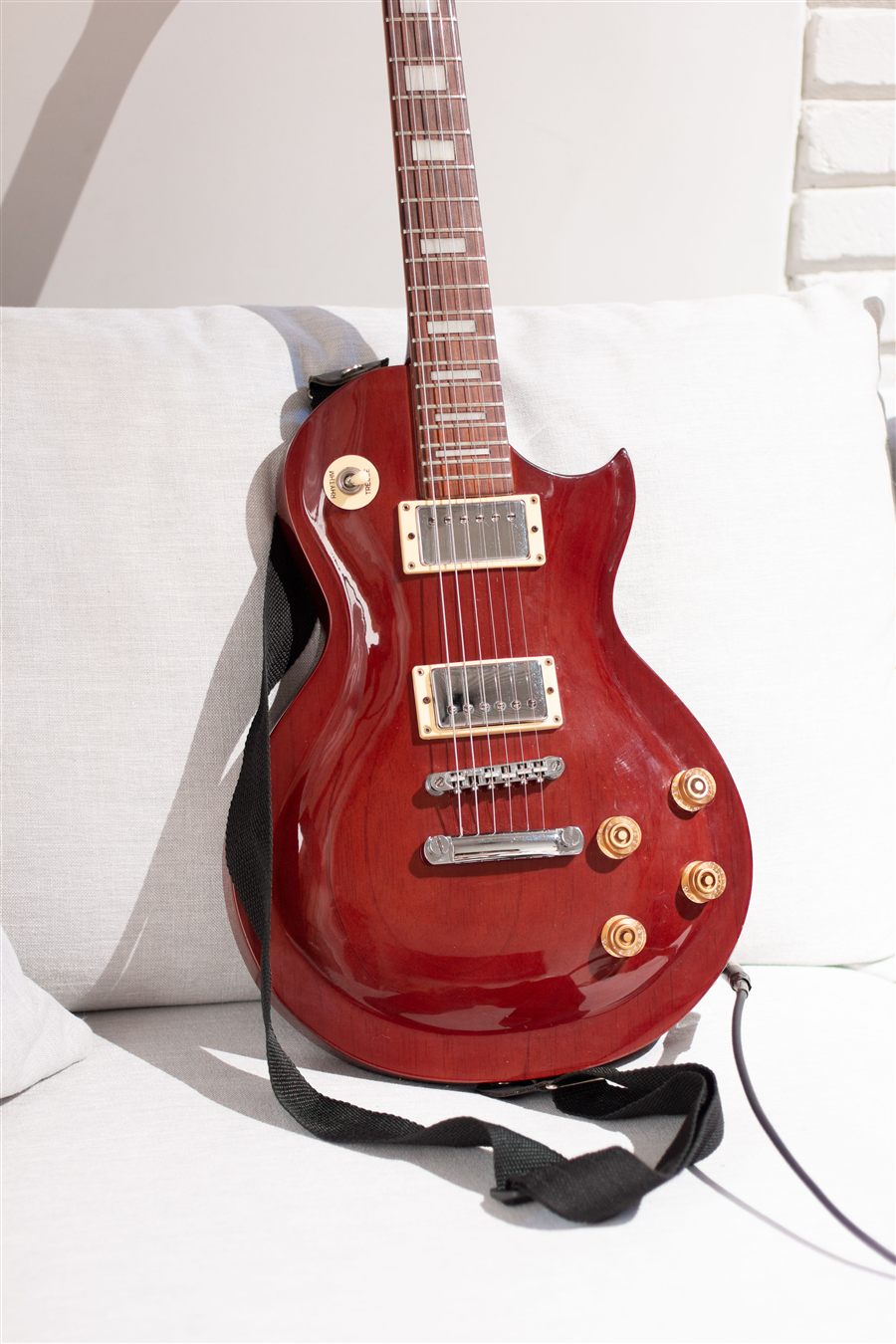
The Stratocaster sounds bright, clear and chimey, weighs less, and offers a lot of tonal variety from three single-coils and a tremolo. The Les Paul sounds warmer, thicker and sustains longer, but it is heavier and its two humbuckers lean toward rock, blues and lead playing. Neither is objectively better: your target sound, your body and your heroes decide. This guide explains where the differences come from, what they mean in practice, and what both cost new and used.
Construction at a glance
| Feature | Stratocaster | Les Paul |
|---|---|---|
| First built | 1954 | 1952 |
| Body | Alder or ash, double cutaway with contours | Mahogany with an arched maple top, single cutaway |
| Neck joint | Bolt-on, usually a maple neck | Glued in (set neck), mahogany neck |
| Scale length | 25.5 in (648 mm) | 24.75 in (628 mm) |
| Pickups | Classically three single-coils | Two humbuckers |
| Controls | 1 volume, 2 tone, 5-way switch | Volume and tone per pickup, 3-way switch |
| Bridge | Tremolo (or hardtail) | Tune-o-matic with stopbar tailpiece |
| Typical weight | about 7 to 8.5 lb | about 9 to 11 lb, sometimes more |
Weights are rough figures, because two examples of the same model can differ noticeably. The differences trace back to two design philosophies: the Strat was conceived as a modular guitar that is easy to build and repair, the Les Paul as a more traditionally built, more massive instrument.
Body and woods
The Stratocaster has an asymmetric double-cutaway body with an extended upper horn and rounded contours for the belly and forearm. It is built from alder or ash; the first models used ash, and lighter alder was added from mid-1956. Budget models often use other woods such as nato.
The Les Paul is a mahogany body with a glued-on, carved maple top. That explains a good part of the weight, since mahogany and maple are dense woods. Many modern Gibson models are weight-relieved with chambers, which can save roughly two to three pounds. How much wood really shapes the sound is disputed among players; see tonewoods on electric guitars. The finish type (nitrocellulose or polyurethane) mostly affects look, ageing and value: nitro vs. polyurethane.
Scale length and feel
Scale length is the vibrating string length. The Strat has 25.5 inches, the Les Paul 24.75, three quarters of an inch less. That has three consequences:
- String tension: With the same string gauge and tuning, tension is lower on the shorter scale. As a rule of thumb the difference is roughly 8 to 10 percent. The Les Paul therefore feels looser, bends come more easily and chords need less finger pressure.
- Fret spacing: Frets sit closer together on the shorter scale, which suits smaller hands.
- Tonal character: The longer scale is considered tighter and clearer, the shorter one a little softer. The effect is audible but matters less than pickups and amplifier.
Neck and fretboard shape the feel as well. The Strat usually has a modern C profile, a fretboard radius of about 9.5 inches and a nut width of around 1.65 inches; popular fretboard woods are maple, rosewood and pau ferro. The Les Paul has a mahogany neck, on current models often a slim taper profile, with a rosewood fretboard and a nut width of about 1.7 inches. Many players find the Strat's C easier to get along with, others like the compact Les Paul neck. Beginners can learn on either without trouble.
Neck joint: bolted or glued
On the Strat the neck is fastened to the body with four screws. That makes production and replacement simple, and a neck can be swapped in a shop if needed. On the Les Paul the neck is glued in. Many players associate that with a more continuous sound and more sustain, while others think the difference is overrated. In practice a set neck is harder to repair, and a neck angle reset is shop work that is considered expensive. On a Les Paul the neck angle is usually around 4 degrees (individual guitars range from 3 to 5). More on the joint types in bolt-on, set neck and neck-through.
Pickups and control layout
The classic Strat has three single-coils. The 5-way switch (from 1977; earlier a 3-way) selects neck, middle, bridge and the two in-between positions that are prized for their "quack" sounds. A volume knob and two tone knobs complete the layout. The single-coil sounds transparent, and the bridge pickup rocky and snappy. Its weakness is susceptibility to interference and hum, for example near monitors and dimmers.
The Les Paul has two humbuckers (in Gibson's line since 1957; the first Les Pauls of 1952 had P-90 single-coils). A humbucker uses two coils wired out of phase, which cancels hum. Tonally it is fatter, more midrange-heavy and lower in treble, with more overdrive potential. Each pickup has its own volume and tone, and a 3-way switch picks neck, both or bridge. Players who know the knobs well get many nuances from this, such as rolling the volume back for a cleaner sound without touching the amp.
The gap is smaller than the pickup types suggest: there are Strats with a bridge humbucker (HSS) or two humbuckers, and Les Pauls are also made with P-90 single-coils. The basics are explained in single-coil vs. humbucker.
Tremolo or Tune-o-matic
The Strat bridge is a tremolo balanced on knife edges like a scale, held against string tension by usually five springs in the rear cavity. You can lower notes with it and, depending on setup, raise them. Many players tighten the springs so the tremolo sits flat and works downward only, which improves tuning stability. A tremolo makes string changes and adjustments a little more involved. Hardtail versions without movement also exist.
The Les Paul uses a fixed bridge (Tune-o-matic) with a separate tailpiece (stopbar). It is mechanically simple, stays in tune and is very easy to restring. In return there is no lever. If you want to explore tremolos, read tremolo systems explained. For adjustments such as action, intonation and truss rod see setup explained. Make truss rod corrections only in small quarter turns; if you meet resistance or hear cracking, go to a shop.
Sound compared
Most sources online agree: the Strat sounds bright, clear, chimey and percussive, the Les Paul warm, thick and singing. This holds above all with an amplifier and effects, which change the sound a lot.
- Clean: The Strat delivers sparkling chords and lots of dynamics, the Les Paul sounds fuller and rounder.
- Crunch: Both work. The Les Paul's humbuckers give more drive and punch, while the Strat stays more transparent and reacts strongly to picking.
- High gain: Humbuckers have an edge because they hum less and push more mids. With a bridge humbucker a Strat can do it too.
- Sustain: The Les Paul often holds notes longer, though with distortion the difference is small.
A rule of thumb about weight says heavier guitars with denser woods sound warmer and punchier. That is a tendency, not a law.
Genres: who plays what
The Strat stands for blues, funk, R&B, pop, country and classic rock. Jimi Hendrix, Eric Clapton and David Gilmour helped define it. The Les Paul stands for blues-rock, hard rock and lead tones; Eric Clapton, Jimmy Page and Slash are among the best-known names. In the late 1950s the Les Paul was a commercial failure (the 1958 to 1960 sunburst models are legendary today), until British blues-rock guitarists discovered it in the mid-1960s. Importantly, both guitars cover almost any genre. In jazz, metal or pop there are famous examples of each.
Weight and ergonomics
The Strat usually weighs about 7 to 8.5 lb, the Les Paul about 9 to 11 lb, in some cases more. A difference of roughly 1.5 to 2 lb or more shows up in two-hour standing sets, less so when seated. The Strat's contours sit against belly and forearm, and its deeper double cutaway gives easier access to the upper frets. The Les Paul has only one cutaway, which makes the very highest positions harder. If you have back trouble, try the Les Paul standing with a strap, or pick a weight-relieved version. Case weight counts too: a hardshell case often adds another 7 to 10 lb.
Prices new and used in the US
The following prices are rough guides from retailer listings (as of Oct. 2026) and move with promotions and configuration.
| Model | New price | Note |
|---|---|---|
| Squier Classic Vibe '50s Stratocaster | about $499.99 (as of Oct. 2026) | budget Strat with alnico single-coils |
| Fender Player II Stratocaster | about $849.99 (as of Oct. 2026) | Mexican-built mid-range Strat |
| Fender American Professional II Stratocaster | about $1,839.99, on sale from about $1,639.99 (as of Oct. 2026) | US-built, many finishes and configurations |
| Epiphone Les Paul Standard '50s | about $699 (as of Oct. 2026) | affordable Les Paul with humbuckers |
| Gibson Les Paul Standard '60s | about $2,599 (plain top) to $2,999 (AAA top); versions with a custom-shop top around $3,299 (as of Oct. 2026) | mahogany with maple top, two humbuckers |
Clean, recent used guitars are commonly priced roughly 20 to 25 percent under new. A used American Professional II Strat typically sells between about $1,075 and $1,325, with an estimated market value around $1,106, about a quarter below its new price (as of Oct. 2026); prices have recently been falling. Used Les Paul Standards from 2019 onward are mostly listed at about $1,600 to $2,200, and clean 2020 to 2022 examples at roughly $1,700 to $1,850 (as of Oct. 2026). Plain-top models can be listed noticeably lower. The ranges are wide because year, specification and condition vary a lot.
Two things reduce value sharply: a refinish is often worth only about half of a guitar with its original finish, and a repaired headstock break can halve the price as well. Repair costs add up: a full refret has been quoted at about $300 to $600, a fret level at around $150 (as of Oct. 2026), and resetting the neck angle on a set neck is very expensive. Weigh repair costs against the market value before buying. The checklist for used guitars is in buying a used electric guitar, and for reissue versus original see vintage vs. reissue.
Alternatives to the Strat and Les Paul
- Telecaster (1950/51): the same 25.5-inch scale as the Strat, two single-coils, one volume, one tone, a pickup selector and a bolt-on neck. Simpler, more direct, biting; popular in country, blues and rock.
- Gibson SG (from 1961): a mahogany double cutaway with a 24.75-inch scale, thinner and lighter than the Les Paul (roughly 9 to 10 lb), with humbuckers or P-90s. It plays fast and sounds a bit sharper with less bass.
- Les Paul style from other makers: there are many Les Paul-like models, including from Gibson's sister brand Epiphone. They deliver the look and humbucker sound at a fraction of the price, usually with simpler woods and hardware.
- Strat style from other makers: from Squier entry models to high-quality copies the choice is huge. The Strat layout is so widespread that even copies are often very playable.
- HSS Strat: a Strat with a bridge humbucker and two single-coils. A compromise if you want Strat feel and more punch with distortion.
Which one for which player
- Beginner on a small budget: a Squier Strat or an Epiphone Les Paul is perfectly fine. A decent setup and enjoyment matter more than the model.
- Rock, hard rock, blues lead: a Les Paul or another humbucker guitar. More mids, more sustain, more drive without hum.
- Clean, funk, pop, country, versatile sounds: the Strat. Five switch positions and a clear tone give more range.
- Standing gigs, back problems: a Strat, Telecaster or SG, or a weight-relieved Les Paul.
- Small hands or a taste for looser strings: the Les Paul for its shorter scale, or a Strat with lighter strings.
- Playing with the tremolo: the Strat. Prefer stable tuning and simple maintenance: the Les Paul.
- Undecided: play both in a shop through the same amp, clean first, then distorted.
Myths and mix-ups
- The Strat only does blues and pop, the Les Paul only metal: false. Both have been played in nearly every style. The choice is about tendency, not limits.
- Humbuckers are louder and better: they usually give more output and mids, but not automatically a better result. The clearer Strat tone is exactly right for many styles.
- Wood alone decides the tone: it contributes, but pickups, amplifier and technique count for more.
- More expensive means better: a good Epiphone or Squier can be more fun than a badly set up premium model. Quality varies between individual examples, especially on pricier guitars.
- The Les Paul is harder to play: it is heavier, but has the shorter scale. Which is easier depends on hands, body and habit.
- Strats never stay in tune: with fresh, stretched-in strings and a well-adjusted tremolo they are stable. A tremolo that works downward only goes out of tune least.
Common mistakes when choosing
- Buying on looks and idols without playing the guitar.
- Testing only while seated instead of standing with a strap.
- Comparing a Strat and a Les Paul through different amps, so the differences lie in the amp.
- Ignoring the condition of neck, frets and electronics on used guitars. More in common mistakes when buying a first electric guitar.
- Forgetting to plan a setup: even new guitars benefit from a proper adjustment.
Test-play checklist
- Use the same amp settings for every guitar, clean and distorted.
- Play standing with a strap and notice weight and balance.
- Play chords, single notes and bends in low and high positions.
- Try every switch position and knob and listen for scratching or hum.
- On a Strat, move the tremolo gently and check whether the guitar stays in tune afterwards.
- On used guitars, look closely at neck, frets, headstock and finish.