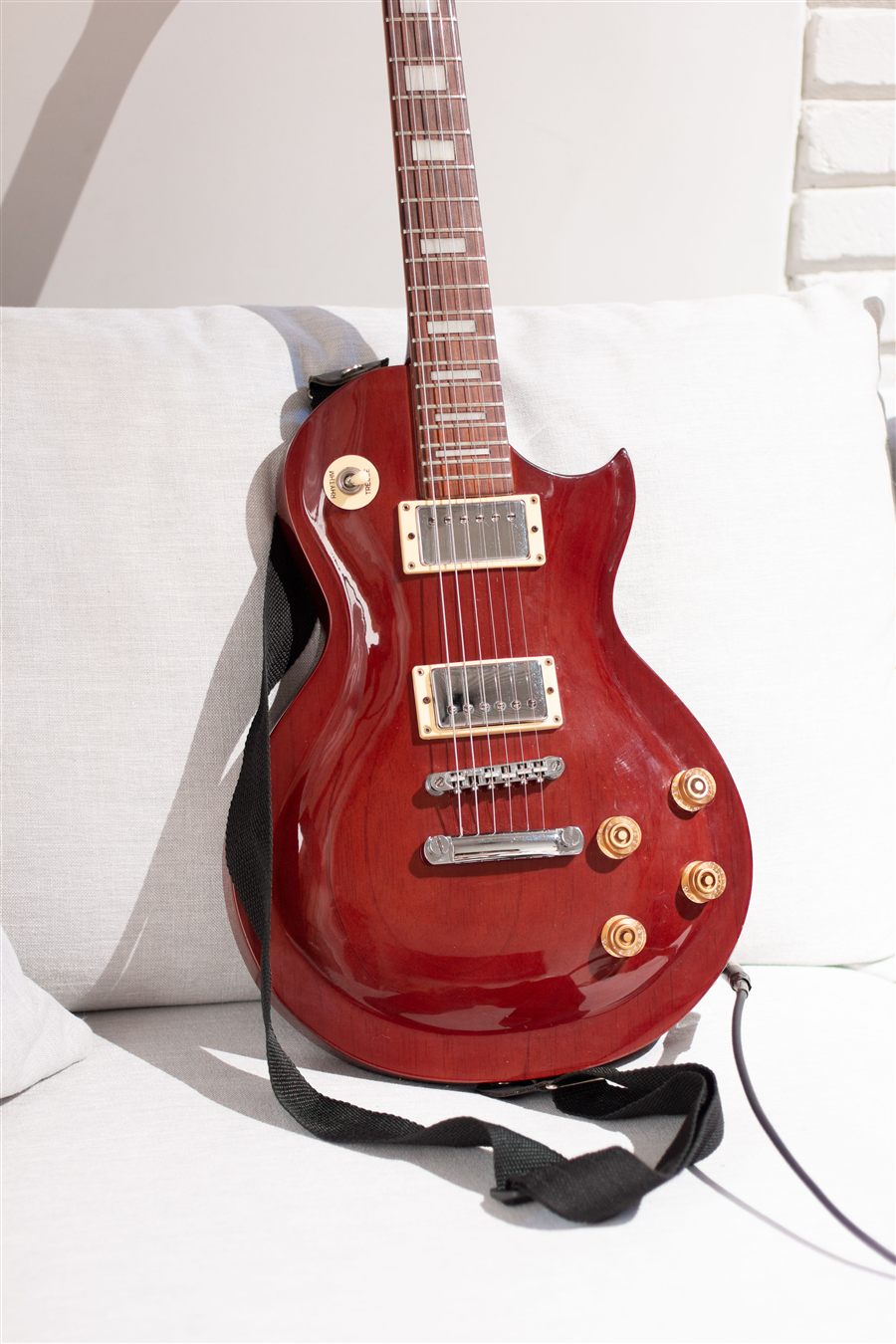
Short answer: Nitrocellulose lacquer is thin, ages visibly and is easy to touch up, but it is delicate. Polyurethane and polyester are thicker, tougher and stay clean-looking for years, but are harder to repair invisibly. The tonal difference on an electric guitar is small and disputed. The condition of the finish, sensible care and a good case matter more.
The two finish families
Almost every electric guitar wears one of two kinds of finish. Nitrocellulose lacquer ("nitro") dries physically: the solvent evaporates and the film stays chemically fairly "open". Polyurethane (PU) and polyester ("poly") cure chemically: the components cross-link into a hard, dense plastic film that can no longer be dissolved by fresh coats. That one difference explains most of what follows.
Nitro was the standard in guitar building in the mid-20th century because it dried quickly, bonded well to wood and polished to a high gloss. From the late 1960s, many production builders moved to polyurethane and polyester, which are more durable, easier to apply and easier to square with environmental rules. Today nitro is mostly found on premium and tradition-minded models and in custom shops, while poly dominates the mid-range and entry level.
Construction and film thickness
Nitro goes on in many thin coats, often around a dozen. Each coat partly dissolves the one beneath and melts into it, then the finish is sanded and buffed. That is slow and needs a controlled environment. Poly builds up in a few coats and cures in hours, which makes it far cheaper to produce.
Thickness figures vary by source. As a rule of thumb, nitro totals roughly 50 to 100 micrometers, while poly can reach 500 to 1,000 micrometers. A carefully applied thin poly may differ from nitro by only a few tenths of a millimeter. So not every poly job is a thick "plastic shell", and not every nitro job is paper thin.
Looks and aging
Yellowing and checking
Nitro keeps releasing solvent for years, becoming thinner and harder as it does, and it changes visibly. Typical signs are yellowing (especially clear coats under UV light) and checking: fine, hair-like cracks in the film that mostly come from temperature swings, often after around five to ten years or later. Checking is normally a cosmetic effect of the finish itself, not a sign of damaged wood. Many players love that patina; others just see wear.
Poly hardly yellows and does not check, so it keeps its looks for decades. If it is damaged deeply, though, it tends to chip off in flakes rather than wear down gradually.
Feel on the neck
Nitro often feels softer and turns silky or satin where you play it most. Poly is smoother and harder and stays glossy under heavy use. Players who like a neck that feels already played in often prefer nitro or a satin finish; others like poly precisely for its constant smoothness.
Tone: what is really in it
The debate is old: a thin finish supposedly lets the wood vibrate more freely, while a thick film supposedly damps it. A thicker finish does measurably damp body vibration a bit more. On an electric guitar, however, the tone comes mainly from the vibrating string, which the pickup captures directly. Body vibration contributes only indirectly.
Most sources online agree the differences are subtle and small next to pickups, amp, strings, hardware and technique. They are easiest to notice in clean playing without effects. On acoustic guitars the effect is larger. For the wood question, see tonewoods on electric guitars. Anyone who buys a guitar solely for "nitro tone" is mainly buying looks and feel.
Durability and repair
Nitro is soft: it dents, scratches and reacts to solvents and some plastics. On the plus side, fresh lacquer melts into the old film. Small chips, dings and scratches can therefore usually be touched up less visibly, although an invisible repair is never guaranteed. Poly is tougher against scratches and everyday wear, but repaired spots often remain visible as an edge or blotch because new material does not bond with the cross-linked old film.
A practical rule: nitro damage is more often repairable, poly damage is less common. Damage that goes through the film into the wood should be looked at by a repair shop soon so moisture cannot get in.
Relic and artificially aged finishes
Relic guitars are aged by the factory or by hand, with finish cracks, wear marks, rusted metal parts and a dulled gloss. The look comes from deliberately cracking and sanding the finish. Real wear tells its own story. When buying used, check that the wear matches the age; telling vintage from reissue gives more pointers. A relic treatment can also be added later; see the cost table below.
Costs of finish work
All values are rough guides (as of Oct. 2026) and vary by shop, so get a quote:
| Work | Rough guide (USA, USD) |
|---|---|
| Simple solid-color refinish of a body (local luthier) | from about $200 |
| Typical full refinish of a guitar or bass body | about $350 to $500 |
| Large hollow or semi-hollow body refinish | up to about $600 |
| Solid-color nitro paint job | around $300 |
| Stripping an old nitro finish | around $150 |
| Stripping poly or urethane | around $275 |
| Relic aging: light / medium / heavy | about $55 / $65 / $90 |
| Relic with finish-over-finish effect | about $150 |
As one example, stripping poly, respraying in nitro and adding relic aging was quoted at around $700 (Stand Oct. 2026).
Refinishes and lost value
A refinished guitar is generally worth much less on the used market than one with its original finish, even if the original has scratches. A common rule of thumb is a discount of around half. A refinish destroys collector value on vintage and sought-after models. On an inexpensive everyday guitar it can make sense if value does not matter and looks do. When buying used, check whether finish looks clean in routing cavities, around screws and under hardware, whether color and gloss match the description, and whether the seller mentions it openly. More on this in buying a used electric guitar.
Care and cleaning
Everyday routine
- Wipe body, neck and headstock after playing with a clean, lint-free microfiber cloth. Sweat and hand oils are the most common reason for dull spots.
- For tougher grime, lightly dampen a soft cloth or put a cleaner made for guitars on the cloth, never spray directly on the instrument so nothing runs into the electronics and cavities.
- Wipe in straight strokes rather than circles; circular motions can spread fine scratches.
- Work sparingly along the body edges and the neck pocket, where cleaner creeps into gaps.
Polish and chemicals
Be extra careful with nitro: solvents, aggressive cleaners and silicone polishes can attack the lacquer or make later touch-ups harder, since new lacquer adheres poorly over silicone. Use only mild products explicitly suited to nitro, if any. On poly, common guitar polishes are fine. Matte finishes get no polish; a cloth and mild soapy water are enough, because polish makes the sheen blotchy. Do not oil a finished (lacquered) maple fretboard, but rosewood and ebony do take oil, see also setup basics for electric guitars. For heavy staining, finish stains or damage, ask a shop rather than experimenting.
Plasticizers: rubber, foam and plastic on nitro
Probably the most avoidable damage on nitro comes from contact with plasticizers. Soft rubber and foam parts, vinyl and some plastics contain additives that migrate out and into the lacquer film. The finish turns soft, dull or tacky there and does not harden back. Heat, sweat and sunlight speed it up; in a warm room even a week of contact can leave marks.
- Stands and wall hangers: Check the contact pads. Cheap soft foam and rubber sleeves are a typical culprit. Pads covered in cotton, felt or leather are safe. A simple fix is a piece of cotton cloth or a cut-off glove finger over the arms.
- Cases: Plush lining, foam or adhesive outgassing at the neck rest can leave visible patches. Do not leave the guitar for months in a case where it touches soft foam; put a cotton cloth between them if needed.
- Straps, cables, accessories: Rubber bands, synthetic straps and cables lying on the finish can leave the same marks.
Poly is less sensitive but not fully immune to aggressive chemicals and synthetic strap materials.
Humidity and temperature
Wood and finish like stable conditions. As a rule of thumb, aim for about 45 to 60 percent relative humidity and 15 to 25 °C (59 to 77 °F). Big, fast swings matter more than the exact figure: they make the neck move, fret ends poke out and finish crack (checking on nitro). A cheap hygrometer in the room or case is worthwhile, and in dry heated air a room humidifier helps.
- Cold: A guitar coming in from the cold or a car stays in its closed case for at least two hours until it reaches room temperature. The rapid change is a main cause of finish cracks.
- Heat and sun: Never leave it in a car, near a heater or behind a window. Heat can damage finish, glue and wood.
- Long-term storage: In a case or on a safe stand, not against an outside wall or in a damp basement. For long periods, slightly reduce string tension but do not slacken fully.
Transport: hard case, gig bag, flight case
Protection and weight compared
| Type | Protection | Weight (rough) | Suited for |
|---|---|---|---|
| Gig bag | medium; padding, little protection against crushing | about 2 to 7 lb | Bike, walking, transit, rehearsal |
| Hard case (molded) | very good; impact and pressure resistant | about 7 to 11 lb | Car, touring, flights, storage, shipping |
| Flight case | maximum; shock and load resistant | noticeably heavier | Touring, flights, freight; not for carrying |
A hard case protects against impacts and, to a degree, buffers climate swings. It is heavier and bulkier. A gig bag is light and convenient day to day but protects noticeably less against drops or crushing. Padding quality matters more than thickness alone: firm, good padding of about 10 mm (0.4 in) can protect better than soft, uneven 30 mm. Look for padding all around, water-resistant material, sturdy zippers and a lid that opens fully.
Fit and prices
Fit decides everything. "Fits Strat-style" does not guarantee your guitar sits properly, so try the guitar in the case before buying. For odd shapes like a Flying V or Explorer, or unusual scale lengths, get the case together with the instrument, because finding one later is hard. A matching original case can raise the resale value.
Rough guides (Stand Oct. 2026): gig bags run from about $20 for budget models to $100 to $150 for good ones, with premium bags above $500. Hard shell cases typically cost about $100 to $280, with budget ones from about $58 to $66. Model-specific flight cases run about $380 to $445.
Storage: stands, wall hangers, case
- Stands: Handy for playing, but only with finish-safe pads (see above). Place the stand where nobody bumps it and do not lean the guitar too far.
- Wall hangers: They save space, but the neck yoke is often soft rubber. Check the material and cover it on nitro. Do not hang the guitar on a cold outside wall or near a heater.
- In the case: The best choice for longer breaks because climate swings are buffered. Check the lining for nitro compatibility and add a cotton cloth if needed.
Preparing a safe shipment
Shipping a guitar in a thin gig bag or with no case is risky. A hard case inside a sturdy box is the usual way:
- Slightly relax the strings (about a half step) so the neck is not under full load.
- Support the headstock and neck area in the case firmly but softly so nothing can move.
- Wrap the hard case in bubble wrap and put it in a sturdy rectangular box with roughly 3 to 4 inches of padding on all sides (double boxing is common).
- Do not let cables or accessories rest directly on the finish.
- Mark it fragile and insure it adequately.
Shipping costs vary by distance, service level and carrier; get a quote. A guitar weighs roughly 6 to 8 lb, and with its case 8 to 15 lb. For used purchases, in-person pickup is safer where possible, as described in common mistakes when buying a first electric guitar.
Common questions and myths
- Does nitro sound better? Measurably a little less damping, audibly rarely. Looks and feel are the real differences.
- Is checking a defect? Mostly cosmetic and normal on nitro. Deep cracks that run through the finish into the wood should be checked.
- How do I tell which finish it is? Reliably only from the model specs and a conversation with a repair shop; looks alone deceive, especially with relic finishes.
- Can I fix nitro myself? Small cosmetic flaws, yes. Beyond that, a shop should do it, because chemicals and sanding quickly cause more harm than good.
- Is a refinish worth it? Cosmetically yes, financially almost never if value matters.