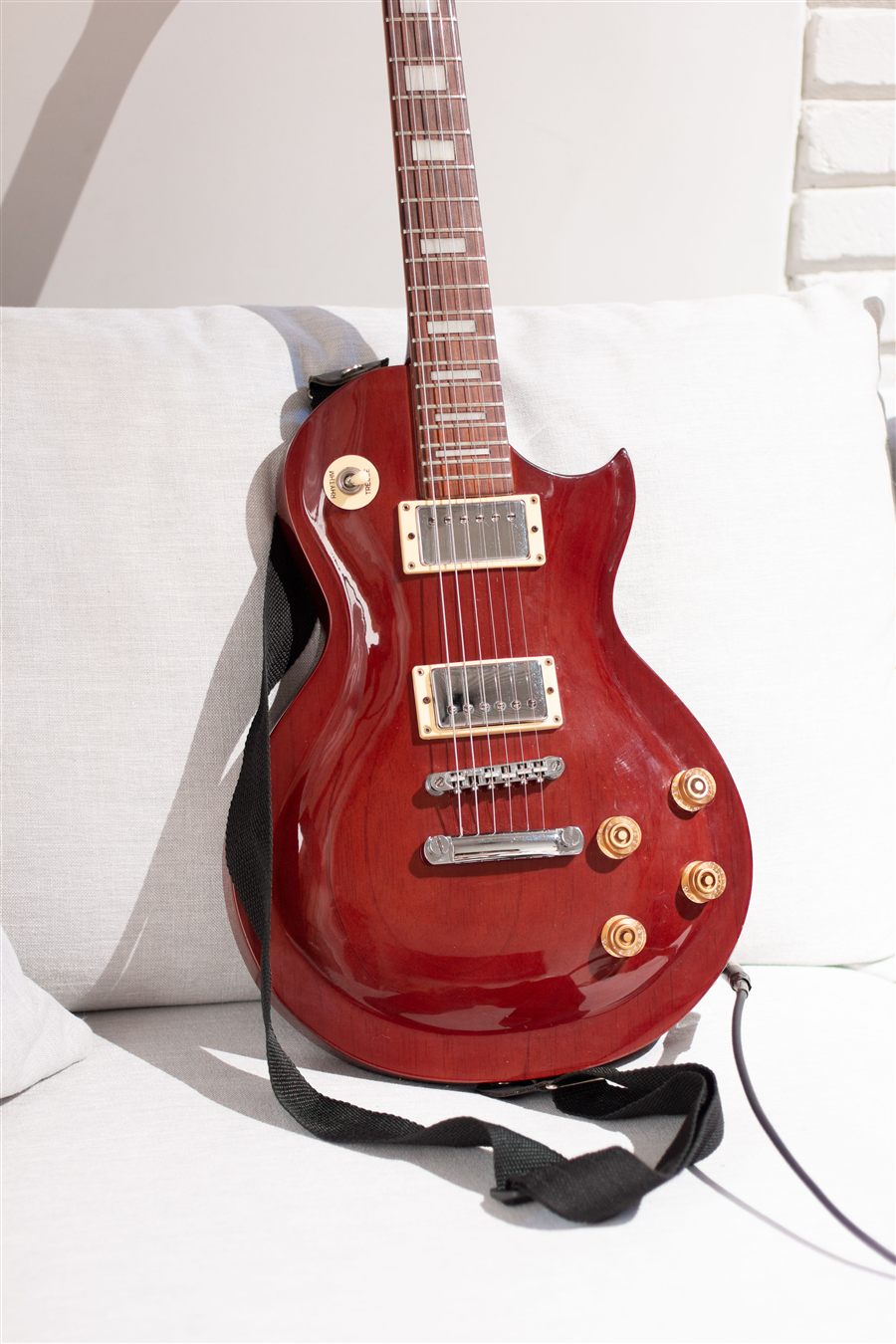
On an electric guitar, pickups, wiring, amp, strings and how you play shape the sound far more than the species of body wood. Wood still matters for weight, feel, looks, price and how lively the neck and guitar feel in your hands. The best-supported effect is that of the neck and fingerboard; the effect of body wood on the amplified tone has not been convincingly demonstrated and remains debated.
Why the debate is different from acoustics
On an acoustic guitar the top vibrates and produces the sound directly. On an electric, magnets sense the steel string's motion and the signal travels through the wiring, cable, amp and speaker. The body does not radiate any sound that the audience hears. It carries the hardware, holds the neck, and at most changes how long and how evenly the string keeps vibrating. That is why "tonewood" is a real point of disagreement among players and builders.
What is supported and what is not
Reasonably well supported
- The neck vibrates more than the body. Measurements on electric guitars describe the neck as long, thin and flexible, and the body as short, thick and stiff. Neck resonances correlate with sustain. At certain notes the neck drains unusual amounts of energy from the string: these are the familiar dead spots, and they are audible.
- Decay can largely be predicted from string and neck. In the models, the body did not have to be included.
- Production variation is large. Two guitars of the same wood from the same line often differ more in weight and vibration behavior than two species differ on average, so small test samples are hard to interpret.
- Sustain differences of a few percent (rule of thumb 5 to 10 percent) are usually inaudible once an amp and distortion are involved.
Disputed or player opinion
- "A heavier body means more sustain and punch" is widespread but not cleanly proven. Weight also depends on pore structure, moisture and hardware.
- The tonal labels for woods (alder balanced, ash bright, basswood midrange-focused, mahogany warm) are mostly experience-based. In blind tests many listeners cannot identify them reliably.
- A well-known thought experiment from sound research: clamp the string in a vise and the pickup sounds nearly unchanged from the guitar it normally sits on. It is anecdotal, but fits the measurements.
- Builders push back that species changes the whole vibration behavior and so the response and feel. That is defensible as long as the effect on the amplified tone is not overstated.
In practice, swapping pickups changes the sound more than swapping body species, and pickups can be changed without a new body. More in the article on single-coil vs. humbucker pickups.
Common body woods at a glance
Densities are rules of thumb, and there is wide variation within a species. Tonal descriptions reflect common perception, not measured laws.
- Alder: medium density (about 0.4 to 0.7 g/cm³), often described as balanced with clear highs and restrained bass. Typical of Strat-style guitars.
- Ash: two variants. Hard ash (northern ash) is hard, dense and heavy (about 0.65 to 0.85 g/cm³), described as bright with quick response. Swamp ash is lighter (about 0.54 g/cm³), described as airier and more even, often with slightly scooped mids. Swamp ash varies widely in weight and is described as increasingly scarce.
- Basswood: light and soft (Janka hardness about 410), described as midrange-focused and smooth, popular in rock and metal, inexpensive. Soft also means dings and dents come easier.
- Mahogany: density about 0.5 to 0.6 g/cm³, Janka hardness 800 to 860, on average heavier than alder or ash. Described as warm and sustaining, often paired with a maple top, typical of Les Paul-style guitars.
- Maple: dense (about 0.6 to 0.75 g/cm³), Janka hardness about 1450, described as bright and clear. Mostly used for tops, necks and fingerboards.
- Poplar: soft, inexpensive, similar in character to alder, described as somewhat dark.
- Okoume: mahogany-like, warm and smooth with slightly reduced highs; on average on the heavy side.
- Korina (limba): mahogany-like but lighter in color and weight, described as clear and warm; known from the Flying V and Explorer in the late 1950s.
- Paulownia: extremely light and bright, prone to dents.
Fingerboard woods, briefly
You touch the fingerboard constantly, so differences are easier to feel here than in the body. Maple is hard, bright and snappy, finished or open-grain. Rosewood is described as warm and round. Ebony is hard, direct and quick to respond. Pau ferro sits between ebony and rosewood and is used as a more sustainable alternative. Wenge is dense and stable. For necks, maple is described as hard and clear, mahogany as softer and warmer. How neck wood and construction interact is covered in the article on bolt-on, set neck and neck-through construction.
Weight: the tangible difference
What you notice on the strap right away is weight. In a survey of 466 guitars without weight relief, average weights per species were close together: from about 7.3 lbs (nyatoh) through basswood, poplar, ash, limba, mahogany, maple and alder to about 8.4 lbs (pine; okoume similar). Differences between individual guitars of one species are often larger than differences between the averages, because hardware, neck, fingerboard and finish count too. So handle or weigh the specific guitar instead of guessing from species. After an hour on your feet, light versus heavy often matters more than any tonal claim.
Looks: where species really decides
- Ash has pronounced open grain and figure and is therefore often finished transparent or natural.
- Maple tops, especially flame or quilt, are a clear visual feature and often sit on mahogany bodies.
- Alder, basswood and poplar have subtle grain and are usually painted in solid colors.
- Roasted maple for necks and fingerboards darkens to golden or brown and is easy to spot by color.
If you buy a transparent finish, you are often paying for the look of the grain. How finishes behave and age is covered in the article on nitrocellulose vs. polyurethane finishes.
Body types: solid, chambered, semi-hollow, hollow
- Solidbody: solid body, the standard for electrics, resistant to feedback even at high volume and gain.
- Chambered: a solid body with routed-out cavities. That saves roughly 15 to 25 percent weight depending on extent. Minimal removal (weight relief) is usually not audible in blind tests. True chambering is reported to sound airier ("bloom" rather than "snap").
- Semi-hollow: hollow body with a solid center block, known since the ES-335 of 1958. The block reduces feedback and supports sustain, but these guitars still feed back more readily at high gain and volume.
- Hollowbody: fully hollow, warm and resonant, typical for jazz, more sensitive at high volume.
Tonal differences are larger with body type than with species, because vibration behavior and feedback tendency really change.
Drying and roasted woods
Fresh wood contains water, oils and sugars. Good wood is dried and stored before building so it moves as little as possible later. In roasting (also called torrefied or baked), wood, usually maple, is heat-treated in a low-oxygen environment. Moisture and part of the extractives are lost, the wood darkens and becomes more dimensionally stable: it swells and shrinks less. The idea is to imitate aged wood. Tonal benefits are anecdotal and sometimes used as a sales argument; the stability benefit is plausible and practically relevant for necks. The roasting itself is a job for specialists, not a home project.
Sustainability and CITES
Since November 26, 2019, finished musical instruments, parts and accessories containing Dalbergia (rosewood) are exempt from CITES permit requirements; Brazilian rosewood stays strictly protected (Appendix I), and raw wood and unfinished parts remain regulated. Other woods such as ebony are not covered by this exemption. This is not legal advice: if you plan to ship an instrument across borders, ask the responsible authority first. Pau ferro and basswood are named as more sustainable options. Swamp ash is described as scarce and is often offered by manufacturers only in higher-end lines.
How wood affects price
As a rough guide from parts pricing (roughly, as of Oct. 2026): a body blank in alder is around 110 USD, mahogany around 100 USD, roasted swamp ash around 155 USD; a maple neck blank is around 30 USD versus around 50 USD roasted. A one-piece body adds roughly 65 to 80 USD. These are parts-supplier figures, not retail guitar prices, and they vary by supplier and date. For finished guitars, there is no proven fixed premium per species: the price depends on model, hardware, build quality and finish, and varies by maker and model. Larger premiums more often come from flame maple tops, natural-finish swamp ash, roasted necks and custom builds (get a quote). Used prices by species are not documented; condition matters more. Useful inspection points are in the article on buying a used electric guitar.
Common questions
Which wood is best for a beginner?
None in particular. Build quality, fret work, setup and a comfortable weight decide. Alder, basswood and poplar are common at this price level and perfectly fine.
Is it worth paying more for swamp ash or mahogany?
Only if you like the weight, looks or feel. As a tonal promise, the premium is not supported. Play the guitar through an amp.
Is the neck more important than the body?
For sustain behavior, dead spots and feel: yes, as far as measurements show.
Does swapping pickups change more than changing wood?
Usually yes, and it can be done without a new body. Soldering and wiring work belongs with a qualified shop.
When buying used, is wood or condition more important?
Condition: cracks, dents, neck warp, frets, electronics. Species explains weight and looks but says little about condition.
Decision guide
- Strap the guitar on: is the weight right for long sessions?
- Play it through an amp similar to your own, not only unplugged.
- Focus on neck, fingerboard, fret work and setup, because you feel those every time you play.
- Choose species by looks and budget, not by supposed tonal rules.
- If you dislike the sound, pickups, strings and setup are the more effective levers.