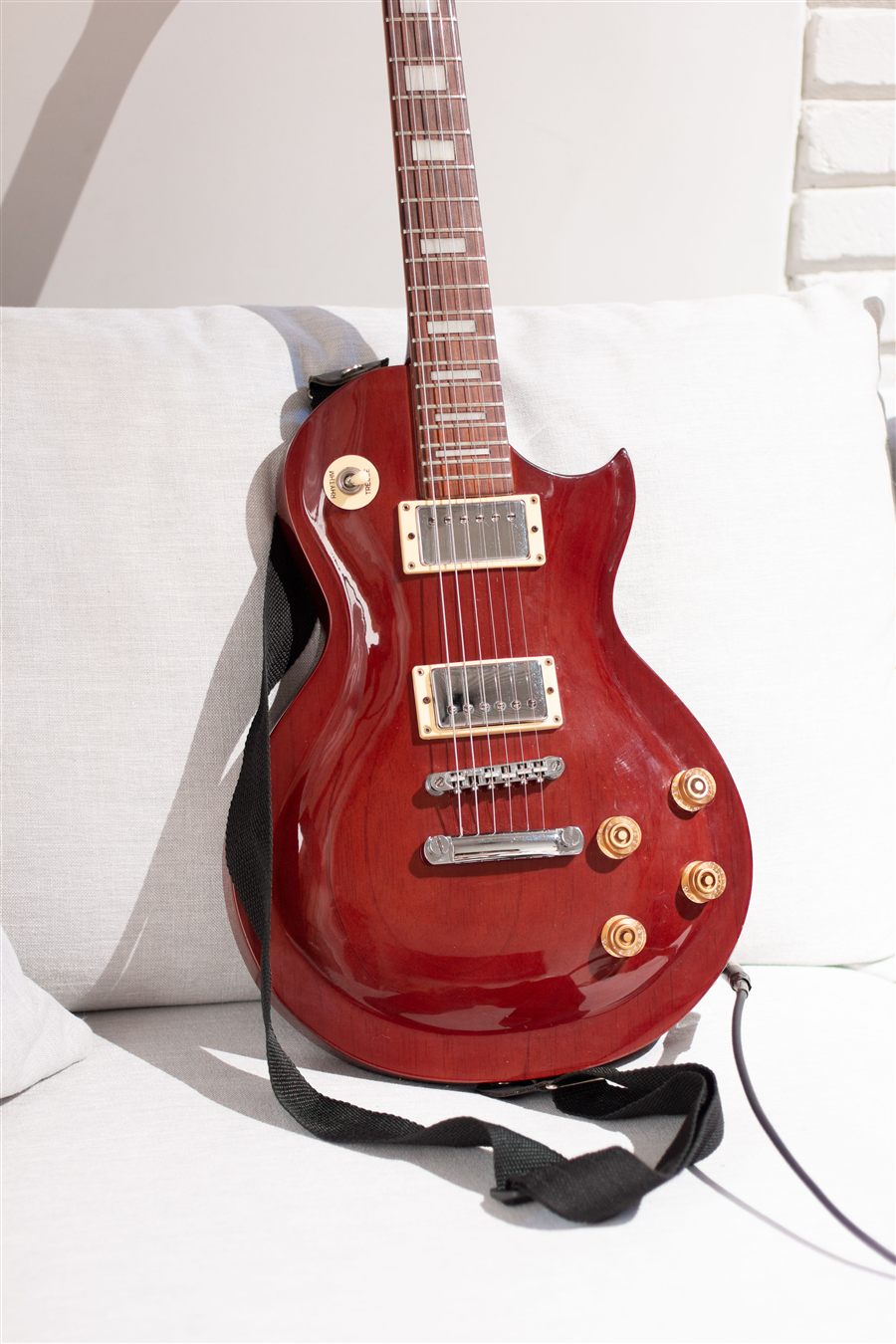
A vintage original is a guitar from a model's early years, usually the 1950s to the mid-1960s, whose value rests on production year, originality and history. A reissue or Custom Shop recreation gives you much of the look and feel for a fraction of the price, but it is not an investment in the same sense. If you mainly want to play, a good reissue or a used Custom Shop guitar is usually the smarter buy; if you want to collect, you need originality, paperwork and often an independent appraisal.
What vintage, reissue and Custom Shop mean
Vintage
In the narrow sense, vintage means old and sought after. For electric guitars the golden era is generally put at 1950 to about 1965, which for Fender means the years before the CBS takeover and for Gibson the 1950s and early 1960s. Later years are slowly catching up: dealers report especially strong percentage gains for late-1960s and 1970s models such as the ES-335, SG and Les Paul Custom. Not every old guitar is vintage in the collector sense. Rarity alone does not create value; there must be demand.
Reissue and Historic
A reissue is a new version of a classic model built to the dimensions and parts of a particular era. Gibson launched its Historic line in 1993 with recreations of the 1958 to 1960 Les Paul. There are also cheaper lines that merely borrow from the original, so "reissue" covers a wide range, from near-exact copy to loose tribute. What counts is the spec sheet, not the name.
Custom Shop, VOS, NOS and relic
Custom Shops build with extra precision, partly by hand. On top of that come aging levels that set how the guitar looks:
- NOS (New Old Stock): built as if it had sat unused in a warehouse, with no wear.
- VOS (Vintage Original Spec): Gibson's term, since 2006, for lightly aged, satin-finished nitrocellulose surfaces.
- Closet Classic and Journeyman Relic: light to moderate patina, fine lacquer checking, dulled hardware and a neck that feels broken in.
- Relic and Heavy Relic: clear finish wear, rub-throughs and dings, deliberately made to look well used.
- Murphy Lab: Gibson's division since 2019 for elaborately aged models, with levels from lightly to heavily aged.
Relic work grew out of repair practice in the 1980s, and Fender showed aged models at NAMM in 1995. It remains debated: critics call it pure cosmetics, others value the broken-in feel, especially on the neck. For collectors the rule is simple: artificial aging does not turn a new instrument into a vintage one. Makers deliberately do not imitate repairs such as headstock breaks, because those would reduce value.
Prices and value development
Price ranges in the US
Originals sit in a different price class than recreations. For all-original Les Pauls in excellent condition, dealers quote roughly $20,000 to $40,000 for 1952 to 1953 Standards, $40,000 to $80,000 for 1954 to 1956, $135,000 to $250,000 for 1957 to 1958 Goldtops and $200,000 to $500,000 or more for 1958 to 1960 sunbursts; late-1960s Standards run about $8,000 to $24,000 (as of Oct. 2026). Original Stratocasters from 1954 to 1965 span roughly $12,000 to over $200,000 depending on year, colour and condition (as of Oct. 2026). A Custom Shop '59-style Les Paul reissue costs about $5,000 to $6,000 new, and used Historic reissues often change hands between about $2,500 and $6,000 (as of Oct. 2026). Figures vary by source, condition and seller. To check a specific model, look at completed sales rather than asking prices.
Value development
- Vintage originals: Good originals from the best years have been a better-than-average store of value over recent decades. Classic models such as the Les Paul, Stratocaster, Telecaster and ES-335 are considered the most stable. That is no guarantee, since markets turn.
- Reissues and Custom Shop: They usually lose value after purchase and are normally cheaper used than new. They are not an investment in the vintage sense. Exceptions are rare small runs and early limited editions, some of which fetch five-figure prices.
- Production models: The ordinary used market applies; see buying a used electric guitar.
Original parts and modifications: what reduces value
On a vintage guitar the question "what has been changed?" often matters more than the year. Two similar-looking instruments of the same year can differ in price by a factor of two. The deductions below are dealer estimates and rough guides; they vary by source, model and quality of the work.
| Change | Typical value reduction (rough guide) | Note |
|---|---|---|
| Refinish | about 40 to 55%, often "half the value" | Usually the largest single deduction, even if the original finish was worn |
| Repaired headstock | about 40 to 50% | The most common damage on Gibson-style angled headstocks |
| Added pickup routing | about 35 to 40% | Not reversible |
| Swapped pickups, no routing | about 25% | Less if the originals come with the guitar |
| Changed electronics | about 10 to 20% | Pots matter for dating |
| Swapped tuners | about 10 to 15% | Often extra screw holes on Gibson-style heads |
| Refret | about 5 to 10%, often minor | Only if done well in factory style |
Why originality weighs so heavily
Reversible changes such as a bolted-on replacement pickguard hurt less than irreversible ones: routing, extra holes, new paint. If you swap parts, keep the originals, because they make a reversal possible and help at resale. Frets are a special case: they are wear items, and a clean refret in the style of the original is usually seen as tolerable, while overly aggressive leveling can hurt. For players' guitars with no collector ambitions these deductions barely apply; what counts is whether the guitar sounds and plays well. More on finishes: nitro vs. polyurethane; more on pickups: single-coil vs. humbucker.
Electrics and neck work belong with a specialist
Old electronics, solder joints and wiring on vintage instruments belong in the hands of an experienced shop, as does anything involving the neck or neck joint. The owner should know WHAT was done and WHY and have it written down. On a glued neck a neck reset is very involved and only worth it on a valuable instrument; on a bolt-on neck the correction is far cheaper. Background: neck constructions compared. Costs depend on the work and the shop; get a quote. As a rough guide, leveling frets runs about $150 and a full refret $300 to $600 (as of Oct. 2026).
Checking serial numbers and authenticity
What a serial number can and cannot do
Serial numbers help narrow down a production period. Major brands use their own systems: Gibson has encoded year and day in eight digits since 1977, and Fender numbers with a letter prefix after 1976 are accurate to within a year or two. On older Fender guitars the number sits on the neck plate and is easy to swap, so it proves little for the early years. A matching serial number therefore only shows that the number fits the scheme. Counterfeiters copy numbers, and some fakes carry identical numbers on several instruments.
Other clues inside the instrument
- Pots and electronics: Date codes on the pots must fit the claimed year. A "1959" with 1973 pots is either heavily modified or fake.
- Neck date, fingerboard, headstock shape and logo: On vintage Fenders these can be checked against each other. No single feature proves authenticity.
- Finish: Paint thickness readings and UV light show whether a finish is original or later. That is a job for specialists.
- Fit of parts: Do parts from different eras sit together? Then it is often a "Frankenguitar" assembled from several instruments.
Certificates and appraisals
A seller's certificate is only as good as whoever issued it. A certificate of authenticity may name the edition without dating the instrument precisely, and the serial number on the paper must match the one on the headstock. For instruments in the five-figure range and above, an independent appraisal by an experienced expert pays off. As a rough guide, authentication services for instruments above about $5,000 are quoted at roughly $89 to $300 (as of Oct. 2026, a single estimate, so get a quote).
Documentation and provenance
The higher the price, the more the paperwork matters. Original sales receipts, photos of earlier owners, repair and maintenance records, the original case and all accompanying papers add value. A continuous chain of ownership helps. Check that the listing and photos agree with the papers. Put agreements about condition and originality in writing; for questions about warranty or returns, ask for legal advice.
Tone, playability and collector value
The tonal gap between an original and a good reissue is often subtle. Aged wood, period parts and thin old finishes are named as causes, but how far they shape the sound is disputed; see the tonewood debate. In build quality, modern recreations are often on par or better. In practice:
- Vintage: 60-year-old electronics, thin finishes, delicate hardware and a price at which you hesitate to take the guitar to a gig. Condition drives price more than the name.
- Reissue and Custom Shop: known quality, current parts, a broken-in neck on relic levels, usually easier to repair, and a factory warranty if bought new.
- Relic: the played-in look is intended, but as a collectible it is not an original. The finish is already aged, so later wear shows less.
Buying advice by goal
- To play: A used Custom Shop reissue or a good production model with suitable specs. The guitar should feel right when you try it; see setup explained.
- Vintage feel on a smaller budget: NOS, VOS or lightly aged models, where the finish will not suffer at the first gig.
- To invest or collect: Originals only, ideally with original finish, pots, pickups and paperwork, and an appraisal if in doubt. Budget for repair and inspection costs.
- To modify and experiment: A production or reissue guitar suits this better than an original whose value you would otherwise destroy.
Common mistakes
- Trusting the serial number alone.
- Treating a certificate as proof without checking who issued it.
- Believing "all original" in a listing without having pots, finish and neck date checked.
- Buying a reissue as an investment.
- Paying original prices for a modified vintage guitar.
- Not adding repair costs to the purchase price; more in typical buying mistakes.
Myths
- "Old always sounds better": Not proven. Condition and setup often matter more than the year.
- "New parts make an instrument better and therefore more valuable": Collectors pay for originality, not for upgrades.
- "A refret ruins the value": A clean refret in factory style usually costs little.
- "Relic is a substitute for vintage": It is a new instrument with an artificial look.