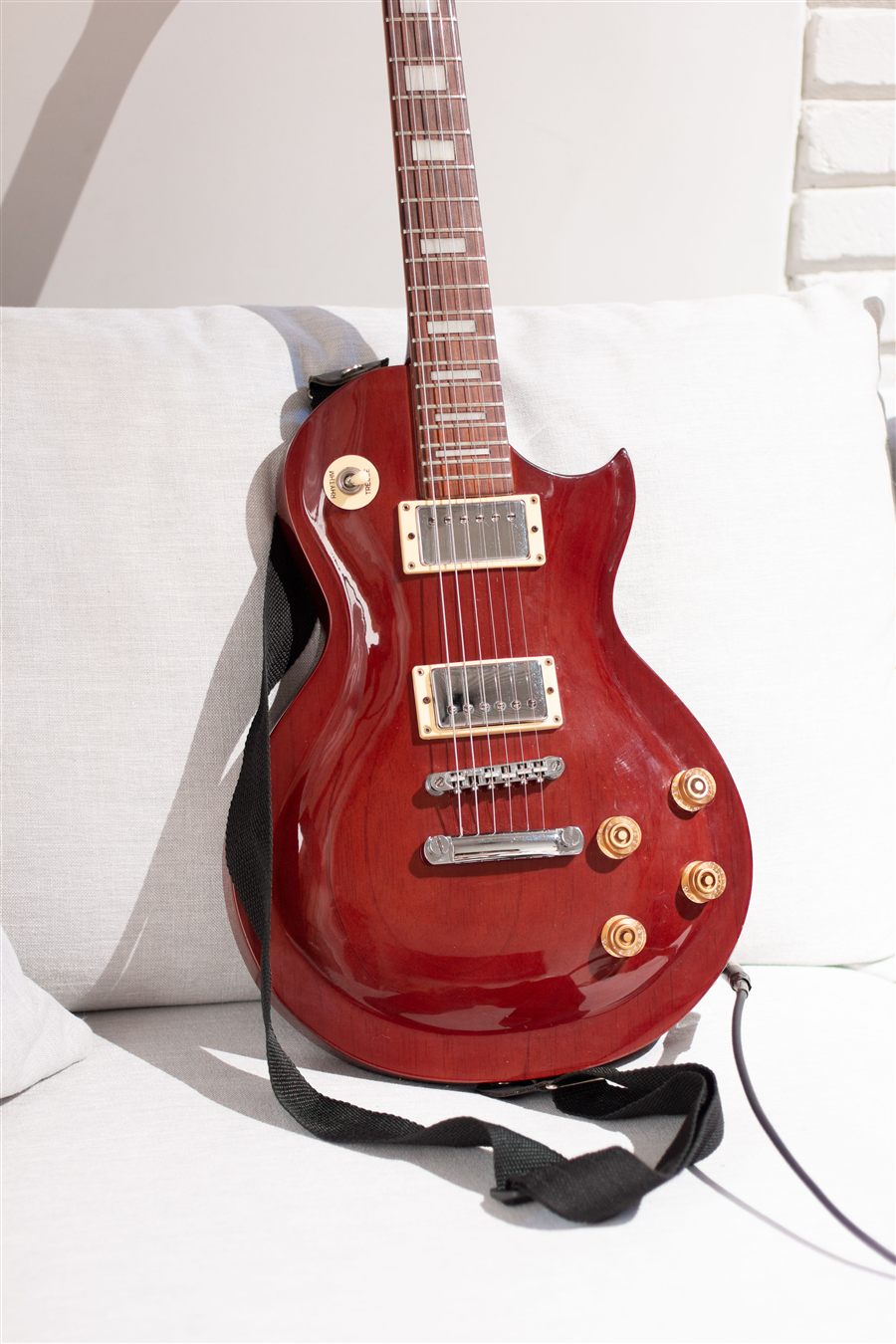
Electric Guitar
Epiphone Les Paul Custom (2020 - Present)
Price: 649 EUR – 890 EUR
Availability: 4/10 (Common)
Epiphone's Les Paul Custom is the dressed-up member of the family: an all-mahogany body edged in multi-ply binding, a bound ebony fingerboard with pearloid blocks, gold hardware throughout and the split-diamond headstock inlay that has marked the model since 1954. Since the 2020 Inspired by Gibson relaunch it has carried CTS pots, a Graph Tech nut, LockTone hardware and Epiphone's own ProBucker humbuckers - and the current run has moved again, to Probucker Custom pickups and a Modern Medium C neck.
About the Epiphone Les Paul Custom (2020 - Present)
Within the Les Paul range the Custom is defined less by a different sound recipe than by a different level of trim - and those trim details are real construction, not decals. The body is solid mahogany with no maple cap (the Heritage Cherry Sunburst version adds a figured maple veneer purely for looks), and it is edged in multi-ply binding: Epiphone's current spec sheet lists seven plies around the top, five around the back and the headstock, and a single ply along the fingerboard. That bound ebony fingerboard is the other giveaway. Epiphone's Les Paul Standard 50s and 60s use rosewood or laurel; only the Custom gets ebony, and only the Custom gets the pearloid block inlays and the large split-diamond headstock inlay instead of trapezoids and a plain crown. Everything metal is gold-plated, down to the pickup covers, jack plate and strap buttons, and the truss rod cover is a two-ply bell stamped 'Les Paul Custom'.
What changed in 2020 is worth being precise about, because it is the difference between two quite different guitars wearing the same name. Epiphone's pre-2020 Les Paul Customs ran the older Alnico Classic pickups and the angular Epiphone headstock; some retailer pages still carry that stale copy. The Inspired by Gibson version introduced for 2020 replaced the headstock with the softer '60s Kalamazoo' shape, fitted ProBucker 2 and ProBucker 3 humbuckers, made CTS potentiometers standard, specified a Graph Tech NuBone nut, added LockTone locking-style Tune-O-Matic and stop bar hardware with Grover Rotomatic 18:1 tuners, and rolled the fingerboard edges. Those were line-wide upgrades, not model-specific ones, which is why the 2020 relaunch is usually discussed as a change in what Epiphone is rather than a new model year.
The current production version moved again. It swaps in Epiphone's Probucker Custom humbuckers in both positions - the company describes them as based on Gibson Custom's Custombucker - trades the 60s SlimTaper neck for a fuller Modern Medium C profile, spells out the binding ply counts, enlarges the headstock's Custom split-diamond inlay, and now ships with a premium gig bag where the 2020 version left the case as an optional extra. Alongside it sits a separate, dearer Inspired by Gibson Custom edition, which is a different instrument again: mahogany with a real maple cap, a one-piece neck with a long tenon, mother-of-pearl rather than pearloid blocks, hand-wired electronics with Mallory capacitors and Switchcraft parts, USA-built Gibson 490R and 498T pickups, and - uniquely for Epiphone - the actual Gibson open-book headstock. Production is in China; Gibson has run its own Epiphone plant in Qingdao since 2004.
Where to buy
Price
–
-
Reverb 649 EUR Best price View details
-
Reverb 699 EUR View details
-
Reverb 759 EUR View details
-
Reverb 890 EUR View details
No platform selected – pick at least one above.
Some links below are affiliate links. We may earn a commission at no extra cost to you.
Source: https://reverb.com/item/81487336-epiphone-2020-les-paul-custom-ebony-with-epiphone-premium-gig-bag
Sound character of the Epiphone Les Paul Custom (2020 - Present)
The all-mahogany body without a maple cap is the single biggest factor here, and it is the same recipe as the original 1954 Custom: mahogany alone gives a warmer, thicker, distinctly midrange-centred voice, where the mahogany-plus-maple construction of a Les Paul Standard adds brightness and a harder initial attack. Epiphone itself draws exactly that distinction when describing the model's history. On top of that sit ProBucker humbuckers built around Alnico 2 magnets with unevenly wound coils, aiming at PAF behaviour - moderate output, a compressed, singing quality when pushed rather than a hard modern edge. In practice the neck position is round and warm with plenty of body for lead lines, the bridge is punchy and vocal with bite but without harshness, and both positions keep more high-end definition than the price suggests, which is the quality forum discussion most often points to. The short 24.75 in scale and glued-in neck reinforce the long, soft sustain the design is known for. The dearer Inspired by Gibson Custom variant, with a maple cap and Gibson 490R/498T pickups, sounds tighter and more aggressive with a firmer attack - useful to know if you want the Custom look with a harder edge.
What owners of the Epiphone Les Paul Custom (2020 - Present) say
The step up from the pre-2020 Custom is immediately noticeable and goes well beyond cosmetics - it plays and sounds close enough to Gibson territory that the price gap becomes the real argument for choosing the Epiphone. The ProBucker 2 and 3 set turns out to be a genuine strength rather than a placeholder: clear, with a flatter voicing than the price suggests, good enough that swapping it out - the usual reflex with stock humbuckers - rarely feels necessary, and in places it even edges out certain Gibson sets.
Where the picture gets more mixed is consistency rather than design. Individual units have turned up with bent bridge saddles or seized bridge screws, and in general it asks for a bit more setup work out of the box than a Gibson does. The nut is usually the weakest link - slots cut a touch shallow or imprecise, occasionally even slightly wider than the neck - and the fret ends can feel sharper toward the top of the board. Binding colour sometimes doesn't quite match across body, neck and headstock, which stands out more on a model whose whole visual identity rests on that binding, and the gold plating on bridge, tailpiece and pickup covers tends to wear or tarnish over time. None of that changes the bottom line: a genuinely good instrument for the money, with a ceiling set by finishing consistency rather than by the design itself - and one that rewards a proper setup and a nut dressing right out of the box.
Playability & handling of the Epiphone Les Paul Custom (2020 - Present)
The measurements are pure Les Paul: a 24.75 in / 628.65 mm scale, a 12 in fingerboard radius, a 43 mm nut and 22 medium jumbo frets on a set, glued-in mahogany neck. The short scale means lower string tension at any given gauge than on a 25.5 in guitar, which is part of why Les Pauls feel slinky under the fingers and why heavier sets remain comfortable here.
Neck feel is where the production run splits. The 2020 version used the slim 60s SlimTaper profile, and its product text specifically mentions rolled fingerboard edges - a small comfort detail that used to be reserved for dearer instruments. The current version fits a Modern Medium C instead, which a review of the closely related Inspired by Gibson Custom described as sitting between a slim 60s neck and a fat 50s carve: quick, but with enough depth to fill the hand. If you have played an older Epiphone Custom and found the neck too thin, this is the relevant change.
The ebony fingerboard is harder and denser than rosewood or laurel and feels noticeably slicker and drier, which suits fast position changes; it also does not need oiling the way an open-pored rosewood board does. Tuning stability gets consistently good marks in reviews, credited to the 18:1 Grover Rotomatics working with the self-lubricating Graph Tech nut. Two practical caveats come up repeatedly from owners and testers: the factory setup usually wants attention (often little more than lowering the bridge, but the nut slots are the weakest point of the build), and the guitar is heavy in the way Les Pauls are - measured examples land roughly between 3.5 and 4.5 kg, so a wide padded strap is not a luxury for long sets.
Recommended accessories & strings for the Epiphone Les Paul Custom (2020 - Present)
The factory string set is a .010-.046 nickel-wound gauge, and that is a sensible place to stay: on the short 24.75 in scale a set of .010s already feels relaxed, so players who want more resistance for drop tunings or heavy rhythm work can move to .011-.049 without the neck or the nut fighting back. Because the instrument leaves the factory with a Graph Tech nut cut for that gauge, a big jump upward is the one change that may need the slots opened up.
The current version includes a premium gig bag. Owners of the 2020-2024 version bought the case separately; Epiphone catalogued a Les Paul hard case (940-ENLPCS) and a lighter EpiLite case (940-ENLPHG) for it. Given the 3.5-4.5 kg weight, a wide padded strap is the single most useful accessory, and locking strap buttons are worth considering since the instrument only has the two standard pins.
Two maintenance notes specific to this model: gold plating is softer and thinner than nickel or chrome, and wear on the bridge, tailpiece and pickup covers is a recurring topic in owner threads, so wiping the hardware down after playing genuinely extends its life. The ebony fingerboard needs far less conditioning than rosewood but will still take an occasional very light cleaning. For amplification, medium-output PAF-style humbuckers in a solid mahogany body are the classic pairing for a valve combo or small stack driven into early breakup - the guitar's own midrange does most of the work, so it does not need a bright amp to cut through.
Technical data for the Epiphone Les Paul Custom (2020 - Present)
| Body | Solid mahogany, gloss finish; no maple cap (Heritage Cherry Sunburst adds a figured maple veneer) |
|---|---|
| Binding | Multi-ply Custom: 7-ply top, 5-ply back and headstock, single-ply fingerboard |
| Neck | Mahogany, glued-in set neck |
| Neck profile | Modern Medium C (current run); 60s SlimTaper with rolled fingerboard edges on 2020-2024 examples |
| Fingerboard | Bound ebony |
| Fingerboard radius | 12 in / 304.8 mm |
| Inlays | Pearloid block; large Custom split-diamond in the headstock (mother-of-pearl) |
| Frets | 22, medium jumbo |
| Scale length | 24.75 in / 628.65 mm |
| Nut | Graph Tech, 1.69 in / 43.0 mm wide (Graph Tech NuBone on the 2020 spec) |
| Neck pickup | Epiphone Probucker Custom (ProBucker 2 on 2020-2024 examples) |
| Bridge pickup | Epiphone Probucker Custom (ProBucker 3 on 2020-2024 examples) |
| Controls | 2 volume and 2 tone, one pair per pickup, on CTS potentiometers with era-appropriate wiring; 3-way toggle pickup selector; black speed knobs; 1/4 in output jack |
| Bridge / tailpiece | Epiphone LockTone Tune-O-Matic bridge with LockTone Stop Bar tailpiece, gold |
| Tuners | Grover Rotomatic, 18:1 ratio, gold-plated |
| Hardware finish | Gold throughout, including pickup covers, jack plate and strap buttons |
| Headstock | 60s Kalamazoo shape |
| Pickguard | 5-ply black |
| Truss rod | Dual action; 2-ply black bell cover marked Les Paul Custom |
| Factory strings | .010 .013 .017 .026 .036 .046 |
| Weight | No official figure; measured examples fall roughly between 3.5 and 4.5 kg |
| Included | Premium gig bag (2020-2024: hard case 940-ENLPCS or EpiLite case 940-ENLPHG optional) |
| Finishes | Ebony, Alpine White, Heritage Cherry Sunburst (exclusive) |
| Model code | EIGLPCEBGH1 (Ebony, current run); EILCEBGH1 (Ebony, 2020 spec) |
| Made in | China |
| Related model | Inspired by Gibson Custom Les Paul Custom (ECLPCEBGH1) - maple cap, long neck tenon, mother-of-pearl blocks, hand-wired electronics with Mallory capacitors and Switchcraft parts, Gibson USA 490R/498T pickups, Gibson open-book headstock, hard case |
The history of the Epiphone Les Paul Custom (2020 - Present)
The model this guitar descends from arrived in late 1953 for the 1954 model year, a year after the first Les Paul model. Les Paul himself asked for a black, formally dressed version of his signature guitar - he wanted it to look like a tuxedo - and the result picked up the nickname Black Beauty. The original was not a black Goldtop: it used a solid mahogany body without the maple cap, an ebony fingerboard with mother-of-pearl blocks, a P-90 at the bridge and a newly designed Alnico V 'staple' pickup at the neck, and frets so low and flat that it earned a second nickname, the Fretless Wonder. Gibson's ABR-1 bridge debuted on it in 1954.
From mid-1957 the Custom carried Seth Lover's PAF humbuckers, often three of them. The single-cutaway version was dropped around 1960 when the shape changed to the double-cutaway body that became the SG, and the Custom as we recognise it returned in 1968 - now with a maple top and a headstock pitch reduced from 17 to 14 degrees. Through the 1970s it was the most-used Les Paul of all, particularly across European progressive rock. Epiphone's own copy for the range makes the tonal consequence of that history explicit: the 1950s all-mahogany Customs were more midrange-focused, while the later mahogany-plus-maple-cap versions gained brightness, snap and attack. The cosmetic signatures - block inlays, split-diamond headstock inlay, extensive binding - survived every one of those changes.
Epiphone has offered Les Paul Customs for decades, but the version that matters here begins in 2020, when the whole Epiphone electric range was rebuilt as the Inspired by Gibson Collection. The Custom arrived in that programme with the new Kalamazoo headstock, ProBucker 2 and 3 pickups, CTS pots, a Graph Tech NuBone nut, LockTone hardware and rolled fingerboard edges, replacing a model that had run Alnico Classic pickups behind the older angular headstock. Two further steps followed. In 2023-2024 Epiphone opened a higher Inspired by Gibson Custom Collection, which gave a Les Paul Custom the real Gibson open-book headstock, a long neck tenon, a maple cap and Nashville-built Gibson pickups. Then a 2025 refresh updated the standard Custom itself with Probucker Custom pickups, a Modern Medium C neck, an included gig bag and a new Heritage Cherry Sunburst finish alongside Ebony and Alpine White.
About Epiphone as a manufacturer
Epiphone did not start as anybody's budget line. Anastasios Stathopoulos founded the workshop in 1873 in Smyrna, then part of the Ottoman Empire, building fiddles and lutes, and moved the business to the United States in 1903. His son Epaminondas - Epi - took over after his father's death in 1915 and in 1928 renamed the company Epiphone, joining his own nickname to the Greek '-phone', meaning voice. Guitar production started the same year, and from 1931 the Masterbilt archtops made Epiphone a genuine rival to Gibson rather than an imitator of it.
That rivalry ended commercially in 1957, when Gibson's parent company CMI bought Epiphone and moved production from Philadelphia into Gibson's own Kalamazoo, Michigan plant. For a little over a decade Epiphones were built alongside Gibsons by the same workforce. From 1970 Gibson pushed the brand offshore to cut costs: Japan first, through Matsumoku, then Korea from the 1980s, then mainly China from 1997, with Gibson opening its own Qingdao factory in 2004. That long drift is why the brand's reputation became so uneven - the name covered instruments built in five countries across five decades at wildly different price points.
The 2020 Inspired by Gibson relaunch is the most substantial course correction in that story and is worth understanding as a deliberate strategy rather than a marketing round. Epiphone split the range into an Inspired by Gibson collection with period-correct appointments and a Modern collection with contemporary features, and standardised parts that had previously been cost-cut: CTS potentiometers throughout, Graph Tech nuts, ProBucker humbuckers with Alnico 2 magnets and unevenly wound coils, LockTone bridges and stop bars. The headline change was the headstock. The old angular Epiphone outline gave way to the softer '60s Kalamazoo' shape - named for a Gibson budget brand of the 1930s - which moves close to Gibson's open-book profile while staying deliberately distinguishable. Parts of the guitar press read that as a half-measure, pointing out that Fender and PRS use one headstock silhouette across every price tier. Epiphone answered it later: the Inspired by Gibson Custom Collection, teased in 2023 and launched in 2024, put the actual Gibson open-book headstock and USA-built Gibson pickups on Epiphone instruments for the first time. Company statements now position the range explicitly as the best-equipped offering below the 1,000 dollar mark.
Notable players & recordings featuring the Epiphone Les Paul Custom (2020 - Present)
Almost all of the famous names associated with this design played Gibson-built Les Paul Customs rather than Epiphones, so the model's reputation is inherited rather than earned by the Epiphone version itself. Randy Rhoads is inseparable from an Alpine White Custom in the Blizzard of Ozz era. Zakk Wylde's 1981 Custom, 'the Grail', became one of rock's most recognisable guitars after he had it refinished with the bullseye pattern specifically so he would not look like a Rhoads imitator; it defined the visual image of Ozzy Osbourne's No More Tears period. Peter Frampton's 'Phenix' is a modified 1954 Black Beauty fitted with three humbuckers, handed to him at the Fillmore West in 1970, photographed on the cover of Frampton Comes Alive!, assumed destroyed in a 1980 cargo-plane crash in Venezuela and returned to him in 2012. Mick Ronson used a Custom on Bowie's Ziggy Stardust and Aladdin Sane. Steve Jones, John Sykes - Gibson later built a limited signature run based on his 1978 Custom - Keith Richards with a three-pickup example in the late 1960s, and James Hetfield in Metallica's early years all belong on the list, and through the 1970s the Custom was the most widely used Les Paul of any kind, especially across European progressive rock.
Epiphone does have its own Les Paul Custom signature history, which is mostly metal-leaning and mostly built around active or modern pickups rather than the standard ProBucker set. Zakk Wylde's Epiphone bullseye Custom carries EMG 81 and 85 humbuckers. Matt Heafy of Trivium has the longest-running relationship: his Origins Les Paul Custom comes in six- and seven-string versions with Fishman Fluence MKH pickups, an Axcess-style contoured heel and modern weight relief. Bjoern Gelotte of In Flames has had Epiphone Customs with EMG 81/85 sets and a thicker Custom '59 neck profile, and Tommy Thayer of KISS has also had an Epiphone Les Paul Custom signature.
Related guides
- Pickup Types Explained: Single-Coil vs. Humbucker View details
- Guitar Setup Explained: Action, Intonation and Truss Rod View details
- Buying a Used Electric Guitar: What to Check View details