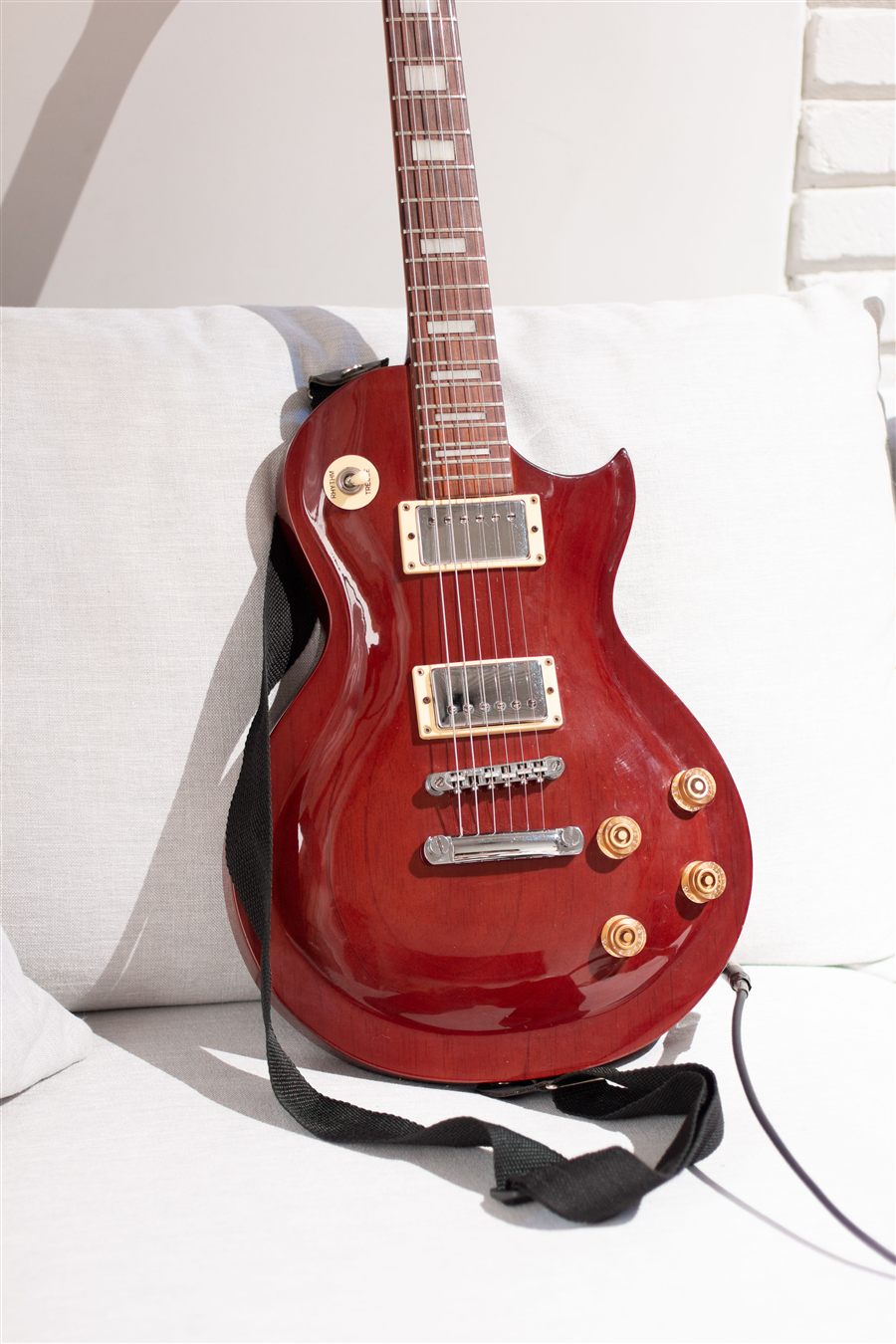
Electric Guitar
Epiphone Casino Reissue (1995-2004)
Price: 1.210 EUR – 2.269 EUR
Price history
Cheapest seen
Most expensive seen
Availability: 6/10 (Common)
A fully hollow archtop with no centre block at all - a genuinely different construction from the semi-hollow Gibson ES-335 covered elsewhere in this research - built around twin dogear P-90 single-coils and a slim taper D neck. This specific 1995-2004 reissue run carries one dating-relevant detail: its neck joins the body at the 17th fret, a spec later production moved to the 16th. It's also, without exaggeration, the guitar all three Beatles guitarists independently bought.
About the Epiphone Casino Reissue (1995-2004)
The Casino's most important construction fact is what it lacks: unlike the ES-335 already covered in this research, there is no solid centre block running through the body at all. This is a genuinely, fully hollow archtop, the Epiphone equivalent of Gibson's own ES-330 - which makes it more feedback-prone at volume, but also gives it a more purely acoustic, resonant character than any semi-hollow or solid-body guitar in this series.
This specific 1995-2004 production run carries a dating detail worth knowing if you're evaluating a used example: the neck joins the body at the 17th fret, whereas the later 2005-onward reissue run moved that joint to the 16th fret - a small but genuine, checkable construction difference between two guitars that otherwise share a model name. The pickups are twin dogear-style P-90 single coils, specifically designated P-90R (neck) and P-90T (bridge), mounted directly to the top rather than suspended the way a humbucker often is - the classic, raw single-coil-in-a-hollow-body recipe that predates humbuckers entirely.
Where to buy
Price
–
-
Reverb 1.210 EUR Best price View details
-
Reverb 1.271 EUR View details
-
Reverb 1.350 EUR View details
-
Reverb 1.392 EUR View details
-
Reverb 1.451 EUR View details
-
Reverb 1.514 EUR View details
-
Reverb 2.269 EUR View details
No platform selected – pick at least one above.
Some links below are affiliate links. We may earn a commission at no extra cost to you.
Source: https://reverb.com/item/94394836-epiphone-casino-reissue-1995-2004-vintage-sunburst
Sound character of the Epiphone Casino Reissue (1995-2004)
P-90 single coils sit tonally between a Fender-style single coil and a humbucker - rawer, more midrange-forward and grittier than a humbucker, but with more output and growl than a typical Strat-style pickup. Mounted in a fully hollow body with no centre block, that character gets an extra layer of genuine acoustic air and resonance no solid-body or semi-hollow guitar in this research can fully replicate - the sound most closely associated with early British Invasion rock and roll, exactly the sonic territory the Beatles used these guitars in.
What owners of the Epiphone Casino Reissue (1995-2004) say
The Beatles connection dominates how this guitar is discussed and marketed, and reviewers and owners generally treat that as earned rather than exploited - the fully hollow, P-90-loaded formula genuinely is the same one McCartney, Lennon and Harrison played, even in reissue form decades later.
The 17th-fret neck joint specific to this 1995-2004 run is treated by knowledgeable buyers as a meaningful, checkable detail when shopping used - not a value judgement between it and the later 16th-fret version, but a genuine spec difference worth confirming rather than assuming either era is identical to the other.
Playability & handling of the Epiphone Casino Reissue (1995-2004)
The slim taper D neck profile is built for comparatively fast playing on what's traditionally a more jazz- and blues-oriented hollow-body shape, keeping the Casino approachable for players coming from solid-body guitars rather than demanding an adjustment period.
The fully hollow body's feedback tendency is the honest trade-off of this construction, more pronounced than on the semi-hollow ES-335 already researched here - a real practical consideration at high stage volume or with heavy gain, though it's also precisely the quality that made the guitar useful as a creative tool rather than only a liability (see history section).
Recommended accessories & strings for the Epiphone Casino Reissue (1995-2004)
At the standard 24.75-inch scale, .010-.046 is a typical starting set. Because the fully hollow body is more feedback-prone than any semi-hollow or solid-body guitar in this research, careful amp placement or a noise gate becomes genuinely more relevant here at high stage volumes - the guitar rewards deliberate use of that feedback rather than fighting it entirely.
Technical data for the Epiphone Casino Reissue (1995-2004)
| Type | Fully hollow archtop electric guitar (no centre block), double cutaway, glued-in (set) neck |
|---|---|
| Production | Epiphone Casino Reissue, 1995-2004, built in Korea (Samick and Peerless) |
| Body | Fully hollow, laminated maple |
| Neck | Mahogany, Slim Taper D profile, elongated headstock with no inlay |
| Fingerboard | Rosewood, parallelogram inlays |
| Scale | 24.75 in. |
| Neck joint | 17th fret (later 2005-onward reissue production moved this to the 16th fret) |
| Pickups | 2x dogear-style P-90 single-coils, designated P-90R (neck) and P-90T (bridge) |
| Controls | 2x volume, 2x tone, 3-way selector switch; passive |
| Bridge / tailpiece | Tune-o-matic bridge with trapeze tailpiece |
| Origin note | Introduced 1961 as model E230TD, the Epiphone equivalent of the Gibson ES-330, originally built at Gibson's Kalamazoo, Michigan plant; genuinely owned and played by Paul McCartney, John Lennon and George Harrison between 1964 and 1966 |
Price history for the Epiphone Casino Reissue (1995-2004)
Cheapest seen: 1.210 EUR · Most expensive seen: 2.269 EUR
Cheapest seen
Most expensive seen
The history of the Epiphone Casino Reissue (1995-2004)
The Casino debuted in 1961 as model E230TD, effectively the Epiphone twin of Gibson's own ES-330: fully hollow, twin P-90 single coils, built at Gibson's Kalamazoo, Michigan factory - a direct consequence of Gibson's 1957 purchase of Epiphone already covered elsewhere in this research, since Epiphone no longer had its own independent manufacturing base by this point.
What makes the Casino's story genuinely unusual is a rare triple coincidence: all three Beatles guitarists independently bought one. Paul McCartney got his first, a 1962 example, in late 1964, specifically because he wanted to further explore the guitar feedback the band had captured on "I Feel Fine" that same year - one of the earliest deliberate uses of feedback in popular music, and the fully hollow Casino's greater feedback tendency made it a genuinely useful tool for that rather than a flaw to avoid. John Lennon and George Harrison each acquired their own in early 1966. Lennon's became the most iconic of the three after he stripped it down to bare wood in 1968, and the resulting natural-finish Casino is the guitar in one of the most reproduced images of him - performing on the rooftop of Apple's London headquarters in January 1969.
This specific reissue run followed decades later, part of a broader shift in Epiphone manufacturing: after Epiphone's contract with Aria ended in 1985 and the Matsumoku factory in Japan closed in 1987, production moved largely to South Korea. Samick built most Epiphones through the mid-1990s, after which Epiphone began spreading production across several manufacturers simultaneously - Casino reissues from this 1995-2004 window came from both Samick and Peerless, the same Korean factory that also built the ESP LTD EC-1000 covered elsewhere in this research.
About Epiphone as a manufacturer
This guitar sits within the same Epiphone-under-Gibson corporate story already covered for the Les Paul Standard '60s researched elsewhere in this project, but it illustrates a different chapter of that relationship: for its first years, the Casino wasn't built in some separate, lesser Epiphone facility at all - it came off the same Kalamazoo, Michigan production lines as Gibson's own guitars, because by 1961 Epiphone genuinely had nowhere else to build it.
The later shift to Korean manufacturers like Samick and Peerless reflects the same general cost-driven migration seen across much of the guitar industry from the 1980s onward - the same Peerless factory, notably, that also built the ESP LTD EC-1000 covered in this research, a reminder that a relatively small number of Asian factories have historically supplied instruments to many different Western guitar brands simultaneously.
Notable players & recordings featuring the Epiphone Casino Reissue (1995-2004)
This is one of the rare cases in this research where the model's fame comes directly and specifically from real ownership rather than a loaned or licensed name: Paul McCartney, John Lennon and George Harrison each genuinely bought and played an Epiphone Casino, independently of each other, between 1964 and 1966. That's a documented, unambiguous connection rather than a marketing association.
What's still worth being precise about: those were 1961/62-era original instruments, not this 1995-2004 reissue. Epiphone and Gibson have also released dedicated John Lennon signature Casino models replicating his specific stripped-finish guitar as a separate product, distinct from the regular reissue researched here.
Related guides
- Vintage vs. Reissue: Is an Old Electric Guitar Worth It? View details
- Stratocaster or Les Paul? Two Electric Guitar Classics Compared View details
- Pickup Types Explained: Single-Coil vs. Humbucker View details