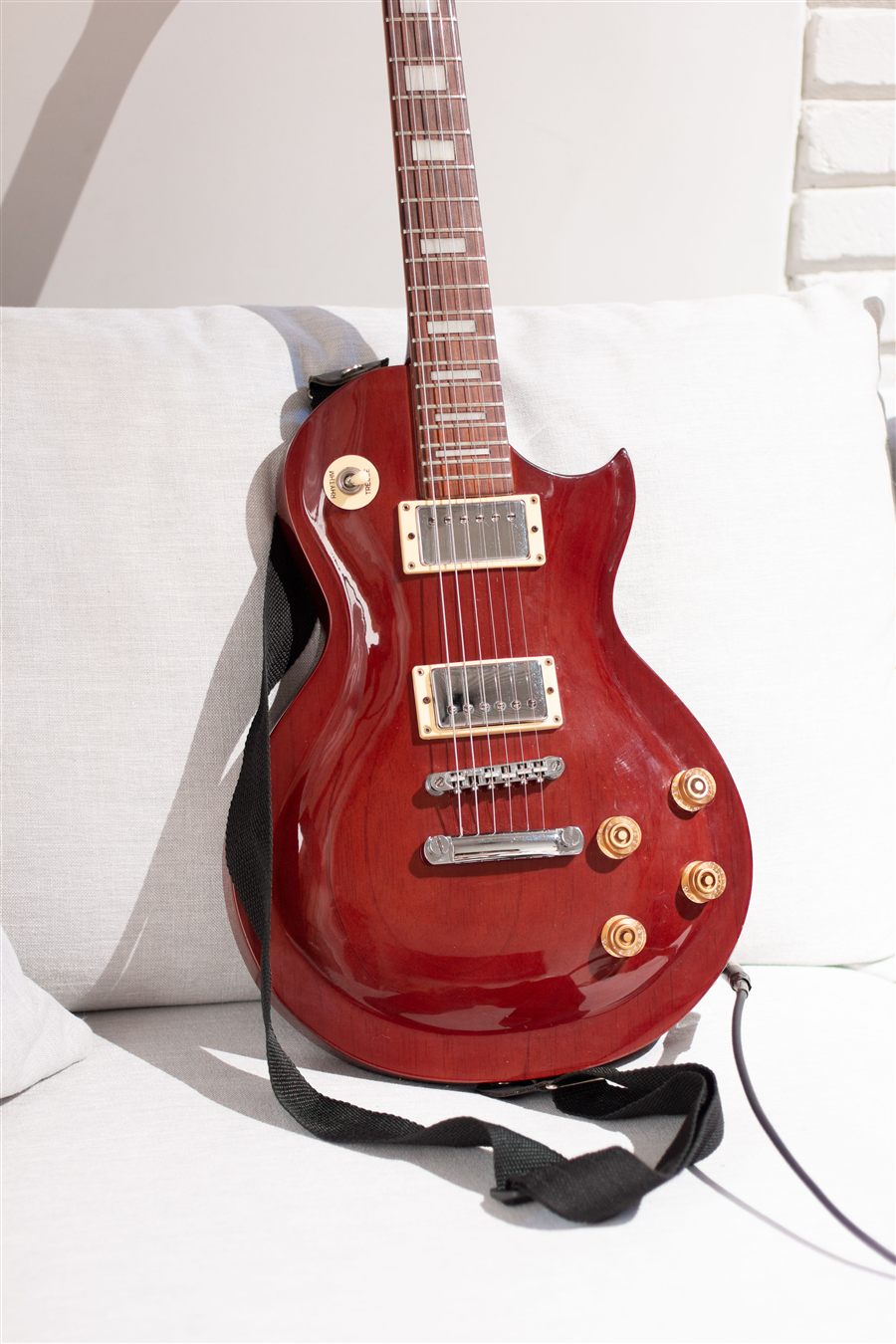
Electric Guitar
Epiphone Les Paul Standard '60s (2020 - Present)
Price: 385 EUR – 385 EUR
Price history
Cheapest seen
Most expensive seen
Availability: 0/10 (Very rare)
Epiphone's affordable take on the '60s-spec Les Paul: mahogany body with a maple top, SlimTaper '60s-C neck, and Epiphone's own ProBucker 2/3 humbuckers built to approximate Gibson's BurstBucker character at a fraction of the price. Part of the 2020 'Inspired by Gibson' relaunch that brought Epiphone's headstock shape and overall fit closer to Gibson's own than at any point since the brand became Gibson's budget arm in 1957 - a genuinely ironic twist, since Epiphone used to be Gibson's actual rival, in the same New York rooms Les Paul himself once jammed in.
About the Epiphone Les Paul Standard '60s (2020 - Present)
This guitar follows the same mahogany-body, maple-top, glued-neck recipe as its Gibson namesake, but the details that separate the tiers are specific and worth naming rather than vaguely implying: the ProBucker 2 (neck) and ProBucker 3 (bridge) humbuckers are Epiphone's own in-house design on Alnico 5 magnets, engineered to approximate Gibson's BurstBucker voicing rather than being the same part shipped under a different logo. Each pickup gets its own independent volume and tone control on CTS potentiometers - four knobs total plus the three-way toggle, the same layout logic as the full-size Gibson version.
One detail is worth being precise about rather than repeating uncritically: some sources describe push-pull coil-split pots on an Epiphone Les Paul with a similar name, but that spec appears to belong to a different variant in Epiphone's lineup (such as the Plustop PRO or Classic) rather than being confirmed for this specific '60s Standard with ProBucker 2/3 pickups. Official Epiphone/Gibson product listings for this model don't confirm coil-splitting, so it's treated here as unverified rather than assumed present.
Where to buy
-
Reverb 385 EUR Best price View details
No platform selected – pick at least one above.
Some links below are affiliate links. We may earn a commission at no extra cost to you.
Source: https://reverb.com/item/99330320-epiphone-les-paul-standard-60s-bourbon-burst-2022
Sound character of the Epiphone Les Paul Standard '60s (2020 - Present)
The ProBucker 2/3 pair is positioned by Epiphone itself as an approximation of Gibson's BurstBucker voicing at a lower price, though no independently verified detailed tonal description of this specific pickup pairing could be confirmed beyond that manufacturer framing. The general Les Paul character this guitar aims for - warm, thick, sustain-forward, the tone commonly credited with defining rock guitar from the late 1960s onward - comes from the same mahogany-and-maple, Alnico-humbucker recipe as the Gibson original, executed at a different price point rather than a different tonal philosophy.
What owners of the Epiphone Les Paul Standard '60s (2020 - Present) say
The 2020 Inspired by Gibson relaunch is consistently treated by long-time observers as a genuine step up rather than a cosmetic refresh, with the closer open-book headstock shape and overall fit-and-finish singled out repeatedly as evidence Epiphone was closing the gap with its parent brand rather than just repackaging the same guitars.
Weight is the one specific, recurring caveat in reviews of this particular model - it's heavier than expected for its price tier, and while most reviewers connect that directly to sustain rather than treating it as a flaw, it's flagged often enough to be worth factoring in before buying, especially for players prioritising comfort over maximum sustain.
Playability & handling of the Epiphone Les Paul Standard '60s (2020 - Present)
Documented at 4.1 kg, this guitar came in as the heaviest instrument in at least one direct comparison review - a genuine, felt trade-off for sustain rather than a design flaw, but worth knowing if you're sensitive to weight during long standing sets, especially for younger or smaller-framed players the review specifically flagged.
The SlimTaper '60s C neck profile mirrors the fast-playing intent of the Gibson Les Paul Standard '60s already researched in this project, in Epiphone's own more affordable execution - the same underlying design philosophy, translated to a different price point rather than watered down.
Recommended accessories & strings for the Epiphone Les Paul Standard '60s (2020 - Present)
The 24.75-inch scale takes the same .010-.046 starting point as other short-scale Les Pauls researched in this project. Given the documented 4.1 kg weight, a wide, well-padded strap is worth prioritising the same way it is on the full-size Gibson Les Paul Standard '50s and '60s already covered here.
Technical data for the Epiphone Les Paul Standard '60s (2020 - Present)
| Type | Solid-body electric guitar, single cutaway, glued-in (set) neck |
|---|---|
| Collection | Epiphone Inspired by Gibson, relaunched 2020 |
| Body | Mahogany with maple top |
| Neck | Mahogany, SlimTaper '60s C profile |
| Fingerboard | Bound Indian laurel, 12 in. radius, pearloid trapezoid inlays |
| Frets / scale | 22 medium jumbo frets; 24.75 in. scale |
| Nut | Approx. 1.69 in. width |
| Pickups | Epiphone ProBucker 2 (neck) and ProBucker 3 (bridge), Alnico 5 magnets, in-house design approximating Gibson BurstBucker voicing |
| Controls | Independent volume and tone (CTS pots) per pickup, 3-way toggle switch; passive - no confirmed coil-split on this specific model |
| Bridge / tailpiece | Epiphone LockTone Tune-o-matic bridge with stopbar tailpiece |
| Tuners | Grover Rotomatic |
| Weight | Documented at 4.1 kg (approx. 9 lb) in at least one comparison review - notably heavy for its price tier |
| Headstock | Open-book style, adopted in the 2020 relaunch, closer to Gibson's own shape than earlier Epiphone designs |
| Origin note | Epiphone was Gibson's genuine competitor from the 1930s until financial trouble led Gibson to buy the company in 1957 for a reported $20,000 |
Price history for the Epiphone Les Paul Standard '60s (2020 - Present)
Cheapest seen: 385 EUR · Most expensive seen: 385 EUR
Cheapest seen
Most expensive seen
The history of the Epiphone Les Paul Standard '60s (2020 - Present)
Epiphone's origin has nothing to do with being a cheaper Gibson - it started as genuine, direct competition. Anastasios Stathopoulos began building fiddles and lutes as a lumber merchant in the Ottoman Empire around 1873, then emigrated to the US in 1903 and opened a Queens, New York factory building ouds and mandolins. After his death in 1915, his son Epaminondas - nicknamed Epi - took over and renamed the company the Epiphone Banjo Company in 1928, riding the era's banjo boom.
Through the 1930s, Epiphone was Gibson's real rival, not its budget shadow. Its New York location drew working musicians directly, including Les Paul himself, who would occasionally jam in Epiphone's own showroom - a genuinely ironic detail, since the guitar shape this model imitates now carries his name under Gibson's brand instead. Epiphone was innovating fast too, introducing electric pickups and amplifiers in 1935, a year ahead of Gibson's own ES-150.
The company's fortunes reversed by the mid-1950s: a 1953 factory move from New York to Philadelphia caused an exodus of skilled craftsmen and a real quality decline, and by 1957 Epiphone was struggling badly enough that Gibson bought the entire company for a reported 20,000 dollars. Rather than shutting the brand down, Gibson president Ted McCarty deliberately kept it alive as a distinct, lower tier - Epiphones went to dealers who wanted Gibson authorization but hadn't yet built the sales record to earn it, cementing the cheaper-than-Gibson perception that still defines the brand today.
The most recent turning point came at NAMM 2020, when Epiphone launched its Inspired by Gibson collections - timed alongside Gibson's own post-bankruptcy Original and Modern Collection relaunch already covered elsewhere in this research. The headstock shape changed from Epiphone's older, sharper-angled design to an open-book style noticeably closer to Gibson's own, while staying legally and visually distinct.
About Epiphone as a manufacturer
Epiphone's relationship to Gibson is genuinely unusual among the brand pairs covered in this research: Squier was built from scratch by Fender specifically as a budget shadow brand, but Epiphone was an independent, historically significant rival that Gibson absorbed rather than invented. That history is why Epiphone retains its own name, its own design language, and - since the 2020 relaunch - its own upper tier built in close collaboration with the actual Gibson Custom Shop in Nashville, using real Gibson USA pickups and solid-wood, one-piece-neck construction on the higher-end Inspired by Gibson Custom Collection models that sit above this Standard '60s.
What that means practically is that Epiphone isn't purely a value-engineered clone brand the way some competitors' budget lines are - it's a company with its own century-and-a-half of instrument-building history that happens to have spent the last several decades inside Gibson's corporate structure.
Notable players & recordings featuring the Epiphone Les Paul Standard '60s (2020 - Present)
No verified current professional endorsement ties a specific touring artist to this exact budget-tier model - consistent with its role as an affordable entry point into the Les Paul shape rather than an artist-driven design.
The genuinely interesting player connection here is historical rather than current: Les Paul the person occasionally jammed in Epiphone's own New York showroom during the 1930s, back when Epiphone was Gibson's real competitor rather than its subsidiary - a detail worth knowing precisely because it complicates the simple assumption that Epiphone has always just been the cheaper version of a Gibson design.
Related guides
- Stratocaster or Les Paul? Two Electric Guitar Classics Compared View details
- Pickup Types Explained: Single-Coil vs. Humbucker View details
- Do Tonewoods Matter on Electric Guitars? The Ongoing Debate View details