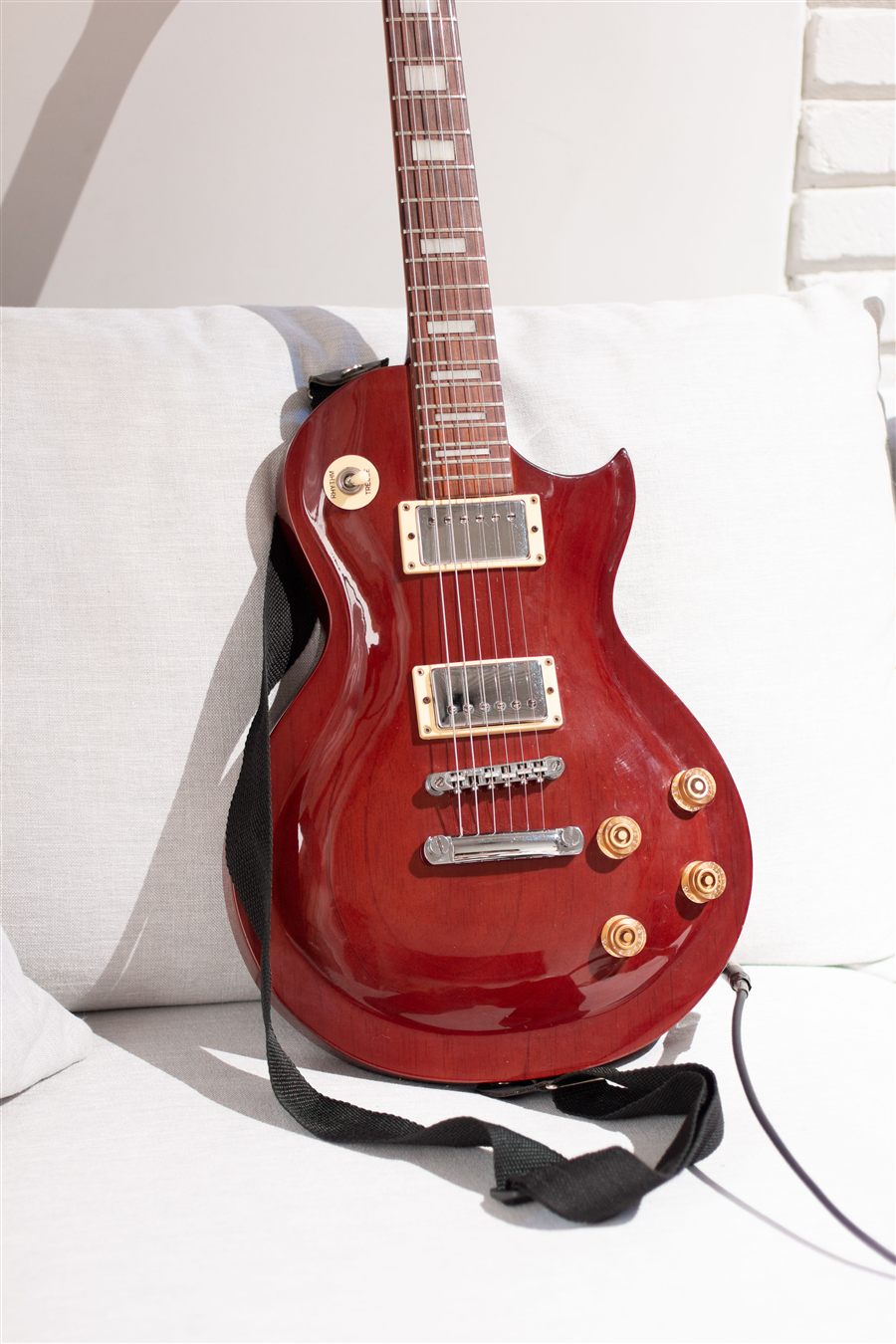
A single-coil uses one coil, sounds bright, clear and bell-like, and picks up mains hum easily. A humbucker uses two coils wired out of phase, cancels that hum, and sounds warmer, thicker and more midrange-focused. The P-90 sits between them as a wide single-coil. Neither design is simply better: what matters is your style, your amp, how much gain you use and how much noise you will tolerate.
How a pickup works
A pickup is one or more magnets plus a coil of very fine enamelled copper wire. When a steel string vibrates over the magnetic field, the field strength changes and the coil produces a tiny alternating voltage of around 0.1 volts by induction. That signal travels through the volume and tone controls to the output jack and on to the amp.
A few typical figures explain the sound: a coil usually has between 4,000 and 10,000 turns, DC resistance sits roughly between 3 and 20 kilohms, and the resonant peak usually falls between 2,000 and 5,000 hertz (rules of thumb, varying by model). More turns mean more output but tend to cost treble. Magnets are either alnico alloys or ceramic: alnico 2 and 3 are considered softer and classic, alnico 5 stronger and more focused, and ceramic is often the strongest and common on high-output models for heavy styles.
Single-coils in detail
A single-coil uses one coil for all six strings. The sound is bright, transparent, rich in overtones and cutting, and picking dynamics stay clearly audible. Typical uses are funk, blues, indie, pop, country and anything with low to medium distortion. Two classics show the range: on a Telecaster the covered neck pickup sounds mellow while the bridge pickup is sharp and twangy. A Stratocaster has three single-coils and a five-way switch.
The weakness is noise: the coil acts like a small antenna and picks up mains hum and interference from electronics. Frequency response typically reaches up to about 5 kilohertz, which adds to the glassy character. Many pickups are dipped in wax to calm microphonic squeal.
Humbuckers in detail
A humbucker has two coils with opposite winding direction and opposite magnet polarity. Interference from outside reaches both coils equally and cancels through the opposite phase, while the string signal adds up. The coils are usually connected in series, which boosts the signal. The history is tangled: a hum-cancelling coil existed as early as 1934, Gibson introduced the PAF humbucker in 1955, and around the same time Gretsch developed the Filter'Tron on a similar principle. Who was first is disputed.
Tonally, humbuckers are warmer, rounder and more midrange-heavy than single-coils, with less sparkle on top and more punch. That suits rock, hard rock, metal, blues and jazz, and it is a clear advantage under heavy distortion, because distortion amplifies noise too. Variants include mini-humbuckers for smaller routs and ceramic-magnet models for high output.
P-90, stacked and noiseless
P-90
The P-90 dates from 1946 and is technically a single-coil, but with a wider, flatter coil and more turns (around 8 kilohms on modern examples). It sounds thicker and more midrange-heavy than a Fender-style single-coil, and more open and raspy than a humbucker. It is regarded as an all-rounder for blues, rock, punk and country, but it hums like any single-coil. It comes as a soapbar, as a dog-ear with side mounting ears, and in a humbucker-sized housing for retrofits.
Stacked and noiseless
Stacked pickups put two coils on top of each other instead of side by side so they fit a single-coil slot. The upper coil provides the tone, the lower one mainly cancels interference. Fender Noiseless pickups have used this principle since 1998. The price of quiet is usually slightly reduced treble and a less snappy attack. Another approach uses an air gap and conductive shielding to keep interference out before it reaches the coil, which is meant to preserve more top end. A special case is the split-coil layout, where each coil covers only some of the strings, as on the Fender Precision Bass.
Single-coils with reverse winding
Many modern Stratocasters have a middle pickup with reverse winding and reverse polarity. Combined with the neck or bridge pickup (switch positions 2 and 4), it largely cancels the hum and gives the airy "quack" sound. Older Stratocasters had three identical pickups, so their in-between positions hum.
Understanding hum and shielding
In the US the power grid alternates at 60 hertz, which produces a low hum. Typical sources are LED dimmers, cheap power supplies, monitors and power strips. Your body acts as an extension of the antenna, so the hum often changes when you move or touch the strings. If it gets quieter when you touch the strings or metal parts, that points to a grounding issue.
What you can do yourself: turn around in the room until the hum drops, switch off interference sources, try another cable and test a different power supply. How the control cavities are shielded (copper foil or conductive paint) and how ground connections are made is work for a pro shop, because it involves soldering and electrics. Here you only get the principle: shielding drains interference away before it enters the signal path. If a guitar still hums badly, take it to a shop.
Tone and genres at a glance
| Type | Sound | Hum | Typical genres |
|---|---|---|---|
| Single-coil | bright, clear, bell-like, low output | prone | funk, blues, indie, pop, country |
| P-90 | thick, raspy, midrange-heavy | prone | blues, rock, punk, jazz |
| Humbucker | warm, fat, midrange-focused, higher output | cancelled | rock, metal, blues, jazz |
| Stacked / noiseless | close to single-coil, slightly less treble | strongly reduced | like single-coil, but with gain |
Position matters almost as much as type: near the bridge any pickup sounds harder and brighter, near the neck softer and bassier. Individual models differ a lot from these patterns, so treat the table as a rule of thumb.
Combinations and switching
The selector switch decides which pickups are active. Guitars with two humbuckers usually have a three-way switch: neck, both, bridge. A Telecaster also has three positions. The five-way Stratocaster version additionally offers neck plus middle and middle plus bridge; these in-between positions sound a little thinner and airier.
Coil splitting switches one coil of a humbucker off so it sounds like a single-coil, brighter and with less output. Note that with one coil the hum protection is gone too. Splitting makes most sense in combination with a second single-coil that stays quiet when both work together. Converting to split or changing other circuits is shop work. Typical labor for a direct pickup swap is about 75 USD (one shop, Oct. 2026); circuit changes and body work cost more and varies by shop, get a quote.
A practical point on used guitars: if a pickup was wired wrongly, the combination of two pickups sounds noticeably thin, bright and annoying because they work against each other (out of phase). A shop can fix it, but it is a reason to ask questions and negotiate.
Pots and capacitors: what they do
Behind the knobs sit potentiometers, or pots, and a capacitor in the tone control. Important: working on them means soldering, so this section only explains what they do so that you can understand listings and advice.
- Volume pot: a variable resistor that reduces signal strength. Its value (usually 250k or 500k ohms, sometimes 1 megohm) affects basic brightness: higher values tend to sound more open and brighter, lower ones darker.
- 250k or 500k: As a rule of thumb, 250k suits single-coils because it tames their harshness, and 500k suits humbuckers, which can sound dull with 250k. Opinions differ, though, and with individual pickups the difference is smaller than people expect.
- Tone pot and capacitor: Together they drain treble when you turn the tone knob down. A larger capacitor value (for example 0.047 microfarad) lowers the cutoff frequency and removes more treble, a smaller one (0.022) stays brighter. As a rule of thumb, if the pot value doubles, about half the capacitor value gives a similar effect. Common pairings are 250k with 0.047 for single-coils and 500k with 0.022 for humbuckers.
- No-load pot: a tone pot that practically disconnects the tone circuit when turned fully up. The signal is considered slightly more direct and brighter.
- Crackling when turned: Old, dirty pots crackle. It is common on older guitars and not a sign of bigger damage. Mild cases can often be cured with contact cleaner; with corrosion only replacement helps.
The capacitor material question (paper, ceramic, film) is a favorite topic of debate; the effect of the capacitance value is much better documented than any effect of the material.
Active or passive
Passive pickups work without power and are the standard. Active models have a preamp in the instrument, usually with a 9-volt battery. They deliver a strong, low-noise, very consistent signal, even under heavy distortion, and often a very defined, compressed sound. Well-known examples are the EMG 81 and EMG 85 humbuckers. The downside: without a battery you get no sound, and circuit options are more limited. Converting from passive to active requires shop work.
When swapping pickups pays off
- Hum bothers you constantly: You play with lots of gain and fight noise. A humbucker or noiseless model can help.
- The sound no longer fits: You changed style and the guitar sounds too thin or too dark.
- Technical failure: A pickup drops out or crackles badly.
- Check the simple things first: action and setup (see setup explained), fresh strings, cable, pots and pickup height.
About pickup height: closer to the strings a pickup sounds louder and harder, farther away quieter and more open. Change the height in small steps, make sure the string does not touch the pickup when fretting high up the neck, and listen after each change.
Keep original parts, because they matter to collectors and at resale (more in vintage vs. reissue). On a used guitar it pays to ask about replaced pickups and pots, see buying a used electric guitar.
Costs in the US
- Humbuckers: a popular vintage-style model costs about 99 USD each, a neck and bridge set about 198 USD (Oct. 2026).
- Shop labor for a direct pickup swap: about 75 USD at one shop, including pickup height and connecting to the existing controls, excluding routing or circuit changes (Oct. 2026). Other shops charge differently, so varies by shop, get a quote.
- Pots, jacks, switches and circuit changes: parts are cheap, labor adds up. Prices vary by shop, so get a quote.
Myths and mix-ups
- Single-coils always hum: No. Noiseless designs and single-coils with reverse winding are much quieter, and good shielding helps.
- Humbuckers never hum: They also pick up interference, only far less. Split, they lose the protection.
- Humbuckers always sound dark: Some are very bright. The sound depends on magnet, turns, position and amp.
- More output is better: More output distorts earlier but often costs treble and dynamics.
- New pickups turn any guitar into another: They change the sound noticeably, but the basic behavior still comes from body, neck, strings and playing.
- Pot value alone decides brightness: It works together with pickup, capacitor and cable. Try first, then change.
Which setup for whom
- Clean, funk, blues, indie: single-coil or P-90.
- Rock, hard rock, metal: humbucker, active for very high gain.
- All-rounder: a humbucker at the bridge combined with single-coils, or guitars with coil split.
- Lots of gain but single-coil character: stacked or noiseless models.
To hear the difference between two classics, see the Stratocaster vs. Les Paul comparison. And if you are just starting, read common mistakes when buying a first electric guitar.