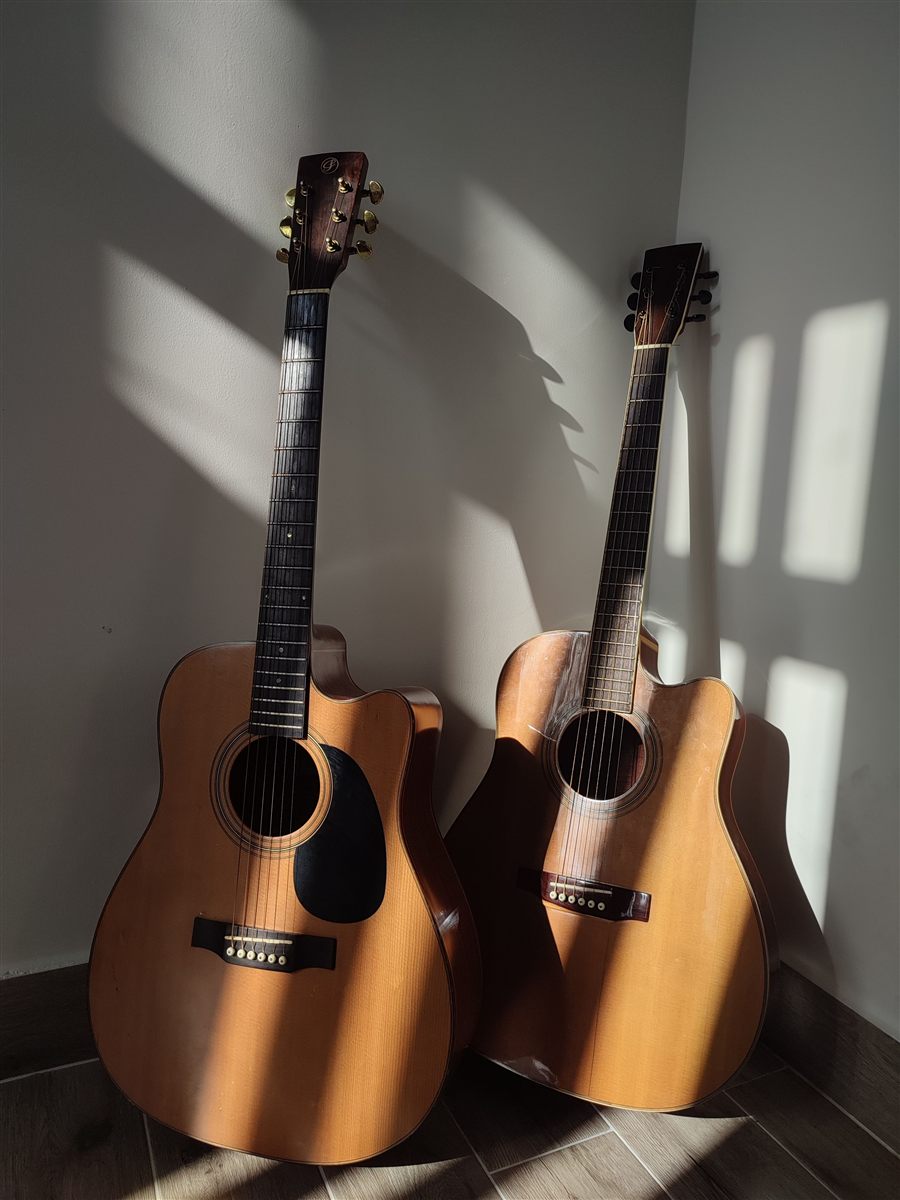
The saddle, nut, bridge pins, tuners and pickup of an acoustic guitar are small and cheap compared with the wood, yet they decide how the instrument plays, stays in tune and sounds when amplified. Short answer: the saddle and nut matter most, and their fit (height, slot shape, contact) matters more than the material. Material differences such as bone versus a good synthetic are real but subtle, and there is no controlled blind test on the subject, so treat strong claims from either camp with caution. If a guitar sounds dull, work through the cheap steps first (fresh strings, setup, saddle and nut, pins) and think about a pickup last.
The parts and what each one does
- Saddle (Stegeinlage): the strip seated in a slot in the bridge. The strings rest on it and it passes their vibration into the bridge and the top. Its height sets the action; its slightly slanted top, longer on the bass side, takes care of intonation.
- Nut (Sattel): the grooved piece at the headstock end of the fretboard. It spaces the strings and sets their height at the first fret.
- Bridge pins (Stegstifte): tapered pegs that wedge each string ball end into the bridge. They also help pass vibration into the body, and a loose or badly fitting pin can rattle.
- Bridge: usually carved hardwood, with rosewood and ebony the common choices, glued to the top. Some bridges combine a wooden body with a separate bone or plastic ridge for the strings.
- Tuners (Mechaniken): worm-gear machine heads that keep the strings at pitch.
- Pickup and preamp: the electronics for amplified playing.
Saddle and nut material
Bone, Tusq and plastic
Hard, dense materials are preferred for saddles and nuts, because a soft one is thought to absorb some of the string energy and wears grooves faster. Saddles come in bone, ivory, high-density plastic and metal, nuts in bone, plastic, brass, Corian, graphite and stainless steel. In practice you meet three groups:
- Bone: the classic upgrade. Workshops describe it as somewhat brighter and clearer, with good sustain, and it lasts a long time. Natural bone varies from piece to piece in density and finish.
- Synthetic ivory such as Graph Tech Tusq: machined to consistent quality, stable against moisture, and cheaper. Tusq is offered as man-made ivory for nuts, saddles (including compensated ones) and bridge pins and is said to give richer overtones. That is a manufacturer claim; no direct comparison with bone is available.
- Plain plastic: common on budget and mid-range factory guitars to hold down cost. It is usually described as softer, with fewer high-frequency details, and it can wear faster.
What a swap realistically brings
Mammoth ivory, brass and other exotic saddle materials exist, but there is no reliable, independent evidence for their tonal effect, so they are left without judgement here. Honest summary: swapping a worn plastic saddle for a well-cut bone or Tusq one can tighten the sound and fixes a poor fit at the same time, so it is hard to say how much comes from the material and how much from the better fit. Expect a subtle change, not a transformation. Pickup note: under-saddle piezos work best with a saddle that sits flat and evenly on the sensor, so material is secondary to precise bottom contact.
Saddle and nut: fit, adjustment and nut check
Fit matters more than material
A saddle should stand firmly in its slot with a flat bottom, with the strings leaving it at a clean angle. A sharp break angle or a rough spot on the saddle top can fray and snap strings, as is widely known among repairers. Wide grooves worn into an old saddle are another warning sign when you inspect a used guitar. Bridge slots differ slightly in width, depth and length, so measure the slot (or the old saddle) before you buy a blank, and make sure the new saddle stands snugly without being forced in.
Lowering the saddle yourself
Lowering the action by sanding the saddle bottom is one of the most common home jobs. The rule of thumb: remove about twice as much from the bottom as you want to gain at the 12th fret, because 1 mm less saddle lowers the action at the 12th fret by roughly 0.5 mm. Typical targets at the 12th fret (underside of the string to the top of the fret) are about 2.2 to 2.8 mm on the low E string and 1.6 to 2.2 mm on the high e string; treat these as rough guides, not rules. Set neck relief first (commonly about 0.15 to 0.25 mm); see our article on action and neck relief.
- Measure the current action at the 12th fret with a ruler or feeler gauges and decide on a target.
- Slacken the strings and lift out the saddle.
- Sand the bottom, never the top, on a flat block with sandpaper. Take off only a little at a time, measure often, and keep the bottom perfectly flat and square to the sides, so the saddle sits evenly in the slot and on a piezo.
- Refit the saddle, tune up and measure again.
Removed material does not come back, so go slowly and keep the original or a spare saddle at hand. If too much is gone, the only real fix is a new saddle (a thin shim underneath is a stopgap, and not ideal with a piezo). Shaping a new bone saddle from a blank, including the top radius and the slanted compensation, is possible with a file, patience and some practice; without the tools, a workshop does it quickly.
Nut: where mistakes are expensive
Nut slots must be cut to the right depth and shape. Too high makes the first positions hard to play and sharp; too low causes buzz at the open strings; slots that pinch or are cracked make strings ping and tune badly. A common check: press a string down at the third fret and look at the gap above the first fret; about 0.08 to 0.13 mm is a typical target. If the gap is clearly larger, the slot is too high; if there is none and open strings buzz, it is too low. Deepening slots is delicate work with dedicated nut files, and it cannot be undone: go one tiny step at a time and practise on a spare nut first. Careless filing ends with a replacement nut, which by experience costs around 50 to 100 USD (as of Oct. 2026). If you are unsure, have a workshop cut the slots. Bone, graphite or hardwood are the materials commonly used.
Bridge pins
Bridge pins are made from plastic, bone, wood or synthetics such as Tusq. A good pin fits snugly, with the string groove pointing toward the saddle, and sits slightly proud of the bridge without bottoming out. A loose pin can click or buzz; strings with a soft wrap near the ball end often help seat loose pins. When you fit a new string, push the pin in, then pull the string gently upward so the ball end seats firmly against the underside of the bridge plate. Claims that expensive pins transform the tone are weakly supported, and there is no solid test. Pins are therefore a cheap fit-and-reliability fix, with some tonal change possible but unproven.
Bridge, bridge plate and bridge lift
The bridge is glued directly to the top and carries the full string tension. If its back edge starts to lift from the top, it should be repaired before it worsens. If anything slides under any part of the bridge, it has to be removed and reglued properly, which is workshop work. A separate, related warning sign when you inspect a used guitar: a very low saddle combined with high action often suggests the neck angle has drifted; the previous owner may have lowered the saddle as a stopgap instead of a neck reset. Also check whether bridge and saddle still have room to be lowered; if both are used up, a reset is likely.
Tuners
On modern steel-string guitars the worm gears usually sit in sealed, permanently lubricated housings; budget guitars sometimes use open gears. Ratio matters for feel: 14:1 is described as the current standard, 18:1 is available from some makers, and some models reach 21:1. Higher means finer adjustment but more turns. When replacing tuners it helps if the hole pattern of the new ones matches the guitar, so no drilling is needed. In the US, workshops charge about 20 USD for fitting a drop-in set, rising to about 60 USD with reaming or drilling (12-string about 110 USD, as of Oct. 2026). Whether the holes line up depends on the model and should be clarified before ordering.
Replacing tuners yourself
Swapping tuners with a matching hole pattern is a simple job. Remove one tuner at a time: loosen the strings, unscrew the small mounting screw(s) on the back of the headstock and the nut or bushing on the front, and pull the unit out. Fit the new one in the same hole, align it so the post stands straight and in line with the others, and tighten the nut and screws firmly but without forcing them; the wood can crack or the thread strip. Work through them one by one, restring and tune up. If the holes do not match, drilling or filling is workshop work.
Pickups and preamps
Types and what to expect
- Under-saddle piezo: the most common choice. It resists feedback and sits unseen below the saddle, but has a very high output impedance and needs a buffer or preamp near the guitar. Many systems carry a small preamp in the side or sound hole, often with a tuner.
- Magnetic sound-hole pickup: easy to fit and fully removable; tone is described as more electric.
- Internal microphone: sounds natural but is prone to feedback at volume.
- Hybrid systems: piezo plus microphone, described as better and less feedback-prone than a microphone alone.
Preamps are usually battery powered (typically a 9 V battery in a small compartment; change it every so often and take it out when the guitar is stored for a long time); for the guitar itself, the usual target is 45 to 55 percent relative humidity (some makers allow 40 to 60 percent).
Retrofit or buy with factory electronics?
A piezo can be fitted into most acoustics and usually without permanent changes, since it sits in the saddle slot and a jack in the endpin; the installation belongs in a workshop. Factory systems are matched to the guitar and built in cleanly, with a preamp and controls. Factory electronics often come with a warranty of about one year, and an Expression System 2 upgrade or install for Taylor guitars costs about 350 USD (as of Oct. 2026). For retrofits, independent workshops price the labour at low levels: about 90 USD to install an under-saddle system, or 60 USD together with a setup (as of Oct. 2026). The pickup itself is extra. If a listing lacks electronics, it is not a dealbreaker, and many players prefer choosing their own system. Factory-fitted electronics, in contrast, can make a guitar easier to sell on the used market, while a poorly done retrofit does not.
Checking electronics on a used guitar
- Put in a fresh battery and test the preamp and tuner; ask the seller when it was last changed.
- Plug in and play every string with the guitar volume up; listen for crackle, hum, uneven string volume or dead strings.
- Gently move the cable in the endpin jack; crackle points to a loose jack or a faulty connection that a workshop has to fix.
- Test every control (volume, EQ, phase, notch) through its full travel.
- Check the saddle is not cracked and sits cleanly on the piezo strip.
Upgrade order for a dull-sounding guitar
- Fresh strings.
- Basic setup: relief, saddle height, nut check (a workshop does it for about 60 to 100 USD, as of Oct. 2026; the steps above cover the DIY version).
- Saddle and nut, bone or Tusq, if the old ones are worn or poorly fitted.
- Bridge pins if loose or ill-fitting.
- Pickup system last, only if you play amplified.
Typical costs
The examples below are approximate guides for US workshops:
| Job | Typical range (USD, as of Oct. 2026) |
|---|---|
| Bone saddle, 6-string | about 60 USD, plus blank |
| New nut | about 130 USD on an acoustic in one price list |
| Nut and saddle together | about 60 to 180 USD |
| Bridge reglue | about 150 to 300 USD |
| Neck reset | about 350 to 1000 USD, depending on source |
| Taylor Refresh service | 115 USD |
Prices differ by workshop, and not every price list distinguishes acoustic from electric work. Ask for a quote first.
Common mistakes
- Sanding the top instead of the bottom of the saddle, or removing too much at once.
- Buying an expensive saddle to fix a problem that comes from the neck angle or a high nut.
- Filing nut slots without proper tools or practice.
- Ignoring a lifting bridge edge.
- Assuming bone is automatically better: a well-fitted synthetic beats a badly fitted bone saddle.
- Not testing electronics with a new battery before buying.
Related reading: buying a used acoustic guitar and humidity and storage.