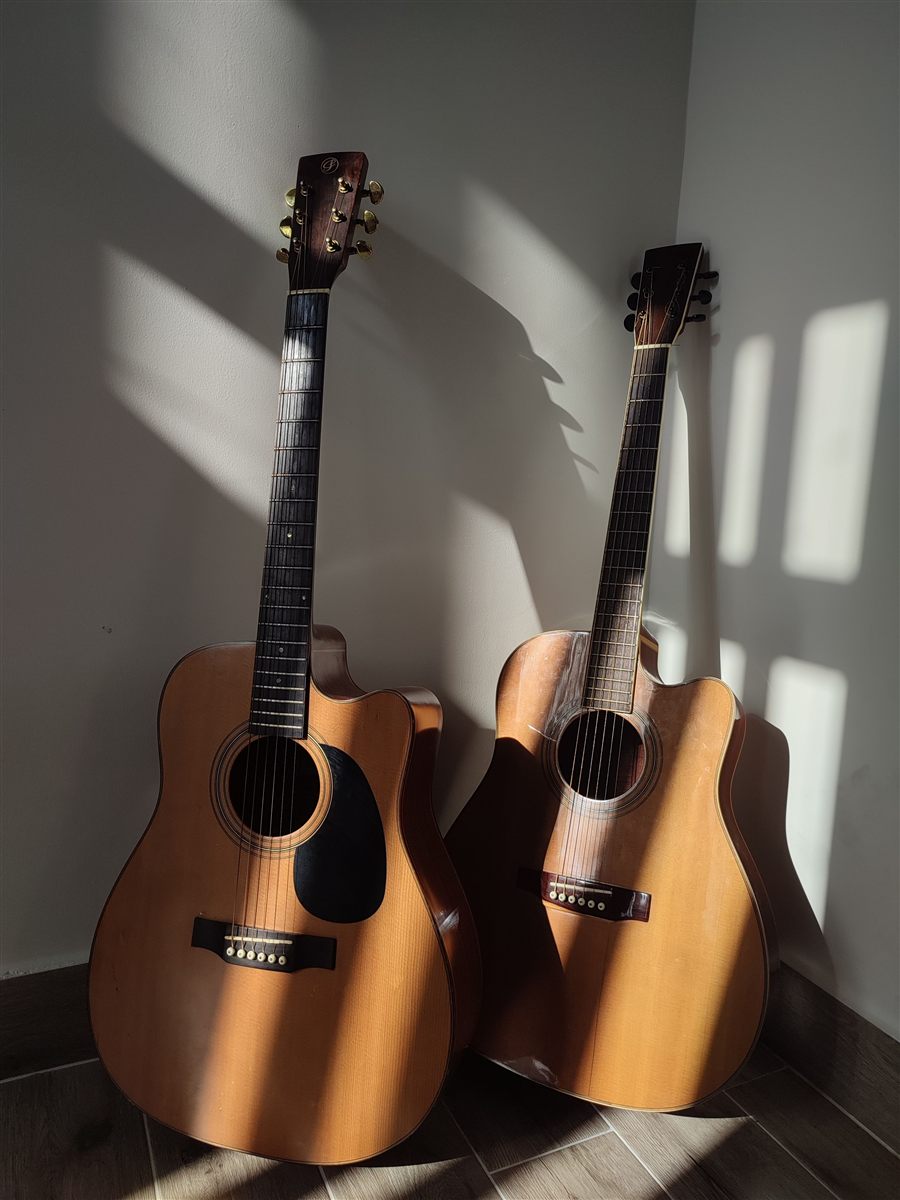
For most steel-string guitars, phosphor bronze in light gauge (.012-.053) is the safe default. 80/20 bronze is the brighter alternative that mellows sooner, and coated strings trade a higher price for a longer fresh life. Gauge changes feel, volume and neck load more than the alloy does, and a jump of several gauge steps is worth a careful setup check. If a used guitar sounds dull, put on fresh strings before judging it.
80/20 bronze vs. phosphor bronze
- 80/20 bronze: the winding is an alloy of about 80 percent copper and 20 percent zinc. Strictly speaking that is brass, because true bronze contains tin. The sound is bright, crisp and projecting with a strong initial sparkle, but it mellows quickly.
- Phosphor bronze: copper alloyed with tin and a little phosphorus. In general metallurgy tin adds corrosion resistance and strength, and phosphorus adds wear resistance. The material has been used for acoustic strings since the early to mid 1970s. The sound is warm and balanced with smooth highs and rich mids, and many guitars leave the factory with it.
The pattern is consistent: 80/20 starts brighter and snappier, phosphor bronze starts rounder and keeps its tone somewhat longer. Why exactly one ages slower has not been measured; we know of no lab figures, so treat claims as direction, not measurement. The difference between the two alloys is audible but smaller than the difference between a fresh and a worn set.
Other wrap materials
- Silk and steel: soft fibre layers under the wrap lower the tension. The voice is warm and mellow with a softer feel; fingerstyle players are the typical users.
- Aluminium bronze: sold for projection and clarity.
- Bell bronze: an alloy from Ernie Ball developed with John Mayer. The composition is not disclosed, and the sound sits between the two classics: the sparkle of 80/20 with the deeper lows of phosphor bronze. A street price of about 12.99 USD per set was listed (US, as of Oct. 2026).
- Kovar and Monel (nickel alloys): offered for lower tension, natural corrosion resistance and a drier, vintage-leaning voice. They are niche choices; start with the two bronzes.
- Nickel bronze: found in coated lines with a clear, focused tone.
Gauges
Numbers and total tension
The gauge name refers to the thickness of the thinnest string in thousandths of an inch; the whole set scales with it. Typical phosphor bronze sets with the tension values of D'Addario sets (in pounds):
| Set | Gauges (high E to low E) | Total tension |
|---|---|---|
| Extra light | .010-.047 | about 133 lb |
| Light | .012-.053 | about 160.5 lb |
| Medium | .013-.056 | about 185 lb |
Our own arithmetic on these figures: light carries roughly 20 percent more pull than extra light, and medium about 15 percent more than light, around 25 lb in absolute terms. In a light set the high E string alone sits at about 23.4 lb, in a medium at 27.4 lb. The boundaries are not uniform: one popular line sells extra light as .010-.050, light as .011-.052 and medium light as .012-.054, so check the numbers, not the label. There is also a custom light set between extra light and light, and heavy gauges are often discouraged because of the load on the top, although heavy sets such as .014-.059 exist. Sets also differ by scale length and tuning.
What gauge does to sound and feel
- Lighter: less pressure on the top, softer sound, easier fretting and bending, less finger fatigue. The price is lower volume and often a shorter life. Smaller bodies suit them.
- Medium: more volume and projection, more midrange and a longer life. Needs more finger strength and loads the neck more. Large dreadnoughts handle it best (see body shapes).
- Fingerstyle vs. strumming: fingerstyle and singer-songwriter players often prefer lights; bluegrass, rock and blues players lean toward medium for volume and bass. Solo players can get by with lighter sets; in a band the extra projection of medium helps.
- Top and bracing: a lightly built or older top may not enjoy a permanent step up in gauge; see bracing. Wood species also colour the effect of the alloy, see tonewoods.
Neck, saddle and setup after a gauge change
- More tension pulls the neck forward and raises the relief; less tension lets it straighten. As a rule of thumb, going lighter can bring fret buzz, going heavier raises the action.
- A gauge change is a good moment to check the neck, and again with the seasons. How to do it yourself is described just below.
- Pitch and intonation can shift. Heavier strings tend to sound slightly sharp and may need saddle compensation; lighter ones the opposite. If you stay with the new set, check the intonation (see below).
- A jump of more than one step (light to medium, say) calls for particular care: check neck and action afterwards, or let a workshop do it; a single step usually works without fuss.
Measuring relief and adjusting the truss rod
To measure relief, tune the guitar to pitch. Put a capo on the first fret and press the low E string down where the neck meets the body (usually around the 14th fret). Now look at the 7th or 8th fret and use feeler gauges to see how much room is left between the string and the top of the fret. A typical target is about 0.15 to 0.30 mm (0.006 to 0.012 inch); figures vary by source and gauge, and lighter sets generally tolerate a little less relief. A set of feeler gauges is cheap.
- Too much relief (a big gap, high action in the middle of the neck): tighten the truss rod clockwise, which straightens the neck.
- Too little or backbow (no gap, buzz in the lower positions): loosen the rod counterclockwise, so the string tension can pull the neck forward again.
The access is under a cover on the headstock or at the neck end inside the sound hole, and a few guitars work the other way round, so check the documentation of your guitar. Use a wrench that fits snugly. Turn only 1/8 to 1/4 of a turn at a time, bring the strings back to pitch, give the neck a few minutes to hours to settle, then measure again. Never force it: if the rod creaks, will not move or the thread turns loosely, stop and take the guitar to a workshop.
Checking action and intonation
Action is measured at the 12th fret, from the underside of the string to the top of the fret. Typical values are about 2.2 to 2.8 mm on the low E string and 1.6 to 2.2 mm on the high e string, as ranges rather than laws. If the action is still too high once the relief is right, the saddle is the next step; see bridge and saddle material for how to lower it. To check intonation, compare the harmonic at the 12th fret with the fretted note at the same fret on each string: a clear difference means the compensation at the saddle is off. Heavier strings tend to read slightly sharp, lighter ones slightly flat; a correctly compensated saddle or a workshop visit fixes it.
Reference values for relief and action vary from source to source, so use them as ranges and, when in doubt, the value your technician gives. The details are in neck relief and action diagnosis.
Coated strings
Coated or treated strings carry a very thin polymer layer, or a treatment, that keeps skin oil and sweat away from the winding. Coated sets come in 80/20 and phosphor bronze. The benefits usually cited are a fresh tone for longer, less corrosion, less squeak and less fret wear. Claims range up to three to five times the life, and one product is advertised as staying in tune 131 percent better. These are advertising claims without independent test data. Expect to pay more: in the US, a coated light set lists at about 19.99 USD against roughly 8 USD per set for the uncoated one in a three-pack (US list prices, as of Oct. 2026). Some players hear slightly less brightness.
Coated sets pay off for players with acidic or sweaty hands, daily players, humid climates or anyone who dislikes restringing. If you play rarely and change strings often anyway, plain strings are cheaper.
How often to change
Interval and signs of wear
There is no fixed interval. A common rule is every few weeks depending on playing time, style, taste and climate; for light use, at least every three to six months is a common recommendation. Humidity, skin oil, sweat and playing force are the factors, and the tone fades over days to months. Change when:
- chords sound dull and the sparkle is gone;
- the strings look dirty, dark or rusty, or the winding feels rough;
- the guitar goes out of tune more often, which is the practical sign;
- intonation up the neck sounds off even though the setup is fine.
It is better to replace strings before they break. Attack, pick thickness and finger oil shorten their life. Wash your hands before playing and wipe the strings with a dry cloth afterwards; that is common advice. Strings can rust in humid conditions, see humidity and storage. Opinions on storage differ: many players leave the strings at pitch for normal storage, while for long storage or shipping it is common to tune down a little so the neck and top are not under full load.
Changing strings and common mistakes
A string change is routine, but go step by step and take care of your eyes and the finish:
- Loosen the strings, remove them and wipe down the fretboard and the area around the bridge.
- Fit the new strings, bridge end first, and make sure each ball end sits properly against the bridge plate.
- Thread each string through the tuner post and wind it neatly, with at least about three quarters of a turn around the post and the coils running downward side by side; a kinked wire weakens the string at that spot. Trim the protruding end after tuning, and watch the sharp wire end.
- Tune up, then lift each string gently with two fingers a few times and retune; repeat until the pitch holds. New strings stay unsteady for a while, which is normal. Overstretching causes breakage.
- If you changed gauge, check relief and action after a day or two (see above).
Typical mistakes: strings that break repeatedly are often caused by a sharp break angle or burrs at the saddle, rough nut slots or poor winding, not by bad strings. Others are forcing the truss rod, changing several gauge steps without a check, and judging a guitar by years-old strings.
Tunings and capo
Standard tuning is E-A-D-G-B-E; fingerpickers also use open G, open D, drop D and DADGAD. Tension depends on tuning as much as gauge, so a permanent change to higher pitch is a small version of a gauge increase, and a lower tuning relaxes the neck and can make the strings feel slack. A capo shortens the vibrating length and raises pitch by a semitone per fret; too much clamp pressure can harm strings and neck, and string and fret condition affect how well the guitar stays in tune with it.
Never steel on a classical guitar
Steel strings do not belong on a classical (nylon-string) guitar. Those instruments have a wider neck of about 52 mm at the nut compared with 43-46 mm for steel-string guitars, and no truss rod; the pull of steel can warp the neck and damage the bridge. Conversely, nylon strings do not suit magnetic or typical steel-string pickups and sound thin on a western guitar. Nylon is gentler on beginners' fingers, but if you own a steel-string guitar, light or extra light strings are the beginner-friendly route.
Strings on a used guitar
Before judging a used guitar, discount the old strings and compare with a fresh set, or ask the seller whether you may restring it; the cost of a test set is small. A dull sound, high-feeling action or constant tuning drift can all be strings. Rule out strings first, then look for structural causes such as relief, saddle height or neck angle (see buying a used acoustic). A 12-string needs its own sets and carries much more total tension, see 12-string vs. 6-string.
Brands and costs
- Uncoated bronze sets: phosphor bronze sets are listed at about 8-10 USD each in packs (US), and ranges run from roughly 5 to 40 USD per set (US, as of Oct. 2026).
- Coated sets: roughly double or more than uncoated, for example about 20 USD for one set (US, as of Oct. 2026).
- Labor: workshops charge a modest fee for restringing and more for a full acoustic setup; ask for a quote. Some shops need a day or two of lead time if you want a particular set.
- Accessories: string-change kits cost about 25-30 USD (as of Oct. 2026).
Checklist
- Not sure? Phosphor bronze, light, uncoated.
- Sore fingers or small body? Try extra light or custom light.
- Need volume in a band or a large body? Consider medium, and check the neck afterwards.
- Sweaty hands or humid room? Consider coated.
- Going more than one gauge step? Check neck and action carefully afterwards, and use a workshop if in doubt.
- Keep the old set label or note the gauges so you can compare later.