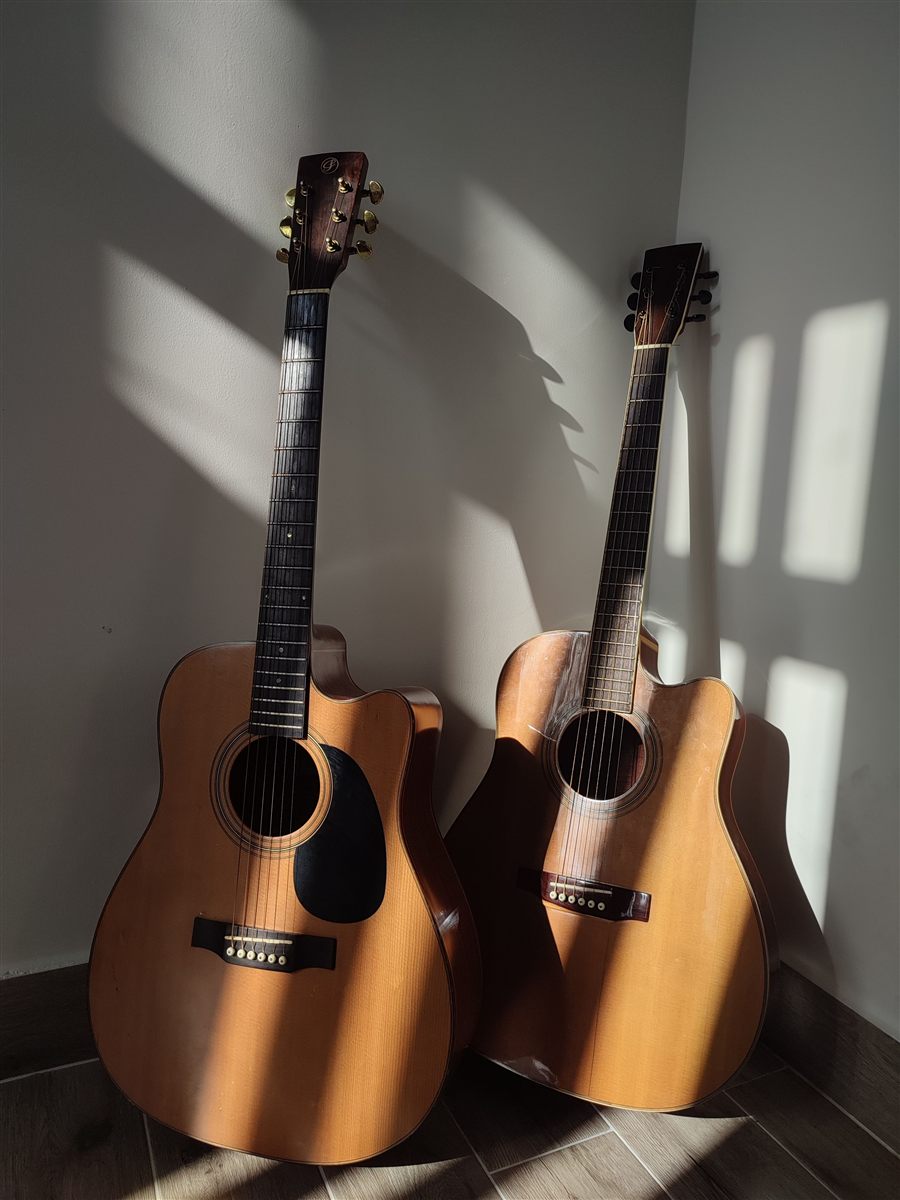
Bracing is the pattern of thin wooden strips glued to the underside of an acoustic guitar's top. It has two jobs that pull against each other: it must keep the thin soundboard from deforming under string tension, and it must leave the top free enough to vibrate and make sound. Almost all steel-string guitars use some form of X-bracing, and the details of how the braces are shaped are a big part of why similar-looking guitars sound different.
What bracing does
The strings pull on the bridge, and the bridge sits in the middle of a plate of spruce or cedar that is only a few millimetres thick. Without reinforcement that plate would belly, crack or fold. Braces stiffen it along chosen lines while the areas between them stay free to move. Together with the tonewood, bracing acts as the guitar's internal voicing framework and controls volume, sustain and responsiveness. Think of it as the tuning of the top: more stiffness and mass in the right places means a stronger, more durable but often less lively top; less means a more responsive top with less safety margin.
Where X-bracing comes from
Two main braces cross in an X just below the soundhole, with smaller tone bars and finger braces around them. C. F. Martin & Company is generally credited with developing the system in the 1850s, but it was never patented, and historians point out that there is no evidence Martin personally invented it; what Martin certainly did was spread it at scale. So treat "Martin invented X-bracing" as a common simplification. X-bracing first served gut-string guitars. When steel strings took over in the early 20th century (Martin focused on steel-string production by around 1921), it proved strong enough to carry the higher tension, which required stronger reinforcement. Classical guitars went a different way: they use fan bracing, which is documented in the work of Antonio Torres around 1850 and earlier in guitars by Francisco Sanguino.
The main patterns
- Standard X-bracing: the default on steel-string flat-tops. Balanced, articulate tone and robust.
- Scalloped X-bracing: the braces are carved with a concave profile so they are lower and lighter between the ends. Martin used scalloped X-braces from the 1850s until about 1944, then switched to tapered, non-scalloped braces, a change that coincided with the heavier steel-string construction. Pre-war guitars with scalloped bracing and Adirondack spruce tops are still among the most sought-after.
- Forward-shifted X-bracing: the crossing point of the X is moved toward the soundhole, which frees more of the lower bout. Makers describe this as a way to get a more open, resonant top. Exact positions and effects differ by maker and model.
- Ladder bracing: braces run straight across the width of the body. On flat-top guitars this is the normal pattern for the back, and some low-cost instruments use it on the top as well, which produces a different, usually less powerful response.
- Fan bracing: the standard for nylon-string classical guitars, where the strings pull far less.
- Lattice bracing: a grid of fine braces, mainly found in modern classical and some experimental builds; it is not the usual pattern on steel-string guitars.
- Maker concepts: Taylor's V-Class, designed by Andy Powers, replaces the X with a V-shaped layout. It is meant to let the top be stiff and flexible in the right places, for more volume, sustain and better intonation. Taylor also offers Fanned V-Class, Scalloped V-Class and the asymmetric C-Class for small bodies with strong bass. These are manufacturer claims, not independent measurements. Further modern designs include the A-brace and falcate bracing.
How shaping changes sound and durability
Three variables matter: brace height, width, and how much wood is removed.
- Lighter and more scalloped: the top moves more easily, which generally means more volume, faster response and often more bass and overtone richness. The price is a smaller margin against belly, cracks and bridge lift, particularly with heavy strings, high tension or a dry environment.
- Heavier and stiffer: the top stays flat longer, takes abuse better and often sounds tighter and more focused, but may feel less lively.
- Brace position and layout: where the X crosses, how the tone bars sit and how the bridge plate is built change which frequencies are favoured. That is why bracing cannot be judged on a spec sheet in isolation.
Bracing is only one element: top wood, top thickness, body size, back and sides, and the maker's voicing all interact. Which is why the idea that scalloped is always better is a myth. Scalloped bracing is lighter and often more responsive, but a well-built standard-braced guitar can outplay a clumsy scalloped one, and a lighter structure is by definition less forgiving. Experienced players also choose non-scalloped designs deliberately for durability and a more compact sound.
Strings and tunings
Six-string steel-string guitars are generally built and tested to withstand medium-gauge strings, even with scalloped bracing, but every top is different. If the top starts to rise abnormally behind the bridge, go back to lighter strings. Lower tunings reduce tension, higher tunings and heavier gauges raise it. A guitar that is happy with light strings may not be happy with mediums over many years, so do not change gauges without watching the area behind the bridge. More on this in string types.
Typical problems with age
- Loose brace: the glue joint between brace and top lets go. Symptom: a buzz or rattle that appears only on certain notes or at certain frets, not on every string. A repairer can re-glue and clamp the brace; this is workshop work.
- Bridge lift: the back edge of the bridge separates from the top. It should be repaired early by a professional so it does not get worse.
- Worn bridge plate: the small hardwood plate under the bridge takes the ball ends of the strings. Ragged, widened or gouged pin holes are a warning sign.
- Belly or bulge: some bulging behind the bridge is normal; excessive bulging indicates stress. Dryness is a major cause, with cracks and sunken tops common when guitars are stored in low humidity. A common target is 45 to 55 percent relative humidity at about 22 to 25 °C (72 to 77 °F); dry conditions can cause cracking and warping, which warranties usually do not cover. See humidity and storage.
- Neck angle: a belly that rises pulls the bridge up and tilts the geometry. A combination of a low saddle and high action points to structural correction, usually a neck reset, rather than a normal setup. The two problems often appear together.
- Cracks across braces: repairs get costlier when a crack crosses a brace or the bridge plate.
How to inspect bracing when buying
- Take a small flashlight and a mirror. Look through the soundhole at the brace joints: no visible gaps or lifted ends, no dark dirt lines where glue has let go.
- Check the bridge plate: pin holes should be clean and round, no splintering or deep grooves between the holes.
- Look at cleats, which are small wooden patches over repaired cracks. A couple of neat cleats are generally not a deal-breaker.
- Tap gently around the top and back with a fingertip and listen for rattles. Play single notes along the neck and listen for isolated buzzes that do not match fret height.
- Check the bridge: slide a thin card or feeler gauge along the back edge; it should not enter. Also look for a visible gap or a raised rear corner.
- Sight along the top from the side: a slight swelling behind the bridge is normal, a pronounced hump is not.
- Look at the saddle: a nearly flat saddle with the action still high suggests a neck-angle problem.
If a seller will not let you look inside, or the guitar has a visible lift, take that into the price or walk away. See also buying a used acoustic guitar and diagnosing string height and neck relief.
What you can do yourself
The bracing itself belongs in the workshop, but a lot of what protects it or shows problems early is easy to do at home.
Watch the top
Lay a straight ruler across the top just behind the bridge and look from the side for a gap. A slight bulge is normal. What matters is change: take a photo from the same angle every few months, or measure the gap, so you can see whether the top is slowly rising. If it clearly rises, have a workshop look at the guitar before something cracks.
Keep humidity under control
Dry air is the most common trigger for cracks, sunken tops and loose braces. A simple hygrometer in the case or room tells you the value; the usual target is 45 to 55 percent at room temperature (about 20 to 25 °C / 68 to 77 °F). If winter humidity sits well below that, a case or soundhole humidifier helps; check it regularly so it does not dry out and the guitar does not get too damp. Details are in humidity and storage.
String changes and string tension
Change strings one at a time rather than removing them all at once, so tension on top and neck stays roughly constant. For long storage or shipping you can slacken the strings slightly, about a whole step, but do not remove them completely; this takes load off the top and bracing. Bring the guitar back up to pitch in small steps and let it settle in between. If you move to heavier strings, watch the top behind the bridge as described above.
Narrowing down a rattle
Before going to a workshop, find where the noise comes from: play the rattling note and gently rest a finger on different spots on the top, sides and bridge. If the noise disappears, you have found roughly where it originates. Also check the simple suspects first: tuning machines, strap buttons, how the saddle sits and loose items in the case. If it stays tied to one note or one area of the body, a loose brace may be behind it. Re-gluing is a job for the workshop.
What repairs cost
Prices vary widely by shop, region and severity; workshops stress that firm figures need an inspection. The ranges below are rough orientation values. All of these are jobs for a specialist workshop, not for home repair.
| Repair | Typical range (USD, as of Oct. 2026) |
|---|---|
| Loose brace (re-gluing) | about $150 to $300 |
| Bridge reglue | about $150 to $300 |
| Simple top crack | about $50 to $250 |
| Crack across braces or bridge plate | about $250 to $400 |
| Bridge plate replacement | about $75 to $400 |
| Neck reset | about $350 to $1,000, many shops $400 to $700 |
The low end of each range is typically a simple job. Bridge or crack work that has to be done with the bracing opened up costs more. A neck reset can also take weeks of shop time, often two to four. Structural repairs should not be attempted with household glue: it makes professional repair harder.
Common mistakes
- Treating a bellied top as cosmetic.
- Putting heavier strings on an old, lightly built guitar without watching the top.
- Living with a rattle that comes from a loose brace; it will not repair itself.
- Assuming scalloped means better. It means lighter, with the trade-offs above.
- Ignoring humidity: a hygrometer costs little compared with a crack repair.
- Buying without looking inside.
Why similar guitars sound different
Two guitars of the same model can differ in top wood stiffness and density, top thickness, how carefully the braces were carved, glue and bridge plate weight, and in age and humidity history. Bracing sets the framework, but voicing is individual work. Trust your ears and a quick look inside rather than the spec sheet.