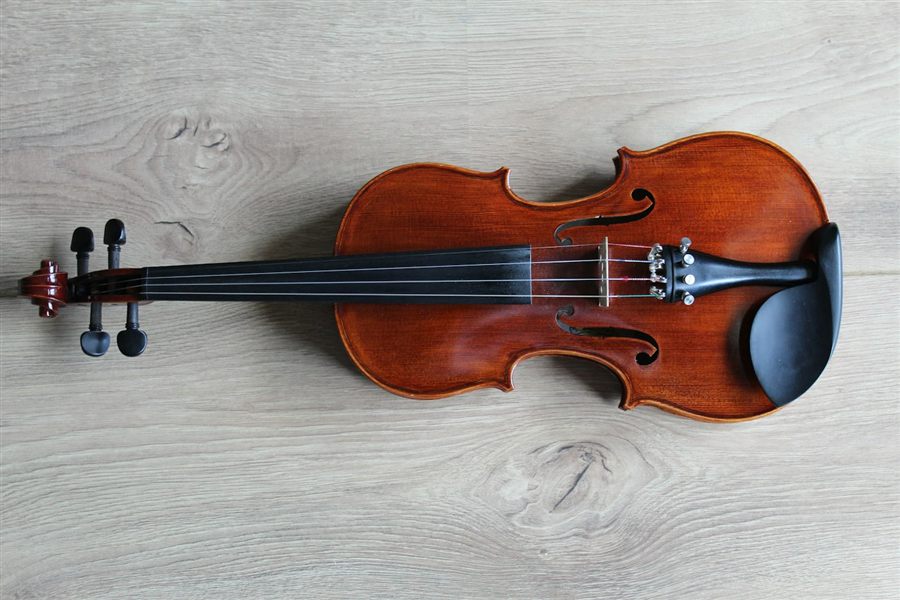
The bridge and sound post are held in place only by string tension and friction, not glue. You can check the bridge yourself and, if it has tilted, gently pull it back upright with a steady hand. The sound post inside the body is a job for a violin shop only. Add string height, pegs, fine tuners, chin rest, shoulder rest and room humidity, and you have the whole setup picture: most problems that look like a "broken violin" turn out to be inexpensive adjustments.
Why the bridge and sound post matter so much
The bridge lifts the strings above the top and passes their vibration into the body. The sound post is a small dowel inside the violin, standing between top and back just behind the bridge foot on the treble (E string) side. It supports the top under string tension and carries vibration to the back. Both parts are fitted, not fixed, which makes them finely adjustable but also vulnerable: even a tiny shift of the sound post can change the tone noticeably.
A problem with these parts therefore says little about the quality of the violin itself. An instrument with a leaning bridge or a dull tone is often only an inexpensive adjustment away from sounding much better. If it is left alone for years, though, it can point to general neglect. For buying advice, see buying a used violin: what to check.
Checking the bridge
What a correctly standing bridge looks like
- The back of the bridge (the side facing the tailpiece) stands at a right angle to the top. Seen from the side, it must not lean toward the fingerboard.
- Both feet sit flat on the top with their full surface. There is no visible gap, not even at a corner. A foot that lifts weakens the tone transfer and often causes buzzing.
- The bridge is centered between the two outer edges of the fingerboard, and the feet sit roughly level with the inner notches of the f-holes. That is the classic bridge position.
- The strings sit in their notches and have not slipped sideways.
- The bridge does not wobble when you tap it very lightly with a finger.
Why it leans
When you tune, and especially after new strings, string tension slowly pulls the top of the bridge toward the fingerboard while the feet stay put. This is normal and not a defect, but you should check it regularly. The further it leans, the more likely it is to warp. A warped bridge can eventually break or strain the top.
Gently straightening the bridge yourself
This is self-help you can learn if you work very carefully. If you are unsure, ask a shop to show you the move once. Some shops straighten a bridge in a few minutes for free or a small fee (varies by shop, get a quote).
- Loosen the strings only slightly, not all of them completely. The goal is that the sound post is never left without string tension.
- Put a soft cloth under the tailpiece to protect the top.
- Hold the bridge at its upper corners with thumb and index finger. Pull it slowly and with little force toward the tailpiece until the back stands square to the top. Work in several small steps rather than one big one. A jerk or too much force moves it too far.
- Check from the side and from the front that the bridge is centered, then retune. The bridge likes to lean again during tuning, so watch it and correct as needed.
- If the strings stick in the bridge notches during tuning and drag the bridge along, a little pencil graphite or dry soap in the grooves helps.
Stop and go to a shop if the bridge looks bent, has a crack, one foot no longer sits flat, or the position is clearly wrong. A shop can cut a new bridge that fits your violin.
If the bridge has fallen over
Do not slacken all the strings completely, or the sound post may fall too. Carefully stand the bridge back up, leave light tension on the strings, and take the violin to a shop. A cloth under the tailpiece protects the top. You cannot judge from the outside whether the sound post moved.
The sound post
What it does and why its position is so sensitive
The sound post supports the top and couples top and back. Its position shapes tone color and the balance between low and high strings. If it sits too close to the f-hole, is too tight or too thin, the tone can turn thin and shrill. Too far toward the center, and the violin sounds weak and loses depth in the low range. Too far behind the bridge or too thick, and response and power suffer. These are workshop rules of thumb. Fine adjustment is craft and is judged by ear on the instrument.
Signs it has shifted or fallen
- The tone suddenly turns dull, thin or shrill, or the response collapses.
- A rattle inside the body, especially when you tilt or move the violin gently.
- In good light, you cannot see an upright piece of wood through the right f-hole.
- The tone changes strongly after a climate change. This happens because the wood moves with humidity, and a readjustment is often all it needs.
A sound post usually falls when all strings are loosened at once or when the instrument takes a hard knock. So change strings one at a time and never take them all off together.
Why only a shop
The sound post is set with special tools through the f-hole, and its position matters down to fractions of a millimeter. A badly set post can dent or damage the top and permanently worsen the tone. You only need to recognize that something is off and then go to a luthier. This is not a home task.
String height, fingerboard and nut
String height (action) is the distance of the strings above the fingerboard. As rough guides, at the end of the fingerboard the G string sits at about 4.0 to 5.5 mm and the E string at about 2.5 to 3.75 mm. With gut strings the height is usually a little higher. At the nut, strings sit about 0.8 mm (G) to 0.6 mm (E) above the fingerboard. These are guide values with some leeway that depend on string type and playing style.
Too high or too low
- High action makes fingering tiring and intonation hard. Common causes are a bridge that is too tall, a sunken fingerboard or a changed neck angle. Only a shop can sort that out.
- Low action leads to buzzing, especially when the wood shrinks in dry air.
Tracking down buzzes and rattles
Work through this list before you head to the shop:
- If it buzzes only on open strings, the nut slots may be too deep.
- If it buzzes only on certain pitches, think of a fingerboard groove, a damaged string or an uneven spot on the board.
- If it buzzes on all strings, check for dust or rosin inside the f-holes, a loose fine tuner, a chin rest touching the tailpiece (put cork or a pad between them), and open seams or cracks.
- Also check string windings and any loose metal parts such as chains or buttons.
Open seams, cracks, a warped fingerboard, and dressing or replacing the fingerboard and nut are jobs for a shop. They involve structure and glue work, not self-help.
Pegs and fine tuners
Pegs that slip or stick
Pegs are wood and react to humidity. In dry air (around 40% relative humidity and below) the wood shrinks, pegs slip and the pitch drops. Push the peg gently into its hole as you turn so it grips. In damp air pegs swell and stick. Then loosen the string and pull the peg slightly outward as you turn. Peg paste or peg compound improves grip and glide and is cheap self-help. In extreme cases, heavily swollen pegs can crack the pegbox. Have pegs refitted in a shop.
Fine tuners
Fine tuners on the tailpiece make small corrections easy. Screw them in firmly and do not turn them past their stop. If a fine tuner has loosened and buzzes, a touch of wax on the thread often helps. Correct big pitch changes at the peg and use the fine tuner only for the last bit. More on string types in violin strings: gut, synthetic and steel compared.
Chin rest and shoulder rest
Both shape your posture. A poor fit is a common, fixable cause of neck and shoulder tension that is often blamed on "bad technique". Together with the right instrument size (see violin sizes for children and adults), it decides whether you play relaxed.
Order and rule of thumb
Start with the chin rest, then the shoulder rest. Measure the distance between your chin and collarbone, then subtract the chin rest height and the thickness of the violin. What is left is roughly the height the shoulder rest should have at its narrowest point. Treat it as a starting value; the final setting comes from playing.
- Too low: you bend your spine or drop your chin, and the neck kinks.
- Too high: the neck stretches, the head tilts to the right, the shoulder rises.
- Long necks: a taller chin rest is better than a very tall shoulder rest.
- Broad shoulders: feet set further out or longer arms. Narrow shoulders: feet closer to the tailpiece.
Typical mistakes
- The rest sits on the shoulder joint instead of the collarbone and upper chest, and the shoulder stays tense.
- The feet are clamped too tightly on the ribs. This can mark the varnish. Grip should come from the rubber, not from force.
- Only the shoulder rest is adjusted while the chin rest stays as it is. The two must fit together.
- The chin rest touches the tailpiece. That causes buzzing. A cork pad or a different model helps.
Which shape fits
Chin rests come centered over the tailpiece, to its left or at the side, in different heights and contours. There is no universally best shape; jaw shape and neck length decide. More expensive does not mean better. You can also play without a shoulder rest, as many folk players do. In classical playing it is common because it keeps the violin free during position shifts. Shoulder rests usually cost little (as of Oct. 2026, often under 30 USD, depending on model).
Fitting yourself is tricky because you cannot see yourself from the side. A teacher who watches you play is more reliable than trial and error. When buying used, you do not have to keep the parts that come with the violin: an uncomfortable stock chin rest is no reason to turn down a good instrument.
Climate and humidity
A violin is made of thin wood that moves with humidity. A common guide is 40 to 60% relative humidity, with 45 to 50% often named as ideal. A hygrometer in the room or case shows where you stand.
- Too dry (under 40%): loose pegs, lower string height, changed tone, open seams and, at worst, cracks. In winter a room humidifier or a humidifier pack in the case helps (usually one per violin). Avoid containers that sit directly inside the instrument.
- Too humid: glue weakens, the wood softens, pegs swell and stick.
- Never leave it in a hot car or direct sun, avoid big temperature swings and keep sweat away.
After a strong climate change (travel, heating season), the tone can shift. A visit to a shop is worthwhile then, because the sound post often needs readjusting.
What shop work costs
Prices vary by shop, region and quality. The figures below are guides for the United States (as of Oct. 2026):
| Job | Guide price |
|---|---|
| New bridge, student to standard | about 85 to 140 USD (professional grade from about 250 USD) |
| Resetting an existing bridge | about 47 USD |
| New sound post | about 60 to 70 USD |
| Sound post adjustment for tone | about 15 to 60 USD |
| Single peg, traditional | about 70 USD (set of four about 128 USD) |
| Fingerboard planing | about 70 to 120 USD |
| Replacing a chin rest | about 57 USD |
| Basic maintenance check (inspection, bridge and post adjustment, peg treatment) | from about 35 USD |
| Full setup | about 85 to 106 USD, varies by shop, get a quote |
Before buying used, ask what a setup would cost and include it in your budget. What a violin offers at which price is covered in budget tiers for used violins. If a certificate or appraisal comes with the instrument, see certificates and appraisals explained. For the bow side, read violin bow quality: what to look for.
Common myths
- "You can adjust the sound post yourself." No. Its position matters down to fractions of a millimeter, and mistakes damage the top.
- "Playing without a shoulder rest is wrong." No. It is a matter of taste and body build.
- "An expensive chin rest is better." No. Fit beats price.
- "A leaning bridge means damage." Usually not. It is an everyday correction as long as nothing is broken.
Everyday checklist
- Check the bridge from the side every time you tune.
- Change strings one at a time, never all at once.
- Keep an eye on humidity and humidify in winter.
- If you hear a rattle, a sudden change in tone or see cracks, see a shop.
- Have the violin checked at a shop once a year, even without an acute problem.