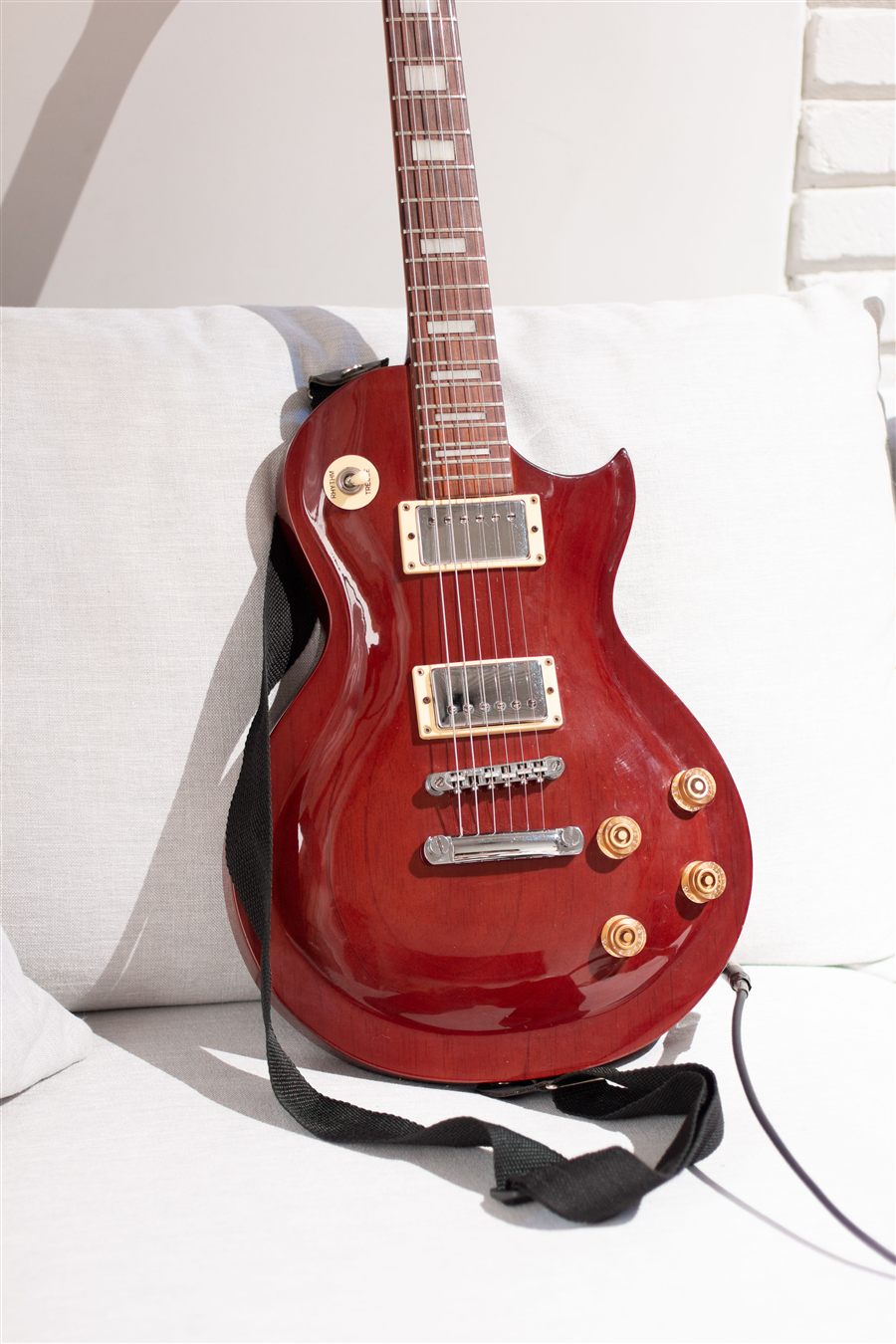
Short answer: A tremolo (strictly speaking a vibrato) changes the pitch of all strings at once by varying string tension at the bridge. The more movable the system, the more expressive it is, but the more work it needs in setup, string changes and tuning stability. If you rarely touch the arm, a fixed bridge (hardtail, or a Tune-o-matic with stoptail) is the simplest choice. If you use it often, look at the nut as well as the bridge, because strings that bind in their slots are the most common cause of drifting pitch.
The Basic Idea: How a Tremolo Works
On a fixed bridge the strings are anchored rigidly. On a tremolo the whole bridge unit sits movably on the body. An arm tilts it, which changes string tension and with it pitch. In most designs, springs hanging in a cavity on the back of the body pull against the strings. At rest, string pull and spring force balance each other.
That balance explains nearly every quirk. If a string breaks or gets bent hard, the balance shifts and the other strings go out of tune. If you switch string gauge, the total pull changes and the system has to be re-balanced.
The names are also swapped: musically, "tremolo" is a volume wobble and "vibrato" a pitch wobble. The Stratocaster arm produces the latter but was called a tremolo from the start, and the name stuck.
The Systems at a Glance
Synchronized Tremolo (Vintage Strat Style)
This design was introduced on the Stratocaster in 1954. A plate carrying six saddles pivots on six screws, and up to five springs hang from a metal block underneath. It is simple, easy to understand and gives subtle vibrato plus pitch drops and raises. The weakness: the screw pivots create friction, and under heavy use the strings do not always return to exactly the same pitch.
A two-point version followed in 1986, with two specially shaped studs replacing the six screws. It reduces friction at the pivot and is seen as a more stable evolution of the same principle.
Floyd Rose and Other Locking Systems
Floyd D. Rose began developing the system in 1976 and received a first patent in 1979. The idea: the strings are clamped at the nut by locking plates and at the bridge inside the saddles, so they cannot creep through the nut slots or the tuning machines. Fine tuners on the bridge take over tuning once the locking nut is closed. The result is excellent tuning stability even with aggressive arm use and extreme effects such as dive bombs. A cam-driven system that appeared around the same time reaches similar results by a different route.
The flip side: setup is involved, string changes take longer, and a string breaking mid-song throws the remaining strings clearly out of tune. Many guides do not recommend it as a first system for beginners. Converting a guitar from another system is shop work with permanent changes to the instrument.
Bigsby
The Bigsby is a tailpiece mounted on the top of the guitar. A spring-loaded arm rotates a roller bar that the strings wrap around, changing tension. It has been built since the 1940s, was the first commercially successful vibrato system, and suits gentle, swaying vibrato of up to about a semitone (rule of thumb). It is classic in country, rock and roll, rockabilly and jazz.
Tuning problems on a Bigsby usually come from the bridge, nut and tuners rather than the unit itself. A steep angle where the strings pass over the bridge can stop them from sliding. Fitting one to a guitar that is not prepared requires drilling and exact alignment, which belongs in a shop. String changes are fiddlier because of the roller bar, but accessories exist that simplify them.
Fixed Bridges: Hardtail and Tune-o-matic with Stoptail
A hardtail bridge anchors the strings rigidly, either through the body or at the bridge body. In the Tune-o-matic and stopbar combination that Gibson introduced in 1953, the strings run through the stopbar, over individually adjustable saddles and on to the nut. The bridge allows precise intonation of each string, and the stopbar height can be adjusted.
Both designs are very tuning-stable and low-maintenance. Because string energy goes directly into the body, they are often credited with slightly more sustain. How big the difference really is depends heavily on the whole instrument and is usually smaller in practice than online debates suggest.
Floating, Decked, Blocked: A Setup Choice
On a Strat-style bridge you can change the basic behaviour without changing hardware:
- Floating: The springs balance the plate so that it lifts slightly off the body (parallel or a few millimeters raised at the rear, vintage roughly 3 to 6 mm, or about 1/8 inch). You can drop and raise pitch. Downsides: bends and broken strings pull everything out of tune, and string changes take longer.
- Decked: The springs pull the plate flush to the body. The arm only lowers pitch. This is more stable, and a broken string only affects the broken string.
- Blocked: A piece of wood between the tremolo block and the cavity wall locks the movement completely. The guitar behaves like a hardtail. Maximum tuning stability, with a dead arm.
Which spring count, spring claw position and block is needed depends on the model and string gauge. The rule of thumb: whenever you change gauge or tuning, the system has to be re-balanced. When in doubt that is a job for a shop, because spring tension changes also affect string height and intonation.
Tuning Stability: Where It Is Really Lost
A system is only as stable as the freedom of the string to slide at every contact point. Friction sits in several places:
- Nut slots: If the string binds, it releases in a jerk after arm use and the pitch stays off. This is the most common single cause.
- String trees: The hold-down for the treble strings brakes the string if it catches.
- Saddles and pivots: The string contact at the saddle and, on vintage systems, the pivot points of the bridge plate.
- Tuners and winding: Too few or too many wraps, unstretched new strings and poorly seated tuners let strings slip.
- Old strings: Worn strings drift more easily and return less reliably.
Many tuning problems blamed on the tremolo start at these points. That is why a well set-up vintage bridge can run stably while a poorly set-up locking bridge still misbehaves.
Nut Material: Bone, Plastic, Graphite, Metal
The nut guides the strings from the fretboard to the tuners. Its material affects only open-string tone, because fretted notes end at the fret rather than the nut. What matters for tuning stability is how cleanly the slots are cut: a well-made budget nut beats a poorly cut premium one.
- Bone: The classic. Warm, sustaining, dense. As a natural material, quality varies, and the dry material benefits from extra slot lubrication.
- Synthetic composites (for example Tusq): Consistent, no soft spots, close to bone in tone. Variants with a built-in lubricating additive are aimed at tremolo guitars.
- Graphite: Self-lubricating with a slightly darker character. Popular with players who use the arm and bends a lot.
- Metal (usually brass): Bright, direct, long-lasting. It can increase string wear and sound too sharp for some players.
- Basic plastic: Common on entry-level guitars, usually weaker in tone and slip.
A replacement is worth considering if the slots are worn out or strings visibly bind. Fitting or making a nut is precision work for a shop.
Do It Yourself: Lubricating the Slots
The cheapest fix for binding strings costs almost nothing. Loosen the string a little, lift it out of the slot, rub a soft pencil lead (graphite) back and forth in the slot, and put the string back. The same works at string trees and, where present, saddle slots. Then stretch the string and retune. After lubricating, pitch should return much better after arm use. If it does not help, the slots are usually too narrow or too sharp and a technician should look at them. Do not use oils or chemicals on the nut or fretboard.
Changing Strings on a Tremolo
Vintage Tremolo (Strat Style)
Change the strings one at a time, not all at once. That keeps tension roughly constant and the bridge stays in position. Alternatively you can wedge a thin piece of wood under the plate until the new strings are stretched. Stretch new strings well and retune several times, then test the arm and check again.
Floyd Rose and Locking Systems
- Secure the bridge: put a piece of wood or, after removing the spring cover, a padded item behind the bridge so it cannot move when strings are loosened. Or change strings one at a time.
- Loosen the locking nut with the right hex key, then release the old string at the saddle and at the tuner.
- New string: cut off the ball end, clamp the cut end in the saddle with the hex key (only lightly, the parts are delicate) and put the fine tuners in mid position first.
- Pass the string through the tuner, wind about three wraps and tune roughly.
- Stretch the strings and retune until the pitch holds, and only then close the locking nut.
- From now on tune only with the fine tuners. Turning the tuning machines with the locking nut closed risks breaking strings.
Bigsby
The strings are hooked over a pin at the roller bar. Change them one at a time and keep the vibrato in its rest position. Accessories that make the change easier are available (around 40 to 50 USD, as of Oct. 2026).
Fixed Bridge
Nothing special: thread through the stopbar or body, wind on, stretch, tune. The simplest case of all.
Springs and Block: The Principle
The springs in the rear cavity oppose the strings. More springs or a tighter spring claw increase pull, drawing the bridge toward the body. Less tension lets it lift. A floating setup often uses fewer springs, a decked one more. Blocking uses a piece of wood to stop movement permanently. When and how the configuration is changed depends on string gauge, tuning and playing style. Because the setup is tied to intonation and string height, this is a typical shop job.
Costs in the USA
- Standard electric guitar setup: roughly 65 to 130 USD depending on shop and region (as of Oct. 2026).
- Setup with a Floyd Rose-type bridge: commonly about 100 to 150 USD (as of Oct. 2026).
- New bone nut including setup: roughly 115 to 140 USD (as of Oct. 2026).
- Restring and tune in a shop: from about 50 USD plus strings (as of Oct. 2026).
- Installing a Bigsby or converting to a locking system: varies by shop, get a quote.
All figures are rough guidelines and differ between shops and cities.
Pros and Cons Compared
| System | Strengths | Weaknesses |
|---|---|---|
| Fixed bridge (hardtail / Tune-o-matic with stoptail) | Very tuning-stable, easy upkeep, direct string contact with the body | No vibrato effect |
| Vintage / synchronized tremolo | Classic feel, easy to understand, subtle vibrato | Friction, sensitive to poor setup, string changes need balance |
| Two-point tremolo | Less friction than six screws | Still needs balancing |
| Floyd Rose / locking system | Best tuning stability under extreme use | Slow string changes, complex setup, hard to retrofit |
| Bigsby | Gentle vibrato, good return to pitch when set up well | Limited range, fiddly string changes, installation needs changes to the guitar |
Myths About Tremolos and Nuts
- "Tremolo guitars always go out of tune." They do not. A well set-up guitar with lubricated slots stays surprisingly stable even with arm use. The culprits are usually slots, string trees or old strings.
- "Blocking adds a lot of sustain." Online opinions contradict each other. The effect is usually described as subtle and masked by pickups, string age and the body. What is certain: tuning stability goes up.
- "The nut material defines the guitar's sound." Only for open strings. Fretted notes are unaffected.
- "Locking systems solve every tuning problem." They remove friction at the nut and tuners, but not a poor setup, bridge balance or old strings.
- "A premium nut beats a well-cut one." Wrong: slot quality counts for more than material.
What to Check on a Used Guitar
Test the tremolo through its full range and then check tuning. Heavy drift often points to setup problems (binding nut slots, spring tension) and does not necessarily mean a broken system. On locking systems, check that the locking nut clamps evenly and that the fine tuners still have enough travel. More on condition checks is in the guide to buying a used electric guitar. Basics of string height and intonation are explained in electric guitar setup, and the build differences of the two classics are compared in Stratocaster or Les Paul.