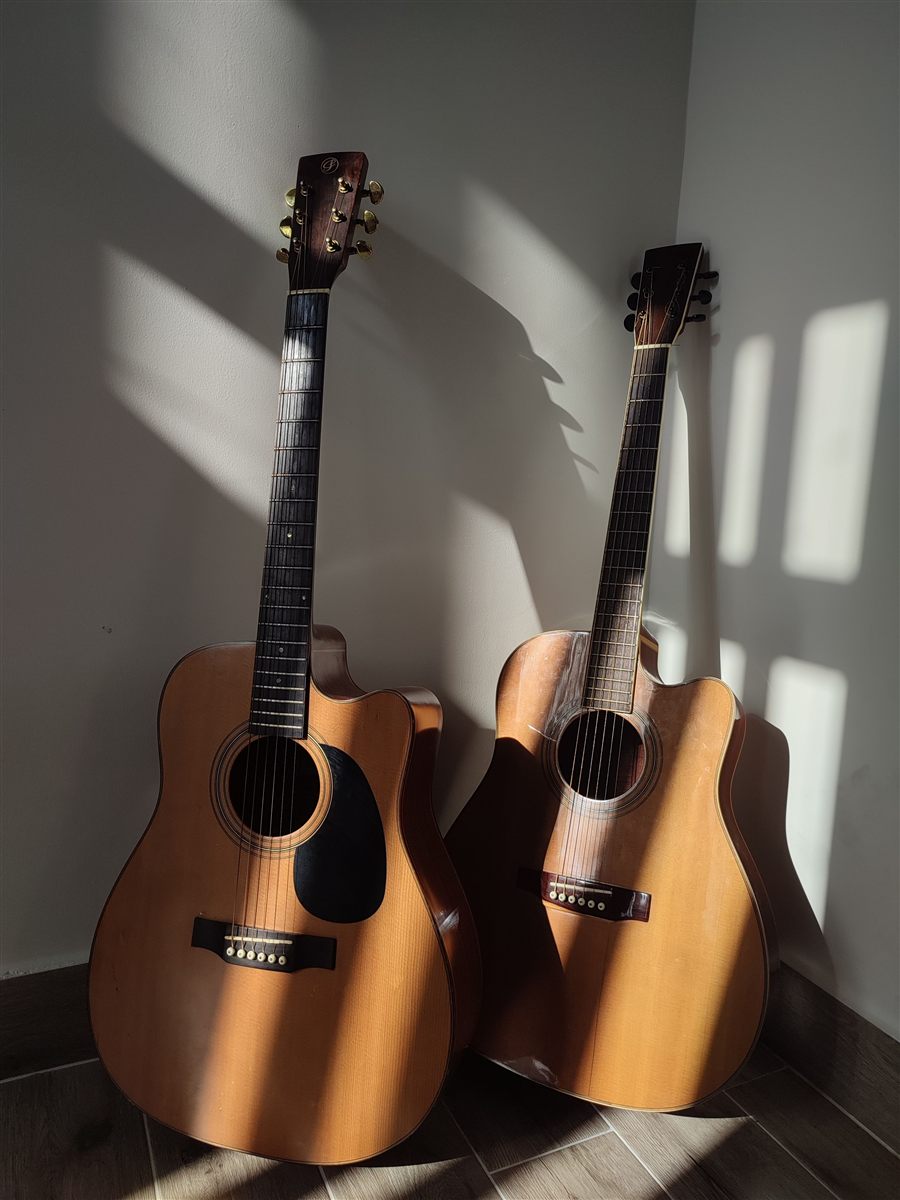
A 12-string acoustic has six courses of two strings each. In the four lower courses the second string sounds an octave higher; the two top courses are doubled in unison. The result is a bright, shimmering, chorus-like sound. The price is a wider and more demanding neck, more tuning effort and clearly more load on top, bridge and neck: according to common string tension tables, a standard light 12-string set pulls with roughly 250 lbs, against about 160 lbs for a light 6-string set. For most players a 12-string works best as a second guitar next to a good 6-string.
How a 12-string is built and strung
Courses and octave strings
In standard tuning E, A, D and G each get a thinner string one octave above, while B and high E get a second string at the same pitch. Low to high: E3-E2, A3-A2, D4-D3, G4-G3, B3-B3, E4-E4 (the higher octave string is listed first here). The thin octave strings brighten the sound; the unison pairs on top add the slight beating that is heard as chorus. The result is a brighter, more harmonically textured sound with a stronger attack, and a blended rather than clearly separated response compared with a 6-string.
Gauges of a typical set
Look at the gauges of a typical light set (D'Addario EJ38, .010-.047). The two top courses use two identical plain strings (.010 and .014). Below that, the G, D, A and E courses each pair a main string with an octave string: the main strings are .023, .030, .039 and .047, the octave strings roughly .008, .012, .018 and .027, and the two lowest octave strings are wound. Other brands pick slightly different octave gauges.
Construction details
Most 12-strings have a longer headstock to fit twelve tuners, and standard bridges use one pin per string. Some designs let a pair share one pin, which means fewer holes in the top. One oddity of the Rickenbacker 360/12 electric is that it reverses the usual order of the octave string within the pair; on acoustic 12-strings the conventional order is normal.
A little history
The idea is old: around 1770 the harp maker Jean Henri Naderman built a twelve-string guitar called the Bissex, long before steel strings. The modern acoustic form comes from the early 20th century folk and blues scene. Lead Belly played a Stella with a somewhat longer scale, slotted headstock and ladder bracing, and it needed a trapeze tailpiece so the bridge would not lift under the tension.
String tension and construction
What the numbers say
The tension of every string in a set can be read from tension tables. Light phosphor bronze 12-string set EJ38 (.010-.047), per string in pounds: the two high E strings 16.2 each, the two B strings 17.8 each, then G 27.9 and 14.7, D 26.7 and 18.5, A 24.7 and 23.4, low E 19.9 and 26.9. Adding the twelve values gives about 251 lbs (roughly 114 kg). The light 6-string set EJ16 (.012-.053) comes to a total of 160.5 lbs. So the 12-string set pulls roughly 90 lbs or 55 to 60 percent more at standard pitch. Treat this as a comparison of two typical light sets, not a law: other gauges, brands and tunings change the numbers. All values are approximate guides.
How builders respond
That extra load is why builders react. Doubling the strings increases total tension, and some, but not all, 12-strings are built with a shorter scale length to compensate. Taylor's 12-fret Grand Concert 12-strings (scale 24 7/8 in, about 632 mm) are built around exactly this lower tension. Others go the other way: the Guild F-512 has a 25 5/8 in scale and scalloped Adirondack braces, and the modern Guild F-412 Standard uses one truss rod plus two graphite support rods in the neck. Before about 1970 many 12-strings had shorter necks and scale lengths; modern ones are built heavier. See our guide on bracing for what the internal structure does.
A practical consequence: never put a heavier set on a 12-string than the model is designed for, and never fit a 12-string set to a guitar that was not built for it. Factory sets are light: Martin ships its 12-string D-X2E with MA500T extra light strings, Guild's F-512 came with .010-.047, and Taylor's 858E and 552CE come with Elixir phosphor bronze light.
Neck, nut width and scale length
The neck is wider because twelve strings must fit. Figures from the model specifications:
| Model | Nut width | Scale length |
|---|---|---|
| Yamaha FG820-12 | 46 mm | 634 mm |
| Martin Grand J-16E 12-string | 46 mm | 645 mm |
| Martin D-X2E 12-string | 47.6 mm (1 7/8 in) | 645 mm |
| Martin D-X2E 6-string (comparison) | 44.5 mm (1 3/4 in) | 645 mm |
| Guild F-412 Standard / F-512 | 1 7/8 in (47.6 mm) | F-512: 25 5/8 in |
| Taylor 858E | 1 7/8 in | 25.5 in |
| Taylor 552CE (12-fret) | 1 7/8 in | 24 7/8 in |
| Taylor 612ce (6-string) vs 652ce (12) | 1 3/4 in vs 1 7/8 in | - |
These 12-string nut widths are about 46 to 48 mm, so the step from a 44.5 mm 6-string is a few millimetres, not a classical-guitar-sized jump. Many 12-strings are narrower than people expect, and slimmer neck profiles make them surprisingly playable. Still, the widths vary by maker, so always check the spec of the individual model. The Rickenbacker 360/12 electric deliberately keeps a conventional width.
Scale length also does not follow one rule. The Martin D-X2E has the same 645 mm on both 6- and 12-string versions, the Yamaha is shorter at 634 mm, and Taylor's 12-fret models are shorter still. 12-strings tend to feel neck-heavy, which the 12-fret construction counteracts.
In practice expect this:
- More finger force for chords, especially full barrés, because you press two strings per course and the string pull is higher. Beginners may struggle with the wider neck and higher tension.
- Sloppy fretting is punished harder: if one string of a pair is muted, the sound turns dull or uneven.
- Action matters, and a 12-string does not have to be set high either. How to check relief and action is described right below; see also action and neck relief diagnosis.
Checking relief and action
The method is the same as on a 6-string. Tune to pitch, put a capo on the first fret and press the low E string down where the neck meets the body (around the 14th fret). At the 7th or 8th fret, feeler gauges show the gap between string and fret: a typical target is about 0.15 to 0.30 mm. Then measure the action at the 12th fret, underside of the string to the top of the fret. As rough guides taken from 6-strings, about 2.2 to 2.8 mm on the low E and 1.6 to 2.2 mm on the high e are common; published figures for 12-strings are scarce, so treat these as a starting point. If the relief is clearly off, adjust the truss rod as described in our string guide, but with extra care on a 12-string: the neck carries much more tension, so turn only about 1/8 of a turn at a time and give it plenty of time to settle before measuring again. If the action is too high with the relief right, the saddle is next; see bridge and saddle.
Sound and typical uses
- Strumming and open chords: the 12-string's home ground. Folk, folk-rock and singer-songwriter accompaniment get a wide, bell-like sheen.
- Fingerpicking: works, but it is harder with paired strings, and the pairs blur fast single-note lines. Lead Belly used picks to keep bass lines and melody distinct.
- Lead playing and bending: hard, because two strings must be moved together and the pair drifts out of tune when bent.
- Not ‘twice as loud’: the change is mainly in brightness and fullness, not raw volume.
- Wood and body matter: mahogany gives a warmer 12-string that is midrange-forward and less boomy than maple or rosewood versions. A small Grand Concert body can give a clear shimmer without a boomy low end. See tonewoods and body shapes.
Well-known players include Leo Kottke, Roger McGuinn, John Denver and Melissa Etheridge.
Tuning, capo and tuning down
- Tuning takes longer: twelve tuners, and each pair has to agree. Tune the octave string against its partner, then recheck after the first strum. 12-strings have a reputation for being tricky in playability and intonation.
- New strings stretch across a larger set, so expect repeated retuning in the first days.
- Tuning down a whole step (D G C F A D) is a classic way to cut the load and warm the tone; with heavier strings players go lower still. Always check the specifications of the specific model.
- Capo: works on a 12-string, but a poorly fitting one pulls the pairs unevenly sharp. Use a flat or fitted pad and check tuning after clamping.
- Intonation: octave strings and unisons will never be as clean as a single string, especially in high positions. This is normal, not a defect.
Restringing and tuning step by step
You can change a 12-string set pair by pair or all at once; changing all of them at once is faster, and a pair at a time keeps the load on the neck more even. Wind each string with at least about three quarters of a turn around the post. Bring the strings up to pitch in several rounds, a few notes at a time, instead of finishing one string after another, so the neck is not loaded unevenly. The thin octave strings break more easily when wound or tuned too high, so go slowly and watch the pitch. Then tune each octave string against its partner, lift each pair gently with two fingers a few times and retune until the pitch holds. Finally check the octave at the 12th fret on a few pairs; if the harmonic and the fretted note disagree clearly, the saddle compensation is off.
Buying used
Why age and history matter
Caution is advised with old used 12-strings because years of high string pull are a force to be reckoned with; a newer one may be fine. Age and history count for more than on a 6-string. General checks are in our used guitar guide.
Specific checks for 12-strings
- Neck angle and set: a lifted neck or a very low saddle with high action means the neck has moved under tension, and counts as a major warning sign. A neck reset is a major repair that only a professional workshop should do: workshops frequently need 2 to 4 weeks; costs vary by shop and tend to be higher for a 12-string, so get a quote first.
- Bridge lift: look for the rear edge of the bridge separating from the top, and gently try to slide a thin card under it; if it goes in, the bridge is lifting. Regluing is also workshop work; costs vary by shop, so get a quote first. See bridge and saddle.
- Belly behind the bridge: sight along the top from the side; a rising hump behind the bridge means the top has deformed.
- Truss rod reserve: with the seller's permission, check that the rod still has reserve: bring the guitar to pitch and turn the rod gently in quarter turns, in both directions. It should move without force and without creaking, and not just spin loosely. A frozen or maxed-out rod limits any adjustment; if in doubt, ask a professional. Very old instruments without truss rods are especially vulnerable to string tension.
- Neck twist and frets: sight along the neck; many players strum hard on 12-strings, so worn frets and deep nut slots are common.
- Hardware: a replaced bridge with extra holes, or a trapeze tailpiece fitted later, deserves questions.
- Tap test: tap the top and sides lightly and listen for rattles or buzzing, which can point to loose bracing or an open glue joint.
- Relief check: use the capo method above; a clearly larger gap or no gap at all, together with a rod that has no reserve, is a warning sign.
The true price of a used guitar is the purchase price plus the work needed to make it reliable, and that applies doubly to 12-strings. If repair costs erase the saving, walk away or negotiate.
Costs and what is available
Purchase
The prices below are approximate guides from list and street prices (as of Oct. 2026) and they change.
- Entry level: Yamaha FG820-12 (solid spruce top, mahogany back and sides) and Harley Benton D-200CE-12 sit in the entry-level price range; no verified US price is on record, so compare current retailer prices.
- Mid-range: Martin D-X2E 12-string (laminated rosewood, with pickup) and Martin Grand J-16E 12-string (solid wood, made in the USA) sit in the mid-range; no verified US price is on record, so compare current retailer prices. A 12-string is not automatically more expensive than its 6-string sibling; listings and promotions differ.
- Higher end: Guild F-412 Standard about $2,799 street price. The Guild F-512 was most recently listed at about $3,700 to $4,100. Martin's whole Standard Series, 6- and 12-strings together, runs about $2,400 to $10,000. Taylor's 100 Series, including the 12-string 150e, starts at $799.
Running costs
Running costs are modest but real (as of Oct. 2026): an uncoated D'Addario EJ38 12-string set (phosphor bronze, .010-.047) is around $16.49, and coated sets such as Elixir Nanoweb Light (.010-.047) are priced higher and, by experience, last a long time on a guitar that is not played daily. With twice the strings and tuners, plan clearly longer for a string change than on a 6-string, and a technician may charge a bit more for a setup. Basic 6-string setups are often quoted at about $60 to $100; shops publish their own lists, so ask for a quote.
Care and string changes
As a rule of thumb, 45 to 55 percent relative humidity is the target; a dry room can lift bridges and open cracks, and tension plus dryness is a worse combination on a 12-string. See humidity and storage. Change strings when they look dirty or sound dull, and keep the gauges consistent. If you tuned down for a long time, return to pitch gradually and watch the neck; if anything looks off, take the guitar to a technician. For string types see bronze vs phosphor bronze.
Humidity: hygrometer and humidifier
Keep a small hygrometer in the case or room and aim for the rule-of-thumb range of about 45 to 55 percent. To check that it reads correctly, put it with a small dish of damp table salt (a paste, not a solution) into a sealed bag for several hours; it should show about 75 percent, and any difference is the error you subtract later. If the reading stays below the range, use a case or sound-hole humidifier according to its instructions and check the reading again after a day or two; do not overdo it, because too much moisture is harmful too.
Strings and storage
When you do not play for weeks, or before shipping, it is common to tune the strings down a little (about a whole step) instead of leaving full tension on the neck; do not slacken them completely. Wipe the strings and the fretboard after playing and change the set when it sounds dull or tuning keeps drifting.
Who should buy a 12-string
Suitability
- Good fit: strummers, folk and singer-songwriter players who already own a reliable 6-string and want a signature sound.
- Poor fit: complete beginners, players with limited hand strength, anyone who wants one guitar for everything, and anyone planning heavy bending or fast lead lines. For most players the 12-string is not the primary guitar.
- Budget logic: spend the main budget on a good 6-string first.
Alternatives to a full 12-string
- Nashville tuning: the four lowest strings of a normal 6-string are replaced with thin octave strings, often from a 12-string set. Note names and chord shapes stay. It started in 1950s Nashville session work and has been used by many well-known bands. Ready-made sets exist, such as D'Addario's EJ38H. It adds sparkle layered with a regular guitar but has no doubled unisons.
- Recording trick: a second take played an octave up gives a similar effect in the studio.
- Electric 12-string: a different sound, not a stand-in for an acoustic.
Common mistakes and checklist
Common mistakes
- Assuming a 12-string is simply easier because you only strum chords.
- Buying an old one cheaply without checking neck angle, bridge and bracing.
- Using 6-string strings or heavier gauges than recommended.
- Leaving all twelve strings fully tuned in very dry air for weeks.
- Expecting a basic setup to fix a guitar whose neck has already moved a lot.
Quick checklist before you decide
- Can I hold full chords and a barré comfortably in the shop?
- Do I have a reliable 6-string already?
- Is the guitar built for 12 strings, with a stated string gauge and nut width I can handle?
- Do neck, bridge and top pass the used-guitar checks above?
- Do I have someone who knows 12-strings for the first setup, or will I check relief and action myself (see above)?
See also our guides on buying a used acoustic guitar and diagnosing action and neck relief.